
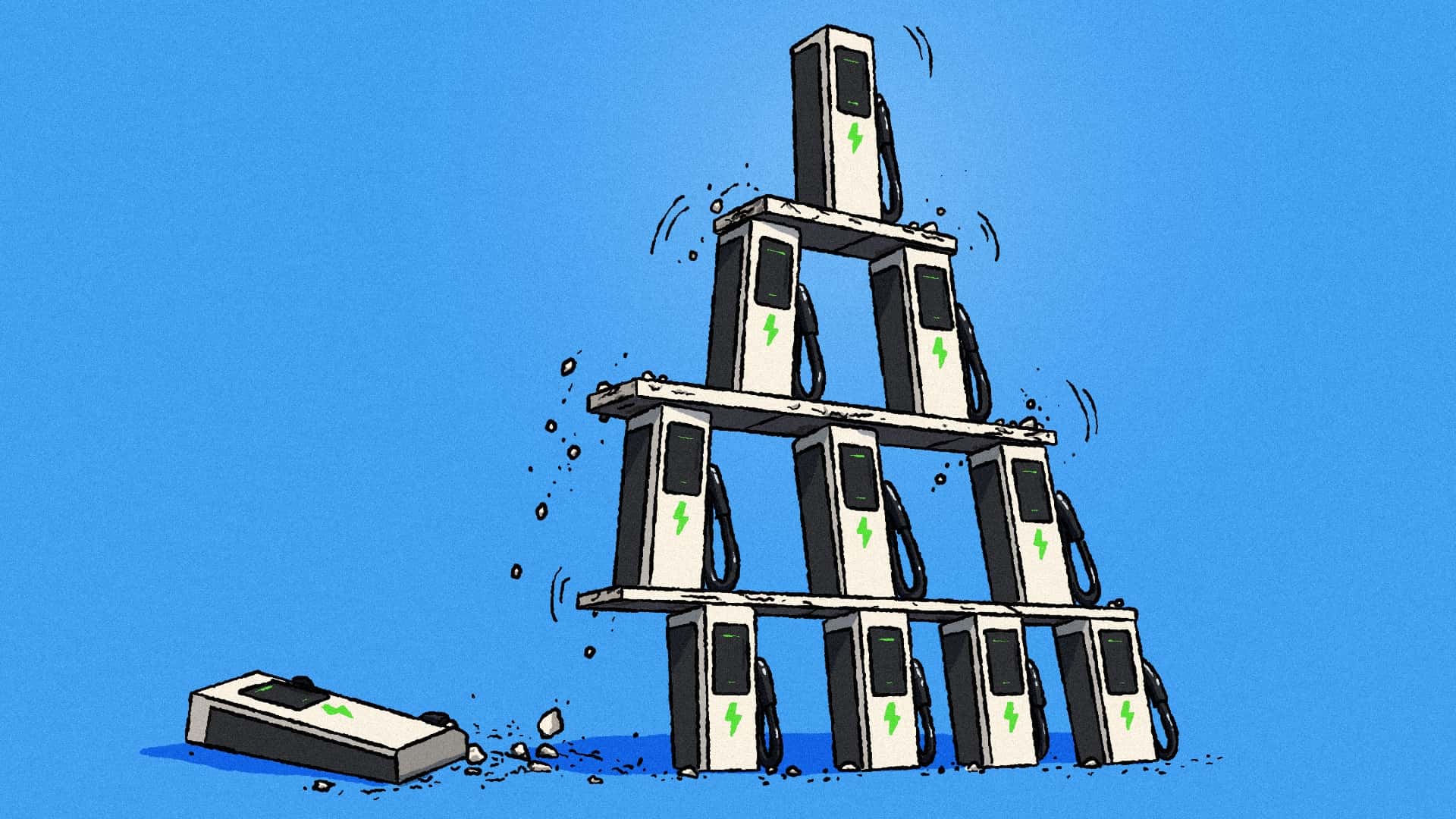
It has been over a year since the federal electric vehicle (EV) tax credit, a crucial incentive valued at $7,500, was rescinded. This significant policy shift, coupled with the discontinuation of fuel economy regulations and other measures aimed at promoting EVs by the then-Trump administration and Congress, sent ripples through the nascent US electric vehicle market. The abrupt removal of these financial motivations created a period of uncertainty and adjustment for manufacturers, dealers, and consumers alike.
As the automotive industry reflects on this pivotal period, a clearer picture emerges of how the market has adapted. Despite initial setbacks, the US electric vehicle market demonstrates resilience, albeit with notable shifts in dynamics and leadership. Industry experts and market data now provide key insights into who is thriving in this evolving landscape and what the future may hold for electric mobility in America.
Key Takeaways from the Post-Incentive Era
- The US electric vehicle market experienced a sharp downturn following the end of federal tax credits but is now showing signs of a gradual rebound.
- Tesla and Rivian have emerged as key drivers of the market’s recovery, significantly outperforming many legacy automakers.
- The used electric vehicle market is witnessing robust growth, indicating strong consumer demand for affordable EV options.
- While the pace of electrification may have slowed, industry observers remain optimistic about the long-term future and continued expansion of electric vehicles in the US.
The US Electric Vehicle Market Shows Gradual Rebound After Initial Setback
The immediate aftermath of the tax credit’s termination saw a sharp contraction in electric vehicle sales. Data from JD Power illustrates a dramatic decline in the electric share of retail car sales, plummeting from over 14% in September of last year to 7.1% in October, and further to a mere 5% by November. This level had not been observed since 2022, signaling a significant shock to the US electric vehicle market.
The sudden removal of incentives led to an immediate impact on purchasing decisions. “That was something that nobody expected, and it made very important and sudden changes in the market, and for us too, right?” stated Hyundai CEO José Muñoz last month. “All of a sudden, you either add the incentive, or you lose sales, or you do something in between.”
Despite the initial trepidation, the market has begun to demonstrate signs of recovery. Tyson Jominy, JD Power’s senior vice president of data and analytics, noted the unexpected resilience. “In general, the EV market has been perhaps more resilient in some ways than we would maybe expect,” Jominy observed. “Sales certainly fell as expected, but we kind of hit the floor quickly.”
The electric vehicle market share rebounded to over 6% in December and climbed past 8% by May, according to JD Power. Most recently, September’s EV share of retail sales stood at 7.9%. “We only went back about two years,” Jominy reflected, “which doesn’t seem so bad.” This indicates a stabilization and gradual return to growth, albeit not to the pre-incentive peak.
Anecdotal evidence suggests that external factors, such as fluctuating fuel prices, may also play a role in this resurgence. Hyundai CEO José Muñoz recounted that after the war in Iran began, dealers, who had previously requested fewer shipments of Ioniq 5s, suddenly increased their demand. This highlights the sensitivity of electric vehicle sales to the cost of conventional fuels.
Further indicating a normalizing market, the duration electric vehicles spend on dealer lots has steadily decreased. According to data from Cars.com, the average EV sold in 89.4 days in September, a significant improvement from 115.6 days in March. This figure is now only marginally higher than the 80.5 days recorded during last year’s peak EV-buying period, suggesting a better balance between supply and demand.
Jenni Newman, editor-in-chief at Cars.com, commented on this trend: “That, I think, is showing that we’re getting closer to the moment where the demand and the supply are in good balance.” This equilibrium is crucial for sustained growth in the US electric vehicle market.
Tesla and Rivian Lead the Charge in EV Recovery
While the overall US electric vehicle market shows signs of recovery, this progress is not uniformly distributed across all manufacturers. A select few automakers, particularly Tesla and Rivian, are disproportionately driving the industry’s comeback, showcasing distinct strengths and strategic advantages.
Between the second and third quarters, total EV sales in the U.S. expanded by 6.1%, reaching approximately 262,000 units, the highest volume since the federal tax credit ended, according to Cox Automotive. However, analysis reveals a critical dependency: without Tesla’s contribution, the market would have experienced a slight contraction. Despite a 19.7% year-over-year sales dip for Tesla in Q3, the overall market contracted by nearly 40%, cementing Tesla’s market share back above 50% within the US electric vehicle market.
Tom Libby, director of loyalty solutions and industry analysis at Mobility Global, observed, “Tesla has pretty much withstood the decline we’ve seen among the non-disruptors.” This enduring performance can be attributed, in part, to Tesla’s established product quality and strong brand loyalty. Data indicates that roughly half of Model Y owners choose another Tesla as their subsequent vehicle, significantly higher than the average 26% model-level loyalty seen across the industry.
Rivian, another EV-focused manufacturer, has also demonstrated remarkable growth. Its deliveries have surged throughout the year, primarily propelled by the introduction of the R2. This model, recognized as a strong competitor to vehicles like the Model Y, is Rivian’s first offering with genuine mainstream appeal, significantly bolstering its position in the competitive US electric vehicle market.
A key factor in this disparity lies in the fundamental business models of automakers. EV-only manufacturers, such as Tesla and Rivian, lacked the option to simply shift production to gasoline-powered models when policy support for EVs waned. In contrast, many legacy automakers have either canceled or postponed the launch of approximately two dozen electric models since last year, including prominent vehicles like the Ford F-150 Lightning, Volkswagen ID.4, and Honda Prologue. This strategic pivot, while understandable as a reaction to looser regulations and altered incentives, inevitably created a product void that impacted their EV sales.
Libby succinctly summarized this business reality: “A lot of people, myself included, tend to forget that the manufacturers are not really in business to make cars. They’re in business to make money.” While many traditional players face challenges in regaining momentum, Toyota stands out as an exception, having consistently grown its EV sales through the introduction of new models this year.
The Used EV Market Experiences a Surge in Demand
Against the backdrop of a fluctuating new car market, the used electric vehicle market has emerged as an unexpected area of robust growth. Far from merely surviving, it is thriving, unequivocally demonstrating strong consumer appetite for battery-powered vehicles at more accessible price points.
Following an initial dip after the cessation of the EV tax credit, sales of pre-owned electric cars quickly rebounded and have since accelerated. Last month, American consumers acquired over 47,000 used electric vehicles, according to Cox Automotive. This represents a significant 21% year-over-year increase, marking the largest-ever share for EVs within the broader used car market.
A crucial driver for this growth is the improved availability and diversity of used EV inventory. The market is no longer predominantly comprised of older, lower-range models like the Chevy Bolt or Nissan Leaf. Instead, there is an increasing supply of modern, long-range electric cars, many of which are entering the secondhand market after being leased over the past few years, providing attractive options for potential buyers seeking entry into the US electric vehicle market.
Industry analysts attribute the sustained demand to several factors, including elevated gasoline prices, with $4-a-gallon gas being a notable motivator. This economic incentive makes the operational savings of an electric vehicle particularly appealing. Furthermore, used EVs are selling at an impressive pace. Cars.com data indicates that pre-owned electric vehicles sell in an average of 41 days, approximately 12 days faster than their internal-combustion counterparts. Mirroring this strong demand, prices for lightly used electric vehicles have appreciated by nearly 10% over the last year, in contrast to the relatively flat prices for used gasoline cars, as reported by iSeeCars.
The EV Revolution: A Delay, Not a Cancellation
Despite the volatile journey experienced by the US electric vehicle market over the past year, a prevailing sentiment of optimism permeates among industry observers and automotive executives. The consensus suggests that while the pace of EV adoption may have decelerated compared to earlier projections, the fundamental shift away from gasoline-powered vehicles is inevitable and enduring.
“We remain optimistic, quite frankly, on the space,” affirmed JD Power’s Tyson Jominy. This perspective is rooted in several global and intrinsic factors that continue to favor electric propulsion. Globally, electric vehicles are gaining significant traction, with sales climbing in numerous markets worldwide. This international momentum often serves as a precursor for long-term trends in major automotive markets like the United States.
Crucially, data indicates a strong loyalty among EV owners: once consumers experience electric driving, they tend to remain committed to the technology. This inherent stickiness of the product category bodes well for sustained growth in the US electric vehicle market. Moreover, the manufacturing economics inherently favor electric cars in the long run. With fewer moving parts, EVs are inherently simpler and, at scale, cheaper to manufacture than complex combustion vehicles. This economic advantage places slower-moving automakers at a competitive disadvantage as global EV production volumes continue to rise.
Jominy highlighted this critical tipping point: “Once you can produce something 30% cheaper,” he noted, “you really can’t just maintain the old way for very long.” This economic imperative suggests that the transition to electric vehicles is not merely a preference but an eventual necessity for manufacturers to remain competitive.
Beyond manufacturing, the charging infrastructure in the U.S. is also experiencing rapid expansion. The last quarter saw the number of DC fast charging ports surpass 80,000, a significant increase from 70,000 at the end of last year. This ongoing development addresses a key concern for potential EV buyers, further strengthening the foundation for future growth in the US electric vehicle market.
The pipeline of promising new models is also expected to inject fresh momentum. Vehicles such as the Rivian R2, Ford’s anticipated $30,000 Fathom pickup, the Slate Truck, and a range of high-tech offerings from luxury brands are poised to attract a broader consumer base and elevate overall sales figures. While some manufacturers, like Hyundai, are strategically investing in various hybrid technologies to navigate the current EV slowdown, their long-term outlook remains firmly electric.
Hyundai CEO José Muñoz underscored this conviction: “What you see everywhere when you look at the trends in the market, EV is there to stay.” This sentiment resonates across the industry, affirming that while the road may be uneven, the electric vehicle revolution in America is definitively on course, albeit with a recalibrated timeline.
Frequently Asked Questions (FAQ)
Q1: What impact did the end of the federal EV tax credit have on the US electric vehicle market?
The discontinuation of the $7,500 federal EV tax credit led to an immediate and significant downturn in electric vehicle sales. The market share of EVs in retail car sales plunged from over 14% to as low as 5% within months, marking the biggest shock the US electric vehicle market had seen.
Q2: How has the US electric vehicle market recovered since the tax credit ended?
The market has shown resilience, gradually rebounding from its low point. EV sales share has climbed back to nearly 8% in recent months, stabilizing closer to levels seen two years prior. This recovery indicates a nascent stabilization and renewed consumer interest.
Q3: Which automakers are primarily driving the EV market’s recovery?
Tesla and Rivian have been instrumental in the market’s recovery. Tesla maintains over 50% of the US electric vehicle market share due to strong brand loyalty, while Rivian’s new R2 model has significantly boosted its deliveries, attracting mainstream attention.
Q4: Why are legacy automakers struggling compared to EV-only manufacturers?
Legacy automakers, unlike EV-only companies, have the option to pivot back to gasoline models. Many have canceled or delayed new EV projects in response to changing regulations and incentives, leading to a product vacuum that impacts their electric vehicle sales and overall market momentum.
Q5: What is the current status of the used electric vehicle market?
The used electric vehicle market is thriving. Sales have surged by 21% year-over-year, reaching the largest-ever share of the used car market. Improved supply of modern, long-range used EVs and high gasoline prices are key factors driving strong demand and quicker sales for pre-owned electric models.
Q6: Is the long-term outlook for the US electric vehicle market still positive?
Yes, industry experts remain optimistic about the long-term future of the US electric vehicle market. Global growth, high customer loyalty, improving charging infrastructure, and the inherent manufacturing cost advantages of EVs are expected to drive continued, albeit potentially slower, displacement of gasoline vehicles.
Q7: How is charging infrastructure developing in the U.S.?
U.S. charging infrastructure is rapidly improving. The number of DC fast charging ports recently surpassed 80,000, representing a significant increase from 70,000 at the end of the previous year. This expansion addresses a critical concern for EV adoption, supporting the sustained growth of the US electric vehicle market.
Q8: Are new EV models expected to boost future sales?
Yes, promising new models like the Rivian R2, Ford’s anticipated Fathom pickup, the Slate Truck, and various luxury EVs are expected to stimulate future sales. These offerings aim to broaden consumer appeal and further drive the long-term expansion of the US electric vehicle market.