
Key Takeaways
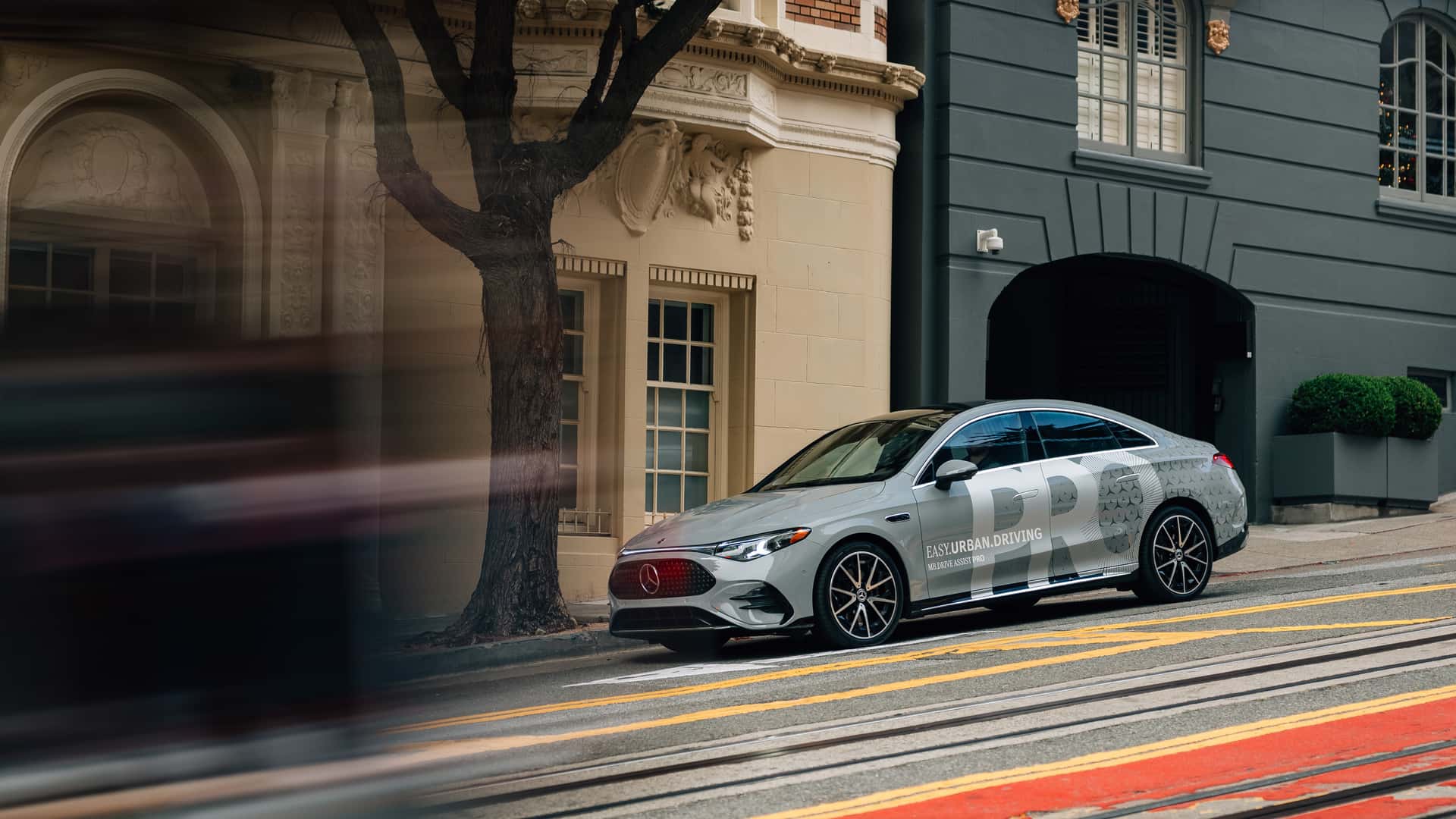
- Mercedes-Benz is launching its MB.Drive Assist Pro system, a direct competitor to Tesla’s Full Self-Driving (FSD) (Supervised) feature, early next year.
- The Mercedes system allows point-to-point automated driving and parking, similar to FSD, but crucially requires drivers to keep a hand on the steering wheel when on surface streets.
- This hands-on requirement stems from Mercedes’ adherence to strict SAE Level 2 autonomous driving definitions, emphasizing driver responsibility on complex urban roads.
- Tesla FSD users, who often drive hands-free even on city streets, express skepticism about adopting a system that imposes more driver intervention.
- Mercedes highlights its multi-sensor approach (cameras, radar, ultrasonic) for enhanced safety and performance, contrasting with Tesla’s camera-centric system.
For many commuters, the daily grind can feel like an endless odyssey. Take Lucian Capellaro, whose routine drive through Laurel Canyon from the San Fernando Valley to Los Angeles’ west end is a constant battle against traffic and winding roads. Hearing colleagues praise Tesla’s Full Self-Driving (FSD) for its ability to navigate autonomously from point A to point B sparked his interest, yet his preference for non-Tesla vehicles, citing design, interior quality, and body style, remained firm.
Now, Mercedes-Benz is poised to offer a compelling alternative. The German luxury automaker is set to introduce its MB.Drive Assist Pro point-to-point automated driving system to a wide array of its electric and internal combustion vehicles early next year. Existing eligible vehicles will gain access to this advanced feature through convenient over-the-air updates, potentially transforming the driving experience for millions.
Mercedes-Benz Enters the Advanced Driver Assistance Race
The upcoming MB.Drive Assist Pro system directly positions Mercedes-Benz against Tesla’s well-known FSD (Supervised) feature. Both systems promise comprehensive automated driving capabilities, enabling vehicles to navigate to a pre-set destination and even park themselves. However, a significant philosophical and operational difference defines Mercedes’ approach.
While both systems allow for hands-free operation on controlled-access highways, the Mercedes offering mandates that drivers keep a hand on the steering wheel when operating on surface streets. This distinction is not indicative of inferiority, but rather a deliberate choice rooted in Mercedes-Benz’s rigorous interpretation of autonomous driving standards.
Adhering to SAE Autonomy Levels: A Philosophical Stand
Mercedes-Benz aligns its autonomous driving development with the Society of Automotive Engineers (SAE) definitions for driving automation levels. MB.Drive Assist Pro, much like FSD (Supervised), is classified as a Level 2 system, or what Mercedes refers to as “Level 2 Plus Plus.” This designation underscores that the system requires continuous driver supervision, meaning the human driver remains primarily responsible for the vehicle’s operation.
The critical distinction between Level 2 and higher levels, such as Level 3, revolves around responsibility. “There is a very important borderline between the levels,” Mercedes Chief Technology Officer Jörg Burzer explained to InsideEVs. “That borderline is that with Level 2 Plus Plus, you are responsible. At Level 3, the machine, the car, the software stack, is responsible.”
Burzer highlighted the inherent complexity of surface streets compared to controlled-access highways. Urban environments present a far greater number of variables, including pedestrians, cyclists, unpredictable traffic, and varied road infrastructure. Consequently, Mercedes deems it essential for drivers to maintain physical contact with the steering wheel in these more challenging conditions to ensure immediate intervention if required.
Driver Perspectives: Safety vs. Convenience
This hands-on requirement resonates with some drivers. Lucian Capellero, despite being an experienced motorcycle rider often associated with risk-taking, sees the logic. “Think about the reaction time it must be for someone to take their hands from off the wheel to on the wheel,” he mused. “I’d view my hand on the wheel as lessening the seconds of reaction time to something crazy happening.”
Customer research conducted by Mercedes-Benz suggests a similar sentiment among European drivers. “In the city, they like to have something, some regulation or some requirement that you have to have a hand on the wheel,” Burzer noted, although he expressed uncertainty about the preferences of U.S. customers.
When pressed on why a customer might choose Mercedes’ system over Tesla’s, which permits hands-off driving on surface streets, Burzer consistently redirected the discussion to regulatory adherence and the SAE levels of autonomy. “The big question is when is level 3 coming?” he insisted. “Because then you can have the hands off (anywhere).”
Tesla FSD Users: A Different Expectation
However, many Tesla FSD users already feel their vehicles operate at a higher level than the SAE definitions might suggest. They often operate their cars hands-free on city streets and appear less concerned with strict adherence to definitions concocted by engineering societies, focusing instead on the practical capabilities their cars demonstrate.
Antonio Hidalgo, another Los Angeles resident, uses FSD regularly and recounts experiences where he has been able to take a nap while driving, albeit with a hat and sunglasses to mask his actions. He observes that the system’s primary flaws are now limited to parking maneuvers. For Hidalgo, the convenience of a truly hands-free experience is paramount.
“If the (Mercedes system) worked the same but I had to keep my hand on the wheel…” Hidalgo considered before concluding, “You know, I probably wouldn’t (make the switch). I mean, I think I would be interested in having a nicer car with a better interior. But no.”
Mharlon Barrientos, who relies on FSD for his commute in Indianapolis, echoed this sentiment. After an initial period of “hovering” his hand on the wheel, system updates and accumulated experience have led him to trust the system fully for hands-off driving. “Having a hand on the wheel as a requirement would be a bit of a step back to the feel of full autonomous driving that I’ve gotten used,” Barrientos stated, recalling that his Model Y originally required hands on the wheel before updates.
Technological Approaches and Safety Philosophy
Mercedes-Benz is quick to highlight what it perceives as a technological advantage of MB.Drive Assist Pro over Tesla’s FSD (Supervised) system. While Tesla’s system primarily relies on cameras to perceive its environment, Mercedes’ offering integrates a more diverse sensor suite.
The Mercedes system utilizes not only cameras but also five radar sensors and 12 ultrasonic sensors to feed comprehensive raw data to its Nvidia-powered onboard computer. “Different sensor inputs increases performance and safety,” asserted Christoph von Hugo, Mercedes’ Head of Active Safety. He implicitly critiqued what he viewed as Tesla’s potentially insufficient reliance on a single sensor type, adding, “Relying on one just is not enough.”
Von Hugo further indicated that Mercedes will not advance to Level 3 capability without the inclusion of LiDAR technology, in addition to cameras, radar, and ultrasonic sensors. It is notable that Mercedes had previously offered a Level 3 system in the U.S. for a brief period, which has since been phased out, underscoring their cautious approach to higher autonomy levels.
Consumer Priorities: Tech Specs vs. Driving Experience
Despite Mercedes’ emphasis on a robust multi-sensor platform, the average consumer’s decision-making process might be more nuanced. Barrientos, for instance, admitted, “I honestly haven’t even thought about the tech behind it, so I’m not so sure knowing that there’s radar and ultra-sonic sensors (on the window sticker) would be a huge selling point.” He believes that real-world performance, demonstrated through videos or reviews, would be more persuasive.
“Just like the Tesla system, I think it would take me some mileage on both highway and streets to gain a trust for the system to know it’ll handle either situation well,” Barrientos added, indicating that practical experience outweighs technical specifications for many users.
Interestingly, Barrientos also expressed that his loyalty isn’t solely tied to Tesla or FSD. “The hands-on requirement in the city would not be enough to sway me off of the car provided I like the rest of the car,” he confessed. “While I like the functionality of FSD, it’s still a bit further down the list of what I look for in a car. Functionality, comfort, value… I still like to feel the mechanics and have the feel of actually driving a car.”
Lucian Capellero shared a similar pragmatic view, wondering how MB.Drive Assist Pro would compare to his wife’s BMW i4, which already features adaptive cruise control and hands-free highway driving assist at low, traffic-jam speeds. “I guess I’d just have to experience (MB.Drive Assist Pro) for myself, but if it can navigate all the craziness that is Laurel Canyon through Hollywood, and it is literally just my hand resting on the wheel, and that’s it, then sure,” he said. “The fact that it’s truly point-to-point, then yes, that sounds super appealing.”
The ultimate question remains whether Mercedes-Benz’s MB.Drive Assist Pro can deliver performance comparable to Tesla FSD, even with its hands-on requirement on city streets. Early passenger-seat demonstrations in San Francisco earlier in the year showed promise. A full, comprehensive review of the system is eagerly awaited to determine its real-world efficacy and whether the philosophical approach taken by Mercedes-Benz strikes the right balance between safety, regulation, and user experience.
Frequently Asked Questions (FAQ)
What is Mercedes-Benz MB.Drive Assist Pro?
Mercedes-Benz MB.Drive Assist Pro is an upcoming point-to-point automated driving system designed to compete with Tesla’s FSD. It allows the vehicle to navigate to a destination and park autonomously, rolling out to various Mercedes models early next year via over-the-air updates.
How does MB.Drive Assist Pro differ from Tesla FSD?
The primary difference lies in driver interaction on surface streets. While both systems allow hands-free operation on highways, MB.Drive Assist Pro requires the driver to keep a hand on the steering wheel when driving on city streets, a mandate not present in Tesla’s FSD (Supervised).
Why does Mercedes require hands on the wheel on surface streets?
Mercedes-Benz adheres strictly to SAE Level 2 autonomous driving definitions. CTO Jörg Burzer states that Level 2 systems necessitate driver responsibility, and the chaotic nature of surface streets with numerous variables demands active driver supervision for safety.
What is SAE Level 2 autonomy?
SAE Level 2 refers to partial driving automation, where the vehicle can control both steering and acceleration/deceleration. However, the human driver must constantly monitor the driving environment and be ready to intervene at any moment, retaining ultimate responsibility.
What sensors does MB.Drive Assist Pro use?
MB.Drive Assist Pro employs a comprehensive sensor suite including cameras, five radar sensors, and twelve ultrasonic sensors. Mercedes emphasizes that this multi-sensor approach enhances performance and safety, contrasting with Tesla’s camera-primary system.
Do Tesla FSD users prefer hands-free driving?
Yes, many Tesla FSD users have adapted to and prefer hands-free driving, even on city streets. They often express skepticism about adopting a system that would require more physical interaction with the steering wheel, indicating a preference for convenience and perceived advanced capability.
Will Mercedes introduce a Level 3 autonomous system?
Mercedes-Benz has stated that it will not advance to Level 3 autonomous capability without incorporating LiDAR technology into its sensor suite, in addition to cameras, radar, and ultrasonic sensors. This indicates a cautious and technology-driven approach to higher levels of autonomy.