
Key Takeaways:
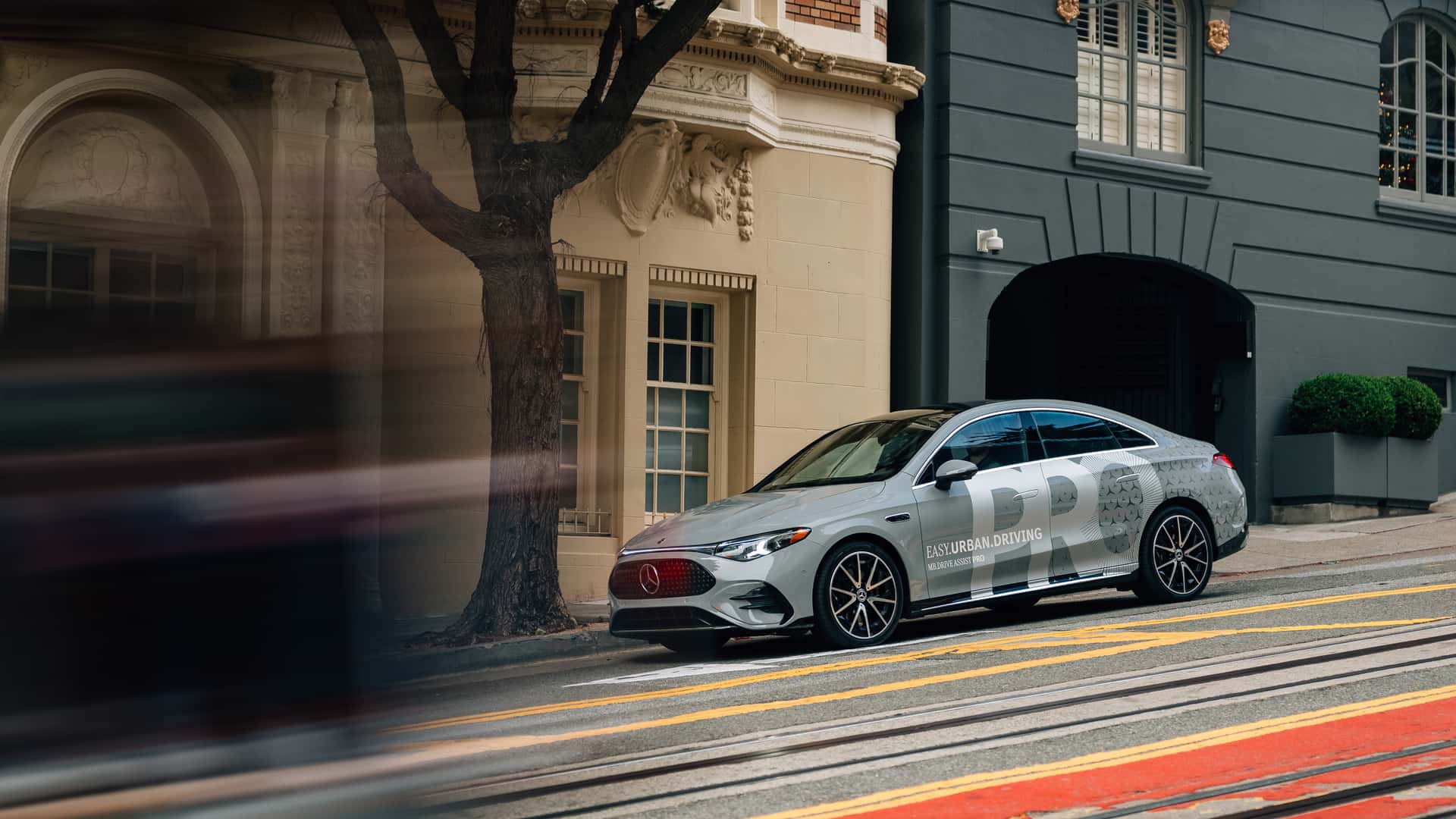
- Mercedes-Benz is launching its MB.Drive Assist Pro, a point-to-point automated driving system, in early 2024 for many of its electric and internal combustion vehicles.
- Unlike Tesla’s Full Self-Driving (Supervised), MB.Drive Assist Pro requires drivers to keep a hand on the wheel on surface streets, adhering strictly to SAE Level 2 autonomous driving definitions.
- Mercedes emphasizes driver responsibility at Level 2 and uses a robust sensor suite including cameras, radar, and ultrasonic sensors, with plans for LiDAR for Level 3.
- Tesla FSD users, accustomed to hands-free driving on surface streets, express skepticism regarding Mercedes’ more conservative approach.
- The debate highlights differing philosophies on autonomous system development: strict adherence to regulatory definitions versus real-world user experience and capability.
The pursuit of fully autonomous driving continues to reshape the automotive industry, promising a future where daily commutes transform from tedious chores into periods of relaxation or productivity. For individuals like Lucian Capellaro, whose daily journey through Los Angeles’ challenging Laurel Canyon is a constant ordeal, the allure of advanced driver-assistance systems is undeniable. While impressed by colleagues touting Tesla’s Full Self-Driving (FSD) capabilities, which allow point-to-point navigation and automated parking, Capellaro harbored a preference for vehicles beyond the Tesla brand, citing design, interior quality, and body style preferences.
Mercedes-Benz is poised to offer a compelling alternative with its upcoming MB.Drive Assist Pro system. Set to roll out to a wide array of the brand’s electric and internal combustion vehicles early next year, this advanced system will also be available as an over-the-air (OTA) update for eligible vehicles already purchased. This move marks a significant entry into the competitive landscape of autonomous driving technologies, directly challenging established players like Tesla.
Adhering to SAE Levels: Mercedes’ Stance on Driver Responsibility
At the core of Mercedes-Benz’s approach to autonomous driving systems lies a fundamental philosophical distinction, particularly in its interpretation of the Society of Automotive Engineers (SAE) autonomous driving levels. The MB.Drive Assist Pro system, while offering comprehensive point-to-point automated driving and parking similar to Tesla’s FSD (Supervised), implements a critical difference: it mandates that drivers maintain a hand on the steering wheel when navigating surface streets. This requirement contrasts with Tesla FSD, which permits hands-free operation even in urban environments, following controlled access highways.
Mercedes-Benz classifies MB.Drive Assist Pro as a Level 2 system, or what the company refers to as “Level 2 Plus Plus.” This classification underscores the necessity of continuous driver supervision. According to Mercedes, the clear demarcation between Level 2 and Level 3 autonomy is paramount. “There is a very important borderline between the levels,” stated Mercedes Chief Technology Officer Jörg Burzer. “That borderline is that with Level 2 Plus Plus, you are responsible. At Level 3, the machine, the car, the software stack, is responsible.”
This strict adherence to SAE definitions dictates the system’s operational parameters. While controlled-access highways present a more predictable environment with fewer variables for Level 2 advanced driver-assistance systems, surface streets introduce a significantly higher degree of complexity and chaos. Consequently, Mercedes engineers deemed it essential for drivers to remain engaged by keeping a hand on the wheel when operating MB.Drive Assist Pro off highways, prioritising safety and clear accountability.
User Perceptions and the Hands-On vs. Hands-Off Debate
The philosophical stance adopted by Mercedes-Benz, while rooted in safety regulations and engineering principles, sparks debate among existing users of rival autonomous driving systems. Lucian Capellero, a motorcycle rider who, despite his risk-taking hobby, values immediate responsiveness in driving scenarios, found Mercedes’ requirement logical. He observed, “Think about the reaction time it must be for someone to take their hands from off the wheel to on the wheel. I’d view my hand on the wheel as lessening the seconds of reaction time to something crazy happening.”
Mercedes’ internal customer research, particularly among European drivers, seems to corroborate this sentiment. Jörg Burzer confirmed, “In the city, they like to have something, some regulation or some requirement that you have to have a hand on the wheel.” However, he acknowledged a potential divergence in preferences, adding, “I don’t know about U.S. customers yet,” highlighting a possible cultural or expectation gap in the adoption of autonomous driving systems.
Indeed, when confronted with the direct comparison—why choose Mercedes’ MB.Drive Assist Pro when Tesla offers hands-free operation on surface streets—Burzer’s response consistently returned to regulatory compliance and the strict definitions of SAE autonomy levels. He reiterated, “The big question is when is level 3 coming? Because then you can have the hands off (anywhere).”
However, many Tesla FSD users often perceive their vehicles as already delivering a Level 3-like experience, irrespective of formal SAE classifications. They operate based on the actual performance and perceived capabilities of their advanced driver-assistance systems. Antonio Hidalgo, an Los Angeles resident and frequent FSD user, candidly admitted to “taking a nap while driving” with FSD engaged on occasion, noting that system flaws are now primarily limited to parking functions. He expressed little inclination to switch to a system requiring constant hand placement on the wheel, even for a “nicer car with a better interior.”
Similarly, Mharlon Barrientos, who uses FSD for his commute in Indianapolis, recalled a time when his Model Y required a hand on the wheel. Through system updates and accumulated experience, he now drives fully hands-off on surface streets. For him, a return to mandatory hands-on driving with MB.Drive Assist Pro would represent “a bit of a step back to the feel of full autonomous driving that I’ve gotten used.” These user experiences underscore a significant divergence in expectations and perceived autonomy between system developers and end-users.
Technological Foundations: Mercedes’ Multi-Sensor Approach
Beyond philosophical differences, Mercedes-Benz underscores a robust technological advantage in its MB.Drive Assist Pro system, particularly concerning its sensor suite. While Tesla’s Full Self-Driving (Supervised) predominantly relies on cameras for obstacle detection and environmental perception, Mercedes employs a comprehensive multi-sensor approach. The MB.Drive Assist Pro integrates not only cameras but also five radar sensors and twelve ultrasonic sensors, all feeding raw data to a powerful Nvidia-powered onboard computer.
Christoph von Hugo, Mercedes’ Head of Active Safety, emphasized the criticality of this sensor fusion. “Different sensor inputs increases performance and safety,” he stated, implicitly critiquing singular sensor strategies. He firmly believes that “Relying on one just is not enough” for ensuring optimal safety and reliability in complex driving scenarios. This comprehensive sensor array is designed to provide redundancy and a more complete, accurate perception of the vehicle’s surroundings.
Looking ahead, Mercedes has also made it clear that its progression to Level 3 autonomous driving capability will necessitate the integration of LiDAR technology, in addition to its existing cameras, radar, and ultrasonic sensors. This commitment to a multi-faceted sensor approach highlights Mercedes-Benz’s emphasis on hardware redundancy and advanced data acquisition as foundational elements for higher levels of autonomy. Notably, Mercedes had briefly offered a Level 3 system in the U.S. market, though it has since been phased out.
However, the technological sophistication of the MB.Drive Assist Pro system may not be the primary selling point for all consumers. Mharlon Barrientos, the Tesla FSD user, admitted, “I honestly haven’t even thought about the tech behind it, so I’m not so sure knowing that there’s radar and ultra-sonic sensors (on the window sticker) would be a huge selling point.” He suggested that real-world performance demonstrations, through videos or detailed reviews, would be more influential than technical specifications alone. “Just like the Tesla system, I think it would take me some mileage on both highway and streets to gain a trust for the system to know it’ll handle either situation well,” Barrientos added.
Broader Appeal and the Evolving Autonomous Landscape
Despite the differing philosophies and technological implementations, the emergence of advanced driver-assistance systems like MB.Drive Assist Pro signifies a maturing market for automated driving. For consumers, the choice extends beyond just the autonomous capabilities to the overall vehicle experience. Mharlon Barrientos, for instance, indicated that the “hands-on requirement in the city would not be enough to sway me off of the car provided I like the rest of the car.” This suggests that while autonomous features are increasingly important, they are part of a larger equation that includes functionality, comfort, and value—elements Mercedes-Benz traditionally excels in.
Capellero echoes this sentiment, pondering how MB.Drive Assist Pro would compare to his wife’s BMW i4, which features adaptive cruise control and low-speed hands-free highway driving assist. His primary interest lies in the system’s ability to genuinely navigate complex routes like Laurel Canyon point-to-point with minimal intervention. “If it can navigate all the craziness that is Laurel Canyon through Hollywood, and it is literally just my hand resting on the wheel, and that’s it, then sure,” he stated, finding the promise of true point-to-point navigation “super appealing.”
The automotive industry is in a critical phase of developing and deploying advanced driver-assistance systems. While Mercedes-Benz’s MB.Drive Assist Pro appears promising, offering a sophisticated alternative to existing autonomous driving technologies, its true real-world performance on complex urban routes remains under keen observation. Early passenger-seat experiences by InsideEVs in San Francisco suggested potential, but a comprehensive review is anticipated to fully assess its capabilities and whether its “hands-on” mandate on surface streets is a pragmatic safety feature or a significant limitation for users accustomed to more permissive systems. The ongoing evolution of these systems will undoubtedly continue to shape consumer expectations and the future of mobility.
Frequently Asked Questions About Autonomous Driving Systems
What is Mercedes-Benz MB.Drive Assist Pro?
Mercedes-Benz MB.Drive Assist Pro is an advanced point-to-point automated driving system. It allows the vehicle to navigate and park autonomously, similar to Tesla’s FSD (Supervised), and will be available in many Mercedes models, both electric and internal combustion, starting early next year via over-the-air updates.
How does MB.Drive Assist Pro differ from Tesla FSD (Supervised)?
The primary difference lies in the hands-on requirement. While both systems operate hands-free on controlled-access highways, MB.Drive Assist Pro mandates that drivers keep a hand on the steering wheel when driving on surface streets, a distinction Mercedes attributes to adherence to SAE Level 2 autonomous driving definitions.
Why does Mercedes require hands on the wheel on surface streets?
Mercedes-Benz adheres strictly to SAE Level 2 autonomy, where the driver remains responsible for vehicle operation. Surface streets present more complex and chaotic driving environments than highways, prompting Mercedes to require driver engagement through hands-on steering to ensure immediate reaction capability and maintain driver responsibility.
What sensor technology does MB.Drive Assist Pro use?
MB.Drive Assist Pro employs a comprehensive sensor suite for environmental perception. It integrates cameras, five radar sensors, and twelve ultrasonic sensors, all feeding data to an Nvidia-powered computer. Mercedes emphasizes this multi-sensor approach enhances performance and safety, contrasting with Tesla’s camera-centric system.
Will Mercedes-Benz offer a fully hands-off system in the future?
Mercedes-Benz acknowledges that true hands-off driving “anywhere” is a hallmark of Level 3 autonomous systems. The company plans to integrate LiDAR technology, in addition to its current sensors, as a prerequisite for achieving Level 3 capability, indicating a cautious, technology-driven progression towards higher levels of autonomy.