
For many commuters navigating congested cityscapes, the allure of advanced automated driving systems promising to alleviate the daily grind is undeniable. Lucian Capellaro, whose daily journey through Los Angeles’ Laurel Canyon is often a tedious affair, found himself intrigued by colleagues’ testimonials about Tesla’s Full Self-Driving (FSD) feature. The promise of entering a destination and letting the car handle the rest sounded like a true reprieve from the stresses of urban traffic. Yet, Capellaro, like many discerning drivers, harbored reservations about owning a Tesla, citing preferences for design, interior quality, and body style.
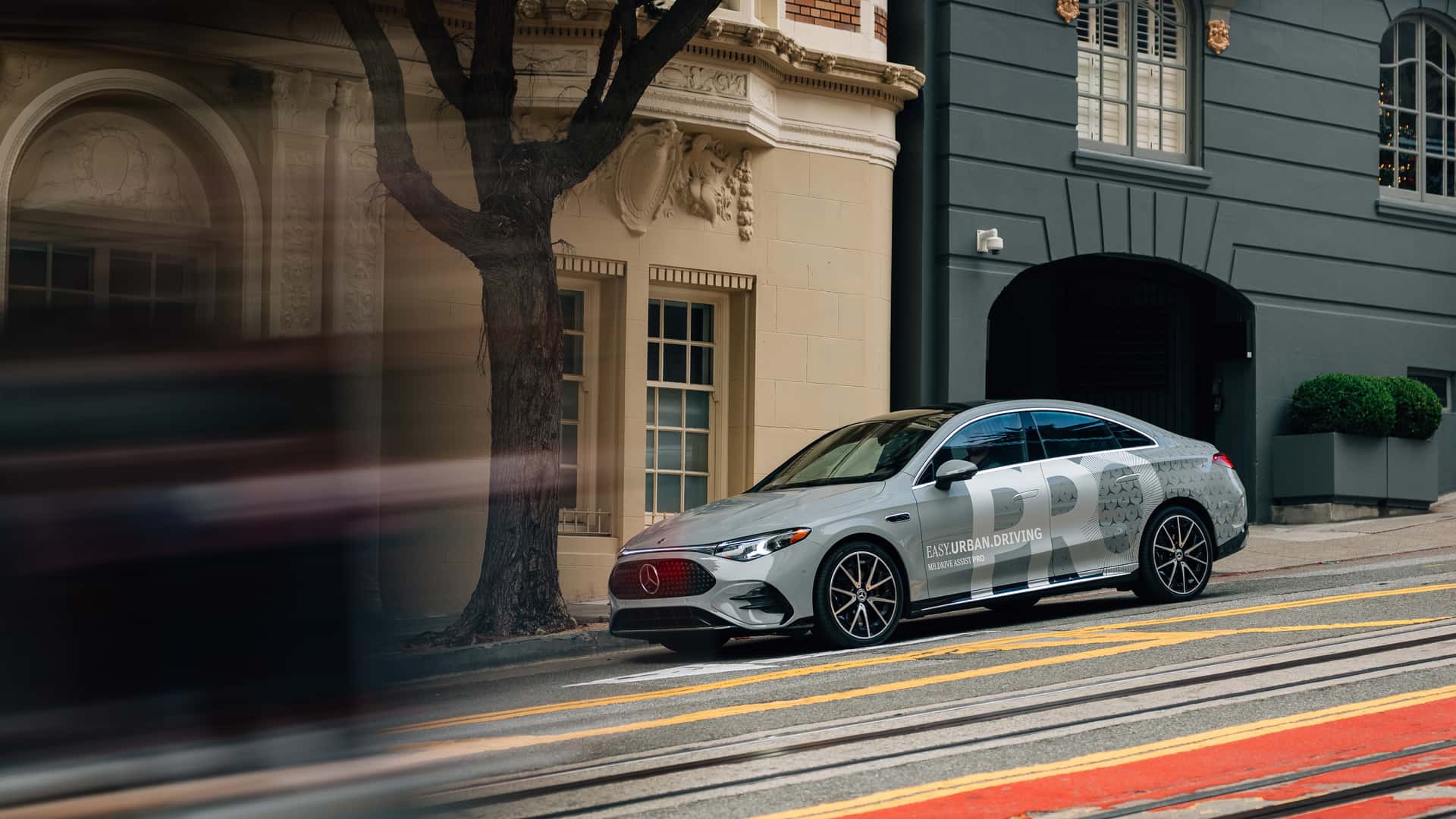
An alternative from Mercedes-Benz is now poised to enter the market, potentially offering a compelling option for drivers like Capellaro. The German luxury automaker is set to integrate its MB.Drive Assist Pro point-to-point automated driving system into a significant number of its electric and internal combustion vehicles early next year. Existing eligible vehicles will also gain access to this technology through convenient over-the-air (OTA) updates, signaling Mercedes-Benz’s strategic push into the rapidly evolving landscape of advanced driver assistance systems (ADAS).
Key Takeaways: Mercedes MB.Drive Assist Pro vs. Tesla FSD
- Point-to-Point Navigation: Both Mercedes MB.Drive Assist Pro and Tesla Full Self-Driving (Supervised) offer point-to-point navigation, driving to a destination and assisting with parking.
- Hands-On Requirement: MB.Drive Assist Pro requires drivers to keep a hand on the wheel on surface streets, while Tesla FSD (Supervised) allows hands-free operation in similar conditions. Both permit hands-free driving on controlled-access highways.
- Philosophical Basis: Mercedes-Benz adheres strictly to the Society of Automotive Engineers (SAE) levels of autonomy, categorizing MB.Drive Assist Pro as a Level 2+ system where the driver remains responsible.
- Sensor Technology: Mercedes-Benz employs a multi-sensor suite comprising cameras, five radar sensors, and 12 ultrasonic sensors. Tesla’s FSD primarily relies on cameras.
- Driver Perception: While European drivers reportedly favor a hands-on approach in city driving, U.S. FSD users often value the hands-free experience, even expressing reluctance to switch to a system requiring constant hand placement.
- Future of Autonomy: Mercedes anticipates Level 3 autonomy, which permits drivers to disengage, will necessitate additional sensor technologies like LiDAR.
Understanding MB.Drive Assist Pro: Mercedes’ Approach to Automated Driving Systems
Mercedes-Benz’s MB.Drive Assist Pro, like Tesla’s Full Self-Driving (Supervised) feature, is designed to guide vehicles from an entered destination to parking. This comprehensive functionality includes navigation through complex traffic scenarios. However, a crucial distinction sets the Mercedes system apart: while it enables hands-free operation on controlled-access highways, it mandates that drivers maintain a hand on the steering wheel when navigating surface streets. This requirement forms the cornerstone of Mercedes’ philosophical approach to automated driving systems.
This difference in interaction is not indicative of inferiority in Mercedes’ technology, but rather reflects a stringent interpretation of autonomous driving “levels” established by the Society of Automotive Engineers (SAE). Both MB.Drive Assist Pro and FSD (Supervised) are classified as Level 2 systems, or what Mercedes refers to as “Level 2 Plus Plus.” In Level 2 autonomy, the driver is always expected to supervise the system and be ready to intervene. Features such as watching a movie or reading a book while the vehicle operates autonomously are characteristic of a Level 3 system, where the vehicle assumes primary responsibility under specific conditions.
The SAE Autonomy Levels and Mercedes’ Strict Adherence
The Society of Automotive Engineers (SAE) International defines six levels of driving automation, ranging from Level 0 (no automation) to Level 5 (full automation). Levels 1 and 2 involve driver assistance, where the human driver monitors the driving environment. Levels 3, 4, and 5 represent conditional, high, and full automation, respectively, where the automated driving system increasingly takes over monitoring responsibilities.
Mercedes-Benz Chief Technology Officer Jörg Burzer elaborated on the company’s commitment to these demarcations. He told InsideEVs, “There is a very important borderline between the levels. That borderline is that with Level 2 Plus Plus, you are responsible. At Level 3, the machine, the car, the software stack, is responsible.” This statement underscores Mercedes’ emphasis on legal and ethical responsibility in the deployment of automated driving systems.
Burzer further explained that controlled-access highways, with their predictable environments and fewer variables, are more amenable to Level 2 hands-free operation. Conversely, surface streets present a far more chaotic and complex array of scenarios—pedestrians, cyclists, unexpected obstacles, varied traffic laws, and dynamic infrastructure. Consequently, Mercedes mandates drivers to keep a hand on the wheel in these challenging urban settings, viewing it as a critical safety protocol.
Driver Perspectives: A Contrast in Experience and Philosophy
The decision to require hands-on driving on surface streets resonates with some, like Lucian Capellaro, despite his openness to advanced technology. As a motorcycle rider, Capellaro is familiar with the need for immediate responsiveness. He stated, “Think about the reaction time it must be for someone to take their hands from off the wheel to on the wheel. I’d view my hand on the wheel as lessening the seconds of reaction time to something crazy happening.” This perspective highlights a fundamental concern about human-machine interface and reaction time in critical situations, informing the design of robust automated driving systems.
Customer research conducted by Mercedes-Benz suggests a similar inclination among European drivers. Burzer noted, “In the city, they like to have something, some regulation or some requirement that you have to have a hand on the wheel,” though he acknowledged uncertainty regarding U.S. customer preferences. This geographic disparity in user expectations could influence future development and market strategies for automated driving systems.
However, many Tesla FSD users hold a different view. Antonio Hidalgo, an L.A. resident who frequently uses FSD, expressed a strong preference for the hands-free experience. He even admitted to having “been able to take a nap while driving” with FSD activated (while wearing a hat and sunglasses, presumably to avoid detection by the internal camera), noting that the only flaws he currently perceives are related to parking. When confronted with the Mercedes system’s hands-on requirement, Hidalgo was reflective but ultimately dismissive. “You know, I probably wouldn’t (make the switch). I mean, I think I would be interested in having a nicer car with a better interior. But no,” he concluded, indicating that the hands-free capability significantly contributes to his satisfaction with Tesla’s automated driving systems.
Mharlon Barrientos, another FSD user from Indianapolis, echoed this sentiment. Having evolved from “hovering” a hand over the wheel to fully hands-off driving as his trust in FSD grew, he sees the Mercedes requirement as a regression. “Having a hand on the wheel as a requirement would be a bit of a step back to the feel of full autonomous driving that I’ve gotten used,” Barrientos stated, recalling that his Model Y originally demanded a hand on the wheel. This experience underscores how user trust and familiarity can reshape expectations for advanced driver assistance systems.
Technological Foundations: Sensor Suites and Safety Protocols
A significant divergence between Mercedes’ MB.Drive Assist Pro and Tesla’s FSD (Supervised) lies in their underlying sensor technology. Mercedes-Benz argues that its system offers enhanced performance and safety by not solely relying on cameras, as Tesla predominantly does. Mercedes’ approach integrates a comprehensive sensor suite comprising traditional cameras alongside five radar sensors and 12 ultrasonic sensors. This diverse array of sensors provides raw data to the vehicle’s Nvidia-powered computer, creating a more robust perception of the surrounding environment.
Christoph von Hugo, Mercedes’ Head of Active Safety, highlighted the benefits of this multi-sensor strategy. “Different sensor inputs increases performance and safety,” he asserted, implicitly contrasting this with what he perceives as a less comprehensive approach by other manufacturers. He firmly added, “Relying on one just is not enough.” Mercedes’ commitment to this layered sensor architecture extends to its future plans for higher levels of autonomy. Von Hugo indicated that the company would not progress to Level 3 capability without incorporating LiDAR technology, in addition to its current cameras, radar, and ultrasonic sensors. Notably, Mercedes did briefly offer a Level 3 system in the U.S., but it has since been phased out, underscoring the complexities and challenges in deploying such advanced automated driving systems.
However, the technical superiority of a multi-sensor approach does not always translate into a compelling selling point for consumers. Mharlon Barrientos admitted, “I honestly haven’t even thought about the tech behind it, so I’m not so sure knowing that there’s radar and ultra-sonic sensors (on the window sticker) would be a huge selling point.” He emphasized that real-world performance and personal experience—gaining trust through mileage on both highways and city streets—would be the ultimate determinants of system preference, rather than a list of technical specifications for automated driving systems.
Consumer Acceptance and the Future Outlook for Automated Driving Systems
Ultimately, the adoption of advanced automated driving systems like MB.Drive Assist Pro will depend on a confluence of factors, including functionality, comfort, and perceived value. Barrientos, despite his current use of FSD, is not unreservedly loyal to Tesla. He stated, “The hands-on requirement in the city would not be enough to sway me off of the car provided I like the rest of the car. While I like the functionality of FSD, it’s still a bit further down the list of what I look for in a car. Functionality, comfort, value … I still like to feel the mechanics and have the feel of actually driving a car.” This perspective reveals that for many drivers, automated features are an enhancement, not a replacement, for the core driving experience.
Lucian Capellaro shares a similar pragmatic view. He wonders how MB.Drive Assist Pro would compare to his wife’s BMW i4, which already offers adaptive cruise control and hands-free highway driving assist at lower, traffic-jam speeds. His interest lies in the system’s real-world capability: “I guess I’d just have to experience (MB.Drive Assist Pro) for myself, but if it can navigate all the craziness that is Laurel Canyon through Hollywood, and it is literally just my hand resting on the wheel, and that’s it, then sure. The fact that it’s truly point-to-point, then yes, that sounds super appealing.” This highlights the importance of practical, tangible benefits and ease of use in garnering consumer interest for automated driving systems.
The true measure of MB.Drive Assist Pro’s efficacy against Tesla FSD will ultimately hinge on its real-world performance. While initial assessments by InsideEVs in January offered promising insights during a passenger-seat ride in San Francisco, a comprehensive review of its capabilities is anticipated. The central question remains: Is the hands-on requirement in city driving a crucial safety measure or an impediment to the full potential of automated driving systems? As these advanced technologies continue to evolve, the answers will shape the future of driving and user expectations.
FAQ: Automated Driving Systems
What is Mercedes-Benz MB.Drive Assist Pro?
MB.Drive Assist Pro is Mercedes-Benz’s advanced point-to-point automated driving system. It allows the vehicle to navigate to a destination and park, similar to Tesla FSD. It will be available in many Mercedes electric and internal combustion vehicles via over-the-air updates.
How does MB.Drive Assist Pro differ from Tesla Full Self-Driving (FSD)?
The primary difference lies in the hands-on requirement: MB.Drive Assist Pro demands drivers keep a hand on the wheel on surface streets, while Tesla FSD (Supervised) permits hands-free operation in similar conditions. Both allow hands-free driving on controlled-access highways.
Why does Mercedes-Benz require hands on the wheel on surface streets?
Mercedes-Benz adheres strictly to SAE Level 2 autonomy definitions, where the driver remains responsible. Surface streets present more complex and chaotic scenarios than highways, making constant driver supervision, including hands on the wheel, a safety priority for their automated driving systems.
What sensor technologies does MB.Drive Assist Pro use?
MB.Drive Assist Pro employs a multi-sensor approach for enhanced perception and safety. It combines cameras with five radar sensors and 12 ultrasonic sensors, delivering comprehensive environmental data to the vehicle’s computer. This contrasts with Tesla’s primary reliance on cameras for its automated driving systems.
What are SAE levels of autonomous driving?
The Society of Automotive Engineers (SAE) defines six levels of driving automation (0-5). Level 2 systems, like MB.Drive Assist Pro and FSD (Supervised), require the human driver to constantly supervise and be ready to intervene. Level 3 and above signify increasing levels of automation where the vehicle assumes more responsibility.
Will Mercedes-Benz offer a Level 3 autonomous system?
Mercedes-Benz indicates that achieving true Level 3 autonomy, which allows drivers to disengage and read or watch content in certain conditions, will necessitate the integration of additional sensor technologies, such as LiDAR, beyond their current camera, radar, and ultrasonic suite.