
Key Takeaways (TL;DR)
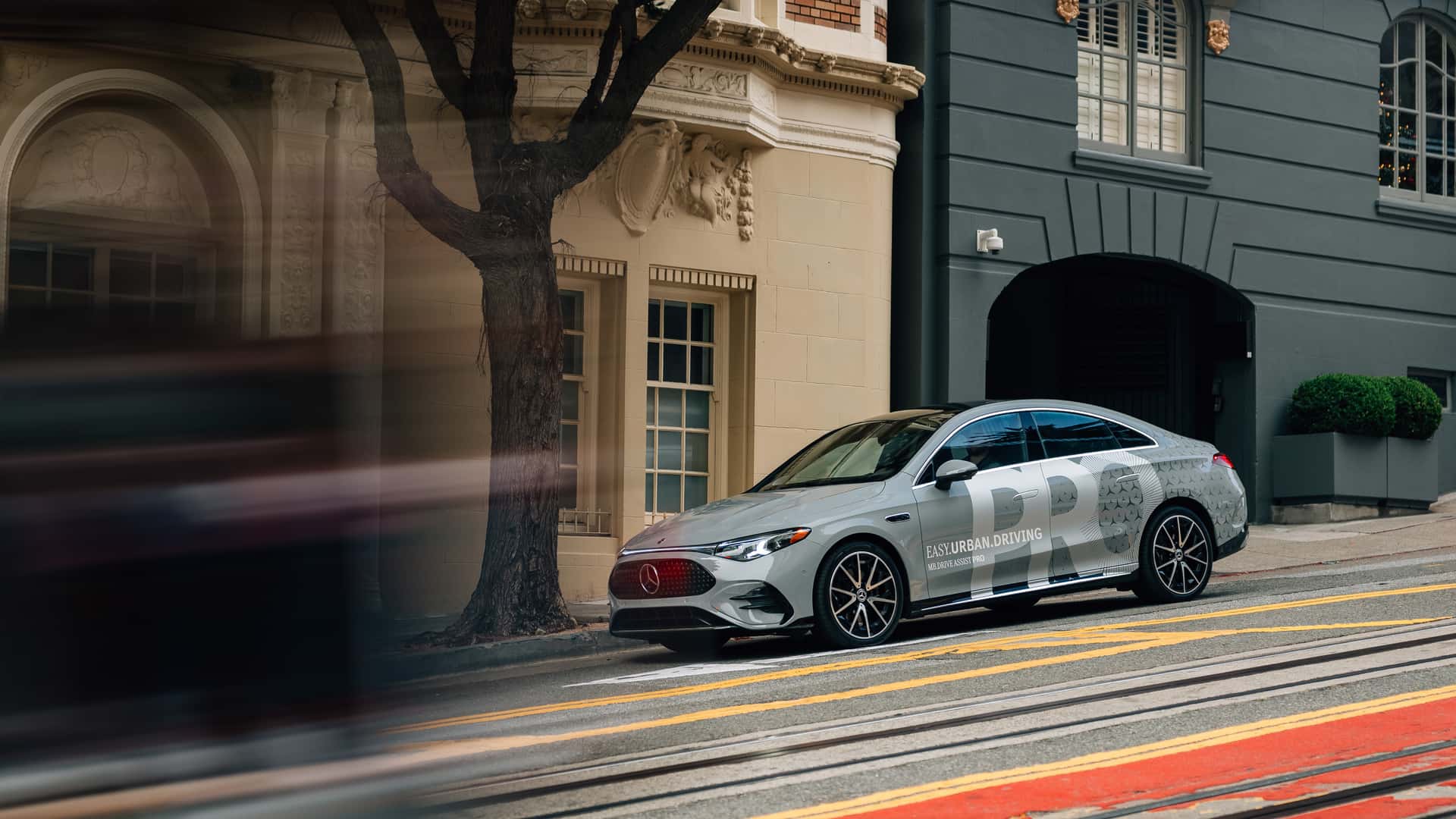
- Mercedes-Benz is launching MB.Drive Assist Pro, a point-to-point automated driving system, in early 2024 for a wide range of its vehicles.
- Unlike Tesla’s Full Self-Driving (Supervised) on surface streets, MB.Drive Assist Pro requires drivers to keep a hand on the wheel when not on controlled-access highways.
- This difference stems from Mercedes’ strict adherence to SAE Level 2 autonomous driving definitions, where the driver remains responsible.
- Mercedes emphasizes a multi-sensor approach (cameras, radar, ultrasonic) for enhanced safety, contrasting with Tesla’s camera-centric system.
- Initial reactions from Tesla FSD users indicate a preference for hands-off driving, although some value vehicle design and comfort over full autonomy features.
- The system promises comprehensive point-to-point navigation and parking, available via over-the-air updates for eligible vehicles.
For many commuters, the daily grind can feel like an endless loop, particularly when navigating challenging routes. Lucian Capellaro, for instance, faces a tedious daily drive through Laurel Canyon from the San Fernando Valley to Los Angeles’ west end. While his colleagues lauded the convenience of Tesla’s Full Self-Driving (FSD) feature, promising effortless point-to-point navigation, Capellaro harbored reservations, driven by a preference for non-Tesla vehicles due to design, interior quality, and body style.
Mercedes-Benz is now poised to offer a compelling alternative. Its advanced MB.Drive Assist Pro point-to-point automated driving system is slated for integration into a significant portion of the brand’s electric and internal combustion vehicle lineup early next year. Owners of already-purchased eligible vehicles will gain access to this feature through convenient over-the-air (OTA) updates.
MB.Drive Assist Pro: Mercedes’ Entry into Advanced Driver Assistance
The upcoming MB.Drive Assist Pro system represents a significant stride in Mercedes-Benz’s commitment to sophisticated driver assistance technologies. Similar to Tesla’s Full Self-Driving (Supervised) functionality, it empowers drivers to input a destination and allow the vehicle to autonomously navigate and park. This comprehensive solution aims to reduce driver fatigue and enhance convenience across various driving scenarios.
However, a crucial distinction emerges when comparing the two systems. While both Mercedes and Tesla enable hands-free operation on controlled-access highways, the MB.Drive Assist Pro mandates that drivers maintain a hand on the steering wheel when traversing surface streets. This operational requirement is not indicative of technological inferiority but rather a deliberate philosophical and regulatory stance adopted by the German automaker.
The Philosophical Divide: Hands-On vs. Hands-Off Autonomy
Mercedes-Benz’s approach to MB.Drive Assist Pro is deeply rooted in a strict interpretation of autonomous driving levels, as defined by the Society of Automotive Engineers (SAE). The MB.Drive Assist Pro, much like Tesla’s FSD (Supervised), is classified as a Level 2 system. Mercedes, however, describes its iteration as “Level 2 Plus Plus,” signifying an advanced form of supervised automation where the driver remains ultimately responsible for vehicle operation.
This contrasts sharply with the capabilities often demonstrated or perceived by many Tesla FSD users, who report hands-off driving even on complex surface streets. A true Level 3 system, which allows drivers to disengage from driving tasks under certain conditions—such as watching a movie or reading a book—shifts the responsibility from the driver to the vehicle itself. Mercedes Chief Technology Officer Jörg Burzer underscored this critical demarcation. “There is a very important borderline between the levels,” Burzer told *InsideEVs*. “That borderline is that with Level 2 Plus Plus, you are responsible. At Level 3, the machine, the car, the software stack, is responsible.”
Navigating Complexities: Highways Versus Surface Streets
The rationale behind Mercedes-Benz’s hands-on requirement for surface streets lies in the inherent complexity of such environments. Controlled-access highways, with their predictable traffic flow and limited variables, present a comparatively simpler challenge for Level 2 autonomous driving systems. Conversely, surface streets are characterized by a far more chaotic and unpredictable array of elements, including pedestrians, cyclists, varied road conditions, and intricate intersections.
Given this complexity, Mercedes insists on driver supervision through tactile engagement with the steering wheel off highways. This decision resonates with drivers like Lucian Capellaro, a motorcycle enthusiast who, despite his adventurous spirit, prioritizes immediate reaction capabilities. “Think about the reaction time it must be for someone to take their hands from off the wheel to on the wheel,” Capellaro commented. “I’d view my hand on the wheel as lessening the seconds of reaction time to something crazy happening.” Mercedes’ internal customer research, particularly among European drivers, reportedly aligns with Capellaro’s sentiment, indicating a preference for maintaining a hand on the wheel in urban driving scenarios. While the preference of U.S. customers is still under evaluation, according to Burzer, the adherence to regulatory definitions remains paramount for the brand.
Tesla FSD Users Weigh In: The Appeal of Unsupervised Driving
The philosophical stance taken by Mercedes-Benz naturally invites scrutiny from the established community of Tesla Full Self-Driving users. Many FSD proponents argue that their vehicles already deliver a hands-off experience far beyond traditional Level 2 definitions, even if technically still classified as supervised. Antonio Hidalgo, a Los Angeles resident and frequent FSD user, attests to the system’s proficiency, claiming he has even taken naps while driving with FSD engaged. His primary criticisms revolve around minor parking issues, suggesting a high degree of trust in the system’s ability to navigate the demanding urban environment of L.A.
When confronted with the hands-on requirement of the Mercedes system, Hidalgo’s response was telling. While acknowledging an interest in a “nicer car with a better interior,” he ultimately concluded he “probably wouldn’t make the switch” from his Tesla if it meant sacrificing the hands-off freedom. Similarly, Mharlon Barrientos, who uses FSD for his commute in Indianapolis, described the prospect of a hands-on requirement as a “step back to the feel of full autonomous driving that I’ve gotten used to.” Barrientos, whose Model Y originally required hands on the wheel, noted that system updates and accumulated experience have fostered sufficient trust to drive fully hands-off today.
The Technology Beneath: Sensors and Safety Philosophy
Beyond the operational distinction, Mercedes-Benz highlights a fundamental difference in its approach to sensor technology compared to Tesla. The MB.Drive Assist Pro system is not solely reliant on cameras for environmental perception, as Tesla’s FSD largely is. Instead, Mercedes integrates a robust suite of sensors, including five radar sensors and 12 ultrasonic sensors, which feed raw data to the vehicle’s Nvidia-powered computer. This multi-sensor strategy is positioned as a key differentiator in terms of performance and safety.
Christoph von Hugo, Mercedes’ Head of Active Safety, articulated this perspective, stating, “Different sensor inputs increases performance and safety.” He implicitly critiqued approaches that rely on fewer sensor types, adding that “Relying on one just is not enough.” Mercedes further emphasizes that it will not progress to Level 3 autonomous capability without the addition of LiDAR technology, augmenting its existing array of cameras, radar, and ultrasonic sensors. (It is worth noting that Mercedes did briefly offer a Level 3 system in the U.S., which has since been phased out).
However, the technical specifications alone may not be the decisive factor for consumers. Mharlon Barrientos candidly admitted that he hadn’t “even thought about the tech behind it,” suggesting that the presence of radar and ultrasonic sensors on a window sticker might not be a significant selling point in itself. He indicated that real-world performance advantages, potentially demonstrated through videos or reviews, would be more persuasive. Ultimately, like with any new system, he would require “some mileage on both highway and streets to gain a trust for the system to know it’ll handle either situation well.”
Beyond Autonomy: The Holistic Car Experience
Despite the advanced capabilities of autonomous driving systems, many consumers, including current FSD users, retain a broader perspective when evaluating a vehicle. Barrientos, for example, is not exclusively loyal to Tesla or its FSD feature. He noted that while he appreciates FSD’s functionality, it ranks lower on his list of priorities compared to overall vehicle attributes such as functionality, comfort, and value. “I still like to feel the mechanics and have the feel of actually driving a car,” he elaborated, indicating a desire for a balanced driving experience.
This sentiment resonates with Capellero, who questions how much of an improvement MB.Drive Assist Pro would offer over the adaptive cruise control and low-speed hands-free highway assist present in his wife’s BMW i4. For Capellero, the true test lies in the system’s ability to flawlessly navigate his notorious Laurel Canyon commute. “I guess I’d just have to experience (MB.Drive Assist Pro) for myself, but if it can navigate all the craziness that is Laurel Canyon through Hollywood, and it is literally just my hand resting on the wheel, and that’s it, then sure,” he said. The prospect of “truly point-to-point” navigation, even with a hands-on requirement, holds considerable appeal for drivers seeking relief from tedious journeys.
The Road Ahead: Performance and User Acceptance
The impending launch of Mercedes-Benz’s MB.Drive Assist Pro sets the stage for a compelling comparison within the rapidly evolving landscape of autonomous driving technology. While *InsideEVs* offered a promising glimpse during a passenger-seat ride in San Francisco in January, a comprehensive review of its real-world performance is keenly anticipated. The central question remains: will the robust performance and enhanced safety offered by Mercedes’ multi-sensor approach and its adherence to established SAE levels outweigh the hands-on-the-wheel requirement for a user base increasingly accustomed to hands-off driving?
The answer will ultimately hinge on the system’s ability to consistently deliver on its promise of safe, reliable, and convenient point-to-point automated driving, balancing regulatory adherence with user expectations. As both manufacturers continue to innovate, the competitive dynamics of the autonomous driving market are poised for significant evolution.
Frequently Asked Questions (FAQ)
What is Mercedes-Benz MB.Drive Assist Pro?
MB.Drive Assist Pro is Mercedes-Benz’s upcoming point-to-point automated driving system, designed to navigate and park vehicles autonomously. It will be available in both electric and internal combustion models, with existing eligible vehicles receiving the feature via over-the-air updates early next year.
How does MB.Drive Assist Pro differ from Tesla’s Full Self-Driving (FSD)?
The primary difference is that MB.Drive Assist Pro requires drivers to keep a hand on the steering wheel when operating on surface streets, whereas Tesla’s FSD (Supervised) allows for hands-off driving in similar conditions. Both systems offer hands-free operation on controlled-access highways.
Why does Mercedes require hands on the wheel on surface streets?
Mercedes-Benz adheres strictly to SAE Level 2 autonomous driving definitions, where the driver maintains responsibility. The company views surface streets as significantly more complex and unpredictable than highways, necessitating active driver supervision for safety and regulatory compliance.
What sensor technologies does MB.Drive Assist Pro use?
MB.Drive Assist Pro employs a comprehensive sensor suite, including cameras, five radar sensors, and 12 ultrasonic sensors. This multi-sensor approach, powered by an Nvidia computer, is emphasized by Mercedes as enhancing performance and safety, a contrast to Tesla’s camera-centric system.
Is MB.Drive Assist Pro a Level 3 autonomous system?
No, MB.Drive Assist Pro is classified as a Level 2, or “Level 2 Plus Plus,” system. Mercedes executives state that true Level 3 functionality, which shifts driving responsibility to the vehicle under certain conditions, would require additional technology like LiDAR sensors.
Will existing Mercedes-Benz vehicles be able to get this feature?
Yes, eligible Mercedes-Benz vehicles that have already been purchased will be able to add the MB.Drive Assist Pro system through over-the-air (OTA) software updates, making the advanced functionality accessible to a wider existing customer base.
How do Tesla FSD users react to Mercedes’ hands-on requirement?
Many current Tesla FSD users, accustomed to a hands-off driving experience, express skepticism about returning to a hands-on requirement. While some appreciate Mercedes’ design and interior quality, the loss of hands-off freedom on surface streets is seen by some as a significant drawback.