
Key Takeaways
Electric vehicle (EV) motors, often overshadowed by batteries, are crucial for performance and efficiency, employing diverse designs.
The primary distinction lies in how their rotors generate magnetism: using permanent magnets, electrically powered coils, or induction principles.
Permanent-Magnet Synchronous Motors (PMSMs) offer high efficiency and power density but rely on rare-earth elements.
Induction Motors (IMs) are robust and avoid rare earths, providing low drag when inactive, though they are generally less efficient.
Electrically Excited Synchronous Motors (EESMs) allow for adjustable magnetic fields, optimizing performance and reducing reliance on rare earths, but add complexity.
Automakers strategically combine these EV motor types, often within the same vehicle, to balance efficiency, performance, cost, and packaging requirements.
The Diverse World of Electric Vehicle Motor Technology
While much attention in the electric vehicle (EV) sector rightfully focuses on battery advancements and range capabilities, the sophisticated engineering within EV motors often goes unnoticed. These propulsion units are far more intricate than simply converting electricity into rotational motion.
Automakers deploy a variety of EV motor technology designs, sometimes even within a single vehicle, to meticulously balance critical factors such as efficiency, raw performance output, compact packaging, and overall production costs.
The fundamental differentiator among these motor types lies in how the rotor, the spinning component, achieves its magnetism. Some designs incorporate permanent magnets, while others generate the necessary magnetic field through powered coils or induction principles.
Understanding How Electric Motors Generate Motion
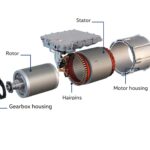
At its core, every electric motor in an EV operates on the principle of electromagnetic force. The system comprises two main components: the stator, a stationary outer section, and the rotor, which rotates within the stator.
The rotor is directly connected to a shaft, transmitting power to the wheels via reduction gearing. This rotating element requires direct current (DC) from the vehicle’s battery pack to function effectively.
An essential component, the inverter, transforms the DC from the battery into controlled alternating current (AC). This AC is then fed into the stator’s coils in a precise sequence, which in turn generates a rotating magnetic field around the rotor.
The rotor, influenced by this constantly moving magnetic pull, continuously follows the field, resulting in the rotational movement that drives the vehicle. The efficiency and characteristics of this process vary significantly across different EV motor technology types.
Synchronous Versus Asynchronous Operation
The term ‘synchronous’ describes motors where the rotor’s rotational speed precisely matches the speed of the stator’s magnetic field. Both permanent-magnet and electrically excited motors fall into this category of synchronous machines.
Conversely, induction motors operate with a slight speed differential between the stator’s magnetic field and the rotor’s spin. This distinction in operational principles significantly impacts their performance attributes.
Permanent-Magnet Synchronous Motors (PMSMs)
Permanent-Magnet Synchronous Motors (PMSMs) represent a dominant form of EV motor technology, widely adopted due to their compelling advantages. In these motors, the magnetic field of the rotor is provided by powerful permanent magnets that are either affixed to or embedded within the rotor structure.
The stator’s rotating magnetic field then exerts a continuous pull on these permanent magnets, causing the rotor to spin. This mechanism can be visualised as a compass needle consistently aligning itself with a moving external magnet.
A key benefit of PMSMs is that the rotor’s magnets do not require an external electrical supply to maintain their magnetism. This inherent design characteristic contributes to higher efficiency, as it eliminates the energy losses associated with powering rotor windings, a feature absent in other motor types.
Advantages and Challenges of PMSMs
PMSMs are highly prized for their exceptional efficiency and their ability to generate substantial power from a compact and relatively lightweight package. These attributes make them a preferred choice for the primary drive motors in most modern electric vehicles, such as the Volkswagen Group’s APP550 rear-wheel drive unit.
However, this advanced EV motor technology comes with its own set of challenges. The powerful magnets integral to PMSMs typically contain rare earth elements. The extraction and processing of these materials can lead to significant environmental concerns and ethical dilemmas.
Furthermore, reliance on rare earth elements exposes manufacturers to potential sourcing difficulties and volatility in global commodity prices. While not all permanent magnets strictly require rare earths, they are the prevalent material choice for high-performance automotive applications.
Induction Motors (IMs): The Asynchronous Alternative
Induction Motors (IMs), also known as asynchronous motors, present an alternative EV motor technology by replacing permanent magnets with conductive bars within the rotor. This distinctive rotor design is often colloquially referred to as a ‘squirrel cage,’ owing to the visual resemblance of its conductive bars joined by end rings to a rodent’s exercise wheel.
The principle behind IM operation involves the moving magnetic field generated by the stator. This field induces an electric current in the rotor’s conductive metal bars, which subsequently creates the rotor’s own magnetic field. This ingenious mechanism allows IMs to produce torque without the need for permanent magnets or an electrical connection directly feeding the rotor.
Operational Characteristics and Applications of IMs
A defining characteristic of an induction motor in an EV is that its rotor always turns slightly slower than the stator’s rotating magnetic field. This crucial speed difference, termed ‘slip,’ is absolutely essential for inducing current in the rotor and, consequently, generating torque. If the rotor were to perfectly match the stator’s field speed, the induction effect and the resulting torque would cease.
The robust design of induction motors, exemplified by components like the Mercedes-Benz C-Class EV front motor, eliminates the need for rare-earth magnets, mitigating the sourcing and cost issues associated with PMSMs. Moreover, when an induction motor is not receiving power, it can spin with very minimal drag, offering a notable advantage for certain applications.
Audi highlights this benefit for the front induction motor in its Q6 E-tron Quattro, which supplements propulsion when required. This dual-motor setup, featuring a permanent-magnet motor for the primary drive axle and a less potent induction motor for the secondary axle, is a common strategy in all-wheel-drive EVs, seen in models from Tesla and General Motors.
Electrically Excited Synchronous Motors (EESMs)
Electrically Excited Synchronous Motors (EESMs) represent a third, sophisticated approach to EV motor technology. Unlike PMSMs with fixed magnets or IMs relying on induced current, EESMs house coils within their rotor that are supplied with electricity, effectively transforming the rotor into an adjustable electromagnet.
This design distinguishes EESMs from induction motors, as they do not depend on ‘slip’ to generate their rotor’s magnetic field. The term ‘excited’ simply denotes that the rotor is energised by an electrical current.
Advantages and Trade-offs of EESMs
The primary advantage of EESMs, illustrated by units like the Renault 5 drive unit, is the ability to precisely adjust the strength of the rotor’s magnetic field. This dynamic control provides engineers with an additional parameter to optimise motor operation across varying speeds and load conditions, enhancing overall efficiency and performance flexibility.
BMW, for instance, has integrated EESMs into its latest sixth-generation EV powertrains. The manufacturer cites their energy efficiency in everyday driving and their capacity to sustain strong power output even at very high rotational speeds as key benefits. Renault also explicitly points to a reduced dependency on rare earths and magnet suppliers as a compelling reason for adopting wound rotors in vehicles like the Renault 5 E-Tech.
The main trade-off with this EV motor technology is the energy consumption required to power the rotor’s field, which introduces some efficiency losses. Additionally, the windings and their associated power supply add a layer of complexity to the motor’s design and manufacturing process compared to simpler permanent-magnet systems.
Strategic Deployment of Diverse EV Motor Technology
The co-existence and strategic combination of different EV motor technology types within a single vehicle underscore the nuanced engineering decisions in electric vehicle design. The Audi Q6 E-tron Quattro serves as a prime example, utilising a highly efficient permanent-magnet motor at the rear for consistent propulsion, complemented by a front induction motor for supplementary performance and enhanced traction when necessary. Critically, the induction motor incurs minimal drag when inactive, thus preserving overall efficiency.
This pragmatic approach extends to other manufacturers. BMW’s new all-wheel-drive configurations, for instance, pair an electrically excited rear motor with a front induction motor. Meanwhile, newer Mercedes-Benz EVs feature a permanent-magnet front motor that can be mechanically disconnected from the wheels when not in use. This clever engineering avoids unnecessary drag and energy losses, further optimising efficiency.
Ultimately, the selection and integration of EV motor technology are multifaceted decisions. They involve a delicate balance of achieving desired performance characteristics, maximising energy efficiency, managing material costs, and optimising packaging within the vehicle architecture. As the electric vehicle market continues its rapid expansion, this strategic diversity in motor design will undoubtedly remain a cornerstone of innovation.
Frequently Asked Questions About EV Motor Technology
What is the fundamental difference between EV motor types?
The core distinction lies in how the rotor (the spinning part) generates its magnetic field. Some motors use permanent magnets, others create magnetism with electrically powered coils on the rotor, and induction motors use electromagnetism induced in conductive rotor bars.
Why do some EV motors use rare-earth elements?
Permanent-Magnet Synchronous Motors (PMSMs) often use rare-earth elements like neodymium to create powerful, compact, and highly efficient permanent magnets. These magnets contribute to high power density and overall motor performance, but introduce sourcing challenges.
What is ‘slip’ in an induction motor?
‘Slip’ refers to the necessary speed difference between the stator’s rotating magnetic field and the rotor’s actual rotational speed in an induction motor. This difference induces current in the rotor, creating its magnetic field and generating torque.
Why do some EVs use two different motor types?
Automakers combine different EV motor types, such as a permanent-magnet rear motor with an induction front motor, to optimise for varying driving conditions. This strategy balances peak performance, sustained efficiency, and cost-effectiveness, while minimising drag from inactive motors.
Are electrically excited motors more efficient?
Electrically Excited Synchronous Motors (EESMs) offer variable magnetic field strength, allowing for highly optimised operation across different speeds and loads, contributing to efficient energy use. However, powering the rotor coils consumes some electricity, which is a trade-off compared to permanent magnet designs.
What are the primary factors influencing EV motor choice?
Key factors include efficiency requirements, desired performance characteristics (e.g., torque, high-speed power), packaging constraints, cost of materials (like rare earths), manufacturing complexity, and the overall balance of advantages and disadvantages for specific vehicle applications.