
While batteries often dominate discussions around electric vehicles (EVs), the sophisticated electric motors driving these machines are equally pivotal to their performance, efficiency, and overall character. Far from being a monolithic component, EV motors employ diverse designs, each presenting unique advantages and engineering challenges. Automakers meticulously select and often combine these EV motor types within a single vehicle, striking a balance between critical factors such as efficiency, raw performance, packaging constraints, and manufacturing costs.
At the heart of every electric motor lies a fundamental principle: the interaction of magnetic fields to produce rotational motion. However, the methods by which these magnetic fields are generated—particularly within the rotor, the spinning component—differ significantly. Some motors utilise permanent magnets, while others generate magnetic fields through powered coils or electromagnetic induction. Understanding these distinctions is crucial for comprehending the varied capabilities and strategic applications across the rapidly evolving electric vehicle landscape.
The Core Mechanics of Electric Vehicle Motors
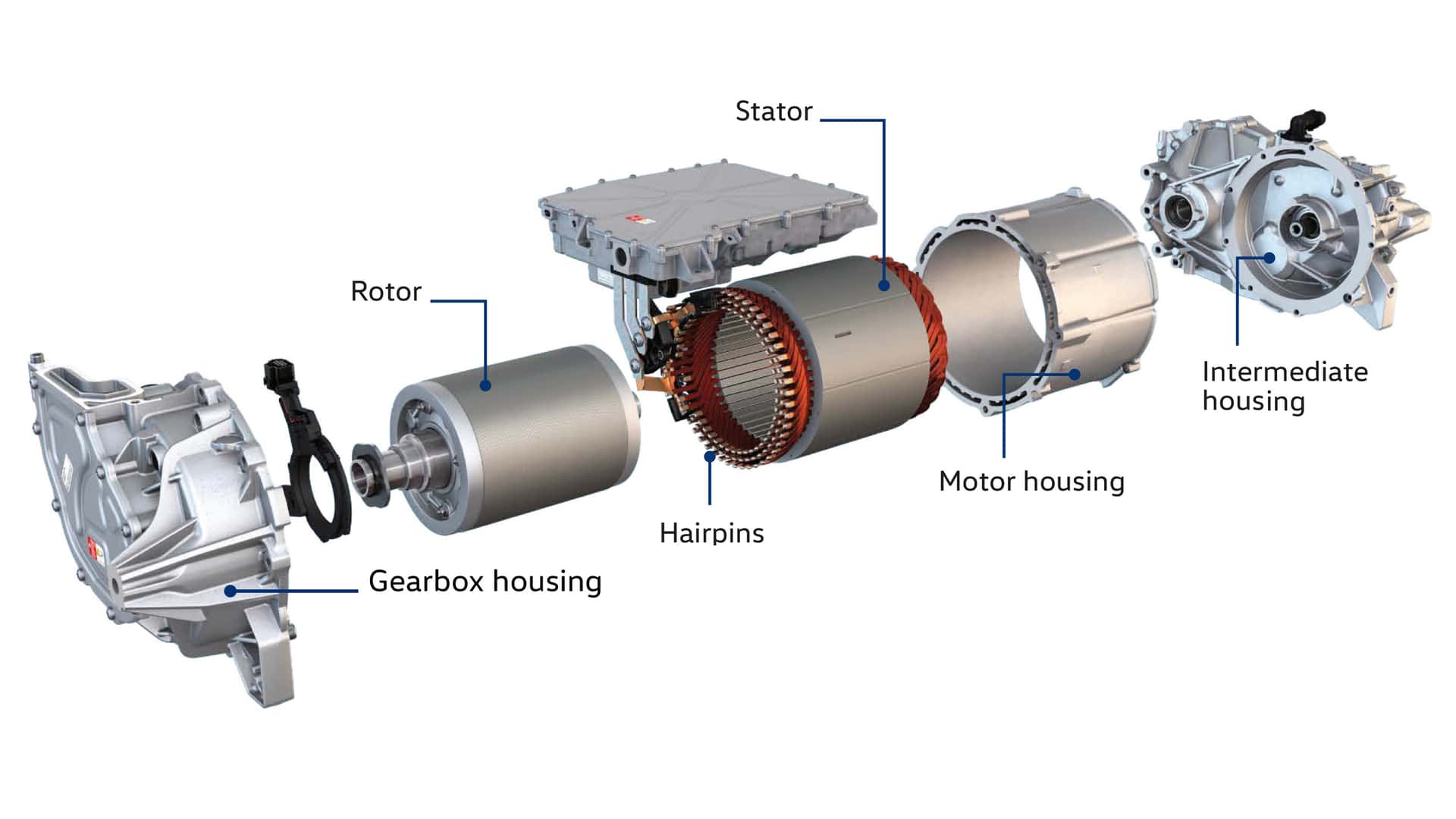
An electric vehicle motor comprises two primary sections: the stator, which is the stationary outer casing, and the rotor, the inner part designed to spin. The rotor is mechanically linked to a shaft that transmits power to the vehicle’s wheels, typically through reduction gearing. Power for the motor is drawn from the EV’s high-voltage battery, which supplies direct current (DC).
However, electric motors primarily operate on alternating current (AC). An essential component called an inverter converts the DC from the battery into controlled AC. This AC is then fed into the stator’s coils in a precise sequence, creating a dynamic, rotating magnetic field. The rotor, whether magnetised or inductively energised, is then pulled along by this continuously moving magnetic field, generating the torque necessary for propulsion.
The term ‘synchronous’ describes motors where the rotor rotates in perfect step with the stator’s magnetic field. This category includes both permanent-magnet and electrically excited motors. Conversely, ‘induction motors’ operate with a slight speed differential—known as ‘slip’—between the stator’s rotating magnetic field and the rotor’s rotational speed, a characteristic essential for their operation.
Permanent-Magnet Synchronous Motors (PMSMs): The Efficient Standard
Permanent-Magnet Synchronous Motors (PMSMs) represent one of the most prevalent EV motor types in modern electric vehicles. In these motors, the rotor is equipped with or embedded with powerful permanent magnets. These magnets inherently provide the rotor’s magnetic field, eliminating the need for an external electrical supply to maintain its magnetism. The stator’s rotating magnetic field then interacts with these fixed magnets, drawing the rotor around.
This design offers several compelling advantages, most notably high efficiency and impressive power output from a relatively compact and lightweight package. Because the rotor’s magnetic field doesn’t require constant electrical input, PMSMs avoid the energy losses associated with powering rotor windings, contributing to superior overall energy conversion. Consequently, a significant number of electric vehicles on the market today employ PMSMs as their primary drive motors, favoured for their robust performance and range optimisation.
However, the use of powerful permanent magnets introduces a significant consideration: material sourcing. The high-performance magnets typically utilised in automotive PMSMs often contain rare-earth elements, such as neodymium and dysprosium. The extraction, processing, and supply chains for these materials can expose manufacturers to geopolitical complexities, ethical sourcing challenges, and volatile price fluctuations. While the term ‘permanent magnet’ doesn’t exclusively imply ‘rare earth,’ these specific materials are the industry’s material choice for the high-performance applications demanded by electric vehicle powertrains.
Induction Motors: The Robust, Rare-Earth-Free Alternative
An alternative to permanent-magnet designs is the induction motor, also known as an asynchronous motor. This EV motor type distinguishes itself by replacing permanent magnets with conductive metal bars integrated into the rotor. The characteristic arrangement of these bars, connected by rings at both ends, often leads to this design being colloquially referred to as a “squirrel cage” due to its resemblance to the exercise wheel for rodents.
The operational principle of an induction motor relies on electromagnetic induction. The stator’s moving magnetic field induces an electric current within the rotor’s conductive bars. This induced current, in turn, generates the rotor’s own magnetic field. This self-generating mechanism allows the induction motor to produce torque without the need for permanent magnets or a direct electrical connection to the rotor.
A key aspect of induction motor operation is ‘slip.’ For current to be induced in the rotor, it must rotate slightly slower than the stator’s magnetic field. If the rotor were to perfectly catch up to the stator’s field, the relative motion required for induction would cease, and consequently, no torque would be generated. This design is highly robust and, crucially, avoids the reliance on rare-earth magnets, mitigating the supply chain and cost concerns associated with PMSMs.
Despite these benefits, generating current within the rotor inevitably produces heat and leads to reduced efficiency compared to PMSMs, especially under continuous high load. However, a significant advantage of induction motors is their ability to spin with very minimal drag when they are not receiving power. This characteristic makes them ideal for secondary propulsion roles in all-wheel-drive (AWD) electric vehicles. For example, Audi employs an induction motor for the front axle of its Q6 E-tron Quattro, complementing a permanent-magnet rear motor. This strategic pairing allows the front motor to provide additional power and traction on demand, while disengaging with minimal energy loss when not active. Many AWD EVs from manufacturers like Tesla and General Motors also utilise this hybrid motor strategy.
Electrically Excited Synchronous Motors (EESMs): Tunable Power Delivery
The Electrically Excited Synchronous Motor (EESM) represents a third distinct approach to EV motor design, offering a unique blend of characteristics. In an EESM, the rotor is fitted with coils that are supplied with electricity, effectively transforming the rotor into an electromagnet. Unlike an induction motor, which relies on slip to create its rotor field, an EESM directly controls the rotor’s magnetism.
This design can be conceptualised as a permanent-magnet motor where the strength of the magnets is dynamically adjustable. The term “excited” simply denotes that the rotor’s magnetic field is actively generated by an electrical current. This capability to precisely adjust the magnetic field strength provides engineers with an additional degree of control, enabling optimal operation across a wide range of speeds and loads. This adjustability can significantly enhance energy efficiency, especially during high-speed cruising or specific driving cycles, and ensure consistent, strong power delivery even at very high rotational speeds.
BMW has adopted EESMs in its latest sixth-generation EV powertrains, citing their energy efficiency in everyday driving scenarios and sustained power output at elevated rotational speeds as key benefits. Similarly, Renault incorporates this technology in vehicles such as the Renault 5 E-Tech, explicitly highlighting the reduced reliance on rare-earth elements and a diversification of magnet suppliers as strategic motivations for choosing wound rotors. The primary trade-off for EESMs involves the energy consumed to power the rotor’s electromagnetic field, along with the added complexity of the windings and the associated power supply system compared to a PMSM.
Strategic Motor Selection in Electric Vehicles
The existence and coexistence of these different EV motor types underscore the complex engineering considerations involved in electric vehicle design. As exemplified by the Audi Q6 E-tron Quattro, which combines a permanent-magnet rear motor with an induction front motor, automakers rarely commit to a single motor technology across an entire vehicle. This strategic integration allows for optimisation of various performance parameters.
The permanent-magnet rear motor, being highly efficient, can serve as the primary propulsion unit, handling everyday driving efficiently. The front induction motor then provides supplementary performance and enhanced traction when required, disengaging with minimal drag when not in use. This modular approach allows manufacturers to tailor vehicle dynamics and energy consumption profiles to specific market demands and driving conditions.
Further demonstrating this adaptability, BMW’s newest all-wheel-drive configurations pair an electrically excited rear motor with a front induction motor. Mercedes-Benz, on the other hand, employs a permanent-magnet front motor in some of its new EV models but integrates a mechanical disconnect mechanism. This allows the motor to be completely disengaged from the wheels when not needed, effectively eliminating drag and parasitic energy losses, thereby enhancing overall vehicle efficiency.
Ultimately, the choice of EV motor types is a multi-faceted decision that aims to optimise energy consumption when power is not required, as much as it is about generating maximum power when demanded. This intricate balance of efficiency, performance, weight, packaging, and material considerations ensures that a diverse array of motor designs will continue to be integral to the future evolution of electric vehicles.
Frequently Asked Questions (FAQ)
What are the main types of electric motors used in EVs?
The primary EV motor types are Permanent-Magnet Synchronous Motors (PMSMs), Induction Motors (Asynchronous Motors), and Electrically Excited Synchronous Motors (EESMs). Each type offers distinct characteristics regarding efficiency, power delivery, and material requirements.
Why do some EVs use different motors for the front and rear axles?
Automakers often combine different EV motor types to optimise for specific needs. For example, a high-efficiency PMSM might be used for the main drive axle, while a robust induction motor provides additional power for the secondary axle, offering flexibility and improving overall efficiency.
Do all EV motors use rare-earth elements?
No. While Permanent-Magnet Synchronous Motors (PMSMs) commonly utilise rare-earth elements for their powerful magnets, Induction Motors and Electrically Excited Synchronous Motors (EESMs) are designed to function without them, reducing reliance on specific material supply chains.
What is the advantage of an Electrically Excited Synchronous Motor (EESM)?
EESMs allow for adjustable magnetic field strength in the rotor, providing engineers with greater control over motor performance and efficiency across varying speeds and loads. This can lead to better energy consumption at high speeds and reduces reliance on rare-earth materials.
How does an Induction Motor differ from a Permanent-Magnet Motor in terms of operation?
A Permanent-Magnet Motor uses fixed magnets on its rotor. An Induction Motor, however, has conductive bars on its rotor where current is induced by the stator’s magnetic field, creating its own magnetic field without permanent magnets or direct electrical supply to the rotor.
What is ‘slip’ in an Induction Motor?
‘Slip’ refers to the necessary speed difference between the stator’s rotating magnetic field and the rotor’s actual rotational speed in an Induction Motor. This differential is crucial for inducing current in the rotor and generating torque; if the rotor matched the field’s speed, induction would cease.