Details of Tesla’s upcoming two-seater, steering and pedaless Robotaxi, the Cybercab, have emerged for the first time, offering a look at its internal components.
Internal Components Revealed
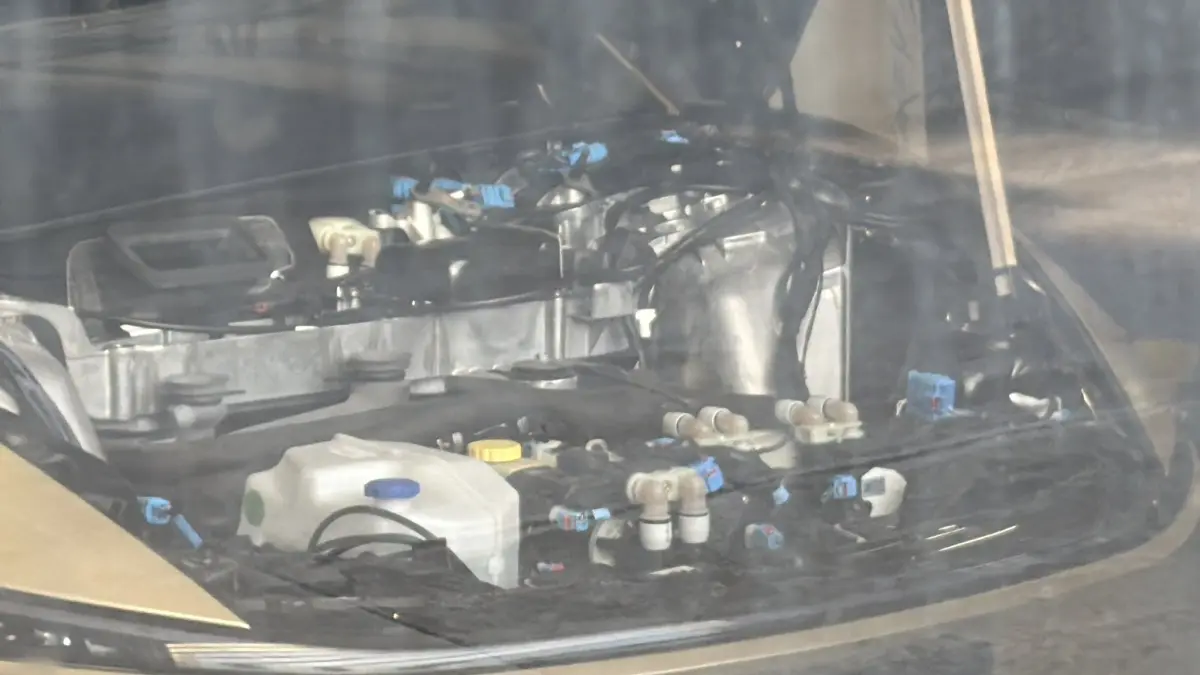
A gold-coloured Cybercab was recently photographed in a Chicago garage with transparent bonnet panels. The images, captured by user Trent on X, showcase key components under the hood. The revealed parts include the heating, ventilation, and air conditioning (HVAC) system, washer fluid reservoir, steering motors designed for autonomous operation, the full-self-driving (FSD) computer, the low-voltage battery, and the main lithium-ion battery.

Cybercab’s Development and Visibility
Tesla initially unveiled the Cybercab at its “We, Robot” event in late 2024. During the event, held at Warner Bros. studios in California, numerous demonstrations of the Cybercab and Model Y Robotaxis were conducted on closed roads. Since its unveiling, sightings of the distinctive golden vehicle have been frequent. These have occurred at Tesla’s test track near Fremont, California, on public roads, and within Tesla showrooms across both the United States and Europe. The vehicle was also part of a six-city European tour, visiting Paris, London, Berlin, Stockholm, Oslo, and Amsterdam.
Production and Cost Expectations
The Cybercab is anticipated to be priced around $A45,000. It is designed as a self-driving robotaxi with ample rear space and a significantly reduced number of internal parts compared to Tesla’s existing passenger vehicles. A lead Tesla engineer previously stated that the Cybercab is expected to feature 50% fewer parts than the Tesla Model 3 electric sedan. This simplification is intended to enable faster scaling of production, contrasting with the highly specialized vehicles used by competitors in the autonomous driving sector, such as Waymo in the US.
Production Timeline Confirmed
Production of the unique two-seater Cybercab is slated to commence in April 2026, a timeline confirmed during Tesla’s recent Q4 shareholders meeting. The latest insights into its internal structure, with fewer components visible under the bonnet, suggest the Cybercab is poised to be one of the company’s most innovative products to date.