
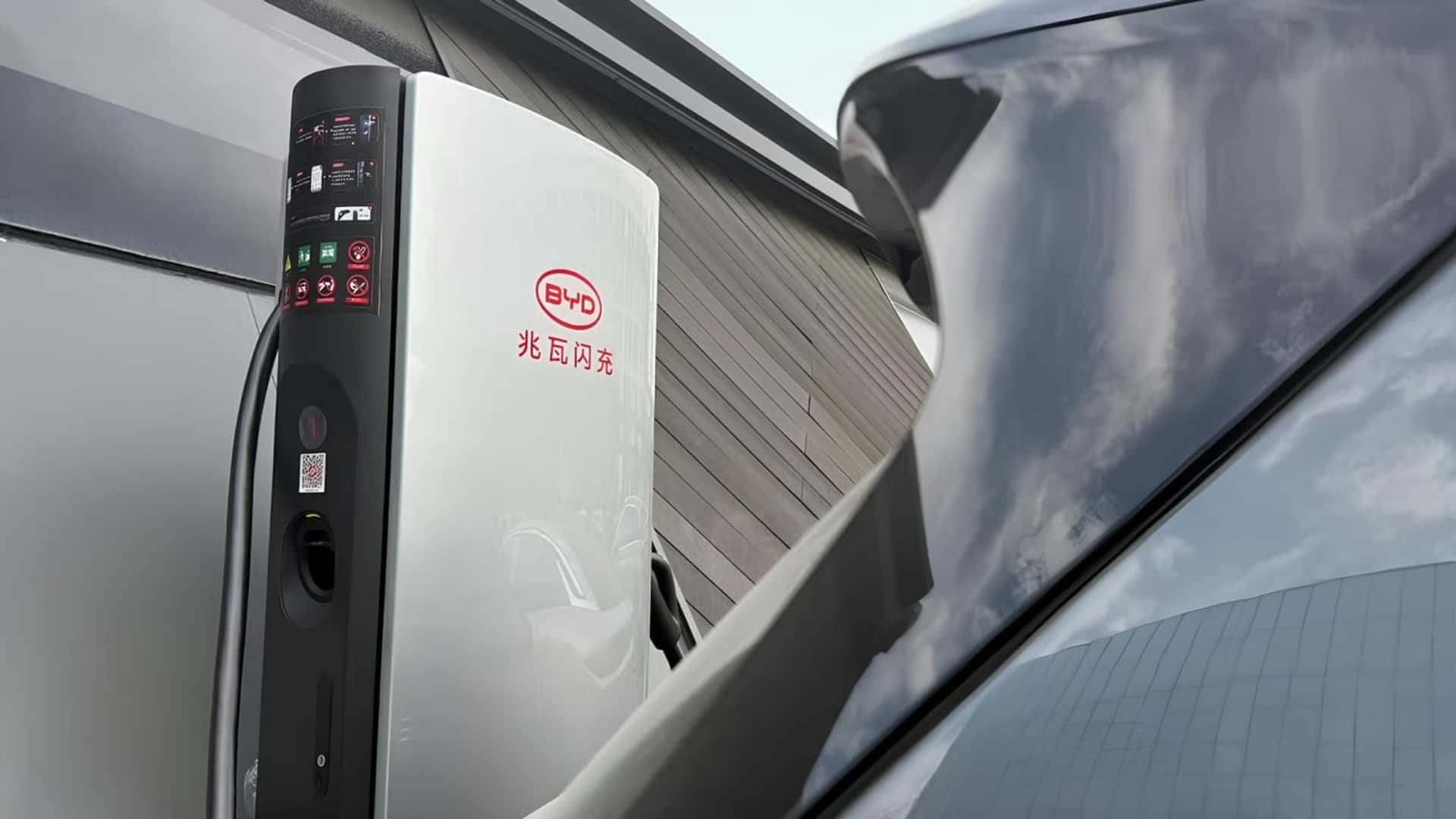
The race for ultra-fast electric vehicle (EV) charging is intensifying, with Chinese automotive giant BYD appearing to roll out a new generation of significantly more powerful megawatt chargers. These distinctive T-shaped DC fast chargers, spotted in China, represent a notable departure from the company’s previously unveiled Flash charging stations and suggest a leap forward in charging capabilities.
A New Generation of Megawatt Charging
These newly observed charging units stand out with their T-shaped design and prominent dual charging cables. This aesthetic and functional difference distinguishes them from the more traditional-looking Flash chargers BYD introduced last year, which also boasted megawatt charging capabilities. The visual divergence has sparked significant interest and discussion within the EV community and among automotive blogs in China.

Initial indications from photos of the charger’s information plates, captured by Chinese bloggers, suggest that some of these new units may be capable of delivering up to 1,500 kilowatts (kW), or 1.5 megawatts (MW). This potential increase in power output surpasses the 1,360 kW capacity BYD stated for its Flash chargers last year. While BYD has not yet made an official announcement regarding this new generation of charging hardware, and a company representative did not respond to inquiries about the new stations, the visible evidence points towards an advancement in their charging technology.
Addressing EV Adoption Barriers
Charging infrastructure and the time it takes to recharge EVs have long been cited as significant hurdles to widespread electric vehicle adoption. For many potential buyers, the prospect of lengthy charging stops, often ranging from 25 minutes to an hour, remains a deterrent compared to the rapid refueling experience of gasoline-powered vehicles.
BYD has been actively working to counter these concerns. Last year, the company showcased EVs capable of accepting a full megawatt of charging power, more than double the highest power rating available in the U.S. at the time. Demonstrations indicated that just five minutes of charging could add approximately 250 miles of range, based on China’s CLTC test cycle, which prioritizes city driving conditions. These advancements have been personally verified in China, underscoring the tangible progress being made.

BYD’s Expanding Charging Network Ambitions
In the competitive landscape of EV charging, brands like Tesla have leveraged their Supercharging networks as a major draw. In China, other automakers such as Xpeng, Nio, and Zeekr have also established significant DC fast-charging networks. Historically, BYD, despite its considerable scale as a manufacturer, has not maintained a dominant charging network presence, opting instead for partnerships and incentives with third-party charging service providers for its EV owners in China.
However, BYD now appears to be making a strong push into the charging infrastructure race. The company previously announced plans to establish 4,000 charging stations independently. This figure is set to expand significantly with an additional 15,000 stations projected through collaborations with third-party charging companies by mid-2025. Currently, China hosts at least 500 first-generation 1 MW stations from BYD, and the new T-shaped chargers could soon be deployed as part of this expansion.
Global Implications of Advanced Charging
While these cutting-edge charging solutions are currently exclusive to China, they serve as a powerful indicator of what is achievable in the EV charging space. The development demonstrates that the goal of achieving charging speeds comparable to refueling a gasoline car is indeed attainable.
BYD is not alone in its pursuit of faster charging solutions. Other major automotive players, including Mercedes-Benz and Zeekr, are also actively developing and implementing technologies aimed at significantly reducing EV charging times. This collective industry effort underscores a shared commitment to overcoming range anxiety and charging inconvenience, paving the way for broader EV adoption worldwide.
The emergence of these new, potentially more powerful megawatt chargers from BYD signifies a critical step forward in making electric vehicles a more practical and appealing option for a wider range of consumers. As the technology continues to evolve and deploy, the gap between EV charging times and traditional refueling will likely continue to shrink.