
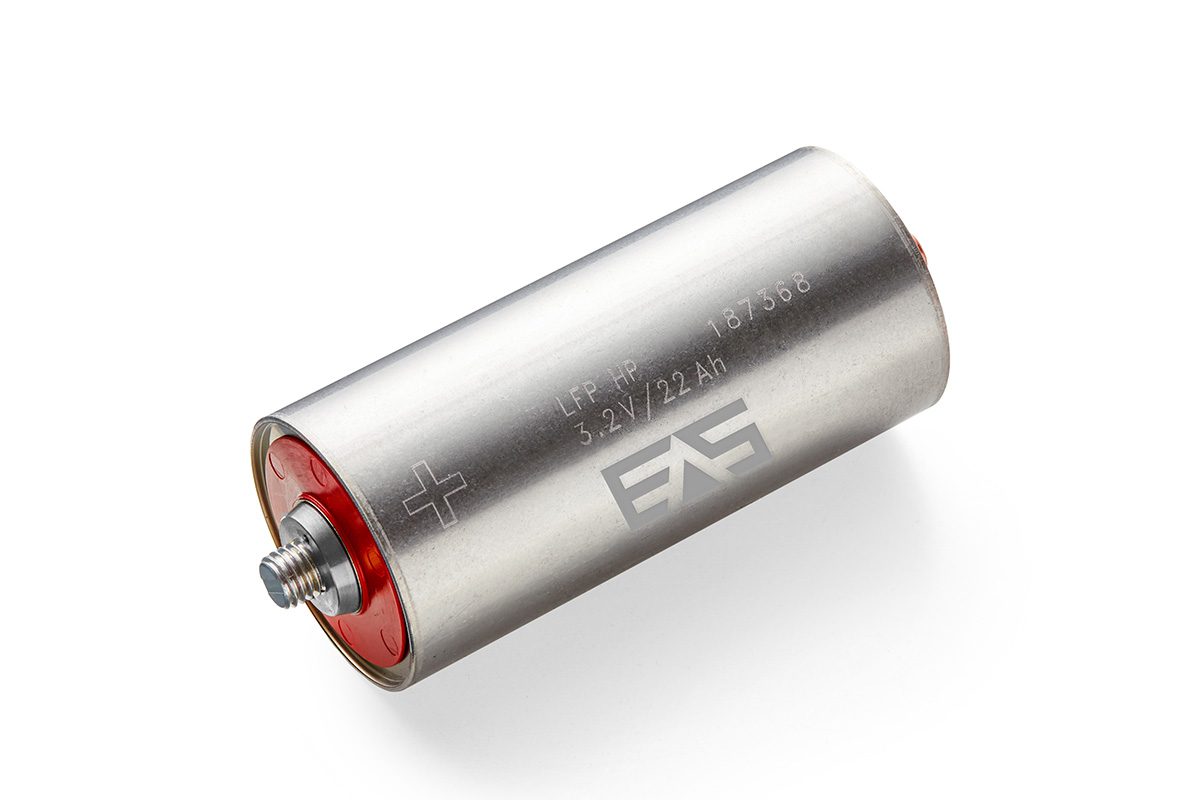
German battery innovator EAS Batteries has announced the commercial launch of its UHP601300 LFP 22, a large-format cylindrical lithium iron phosphate (LFP) cell that incorporates Asahi Kasei’s advanced Acetolyte, an acetonitrile-based electrolyte. This pioneering development is poised to significantly enhance EV battery performance and extend capabilities across various high-demand applications.
According to both companies, the integration of Acetolyte into LFP cells delivers remarkable improvements. This novel electrolyte boasts higher ionic conductivity, lower internal resistance, and superior rate capability across a significantly wider temperature spectrum compared to conventional carbonate-solvent-based electrolytes. These attributes are critical for next-generation energy storage solutions.

Key Takeaways
- EAS Batteries has launched the UHP601300 LFP 22 cell, featuring Asahi Kasei’s acetonitrile-based Acetolyte electrolyte.
- The new LFP cell offers a 60% improvement in continuous discharge power and enhanced pulse discharge capabilities.
- Acetolyte addresses critical challenges of conventional lithium-ion batteries, including improved low-temperature power output and high-temperature durability.
- The technology is currently undergoing customer evaluations for high-rate applications in motorsport, aerospace, and heavy industrial equipment.
- EAS Batteries and Asahi Kasei are also developing a 46xxx cylindrical format and plan to sub-license the combined technology to global OEMs.
Revolutionising LFP Cell Performance with Acetolyte
The UHP601300 LFP 22 cell sets a new benchmark for lithium iron phosphate technology. The core innovation lies in the Acetolyte electrolyte, which leverages acetonitrile to overcome inherent limitations often associated with traditional LFP formulations. This chemical breakthrough translates directly into tangible operational benefits for battery users.
Enhanced ionic conductivity allows for more efficient movement of lithium ions within the battery, facilitating faster charge and discharge rates. Simultaneously, a lower internal resistance minimises energy loss as heat, improving overall efficiency and thermal management. These factors collectively contribute to the cell’s dramatically improved rate capability.
Unprecedented Power Output and Durability
Compared to EAS cells utilising conventional electrolytes, the UHP601300 LFP 22 with Acetolyte demonstrates significant performance gains. The nominal capacity stands at 22 Ah, providing a robust foundation for diverse energy needs. The continuous discharge capability sees a substantial leap, achieving 2,550 W/kg, equating to 880 A at 40C.

This represents a remarkable 60% improvement in continuous power when contrasted with conventional electrolyte cells, which offer 1,550 W/kg or 550 A at 25C. This drastic increase in sustained power delivery is particularly pertinent for applications demanding consistent, high-energy output over extended periods.
The pulse discharge performance, measured over a two-second interval, also shows an impressive gain. The Acetolyte-powered cell delivers 3,760 W/kg, reaching 1,320 A at 60C. While the pulse discharge gain of approximately 10% is more modest than the continuous power improvement, it still signifies enhanced peak performance for short, intense power bursts.
For applications such as motorsport, aerospace, or heavy industrial equipment, where sustained current delivery is paramount, the continuous discharge improvement offers significant real-world utility. These sectors often require batteries that can consistently provide high power without degradation, a requirement now met with greater efficacy by the new EAS cells.
Extended Cycle Life and Temperature Resilience
Beyond raw power metrics, the UHP601300 LFP 22 also exhibits superior longevity. It achieves 2,400 cycles at a 5C/5C rate with 100% Depth of Discharge (DoD) while retaining 80% of its initial capacity. This extended cycle life translates to greater operational durability and a longer service life for battery systems, reducing replacement costs and downtime.
A critical advantage highlighted by Asahi Kasei is Acetolyte’s ability to enable better power output at low temperatures and improved durability at high temperatures. These are two persistent problem areas for conventional carbonate-electrolyte lithium-ion cells. The capacity fade and performance drop in extreme weather conditions have long been challenges for electric vehicles and other battery-dependent systems. The new electrolyte promises to mitigate these issues, expanding the operational envelopes for LFP batteries.
Strategic Partnership and Future Formats
The successful development and commercialisation of the UHP601300 LFP 22 are the direct result of a focused collaboration between EAS Batteries and Asahi Kasei. This partnership underscores a shared commitment to advancing battery technology through innovative material science.
The companies are not resting on their laurels; they are actively exploring the integration of this advanced electrolyte into the increasingly popular 46xxx cylindrical format. Prototypes of this format are already available, with a targeted product launch later this year. The 46xxx format, known for its favourable energy density and manufacturing efficiency, is primarily designed for low-voltage EV batteries, aligning with broader automotive industry trends.
Expanding Global Reach Through Sublicensing
A key aspect of their long-term strategy involves sublicensing the combined Acetolyte-LFP cell technology to global original equipment manufacturers (OEMs) and battery manufacturers. This approach aims to accelerate the adoption of this high-performance solution across the electric vehicle ecosystem and other industrial sectors worldwide. By making the technology accessible, EAS Batteries and Asahi Kasei seek to establish it as a new standard for high-performance LFP cells.
Osamu Matsuzaki, Senior Executive Officer and Head of Corporate R&D and IP at Asahi Kasei, commended the speed and efficacy of their joint efforts. “The short time from signing our license agreement in November 2025 to the start of serial production in March 2026 reflects the focused and highly collaborative efforts between EAS Batteries and Asahi Kasei,” Matsuzaki stated, highlighting the rapid progress made possible by their partnership.
Implications for Various Industries
The enhanced EV battery performance offered by the Acetolyte-powered LFP cells has far-reaching implications. For the electric vehicle sector, it promises more robust performance in diverse climates, faster charging capabilities, and potentially longer vehicle ranges, thereby addressing key consumer concerns.
Beyond EVs, industries such as aerospace, defence, and heavy machinery, which rely on batteries for mission-critical functions, stand to benefit immensely from the improved power output, durability, and temperature resilience. These advancements could unlock new design possibilities and operational efficiencies across a spectrum of high-demand applications.
The introduction of the UHP601300 LFP 22 cell marks a significant step forward in battery technology, offering a potent combination of high power, extended cycle life, and broad temperature tolerance, driven by the innovative acetonitrile-based electrolyte.
Frequently Asked Questions (FAQ)
What is the key innovation in EAS Batteries’ new LFP cell?
The core innovation is the integration of Asahi Kasei’s Acetolyte, an acetonitrile-based electrolyte, into EAS Batteries’ UHP601300 LFP 22 cell. This electrolyte dramatically improves ionic conductivity, lowers internal resistance, and enhances rate capability across varied temperatures, leading to superior overall battery performance.
How does Acetolyte improve EV battery performance?
Acetolyte boosts EV battery performance by providing a 60% increase in continuous discharge power and better pulse discharge. It also enables superior power output at low temperatures and improved durability at high temperatures, addressing common challenges for electric vehicles in diverse climatic conditions.
What specific performance gains does the UHP601300 LFP 22 offer?
The cell boasts a nominal capacity of 22 Ah. It delivers 2,550 W/kg (880 A at 40C) for continuous discharge and 3,760 W/kg (1,320 A at 60C) for pulse discharge. Its cycle life is also impressive, retaining 80% capacity after 2,400 cycles at 5C/5C and 100% Depth of Discharge.
Which industries are expected to benefit most from this new battery technology?
High-rate applications in sectors such as motorsport, aerospace, and heavy industrial equipment are prime beneficiaries. The battery’s ability to deliver sustained high current and operate reliably across a wide temperature range makes it ideal for demanding environments where consistent power delivery is crucial.
What are the future plans for this acetonitrile-based electrolyte technology?
EAS Batteries and Asahi Kasei are developing prototypes for the 46xxx cylindrical format, targeting a launch this year for low-voltage EV batteries. They also plan to sub-license the combined technology to global OEMs and battery manufacturers to accelerate its widespread adoption across the electric vehicle and energy storage markets.