
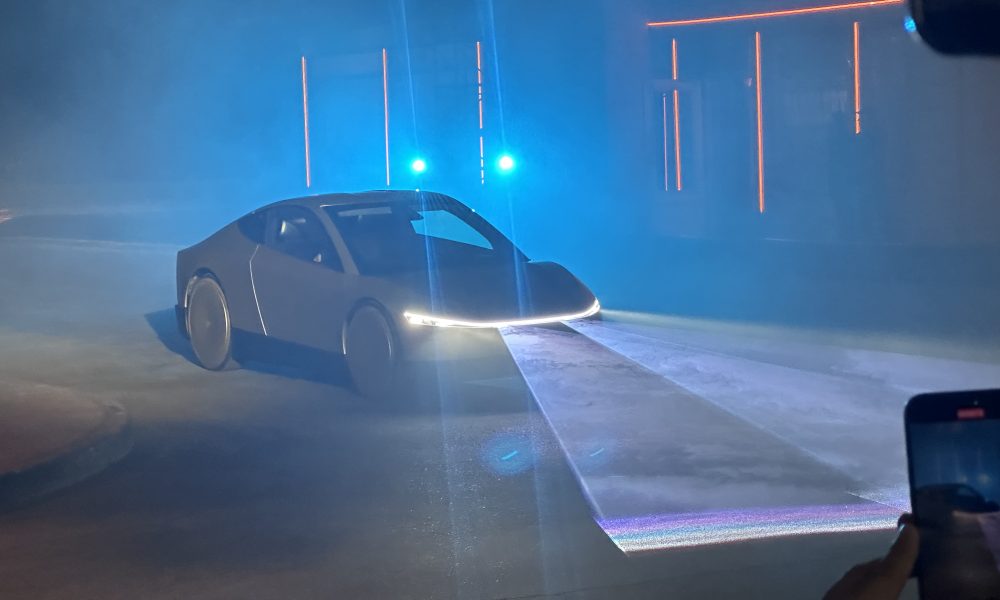
A significant shift in federal regulations is poised to accelerate the development and deployment of autonomous vehicles, particularly benefiting Tesla’s manual-free Cybercab. The Trump Administration, through the U.S. Department of Transportation and the National Highway Traffic Safety Administration (NHTSA), initiated new rulemaking on June 25, 2026, aimed at modernizing Federal Motor Vehicle Safety Standards (FMVSS) for automated driving systems.
This regulatory overhaul seeks to remove the requirement for traditional manual brake pedals in vehicles designed exclusively for automated operation. Such changes directly align with Tesla’s vision for the Cybercab, which the company has confirmed will operate without a steering wheel or conventional pedals, signifying a pivotal moment for the future of autonomous mobility.

Key Takeaways
- The Trump Administration’s NHTSA has commenced rulemaking to eliminate the manual brake pedal mandate for vehicles exclusively driven by automated systems.
- This regulatory change directly benefits the Tesla Cybercab, designed to operate without a steering wheel or pedals.
- Revisions to FMVSS No. 135 will allow autonomous vehicles (AVs) without manual controls to meet stopping distance criteria via alternative testing.
- Tesla’s official documentation for First Responders confirms that production Cybercab units will not feature manual controls, reserving them for engineering or test vehicles.
- Tesla has also released its Full Self-Driving (FSD) v14 ‘Lite’ suite for older Hardware 3 (AI3) vehicles, bringing advanced capabilities, Reinforcement Learning, and offline models previously exclusive to HW4.
- These combined developments underscore a progressive trajectory for both regulatory frameworks and autonomous driving technology, facilitating wider adoption and enhanced safety features.
NHTSA Initiates Regulatory Overhaul for Autonomous Vehicles
The National Highway Traffic Safety Administration (NHTSA), under the U.S. Department of Transportation, announced on Thursday, June 25, 2026, the commencement of a rulemaking process concerning the Federal Motor Vehicle Safety Standards (FMVSS). This initiative marks a crucial step toward updating federal guidelines to accommodate advanced autonomous vehicle technologies.
Specifically, the proposed changes aim to eliminate the mandate for manual brake pedals in vehicles engineered to be driven solely by automated driving systems. This regulatory adjustment is a direct response to the evolving landscape of self-driving technology, where vehicles like the Tesla Cybercab are envisioned to operate without human intervention or traditional driver controls.
Impact on Tesla Cybercab: A Strategic Advantage
Tesla has long asserted that its Cybercab, intended for a future robotaxi fleet, would function entirely without a steering wheel or conventional pedals. The proposed revisions to FMVSS No. 135, which currently mandates standard braking systems for light-duty vehicles, directly address this innovative design.

Currently, FMVSS No. 135 requires light-duty cars to incorporate traditional manual braking systems that allow an operator to slow the vehicle. With the advancement of self-driving capabilities across the United States, these regulations have been deemed in need of modernization to facilitate the safe deployment of fully autonomous vehicles.
Proposed Revisions to FMVSS No. 135
The Trump Administration’s proposed changes to FMVSS No. 135 include several key provisions designed to enable the operation of advanced autonomous vehicles:
- The new rules would remove the requirements for hand- or foot-operated brake controls for vehicles specifically designed never to be operated by a human. Existing regulations would still apply to autonomous vehicles that retain manual controls, catering to different levels of automation.
- All subject vehicles, regardless of their control mechanisms, must continue to meet the same stringent stopping distance performance criteria. This will be achieved through alternative testing procedures tailored for automated systems, ensuring no compromise on fundamental safety.
- While these updates ensure that automated vehicles can physically stop as commanded, NHTSA is also actively developing separate safety performance requirements. These will specifically address the complex behaviors and operational parameters of autonomous vehicles in diverse real-world driving scenarios.
- NHTSA affirms its commitment to safety oversight, stating that it will continue to utilize its broad defect enforcement authority. This includes investigating unsafe automated driving system behavior and overseeing necessary recalls, thereby holding developers accountable for safe performance.
Accelerating Autonomous Vehicle Deployment
Industry administrators express considerable enthusiasm for these regulatory advancements, recognizing their potential to streamline the deployment of self-driving vehicles. Such rule adjustments are deemed more than reasonable as autonomy becomes an increasingly integral part of passenger travel, providing manufacturers with crucial flexibility.
These changes are expected to empower manufacturers with the ability to self-certify their autonomous vehicles, circumventing bureaucratic hurdles that could otherwise delay the introduction of these transformative technologies. This proactive approach aims to foster innovation while upholding robust safety standards.
NHTSA Administrator Jonathan Morrison underscored the significance of this moment, stating, “We are at the cusp of the greatest technological revolution in vehicle technology since the innovation of the Model T.” He further elaborated on the necessity of adapting regulatory frameworks: “If we want America to lead the way, we have to reimagine our regulatory framework. That’s why under Secretary Sean Duffy’s AV Framework, NHTSA is tearing down pointless barriers to innovative designs while strengthening the fundamental safety requirements that matter and holding AV developers accountable for safe performance.”
Tesla Cybercab’s Manual-Free Design Confirmed
The Tesla Cybercab entered mass production at Gigafactory Texas in April 2026, marking a pivotal step toward its integration into the planned Robotaxi fleet. Further clarification regarding the Cybercab’s design came to light through a First Responders Guide released by Tesla on June 29, 2026.
This essential document, designed to equip emergency personnel with proper guidance for various situations, revealed a critical detail about the Cybercab’s production models. On one of its pages, Tesla explicitly stated its intention for the ride-hailing vehicle:
“A Cybercab equipped with steering wheel, brake pedal, and an acceleration pedal is typically an engineering or test vehicle, and operates at SAE Level 2 autonomy. Cybercab is not typically equipped with a steering wheel or acceleration and brake pedals.”
This statement unequivocally confirms that the production versions of the Cybercab destined for public ride-hailing services will indeed be devoid of manual controls. While engineering and test vehicles may retain a steering wheel and pedals for safety monitors, the core production fleet will be fully automated, reinforcing Tesla’s commitment to a truly autonomous driving experience.
Advancing Full Self-Driving: FSD v14 ‘Lite’ for Older Hardware
In a related development on June 29, 2026, Tesla released its Full Self-Driving (FSD) v14 ‘Lite’ suite to owners of vehicles equipped with Hardware 3 (HW3), also known as AI3 chips. This release is significant as it brings advanced capabilities previously thought to be exclusive to newer hardware configurations.
The FSD v14 ‘Lite’ suite distills the intelligence and driving behavior from HW4’s v14 series into the HW3 architecture. This innovative approach allows HW3 vehicles to directly learn how to handle complex scenarios by leveraging the advanced algorithms and data processing capabilities refined on HW4, effectively bridging a technological gap.
Key Features and Improvements in FSD v14 ‘Lite’
The release notes for the v14 ‘Lite’ suite highlight several crucial enhancements:
- **Intelligence Distillation:** It distills the intelligence from HW4 V14 into HW3, enabling HW3 to learn scenario handling using HW4 V14 as a guide. This process unlocks improvements like Reinforcement Learning (RL) and offline models for HW3.
- **Enhanced Responsiveness:** The system shows improved both proactive and reactive responsiveness across a wide variety of categories. This includes more refined navigation handling, smoother merges and forks, improved pedestrian interactions, better response to traffic lights, and enhanced management of vehicle cut-in scenarios.
- **Improved Comfort:** General driving comfort has been enhanced in nominal scenarios. Users can expect fewer false slowdowns, smoother steering inputs, and more consistent lane centering, contributing to a more natural driving experience.
- **Expanded Capabilities:** The update introduces comprehensive parking, unparking, and reversing capabilities, significantly broadening the system’s utility in diverse urban environments.
- **Arrival Options:** New ‘Arrival Options’ allow users to select their preferred parking location when reaching a destination, choosing between a Parking Lot, on the Street, in a Driveway, or at the Curbside.
- **Speed Profiles:** Speed Profiles, which customize driving style preferences, are now available at all times, offering greater personalization for the autonomous driving experience.
Ashok Elluswamy, Tesla’s Head of AI, commented on the release, stating, “It includes destination options and speed profiles on city roads, but more importantly significantly improved safety. We hope you’ll enjoy it, once the build ships wide.” This update represents a commitment to existing FSD subscribers, particularly given previous discussions about the limitations of HW3 for unsupervised self-driving.
While Tesla CEO Elon Musk had previously acknowledged that HW3 vehicles might not achieve unsupervised Full Self-Driving, the v14 ‘Lite’ release demonstrates Tesla’s ongoing efforts to maximize the capabilities of earlier hardware. The phased rollout, starting with Early Access Program customers, is expected to expand widely in the coming weeks, delivering on a promise made to owners during a prior earnings call.
The Road Ahead for Autonomous Mobility
The convergence of progressive regulatory adjustments and continuous technological innovation from companies like Tesla marks a transformative period for autonomous vehicles. The Trump Administration’s moves to adapt federal safety standards signify a proactive approach to nurturing this nascent industry, promising reduced red tape and accelerated deployment.
Concurrently, Tesla’s advancements with its Cybercab and Full Self-Driving software updates illustrate the rapid evolution of automated driving systems. As these legislative and engineering efforts mature, the vision of safer, more efficient, and fully autonomous transportation inches closer to widespread reality, reshaping urban landscapes and travel paradigms.
FAQ
What are the new Trump Administration rules for autonomous vehicles?
The Trump Administration, via NHTSA, commenced rulemaking to eliminate the federal mandate for manual brake pedals in vehicles designed exclusively for automated driving systems. This update aims to modernize FMVSS No. 135 to better suit the design and operation of advanced autonomous vehicles.
How do these rules impact the Tesla Cybercab?
These new regulations directly benefit the Tesla Cybercab, which is explicitly designed to operate without a steering wheel or pedals. By removing the manual brake pedal mandate, the rules create a more favorable regulatory environment for the deployment of Tesla’s fully autonomous robotaxi fleet.
What is FMVSS No. 135, and how is it changing?
FMVSS No. 135 is a Federal Motor Vehicle Safety Standard that currently requires standard braking systems on light-duty vehicles, including manual brake controls. The proposed changes will remove the requirement for manual controls in vehicles designed never to be operated by a human, while still mandating equivalent stopping performance through alternative testing.
Will all Tesla Cybercabs lack manual controls?
According to Tesla’s First Responders Guide, production Cybercab units intended for ride-hailing services will not be equipped with a steering wheel or pedals. Cybercabs featuring manual controls are typically designated as engineering or test vehicles and operate at SAE Level 2 autonomy.
What improvements does FSD v14 ‘Lite’ bring to older Tesla vehicles?
FSD v14 ‘Lite’ for Hardware 3 (AI3) vehicles distills intelligence from HW4, unlocking improvements like Reinforcement Learning and offline models. It enhances responsiveness, driving comfort, and introduces new capabilities such as parking, unparking, reversing, customizable Arrival Options, and always-available Speed Profiles for a more personalized driving experience.
What is SAE Level 2 autonomy?
SAE Level 2 autonomy, or partial driving automation, means the vehicle can control both steering and acceleration/braking simultaneously under specific conditions. However, the human driver must remain engaged, monitor the driving environment, and be ready to take over at any time, typically found in advanced driver-assistance systems (ADAS) that still include manual controls.
What is the significance of FSD v14 ‘Lite’ bringing HW4 capabilities to HW3?
This is significant because it allows older Hardware 3 vehicles to benefit from the advanced algorithms, Reinforcement Learning, and offline models developed for the newer Hardware 4. It enhances the safety and performance of FSD on a broader range of existing Tesla vehicles, fulfilling a prior commitment to early FSD adopters.