
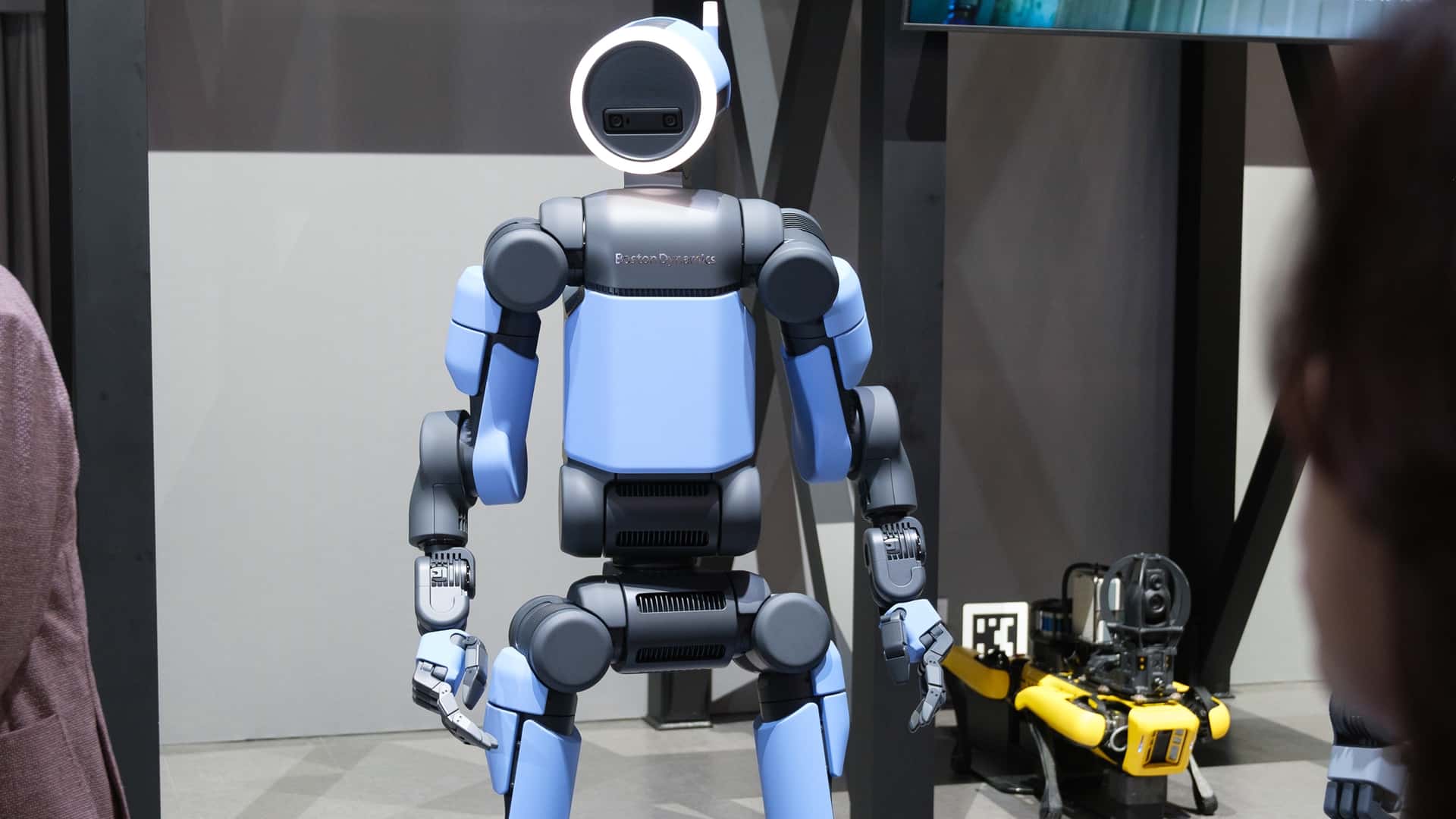
Hyundai is set to revolutionize its manufacturing process with the integration of approximately 30,000 robots, including advanced humanoid models from its subsidiary Boston Dynamics, by the year 2028. This strategic move, unveiled at CES, signals a significant push towards automation in the automotive industry.
Introducing the Atlas Robot
At the forefront of this initiative is the Atlas robot, a bipedal humanoid designed for tasks requiring human-like dexterity and precision. Standing 6.2 feet tall and weighing 198 pounds, Atlas is capable of lifting up to 110 pounds and reaching heights of 7.5 feet with extended arms. Its operational range spans extreme temperatures from -4 to 104°F (-20 to 40°C), though performance may be affected in such conditions.

Advanced Capabilities and Design
Unlike previous hydraulic models, the latest Atlas iteration utilizes electric actuators, enabling both powerful movements and delicate handling. “I believe actuators are the most critical hardware component that determines a lot of overall performance,” stated Jaehoon Chang, Vice Chairman of Hyundai Motor Group. These actuators, which represent about 60% of a robot’s material cost, will be manufactured at scale by Hyundai’s in-house supplier, Hyundai Mobis, leveraging the company’s extensive production capabilities.
The robot is equipped with three “human-scale” tactile fingers, allowing it to pick up and manipulate small objects, such as car visor components, without damage. Its applications are projected to include part sorting, machine operation, and general material handling.
Autonomous Operation and Efficiency
Demonstrations have showcased Atlas autonomously moving engine covers from containers to a mobile dolly, highlighting its real-time motion planning and on-the-fly adjustments using integrated cameras and sensors. The robot can also scan barcodes for inventory management. While teleoperation via virtual reality is possible, the primary design focus is autonomous operation.

Boston Dynamics claims the current Atlas model can be set up in just one day, learns new tasks rapidly, adapts to dynamic environments, and requires minimal human supervision. Furthermore, Atlas features swappable battery packs, allowing for autonomous battery changes that ensure continuous operation, with an estimated runtime of around four hours.
Safety and Deployment
Designed with safety in mind, Atlas features a 360-degree vision system for navigating around humans and incorporates padding and minimal pinch points. The robot is also highly rated for ingress protection, offering complete dust resistance and significant water protection.
The first application for Atlas in Hyundai’s production lines will be parts sequencing, ensuring components are delivered precisely when and where needed on the assembly line. Its task range is expected to expand over time.
Future of Manufacturing
Atlas robots are already in production and are slated for deployment at the Hyundai Motor Group Metaplant America near Savannah, Georgia, by 2028. Training will occur at the Robot Metaplant Application Center (RMAC). While the economic return on investment is still to be fully assessed, Atlas is considered a commercially viable humanoid robot, representing a significant industry milestone.
Hyundai acknowledges the potential for job displacement but emphasizes the creation of new roles in servicing, training, and supervising these robots. The company is also exploring other robotic integrations, including a robotic arm for charging autonomous vehicles and automated parking systems, underscoring its commitment to a highly automated future.