
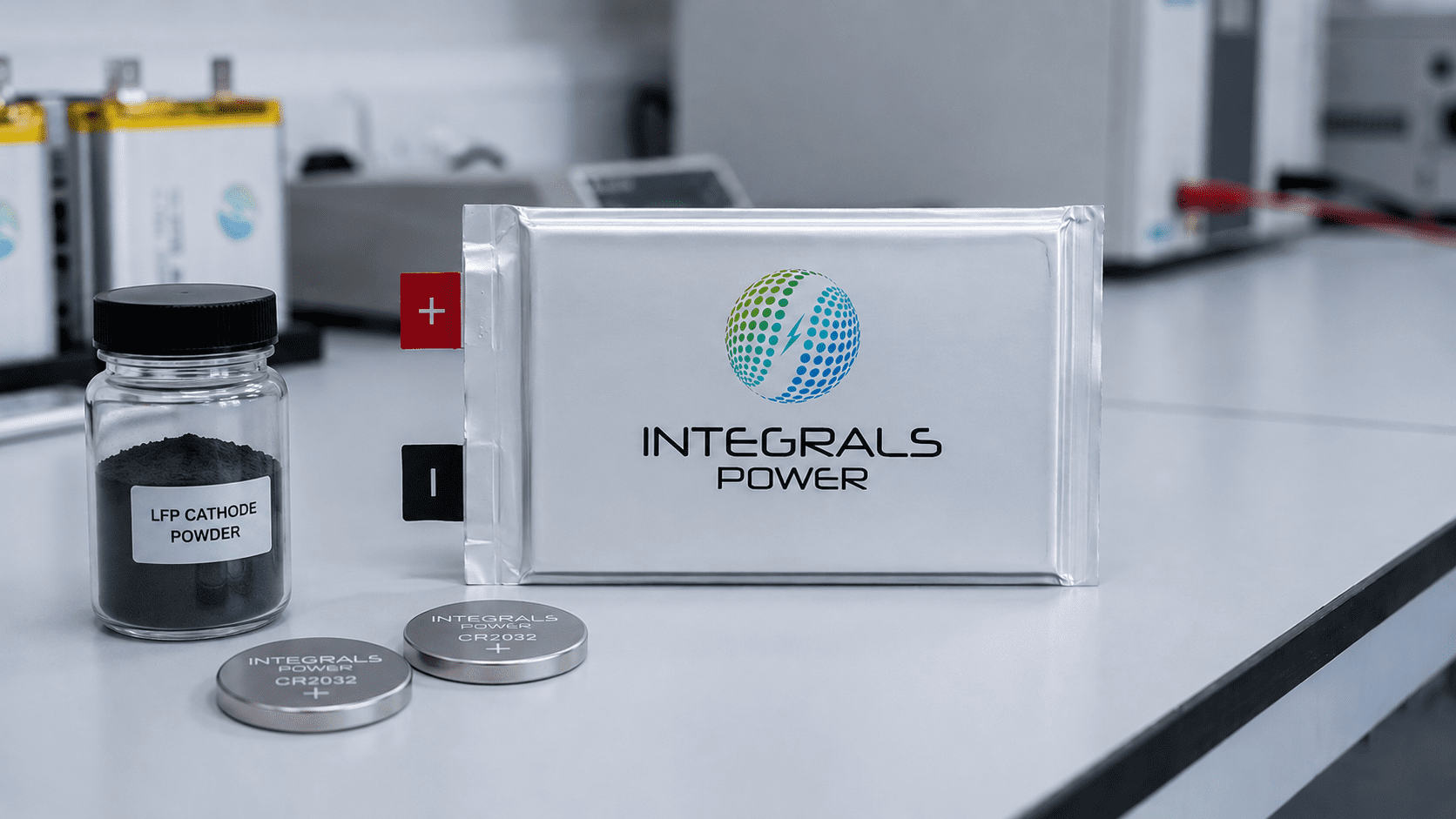
Milton Keynes, UK – Integrals Power, a prominent UK-based battery technology firm, has announced a significant breakthrough in the development of its lithium iron phosphate (LFP) cathode active material. Recent external cell testing conducted at the esteemed University of St Andrews has validated the company’s UK-made LFP cathode, demonstrating a specific capacity exceeding 153 mAh/g.
This crucial benchmark positions Integrals Power’s domestically manufactured LFP cathode on par with the high-performance Chinese LFP materials that currently dominate the global market. The validation marks a pivotal step towards establishing a robust, independent Western supply chain for advanced battery components, a key strategic objective for governments and automakers worldwide.

Key Takeaways:
- Integrals Power’s UK-made LFP cathode achieved over 153 mAh/g specific capacity in independent cell tests, matching leading Chinese materials.
- The validation, conducted at the University of St Andrews, provides crucial impartial evidence of performance.
- This development addresses the critical need for diversified, non-Chinese LFP battery supply chains for electric vehicles and energy storage.
- The company asserts its UK-made LFP cathode can compete on cost without a premium, sourcing raw materials exclusively from Europe and North America.
- The successful testing is foundational for scaling up production and fostering commercial confidence in Western LFP technology.
Pioneering Performance in Lithium Iron Phosphate Battery Technology
The achievement by Integrals Power comes amid a global push for greater supply chain resilience and reduced reliance on singular geographical sources for critical battery materials. Lithium iron phosphate (LFP) batteries are increasingly favoured for electric vehicles (EVs) and stationary energy storage solutions due to their inherent safety, longer cycle life, and cost-effectiveness compared to nickel-cobalt-manganese (NCM) chemistries.
LFP’s theoretical specific capacity hovers around 170 mAh/g, with commercial-grade materials typically operating close to this maximum. Integrals Power’s verified performance of over 153 mAh/g places its UK-made LFP cathode firmly within the competitive band, signaling a significant advance for European battery manufacturing capabilities.
Rigorous Independent Cell Testing Protocol
The validation program undertaken at the University of St Andrews is comprehensive, moving beyond mere material-level analysis to evaluate Integrals Power’s iron phosphate precursor—the foundational feedstock for its LFP cathode—within fully functional battery cells. This approach ensures that the material’s real-world performance characteristics are accurately assessed.
During these early-stage cell prototype assemblies, the UK-made LFP cathode from Integrals Power is paired with standard commercial anodes and a conventional liquid electrolyte. The constructed cells then undergo extensive testing, enduring hundreds of charge-discharge cycles. Key performance indicators meticulously monitored include capacity retention over time, rate capability (how quickly the battery can be charged and discharged), and long-term cycling stability (how well the battery maintains its performance over its operational lifespan).
This independent academic validation is paramount for establishing credibility in a highly competitive and technically demanding industry. It provides the impartial, data-driven evidence that potential customers, partners, and investors require for informed procurement and qualification decisions. Furthermore, the robust dataset generated from these tests serves as a critical foundation for future scale-up to larger multi-layer pouch or prismatic cells, which are commonly used in commercial EV applications.
Addressing Global Supply Chain Dependencies
The global battery market, particularly for LFP chemistries, has seen an overwhelming dominance by Chinese manufacturers, who, by Integrals Power’s estimates, account for approximately 90% of worldwide LFP production. This concentration creates significant geopolitical and economic vulnerabilities for countries heavily investing in electric mobility and renewable energy storage.
Western governments and major automakers are increasingly prioritising the diversification and localisation of their battery supply chains. This strategic imperative aims to enhance energy security, mitigate geopolitical risks, and foster domestic industrial growth. In this context, the independent validation of domestically produced materials, such as the UK-made LFP cathode by Integrals Power, becomes an indispensable prerequisite for broader commercial adoption.
The ability of Integrals Power to produce a competitive LFP cathode at its pilot plant in Milton Keynes, coupled with its commitment to sourcing raw materials exclusively from European and North American suppliers, directly addresses these strategic concerns. It offers a tangible pathway towards building a more resilient and geographically diversified battery ecosystem.
CEO’s Vision: From Ambition to Verified Evidence
Behnam Hormozi, founder and CEO of Integrals Power, articulated the significance of this milestone. He stated, “The battery industry has long been told that matching Chinese LFP performance from a Western supply chain is an ambition rather than a reality. This collaboration with the University of St Andrews is about converting that ambition into independently verified evidence. Cell testing is the foundation on which commercial confidence is built.”
Hormozi’s remarks underscore the industry’s long-standing challenge and the strategic importance of this validation. It moves the conversation from theoretical possibility to demonstrated capability, providing concrete data that can drive commercial partnerships and widespread adoption of the UK-made LFP cathode.
Economic and Strategic Implications for the UK and Beyond
The successful validation of Integrals Power’s UK-made LFP cathode has far-reaching implications. For the United Kingdom, it bolsters its position in the rapidly expanding global EV and energy storage sectors, potentially attracting further investment and creating high-skilled jobs in advanced manufacturing and battery research.
Beyond national borders, this development signals to the broader European and North American markets that viable, high-performance alternatives to existing LFP supply chains are emerging. Automakers and energy companies seeking to localise their production and secure their material sources will find Integrals Power’s offering particularly compelling, especially given the claim of no cost premium over Chinese material.
This achievement is not merely a technical triumph; it represents a strategic advancement in fostering regional self-sufficiency in critical battery components. As the transition to electric vehicles accelerates, securing a diverse and robust supply of advanced battery materials, including this promising UK-made LFP cathode, will be crucial for sustainable growth and innovation.
FAQ Section
What is LFP cathode active material?
LFP (Lithium Iron Phosphate) cathode active material is a key component in a type of rechargeable battery known for its safety, long lifespan, and cost-effectiveness. It is widely used in electric vehicles (EVs) and grid-scale energy storage systems due to its robust performance and thermal stability.
What is ‘specific capacity’ in battery testing?
Specific capacity measures the amount of charge a battery material can store per unit of mass, typically expressed in milliampere-hours per gram (mAh/g). A higher specific capacity indicates that the material can store more energy for a given weight, making it more efficient for battery applications.
Why is independent validation important for new battery materials?
Independent validation, especially from academic institutions like the University of St Andrews, ensures that performance claims are verified impartially. This builds trust and credibility with potential commercial partners and customers, providing objective data essential for procurement, qualification, and investment decisions in the battery industry.
Why is reducing dependence on Chinese LFP material a priority?
Chinese manufacturers dominate global LFP production, leading to concerns about supply chain vulnerability, geopolitical risks, and economic dependence. Western governments and automakers seek to diversify sources to enhance energy security, foster domestic industries, and ensure a stable supply for their growing electric vehicle and energy storage sectors.
How does Integrals Power’s UK-made LFP cathode compare to market leaders?
Integrals Power’s UK-made LFP cathode achieved a specific capacity of over 153 mAh/g in cell tests, which is comparable to the performance of leading commercial LFP materials currently on the market, primarily from China. The company also claims it achieves this without a cost premium and uses European/North American raw materials.
What does ‘rate capability’ and ‘cycling stability’ mean in battery tests?
Rate capability refers to a battery’s ability to deliver current efficiently at different discharge rates—how quickly it can be charged and discharged without significant performance loss. Cycling stability indicates how well a battery maintains its capacity and performance over many charge-discharge cycles, crucial for long battery life.