
Key Takeaways
- Range Rover has introduced the world’s first production vehicle equipped with electrostatic speakers, developed in partnership with UK-based Warwick Acoustics.
- This innovative audio system in the Range Rover SV Ultra offers a radically simplified design, replacing traditional cones, voice coils, and magnets with a 1-millimeter membrane suspended between charged metal plates.
- The electrostatic speakers deliver unparalleled clarity, precision, and a unique sense of spatial audio, reproducing sound with virtually no distortion.
- Beyond superior sound quality, the technology boasts significant efficiency gains, consuming 90% less energy and possessing 90% less mass than conventional units, potentially extending an EV’s range by up to 20 miles (WLTP).
- Currently standard on the SV Ultra trim and an option for other SV trims at $12,570, this advancement marks a potential paradigm shift for high-end automotive audio.
A new benchmark for automotive sound has been set with the introduction of Range Rover’s electrostatic speakers, a groundbreaking innovation poised to transform the in-car audio experience. Jaguar Land Rover (JLR) claims to be the first automaker globally to integrate this advanced technology into a production vehicle, promising an auditory journey akin to a concert hall.
Journalists who recently experienced this pioneering system in the Range Rover SV Ultra reported an immediate and profound impact. The clarity and depth of sound, particularly during a demonstration of specific tracks, evoked a level of sensory engagement typically reserved for live performances or high-fidelity home cinema systems like Dolby Atmos. This advancement highlights a significant leap in audio engineering for the luxury automotive segment.

A Paradigm Shift in Automotive Audio Technology
For over a century, the foundation of automotive audio systems has largely remained consistent, relying on dynamic drivers. These conventional speakers operate with three primary components: a voice coil, a magnet, and a diaphragm attached to a cone. An electrical signal energises the voice coil within a magnetic field, causing it to move rapidly. This movement, in turn, pushes the cone, displacing air to generate sound waves.
Despite continuous advancements in materials, tuning algorithms, amplifier power, and software sophistication, these systems adhere to the same fundamental principle. Even planar magnetic headphones, an evolution in personal audio, retain the use of magnets and coils, albeit without the traditional cone structure.
Beyond Conventional Sound Systems
Today’s premium automotive audio offerings are remarkably sophisticated in their own right. Systems such as the Bowers & Wilkins Diamond Surround Sound in Volvo and BMW models, the Burmester 3D spatial audio in Mercedes-Benz, or the AKG systems with Dolby Atmos in Cadillacs, have each elevated the in-car listening experience. These systems deliver impressive immersion and entertainment, pushing the boundaries of what was previously thought possible within a vehicle cabin.

However, Range Rover’s electrostatic speakers introduce a fundamentally different approach. This technology dramatically simplifies the hardware, eliminating the need for cones, voice coils, and magnets altogether. Instead, the core component is an ultra-thin, 1-millimeter membrane suspended between two electrically charged metal plates.
Engineering Innovation: The Warwick Acoustics Partnership
This revolutionary technology, developed in collaboration with UK-based Warwick Acoustics, forms the heart of Range Rover’s new audio system. A disassembled version of the electrostatic speaker reveals its elegant simplicity, being approximately the size of a human palm.
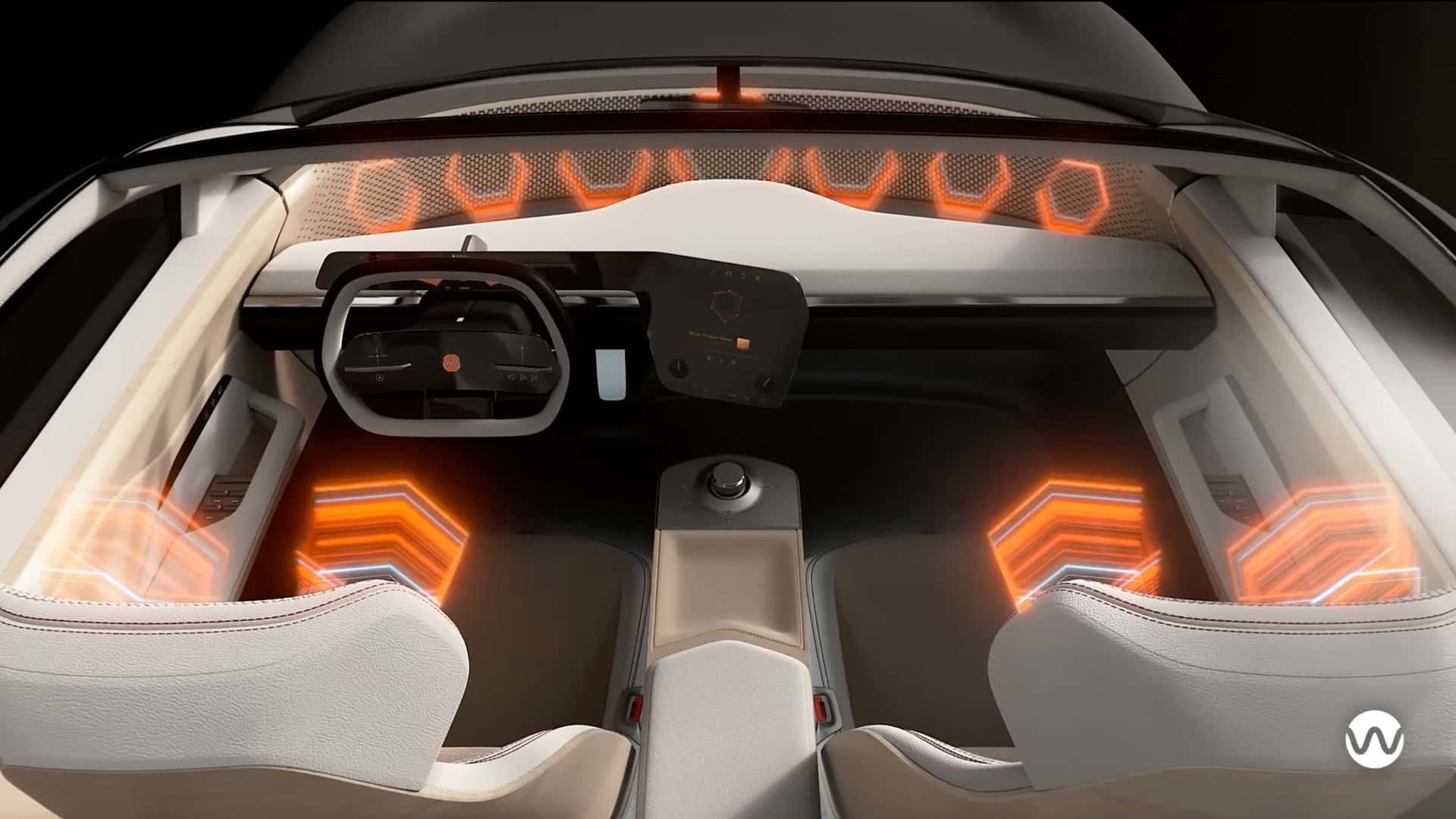
The Range Rover SV Ultra incorporates 21 of these compact membranes throughout its cabin. Unlike traditional speakers that move a separate cone, the membrane itself vibrates directly in response to an electrical signal to produce sound. This significantly reduced moving mass enables these speakers to reproduce audio with extraordinary precision and an almost imperceptible level of distortion, as explained by Tilesh Karania, Senior Electrical Innovation Engineer at Jaguar Land Rover, during the system’s demonstration.
Environmental and Efficiency Implications
The benefits of Range Rover’s electrostatic speakers extend beyond acoustic fidelity. Land Rover reports that these units respond an astonishing 1,000 times faster than conventional speakers. Critically, they consume 90% less energy and weigh 90% less. Furthermore, their design eliminates the use of magnets and rare-earth materials, addressing critical sustainability concerns in manufacturing.
Warwick Acoustics highlights the potential for these speakers to enhance electric vehicle efficiency. The company estimates that in an EV equipped with a 100-kilowatt-hour battery, its electrostatic system could contribute to a saving of up to 20 miles in WLTP range. This gain is attributed to the system’s lower power consumption, reduced mass, and overall lighter weight, although Land Rover has not specified the exact weight savings compared to a mainstream premium audio setup.
An Unparalleled Listening Experience
Experiencing Range Rover’s electrostatic speakers is often described as transformative. During demonstrations, specific audio nuances become strikingly apparent. For instance, in Susanne Vega and DNA’s “Tom’s Diner,” listeners can distinctly perceive the artist’s inhales before each sentence, a testament to the system’s jaw-dropping clarity.
Similarly, tracks like “Hotel California” reveal an exceptional separation and clarity across all instruments—acoustic guitar, electric guitars, bass, drums, and percussion. Each element is rendered with remarkable fidelity, ensuring nothing sounds muddled, compressed, or distorted. The listening environment transforms into what feels like a professional recording studio, where the clarity is so profound that the speakers themselves seem to disappear.
The Unique Sense of Space
Beyond the detailed note reproduction, a key differentiator of Range Rover’s electrostatic speakers is the unique sense of spatial audio they create. Unlike conventional 3D spatial audio systems that direct distinct sounds from various directions, this technology fosters an impression that the music exists beyond the physical confines of the vehicle cabin. The sound appears to originate from outside the car’s walls, evenly diffused and beautifully cohesive.
It becomes challenging to pinpoint the precise direction of the sound source, whether from front or rear speakers, as the audio naturally floats and envelopes the interior like a subtle scent. This immersive and cohesive soundstage contributes to a calming effect, making even high volumes feel remarkably comfortable and less fatiguing over extended listening periods. The impressive range of these speakers ensures that diverse genres, from rock anthems to pop ballads like Taylor Swift’s “Lavender Haze,” are reproduced with consistent, exceptional clarity.
The “Body and Soul” Feature: A Haptic Integration
To augment the immersive sound experience, the system incorporates five additional bass speakers, complemented by “Body and Soul” seats and a “Haptic Floor.” The floor vibrates with a bass-like effect, powered by transducers. Four similar transducers are integrated into each seat, designed to enhance the low-frequency impact. While this haptic feedback adds another dimension to the experience, some find the seat vibrations can be dialled down or deactivated if preferred, as the pure acoustic clarity of the electrostatic speakers themselves often proves sufficient and compelling.
Availability and Future Outlook
Currently, Range Rover’s electrostatic speakers are a standard feature on the SV Ultra trim of the gas-powered Range Rover. For non-ultra SV trims, this extraordinary audio system is available as an option at a price of $12,570. For buyers investing a quarter-million dollars into a Range Rover SV, this five-figure option represents a relatively modest addition for an unparalleled audio experience.
The introduction of Range Rover’s electrostatic speakers marks a significant advancement in automotive audio. While existing premium audio systems remain impressive, this new technology raises the industry bar considerably. It is anticipated that this innovation could spark a trend, with other luxury automakers potentially pursuing partnerships with Warwick Acoustics or similar advanced acoustic solutions for their flagship models. The broader hope is that this groundbreaking technology, currently exclusive to high-end luxury vehicles, will eventually become more accessible, trickling down to a wider range of vehicles and marking one of the most substantial leaps in automotive audio in decades.
FAQ Section
What makes Range Rover’s electrostatic speakers different from traditional car audio systems?
Unlike conventional systems that use cones, voice coils, and magnets, Range Rover’s electrostatic speakers feature a 1-millimeter membrane suspended between charged metal plates. This simplified design allows the membrane itself to vibrate, producing sound with exceptional precision and significantly reduced distortion.
What are the main benefits of electrostatic speakers in a vehicle?
The primary benefits include unparalleled sound clarity, incredibly fast response times (1,000 times faster than conventional units), and a unique, immersive sense of spatial audio. Additionally, they consume 90% less energy and have 90% less mass, while also being free of rare-earth magnets.
How do these speakers impact electric vehicle efficiency?
Due to their significantly lower power consumption and reduced weight, electrostatic speaker systems can contribute to increased electric vehicle efficiency. Warwick Acoustics estimates that on a 100-kilowatt-hour battery EV, this technology could add up to 20 miles of WLTP range.
Where are Range Rover’s electrostatic speakers available?
Range Rover’s electrostatic speakers are currently offered as standard equipment on the SV Ultra trim of the gas-powered Range Rover. For other SV trim levels, they are available as an optional upgrade, priced at $12,570.
Will this technology become more widely available in the future?
While presently exclusive to high-end luxury vehicles, the groundbreaking nature of Range Rover’s electrostatic speakers suggests a strong potential for wider adoption. Industry observers anticipate that this innovation could influence other automakers, potentially leading to its integration into more mainstream vehicles over time.
Who developed the electrostatic speaker technology for Range Rover?
The innovative electrostatic speaker technology integrated into the Range Rover was developed in partnership with Warwick Acoustics, a UK-based company specializing in advanced audio solutions. This collaboration brings cutting-edge acoustic engineering to the automotive sector.