
Key Takeaways:
- Red E Charge has introduced ‘Red E Go,’ enabling Plug & Charge functionality at many of its EV charging stations across the U.S.
- This new feature allows electric vehicle drivers to initiate charging and process payments automatically after a quick, one-time setup, eliminating the need for smartphone apps or credit cards at the station.
- The Detroit-based company was recognized as the fourth fastest-growing DC fast charging network in the United States during the second quarter of the year, adding 315 new ports.
- With over 1,000 locations and approximately 4,600 charging ports across 46 American states, Red E Charge continues to expand its comprehensive charging infrastructure.
- Red E Charge also ranked fifth in overall customer satisfaction in JD Power’s latest Electric Vehicle Experience (EVX) Public Charging Study, showcasing a strong commitment to user satisfaction.
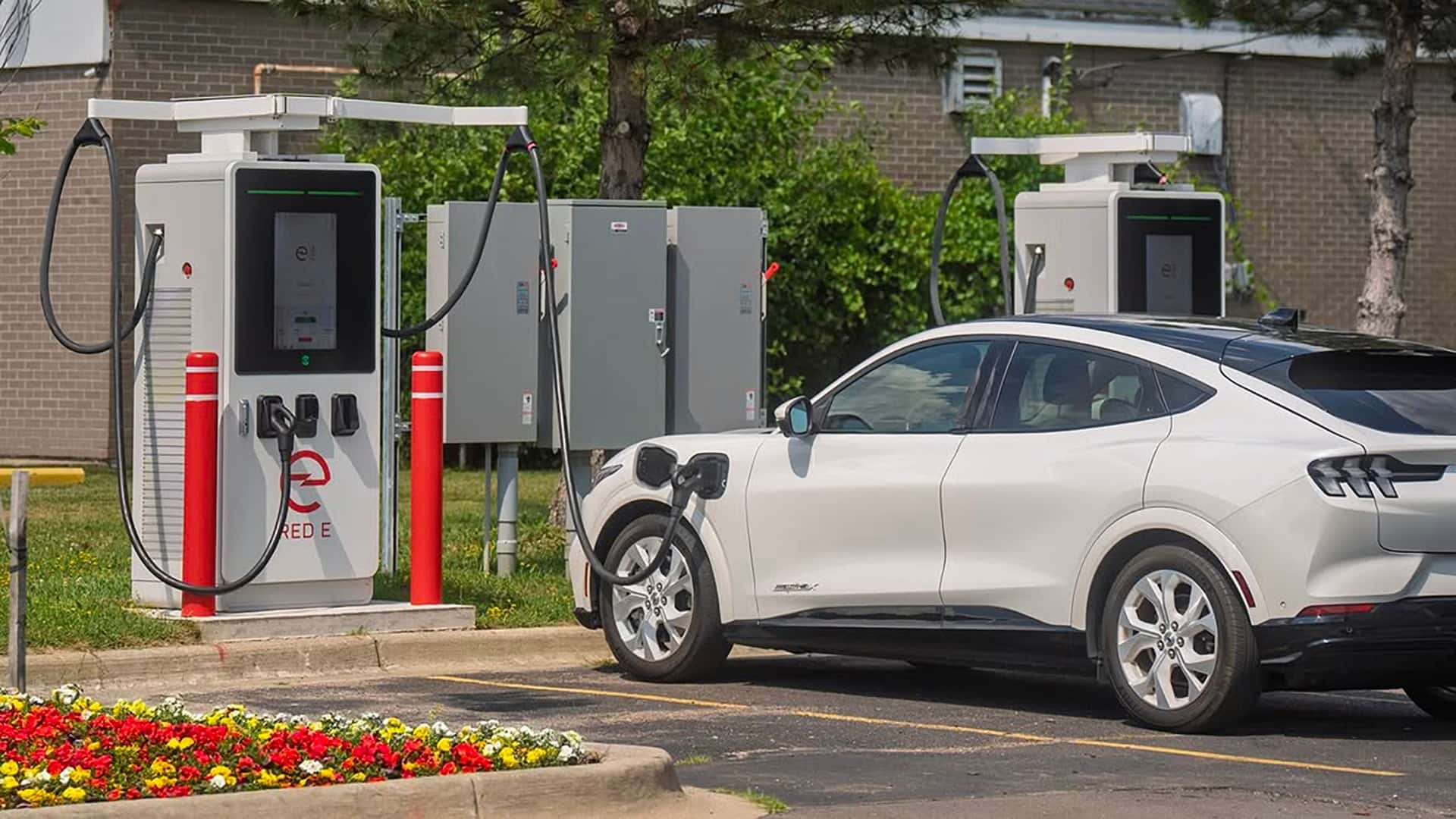
In a significant move poised to redefine the public EV charging experience, Red E Charge, one of the rapidly expanding electric vehicle charging networks in the United States, has activated its innovative Plug & Charge functionality. This enhancement promises a more streamlined and convenient charging process for EV drivers nationwide.
The Detroit-headquartered company’s latest offering, branded as ‘Red E Go,’ simplifies transactions by allowing automatic authentication and payment after an initial account setup. This development aims to alleviate common frustrations associated with public charging, bolstering the overall appeal of electric vehicle ownership.
Red E Charge Simplifies the EV Charging Experience with ‘Red E Go’
The introduction of Plug & Charge functionality marks a pivotal moment for Red E Charge customers. This advanced technology enables electric vehicle drivers to connect their vehicle to a compatible charging station and commence charging without further interaction.
Gone are the days of fumbling with smartphone applications, scanning QR codes, or swiping physical credit cards at the charging dispenser. The ‘Red E Go’ service streamlines the entire interaction, providing a hassle-free solution for topping up an EV’s battery.
For activation, EV drivers simply need to complete a straightforward, one-time setup process within the Red E Charge smartphone application. This involves registering their electric vehicle details and preferred payment method, ensuring that all subsequent compatible charging sessions are seamless and automated.
This commitment to simplifying the user journey is critical for broader EV adoption, addressing one of the key barriers often cited by prospective electric vehicle owners: the complexity and inconsistency of public charging. By making the EV charging experience more intuitive, Red E Charge contributes positively to the ongoing transition to electric mobility.
Rapid Expansion and Growing Infrastructure Across the U.S.
Red E Charge has not only focused on enhancing user convenience but also on robust network expansion. The company has rapidly scaled its presence across the United States, establishing itself as a significant player in the burgeoning EV charging sector.
According to data from the Department of Energy’s Alternative Fuels Data Center, Red E Charge currently operates more than 1,000 locations. These encompass a substantial network of approximately 4,600 charging ports, spanning across 46 American states.
Within this extensive infrastructure, a significant portion is dedicated to high-speed charging. There are 2,159 fast charging ports available across 579 dedicated stations. These DC fast charging options are crucial for long-distance travel and quick top-ups.
Furthermore, the network supports a broad range of charging needs by incorporating Level 2 charging. Around 600 of these locations also host nearly 2,500 Level 2 charging ports, offering more accessible and typically slower charging solutions for various scenarios, such as workplace or overnight charging.
A Force in Network Growth: Outpacing Major Competitors
Red E Charge’s strategic expansion efforts have not gone unnoticed within the industry. A recent report by Paren highlighted the company’s impressive growth trajectory in the second quarter of this year, positioning it prominently among leading EV charging networks.
The report revealed that Red E Charge emerged as the fourth fastest-growing DC fast charging network nationwide. During this period, the company added a substantial 315 new fast charging ports, demonstrating its commitment to expanding accessible electric vehicle charging options.
This growth rate placed Red E Charge behind industry giants such as Tesla, Walmart, and ChargePoint. However, it notably surpassed other major players in the competitive landscape, including Electrify America, EVgo, and the emerging Ionna network.
Such rapid expansion is indicative of Red E Charge’s aggressive strategy to capture market share and provide vital infrastructure for the increasing number of electric vehicles on American roads. The consistent addition of new ports directly contributes to alleviating range anxiety and improving the overall EV charging experience.
Enhancing User Satisfaction: Red E Charge’s Standing in the Market
Beyond geographical and port expansion, Red E Charge has also focused intently on the quality of its service, which is reflected in its customer satisfaction ratings. The network achieved a commendable position in JD Power’s latest Electric Vehicle Experience (EVX) Public Charging Study.
In the comprehensive study, Red E Charge secured the fifth position in terms of overall customer satisfaction, scoring 628 points on a 1,000-point scale. While this score was slightly below the segment average of 666 points, it demonstrated a strong performance in a highly competitive market.
The network’s satisfaction levels were noted to be higher than those of other prominent networks, including Electrify America, EVgo, and ChargePoint. This indicates that despite being a relatively newer entrant compared to some, Red E Charge is providing a reliable and positive EV charging experience for its users.
The study further highlighted that networks ranking higher than Red E Charge included Ionna, the Mercedes-Benz Charging Network, the Rivian Adventure Network, and Tesla’s Supercharger network. Red E Charge’s strong showing underscores the importance of operational reliability, consistent performance, and user-friendly features in cultivating a loyal customer base.
Diverse Charging Options and Pricing Structure
Red E Charge’s commitment to versatility is evident in the diverse range of charging specifications offered across its network. The power output available at Red E Charge stalls varies significantly, catering to different electric vehicle models and charging needs.
Drivers can find stations offering power outputs ranging from a modest 10 kilowatts to an exceptionally powerful 640 kilowatts. This wide spectrum ensures that both slower, more cost-effective charging and ultra-rapid charging for compatible vehicles are available.
In terms of compatibility, the network supports all major plug types used in the U.S. electric vehicle market. These include J1772 for Level 2 AC charging, CCS1 (Combined Charging System) for DC fast charging, NACS (North American Charging Standard), and CHAdeMO, ensuring broad accessibility for a variety of EV models.
Pricing for the EV charging experience on the Red E Charge network also reflects this diversity, varying based on location and plug type. According to data tracked by DCFC Tracker, prices range from $0.40 per kilowatt-hour (kWh) to $1.15/kWh.
This dynamic pricing structure allows Red E Charge to adjust to local energy costs, demand, and station-specific operational expenses, offering a flexible model for consumers. Drivers are encouraged to check the app for current pricing at their chosen station.
The Broader Impact on EV Adoption
The continuous innovation and expansion by networks like Red E Charge are vital for accelerating electric vehicle adoption across the nation. A seamless and reliable EV charging experience directly addresses the concerns of potential buyers regarding infrastructure accessibility and ease of use.
As the number of electric vehicles on the road grows, so does the demand for a robust and user-friendly charging ecosystem. Developments like ‘Red E Go’ reduce friction in the charging process, making EV ownership more appealing and practical for a wider demographic.
Improved charging infrastructure also plays a crucial role in enabling longer journeys and reducing reliance on home charging solutions. This is particularly important for residents in urban areas or those without dedicated home charging facilities.
The Future of EV Charging Convenience
The move by Red E Charge to integrate Plug & Charge technology signifies a broader trend within the electric vehicle industry towards greater convenience and interoperability. This technology, standardized under ISO 15118, is becoming a benchmark for advanced charging networks.
As more electric vehicles come equipped with the necessary communication protocols, and charging networks upgrade their hardware and software, the Plug & Charge functionality is expected to become a standard feature. This evolution promises to further simplify the public EV charging experience for all.
The continuous drive for innovation, coupled with significant investment in infrastructure, is paving the way for a future where charging an electric vehicle is as effortless as refueling a conventional car. Red E Charge’s latest initiative positions it at the forefront of this transformative journey, enhancing the daily lives of electric vehicle drivers.
Frequently Asked Questions (FAQ)
What is Plug & Charge technology?
Plug & Charge technology simplifies the EV charging process. After an initial setup where a driver’s vehicle and payment method are linked to their account, they can simply plug their electric vehicle into a compatible charger. The system automatically authenticates the vehicle and initiates the charging session and payment, eliminating the need for apps or credit cards at the station.
Which Red E Charge service offers Plug & Charge?
Red E Charge has branded its Plug & Charge service as ‘Red E Go.’ This feature is available at specific Red E Charge stations across its network. Drivers can typically find information on compatible stations within the Red E Charge smartphone application or by visiting the company’s website for the latest updates.
How many charging locations does Red E Charge operate?
As of recent data from the Department of Energy’s Alternative Fuels Data Center, Red E Charge operates over 1,000 charging locations. These locations collectively host approximately 4,600 charging ports, providing extensive coverage across 46 states in the United States, supporting both fast charging and Level 2 options.
How did Red E Charge rank in network growth?
In the second quarter of the current year, Red E Charge was identified as the fourth fastest-growing DC fast charging network in the U.S. This growth was highlighted in a Paren report, which indicated that the company added 315 new fast charging ports, outpacing several established competitors in the market.
What is Red E Charge’s customer satisfaction rating?
Red E Charge achieved a strong fifth place in overall customer satisfaction in JD Power’s latest Electric Vehicle Experience (EVX) Public Charging Study. The network scored 628 points on a 1,000-point scale, demonstrating higher satisfaction levels than major networks like Electrify America, EVgo, and ChargePoint.
What types of charging plugs does Red E Charge support?
Red E Charge stations are designed to be highly compatible with a wide array of electric vehicles. The network supports common charging standards including J1772 for Level 2 AC charging, CCS1, NACS (North American Charging Standard), and CHAdeMO for DC fast charging. This ensures broad accessibility for most EVs on the road.
What is the range of power output at Red E Charge stations?
The power output at Red E Charge stations is quite diverse, catering to various charging speeds and vehicle requirements. Power levels typically range from 10 kilowatts (kW) for slower charging needs up to an impressive 640 kW for ultra-fast charging. This variety allows drivers to choose the appropriate charging speed for their vehicle and schedule.