
Key Takeaways:
- The Rivian Assistant, an in-house developed AI voice assistant, is now rolling out to R1S and R1T vehicles through the latest over-the-air software update.
- This advanced system offers natural-language processing, allowing drivers to issue complex multi-step commands and engage in more intuitive interactions with their electric vehicles.
- Unlike basic voice controls, the Rivian Assistant is deeply integrated into the vehicle’s hardware and software, leveraging both proprietary and external AI models.
- Key functionalities include adjusting drive modes, viewing vehicle cameras, retrieving navigation information, answering general knowledge questions, and acting as a digital owner’s manual.
- A standout feature is its ‘agentic capability,’ exemplified by the seamless integration with Google Calendar for managing appointments and communications via voice.
- Availability requires an active connectivity subscription, and the assistant is slated for integration into the forthcoming Rivian R2 model.
Rivian, the burgeoning electric vehicle manufacturer, has officially commenced the rollout of its highly anticipated in-house artificial intelligence (AI) voice assistant, branded as the Rivian Assistant. Announced during the company’s Autonomy & AI Day last December with an initial timeline of early 2026, the feature is now reaching R1S and R1T owners much sooner than expected, delivered via the company’s latest over-the-air (OTA) software update.
This deployment marks a significant advancement in the in-vehicle user experience, moving beyond conventional voice command systems to offer a more natural and deeply integrated interaction paradigm. The Rivian Assistant is set to redefine how drivers engage with their vehicles, making complex tasks simpler and more accessible through conversational AI.
Beyond Basic Voice Control: The AI Advantage
The introduction of the Rivian Assistant places the EV startup firmly within a growing trend in the automotive industry: the integration of advanced AI chatbot technology into vehicle operating systems. This initiative aims to elevate the utility and sophistication of in-vehicle voice assistants, responding to consumer demand for more intuitive and capable digital interfaces.
While other prominent automakers, such as General Motors, Volvo, and Polestar, have announced plans to incorporate platforms like Google Gemini, and newer Tesla models feature xAI’s Grok, Rivian’s approach emphasizes a bespoke system. This strategic decision allows for a tailored experience that is intricately linked to the unique ecosystem of Rivian vehicles.
Deep Integration: A Core Differentiator
What truly distinguishes the Rivian Assistant is its foundational integration into the vehicle’s core architecture. Rivian highlights that this AI is not merely a superficial overlay or an extension of phone-mirroring systems. Instead, it is ‘built directly into your vehicle’s hardware and software,’ as stated by the company.
This deep integration provides the Rivian Assistant with unparalleled access and control over various vehicle functions. It allows the system to ‘talk to every aspect of the vehicle and get things done for you,’ fostering a more cohesive and responsive environment for the driver.
Leveraging Advanced AI Models
The power behind the Rivian Assistant stems from a hybrid approach to its underlying technology. The system intelligently utilizes both in-house developed AI models and carefully selected external AI models. This combination ensures a robust and versatile capability, enabling the assistant to perform a wide array of tasks from basic commands to complex information processing.
This sophisticated AI framework is designed to understand natural language with high accuracy, moving away from rigid, keyword-specific commands. It translates conversational requests into actionable commands, significantly enhancing the hands-free driving experience and promoting safer interactions.
Unlocking Advanced Capabilities: What the Rivian Assistant Can Do
From initial demonstrations, the Rivian Assistant promises a rich suite of functionalities that extend far beyond the typical limitations of conventional voice recognition. Its advanced natural-language capabilities empower drivers to interact with their vehicles in an intuitively conversational manner.
Seamless Vehicle Management
Drivers can activate the Rivian Assistant by simply saying, “Hey Rivian,” or by pressing a dedicated button on the steering wheel. Once engaged, the system can execute a variety of direct vehicle controls. This includes tasks such as adjusting different drive modes, which can alter the vehicle’s performance characteristics, or viewing feeds from the vehicle’s various cameras, providing enhanced situational awareness without diverting attention from the road.
The ability to manage these critical vehicle functions through voice commands streamlines the driving experience, offering both convenience and a heightened sense of control, particularly in dynamic driving conditions.
Intelligent Navigation and Information Retrieval
The Rivian Assistant is also engineered to act as an intelligent co-pilot for navigation and information gathering. It can help users learn about points of interest along their route or at their destination, providing real-time information to enhance travel planning. Furthermore, its capacity for complex, multi-step commands marks a significant leap forward.
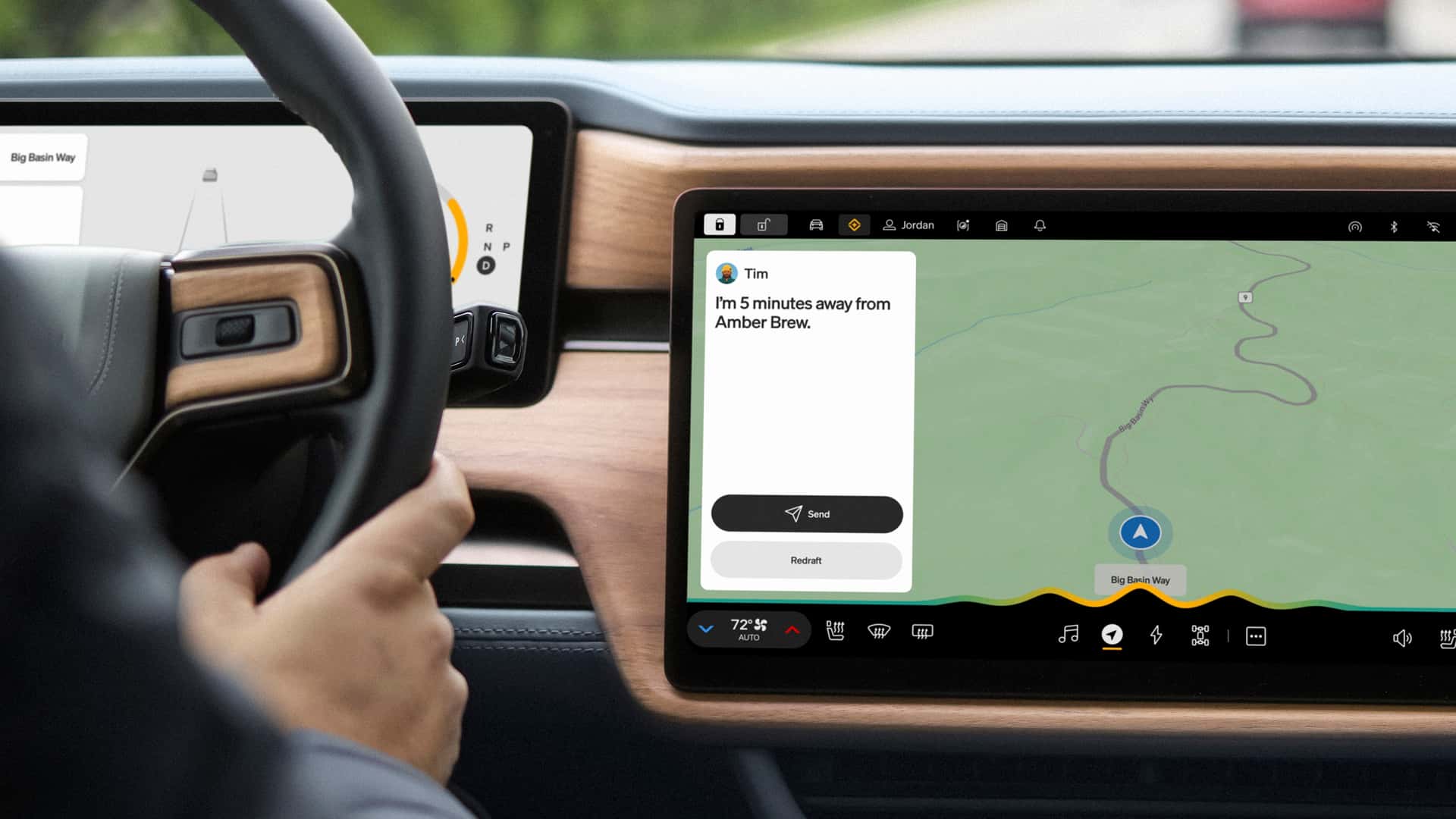
For instance, a driver could issue a command like, “Send a friend a batch of restaurant recommendations and my ETA from the navigation system.” The assistant processes this layered request, pulling data from both navigation and external services, then intelligently compiles and dispatches the information. This capability demonstrates a sophisticated understanding of user intent and a seamless execution across integrated systems.
Contextual Understanding and General Knowledge
A key aspect of the AI’s intelligence is its ability to remember context from previous interactions within a given session. This ‘memory’ allows for more fluid and natural follow-up questions and commands, preventing the need to re-state information and improving the efficiency of the dialogue. It signifies a move towards truly conversational AI within the automotive space.
Beyond vehicle-specific tasks, the Rivian Assistant can also answer general knowledge questions, akin to popular AI chatbot tools like ChatGPT. This broad informational capability transforms the vehicle into a mobile information hub, capable of providing quick answers to a wide range of queries, from trivia to practical advice.
Your Vehicle’s Digital Manual
Rivian also positions the assistant as ‘an encyclopedia for your vehicle.’ This particular feature aims to eliminate the need for drivers to sift through cumbersome physical owner’s manuals or digital PDFs. Instead, drivers can simply ask their vehicle direct questions about its operation or maintenance.
Queries such as, “How do I change a tire?” or “What do these warning lights mean?” can be answered instantly by the Rivian Assistant. This on-demand access to critical vehicle information enhances driver empowerment and convenience, fostering greater self-sufficiency on the road.
The Agentic Leap: Google Calendar Integration
Perhaps one of the most compelling aspects of the Rivian Assistant is its ‘agentic capability,’ which allows it to connect various external services and execute tasks on the user’s behalf. The first such integration to be rolled out is with Google Calendar, showcasing a practical application of this advanced functionality.
For Rivian owners who link their Google accounts, the assistant enables voice-controlled management of their schedules while driving. This means users can, by voice command alone, move meetings, navigate directly to upcoming appointments, or relay specific calendar information via text messages to contacts. This deep integration with a widely used productivity tool significantly boosts hands-free utility and productivity for busy individuals on the go.
The Evolving Landscape of In-Vehicle AI
The rapid advancement in in-vehicle AI, spearheaded by companies like Rivian, signifies a broader paradigm shift in automotive technology. These intelligent assistants are transforming the car from a mere mode of transport into a sophisticated, interconnected digital environment. The focus is increasingly on creating a seamless extension of a user’s digital life, accessible and manageable through natural human language.
This evolution points towards future vehicles that are not only capable of understanding complex commands but also anticipating driver needs, learning preferences over time, and proactively assisting with navigation, communication, entertainment, and vehicle maintenance, all through an intuitive voice interface. The competition among automakers to deliver the most robust and intelligent AI experiences is heating up, benefiting consumers with increasingly smart and responsive vehicles.
Availability and Future Rollout
The Rivian Assistant is currently being deployed to all Generation 1 and Generation 2 R1S and R1T vehicles. It is important to note that access to this advanced AI functionality requires an active connectivity subscription, ensuring a consistent and reliable user experience through over-the-air updates and cloud-based processing. This subscription model supports the ongoing development and enhancement of the Rivian Assistant, promising future expansions of its capabilities and integrations.
Looking ahead, Rivian has confirmed that the Rivian Assistant will also be a core feature in its upcoming R2 model, slated for customer launch in the coming weeks. This commitment underscores Rivian’s vision to equip its entire vehicle lineup with cutting-edge AI, ensuring that next-generation models inherit and build upon these sophisticated digital tools from inception.
The expedited release of the Rivian Assistant demonstrates the company’s agility and commitment to delivering innovative technology to its customers. It sets a new benchmark for in-vehicle voice interaction, blending advanced AI with practical, user-centric functionalities to enhance the electric vehicle driving experience.
FAQ Section
What is the Rivian Assistant?
The Rivian Assistant is an advanced AI-powered voice assistant developed in-house by Rivian. It enables natural-language interaction with the R1S and R1T electric vehicles, allowing drivers to control various functions, access information, and integrate with external services using voice commands.
Which Rivian vehicles will receive the AI assistant?
The Rivian Assistant is rolling out to all Generation 1 and Generation 2 R1S and R1T vehicles via a software update. It will also be included as a standard feature in the new Rivian R2 model upon its launch, ensuring broad accessibility across Rivian’s vehicle lineup.
What are the primary functions of the Rivian Assistant?
Key functionalities include adjusting drive modes, viewing vehicle cameras, providing navigation information and points of interest, answering general knowledge questions, and serving as a digital owner’s manual for vehicle-specific queries. It also supports complex, multi-step commands for enhanced user convenience.
Does the Rivian Assistant require a subscription?
Yes, to access the full capabilities of the Rivian Assistant and ensure continuous updates and functionality, vehicle owners must have an active connectivity subscription. This subscription facilitates the over-the-air updates and cloud-based AI processing essential for the system’s performance.
How does Rivian’s AI assistant compare to other in-vehicle systems?
The Rivian Assistant distinguishes itself through deep integration directly into the vehicle’s hardware and software, offering more extensive control and contextual understanding than many basic voice command tools. Unlike systems reliant on phone mirroring, Rivian’s solution is purpose-built for its vehicles, enhancing its unique capabilities.
What is the ‘agentic capability’ of the Rivian Assistant?
The ‘agentic capability’ refers to the assistant’s ability to connect and execute tasks across various external services. The first example of this is its integration with Google Calendar, allowing drivers to manage meetings, navigate to appointments, and relay calendar information via voice commands while driving.
Was the Rivian Assistant released earlier than planned?
Yes, the Rivian Assistant was initially announced at Rivian’s Autonomy & AI Day for an early 2026 release. However, Rivian has accelerated its deployment, making it available to R1S and R1T owners much sooner through a recent over-the-air software update.