
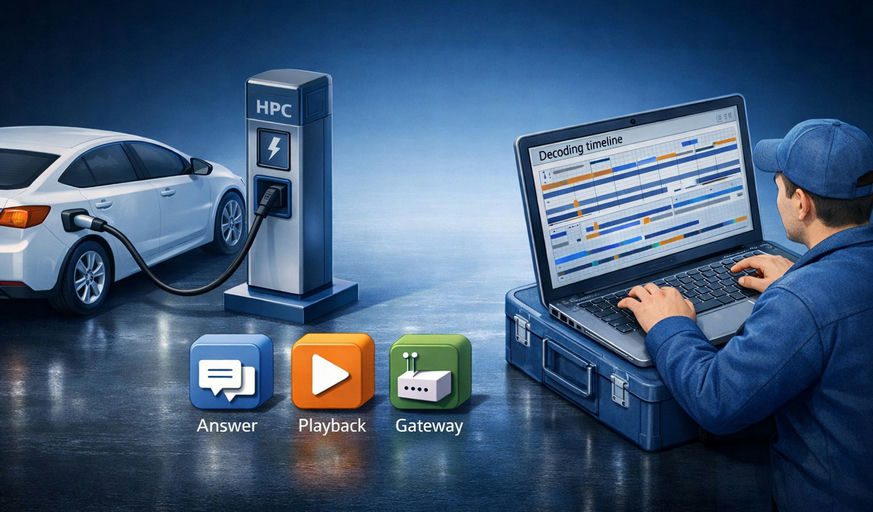
A forthcoming webinar at the March Virtual Conference on EV Engineering aims to equip professionals with advanced strategies for rapidly identifying and resolving charging interoperability issues. Presented by comemso electronics GmbH, the session will focus on a systematic methodology designed to pinpoint failures without the need for extensive on-site visits or complex raw data analysis.
Accelerating Interoperability Diagnostics
The core objective of the webinar is to provide practical techniques that allow engineers to clearly isolate the root causes of charging system failures and reliably reproduce them. This approach is intended to significantly reduce the time and resources currently spent on troubleshooting complex EV charging ecosystems.
Key Benefits for EV Engineers
Participants can expect to gain valuable insights into several key areas of troubleshooting:
Targeted Isolation Strategies
The session will detail methods for effectively differentiating between issues originating from the Electric Vehicle (EV), the Electric Vehicle Supply Equipment (EVSE), and the communication protocols that govern their interaction. This clear separation is crucial for efficient problem-solving.
Reducing Troubleshooting Time
By adopting a structured analytical process, engineers can move away from time-consuming trial-and-error methods often employed in the field. The webinar will emphasize techniques that enhance diagnostic accuracy and speed.

Clear, Comprehensible Results
The presentation will focus on generating results that are easily understood by development, testing, and service teams. The aim is to present findings in a clear format, avoiding the overwhelming nature of raw data dumps and technical jargon.
Virtual Conference Overview
The webinar is scheduled for March 12, 2026, at 8:45 am EDT. Registration for this session is free.
The March Virtual Conference on EV Engineering, running from March 9 to 12, 2026, will cover a broad spectrum of topics essential to the EV industry. The conference content is designed to address the entire EV engineering supply chain and ecosystem.
Key areas of focus include motor and power electronics design and manufacturing, cell development, battery systems, comprehensive testing methodologies, powertrain development, thermal management solutions, circuit protection, wire and cable technologies, and electromagnetic interference/compatibility (EMI/EMC).
Register for the Virtual Conference on EV Engineering
The Virtual Conference on EV Engineering offers attendees the opportunity to engage with a wide array of technical sessions, all accessible live or on demand. Registration for the conference is free of charge.
The conference program features numerous sessions relevant to the evolving landscape of electric mobility. These include discussions on enabling highly-efficient and affordable e-mobility through advanced technologies like Automotive CoolGaN™, introducing AI-powered solutions such as LOCTITE SOLVE for virtual adhesives hubs, and exploring the potential of new semiconductor devices like CoolSiC™ for next-generation xEV power conversion.
Further sessions will delve into critical challenges such as solving EV circuit protection issues by focusing on reset capabilities rather than replacement, and providing insights into designing safer e-mobility battery packs through material selection and rigorous testing. The conference will also cover emerging technologies and essential engineering practices, including modeling hydrogen fuel cells and electrolyzers, building realistic testing environments for EV technology verification, and implementing new strategies for high-voltage fault management in next-generation EVs.
Advanced validation techniques, such as full-power inverter validation using Power HIL systems and accelerated testing of power-level charging and communication control for Megawatt Charging Systems, will also be presented. Additionally, sessions will address the application of functional safety principles to eMobility battery systems and the design of batteries that meet stringent upcoming regulations, focusing on preventing flame-outs and explosions.