
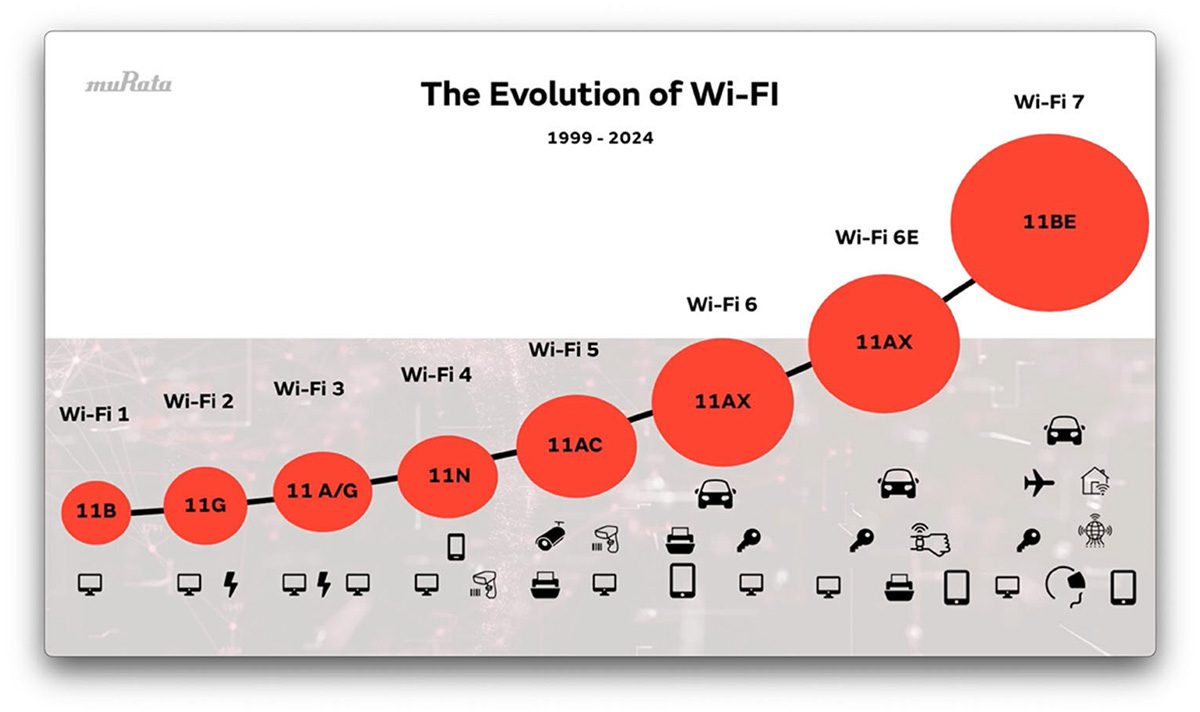
The automotive industry is on the cusp of a significant technological leap with the advent of Wi-Fi 7, a next-generation wireless standard set to redefine in-car connectivity. Experts highlight its potential to dramatically improve data transmission speeds and reliability, paving the way for more sophisticated Advanced Driver-Assistance Systems (ADAS) and fully autonomous driving capabilities.
Understanding Wi-Fi 7’s Advancements
Wi-Fi 7, also known as IEEE 802.11be, introduces substantial upgrades over its predecessors. It boasts a theoretical maximum speed that is significantly higher than Wi-Fi 6/6E, a crucial factor for the immense data volumes generated by modern vehicles.

Key features contributing to this enhanced performance include support for up to 16 spatial streams, which allows for more simultaneous data connections, and the utilization of a 320MHz channel width. This wider channel capacity is instrumental in handling the high bandwidth demands of real-time data processing required for autonomous navigation and advanced safety features.
The Automotive Imperative for High-Speed Connectivity
The drive towards autonomous vehicles and increasingly complex ADAS necessitates a robust and high-capacity communication infrastructure. These systems rely on continuous streams of data from sensors, cameras, and LiDAR, which must be processed and acted upon with minimal latency.
Wi-Fi 7’s enhanced bandwidth and efficiency are ideally suited to meet these demands. The technology can support the simultaneous transmission of large data packets, essential for tasks such as high-definition mapping, vehicle-to-everything (V2X) communication, and over-the-air software updates for critical vehicle functions.

A Deep Dive into Wi-Fi 7 for Automotive Applications
A comprehensive white paper, titled “Murata Wi-Fi 7 Automotive Connectivity and Efficiency White,” delves into the specific capabilities of Wi-Fi 7 and its profound relevance to the automotive sector. This document serves as a vital resource for industry professionals seeking to understand and leverage this transformative technology.
The paper likely details how Wi-Fi 7’s architecture, including features like Multi-Link Operation (MLO) and improved modulation schemes, contributes to its superior performance. MLO, for instance, allows devices to connect across different frequency bands simultaneously, enhancing throughput and reducing latency. This is particularly beneficial in dynamic automotive environments where signal interference can be a challenge.
Enhancing Efficiency and User Experience
Beyond autonomous driving, Wi-Fi 7 is expected to significantly improve the in-car passenger experience. Faster and more reliable connectivity will enable seamless streaming of high-definition content, advanced infotainment systems, and robust cloud-based services.
The efficiency gains from Wi-Fi 7 also extend to network management within the vehicle. With more devices and data-intensive applications coming online, the ability of Wi-Fi 7 to handle increased traffic without performance degradation is crucial for a smooth and responsive user interface.
The Role of Industry Leaders in Driving Adoption
The development and implementation of Wi-Fi 7 in automotive applications are being spearheaded by key industry players. Companies like TTI and Murata are at the forefront, providing the necessary components and expertise to integrate this advanced technology into vehicle platforms.
The availability of detailed white papers and technical documentation, such as the one offered by TTI and Murata, underscores the industry’s commitment to educating stakeholders and accelerating the adoption of Wi-Fi 7. These resources provide critical insights into the technical specifications, benefits, and implementation strategies required to harness the full potential of this technology.
The Path Forward: From Today’s Cars to Tomorrow’s Autonomous Fleet
As automotive manufacturers continue to push the boundaries of innovation, connectivity remains a cornerstone of progress. Wi-Fi 7 represents a critical enabler, promising to deliver the speed, reliability, and capacity needed for the next generation of vehicles.
From enhancing safety through advanced ADAS to unlocking the full potential of autonomous driving and enriching the in-car digital experience, Wi-Fi 7 is set to be a defining technology in the evolution of the automobile. Industry professionals are encouraged to explore the detailed technical information available to prepare for this connected future.
Download the full paper from TTI and Murata to gain in-depth knowledge on automotive Wi-Fi 7 connectivity.
First Name
Last Name
Company
Email
Job Title
Country
Consent to email
Yes, please email me the whitepaper. I consent to receiving emails with more information about this topic from ChargedEVs and/or the topic sponsor. I acknowledge that I agree to the Terms of Use and the Privacy Policy.
Captcha
DOWNLOAD
Upcoming Virtual Conference on EV Engineering: Free to Attend
Don’t miss our next Virtual Conference on March 9-12, 2026. Register for the free webinar sessions below to watch them live or on demand.
Automotive CoolGaN™ Enabling Highly-Efficient & Affordable E-Mobility
Register
Exclusive Introduction To LOCTITE SOLVE: AI-powered Virtual Adhesives Hub
Register
Unlocking Next-Gen xEV Power Conversion: New CoolSiC™ Devices
Register
Reset Instead Of Replace: Solving EV Circuit Protection Challenges
Register
Designing Safer E-Mobility Battery Packs: Materials And Testing Insights
Register
Modeling Hydrogen Fuel Cells And Electrolyzers
Register
Building Realistic And Dynamic Testing Environments For EV Technology Verification
Register
New Strategies For High Voltage Fault Management In Next-Gen EVs
Register
Full‑Power Inverter Validation Using Power HIL Systems
Register
Megawatt Charging Systems: Accelerated Testing Of Power‑Level Charging And Communication Control
Register
Applying Functional Safety To eMobility Battery Systems
Register
Designing Batteries For Upcoming Regulations: No Flame Out, No Explosion
Register
LOAD MORE SESSIONS