
Key Takeaways
- A European consortium, HiPower 5.0, is developing an ultra-compact 22-kilowatt (kW) bidirectional on-board charger (OBC) for electric vehicles (EVs).
- The innovative OBC will fit into a mere 4-liter package, a significant reduction from the current market average of 12 liters for comparable systems.
- This breakthrough is enabled by monolithic, bidirectional gallium nitride (GaN) semiconductors from Infineon, which handle current flow in both directions within a single component.
- Fraunhofer IZM leads the project, focusing on a whole-system design approach rather than individual component optimization, integrating electronics directly into circuit boards to save space and reduce losses.
- The HiPower 5.0 project, funded by the EU and member states with €33.7 million, brings together 46 partners from 10 European nations, including major OEMs and suppliers.
- The technology promises to enhance EV charging efficiency, reduce vehicle weight, and facilitate vehicle-to-grid (V2G) capabilities, advancing sustainable e-mobility and smart energy management.
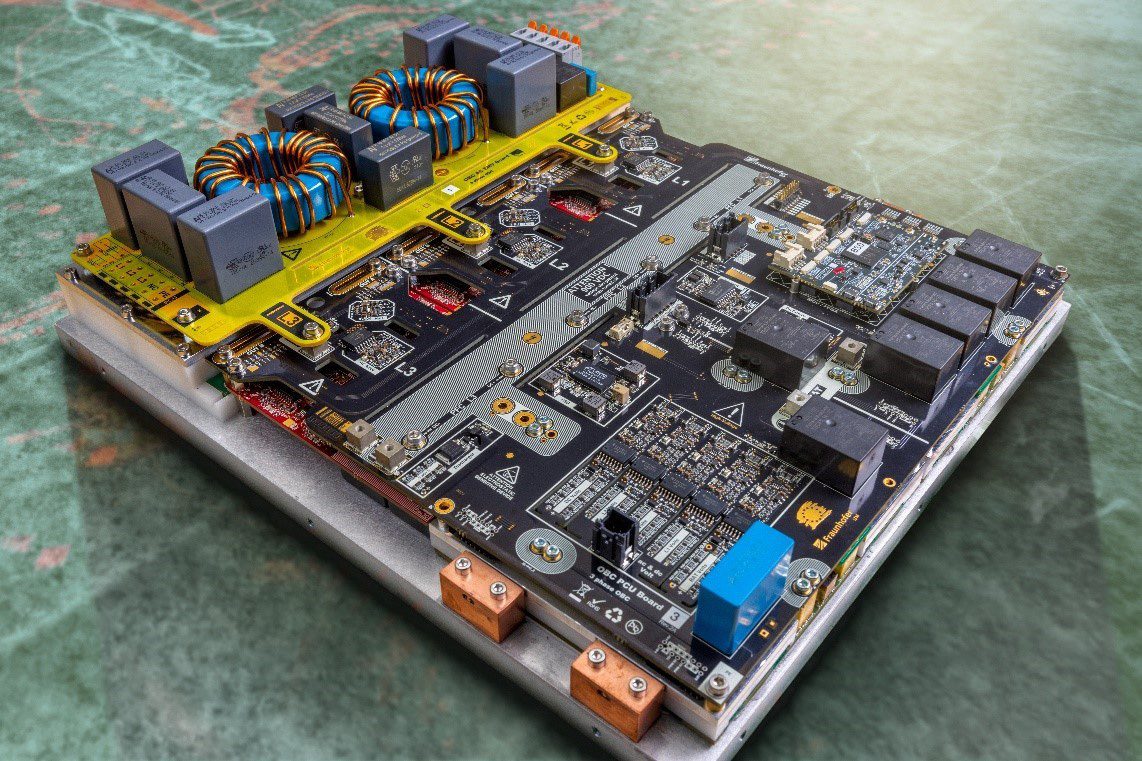
A groundbreaking European initiative is poised to redefine the landscape of electric vehicle (EV) charging technology. A consortium, spearheaded by the renowned Fraunhofer IZM, is diligently working to develop a 22-kilowatt (kW) on-board charger (OBC) designed to occupy an unprecedentedly compact 4-liter volume. This represents a remarkable reduction to just one-third of the typical 12-liter footprint currently observed for similar systems in the market.
This ambitious endeavor, integral to the EU-funded HiPower 5.0 project, leverages cutting-edge monolithically integrated, bidirectional gallium nitride (GaN) semiconductors supplied by Infineon. Launched in August 2025 and slated to conclude in June 2028, the project aims to accelerate the transition to more efficient and integrated EV solutions, marking a significant advancement in EV engineering news.

Driving the Future of EV Charging Technology
The quest for smaller, more efficient, and powerful EV charging components is a critical frontier in the evolution of electric mobility. As demand for EVs continues its upward trajectory, the efficiency and integration of charging infrastructure within vehicles become paramount. The HiPower 5.0 project directly addresses this need by targeting an on-board charger that not only delivers substantial power (22 kW) but also boasts an unparalleled compact form factor.
A 22 kW charging capability allows for significantly faster charging times, especially when paired with compatible AC charging stations. Furthermore, the bidirectional nature of this charger is a game-changer, enabling vehicles to not only draw power from the grid but also feed electricity back into it. This capability is crucial for the development of Vehicle-to-Grid (V2G) systems, which can support grid stability, facilitate energy management in homes and businesses, and unlock new revenue streams for EV owners.
The GaN Advantage: Monolithic Integration for Enhanced Performance
The core innovation propelling this compact design lies in the adoption of bidirectional Gallium Nitride (GaN) semiconductors from Infineon. Traditional OBC designs typically necessitate separate semiconductors to manage current flow in forward and reverse directions. This conventional approach increases component count, design complexity, and overall package size.
In stark contrast, the newly developed monolithic GaN component is engineered to handle both directions of current flow within a single device. This ingenious integration dramatically reduces the number of required components and opens the door to innovative circuit topologies that were previously impractical or impossible with traditional silicon-based power electronics. The inherent properties of GaN — higher electron mobility and breakdown voltage — allow for faster switching speeds, higher power density, and reduced energy losses compared to silicon.
Fraunhofer IZM had previously showcased a non-bidirectional 22 kW OBC prototype at PCIM Europe 2024, demonstrating the initial capabilities of their design philosophy. The HiPower 5.0 project now builds upon this foundation by integrating the critical bidirectional GaN capability. This next phase is also focused on achieving further enhancements in both energy efficiency and cost-effectiveness, pushing the boundaries of what is possible in EV engineering news.
A System-Level Approach to Miniaturisation
Achieving such a dramatic reduction in volume is not merely about using smaller components; it necessitates a fundamental shift in design philosophy. Fraunhofer IZM champions a holistic, whole-system approach to design, moving beyond the conventional method of optimising individual components in isolation. This strategy views the entire system as an interconnected entity where every design decision is made with the overall objective of compactness and efficiency in mind.
A key aspect of this methodology involves embedding multiple electronic components directly into the circuit boards themselves. This innovative technique significantly shortens electrical paths, which in turn minimises parasitic losses – energy losses that occur due to unintended electrical effects within a circuit. By consolidating and integrating electronics at a deeper level, the design not only saves invaluable space within the charger package but also boosts the overall performance and thermal management of the system. This meticulous attention to system architecture is vital for unlocking the full potential of advanced materials like GaN in high-power applications.
A Pan-European Collaboration for Innovation
The HiPower 5.0 project exemplifies the power of collaborative research and development on a continental scale. It unites a formidable consortium of partners from across 10 European nations, pooling diverse expertise and resources to tackle complex technological challenges in EV engineering news.
The consortium comprises 2 leading Original Equipment Manufacturers (OEMs), 21 tier-1 and tier-2 suppliers crucial to the automotive supply chain, 6 specialised power electronics companies, 10 prestigious universities contributing cutting-edge academic research, and 7 reputable research institutions like Fraunhofer IZM. This broad spectrum of participants ensures a comprehensive approach, from fundamental research to practical application and industrial scaling.
Notable participants in this ambitious undertaking include global technology giants such as Infineon, Mercedes-Benz, Mahle, Valeo, Siemens, Vitesco Technologies, TDK Electronics, and AVL. The collective intelligence and resources of these entities are directed towards developing solutions that will have a profound impact on the future of electric mobility.
The project’s scope is extensive, covering 6 distinct use cases that span both the automotive sector and marine shipping, highlighting the versatility and broad applicability of the developed technologies. The total funding for the HiPower 5.0 project stands at a substantial €33.7 million, sourced from the European Union and its member states. Germany’s commitment to innovation is evident with a contribution of €5.74 million from the German Federal Ministry of Research, Technology, and Space, complemented by €0.12 million from the Free State of Saxony.
Implications for Electric Vehicle Adoption and Smart Grids
The successful development and deployment of this ultra-compact, high-power bidirectional OBC hold significant implications for the future of electric vehicles and the broader energy ecosystem. Faster and more convenient charging will undoubtedly reduce range anxiety, making EVs a more attractive option for a wider demographic. The smaller footprint of the charger also means less space and weight allocated within the vehicle, potentially allowing for greater battery capacity, increased passenger comfort, or more agile vehicle designs.
Beyond the vehicle itself, the bidirectional capability is a cornerstone for the integration of EVs into smart grids. V2G technology allows EVs to act as mobile energy storage units, storing renewable energy when abundant and feeding it back during peak demand or grid instabilities. This not only enhances grid resilience but also supports the wider adoption of intermittent renewable energy sources like solar and wind power. As such, this advancement in EV engineering news contributes directly to sustainable energy practices and a more robust, decentralised energy infrastructure.
The HiPower 5.0 project’s commitment to efficiency and cost reduction will also play a pivotal role in making advanced EV technology more accessible. By optimising the design and manufacturing processes of crucial components like OBCs, the consortium is helping to drive down the overall cost of EVs, accelerating their mass adoption across Europe and beyond. This collaborative European effort is setting a new benchmark for innovation in the e-mobility sector, promising a future where electric vehicles are not just a mode of transport but an integral part of an intelligent energy network.
Frequently Asked Questions (FAQ)
What is the primary goal of the EU-funded HiPower 5.0 project?
The project aims to develop a highly compact 22 kW bidirectional on-board charger for electric vehicles, reducing its volume to 4 liters, significantly smaller than current market averages, while improving efficiency and cost.
How does the new charger achieve its compact size?
The compact size is primarily achieved through the use of monolithic, bidirectional gallium nitride (GaN) semiconductors and a whole-system design approach that embeds multiple electronic components directly into circuit boards, shortening electrical paths and saving space.
What are bidirectional GaN semiconductors and why are they important?
Bidirectional GaN semiconductors from Infineon can handle current flow in both directions within a single device. This reduces component count, enables new circuit topologies, and enhances efficiency compared to traditional silicon-based systems requiring separate components for each direction.
Which organisations are part of the HiPower 5.0 consortium?
The consortium comprises 46 partners from 10 European nations, including Fraunhofer IZM (lead), Infineon, Mercedes-Benz, Mahle, Valeo, Siemens, Vitesco Technologies, TDK Electronics, AVL, along with universities and research institutions.
What is the significance of a 22 kW bidirectional on-board charger?
A 22 kW charger enables faster AC charging. Its bidirectional capability is crucial for Vehicle-to-Grid (V2G) applications, allowing EVs to feed power back to the grid, supporting grid stability and renewable energy integration, key aspects in EV engineering news.
What is the total funding for the HiPower 5.0 project?
The project has secured €33.7 million in total funding from the EU and its member states, including €5.74 million from the German Federal Ministry of Research, Technology, and Space, and €0.12 million from the Free State of Saxony.
When is the HiPower 5.0 project expected to conclude?
The HiPower 5.0 project commenced in August 2025 and is scheduled to run until June 2028, aiming to bring these advanced EV charging technologies to fruition within this timeframe.