
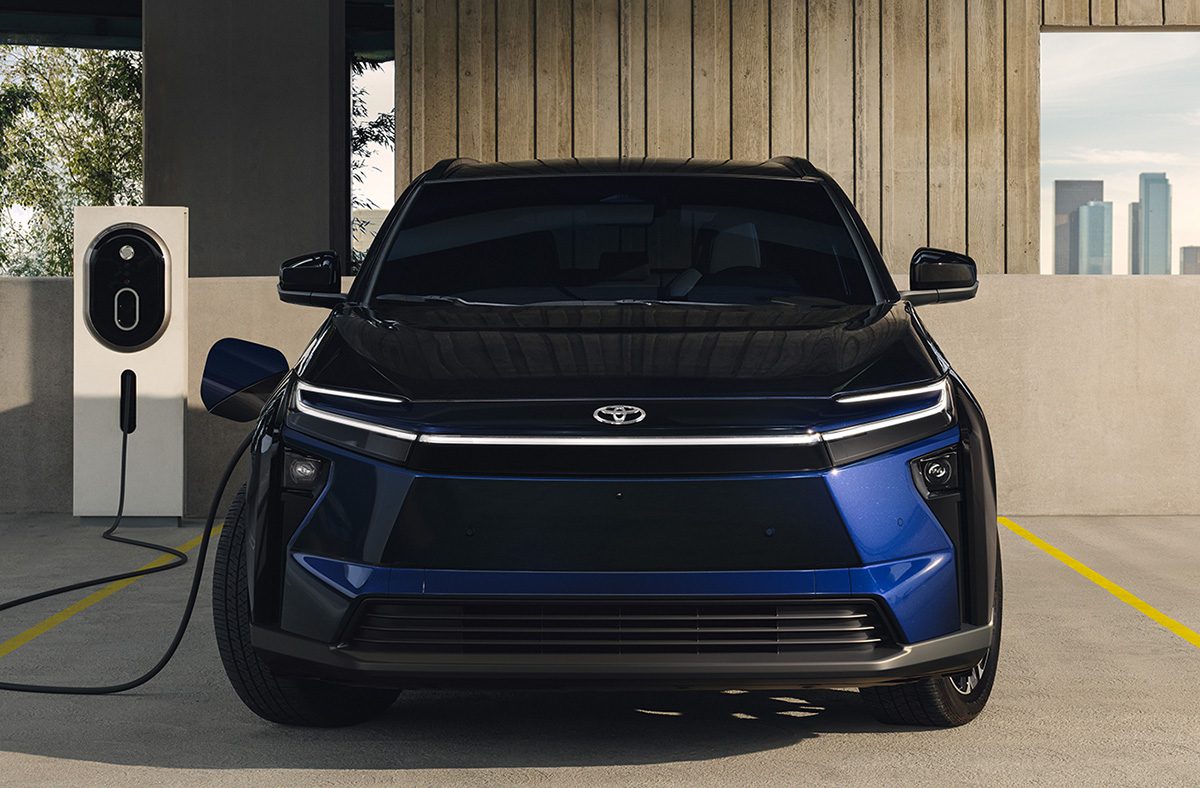
As other major automakers consider retrenching their electric vehicle (EV) plans, a curious question emerges: Why is Toyota, a company long known for its cautious approach and hybrid dominance, now aggressively rolling out a series of new EVs? This strategic move by the Japanese automotive titan, which includes four new Toyota-branded EVs and two additional Lexus models for the U.S. market, has naturally piqued the interest of industry observers and fellow journalists alike. It prompts a deeper look into the intricate reasoning behind Toyota’s EV strategy.
The queries arise amid a perceived slowdown in EV sales in certain segments and a reported relaxation of regulatory pressures, such as CAFE penalties, the end of zero-emission vehicle (ZEV) mandates, and the elimination of federal efforts to limit vehicle emissions. Industry insiders ponder whether Toyota sees a demand invisible to others, or if deeply embedded commitments in manufacturing and supply chains are driving this expansion. This article delves into the core tenets of Toyota’s EV strategy, offering a comprehensive perspective on its calculated progression into the electric future.

Key Takeaways
- Methodical Execution: Toyota is meticulously following a long-term plan, announced in 2021, to invest $35 billion in EV development and launch 30 battery-electric models globally by 2030, with six designated for North America.
- Long-Term Vision: The automaker’s approach mirrors its successful, decade-long investment in hybrid technology, demonstrating a willingness to absorb initial losses for sustained future profitability and market leadership.
- Strategic Partnerships: A robust collaboration with Subaru, which includes shared EV platforms, significantly boosts production volumes and spreads development costs, particularly for the crucial North American market.
- Consumer-Centric Design: Toyota recognizes that consumer demand for EVs is driven by superior vehicle performance and lower operating costs, rather than solely environmental mandates.
- Market Resilience: Despite headlines suggesting an EV market slowdown, underlying data indicates a temporary sales pull-forward due to incentives, with sustained long-term growth anticipated, especially for more affordable models.
A Strategic Shift Unveiled
Toyota’s current push into the electric vehicle market, featuring models like the bZ, C-HR EV, bZ Woodland, and Highlander EV, alongside Lexus’s new offerings, is not a sudden pivot. Rather, it represents the methodical execution of a long-term vision articulated years ago. The company, often described as a ‘large ship that turns slowly,’ initiated this trajectory over four years ago, demonstrating a deliberate and well-considered approach to the evolving automotive landscape.
In December 2021, Toyota publicly committed to an ambitious plan: investing $35 billion into building a diverse range of electric vehicles. This commitment aimed to introduce 30 different battery-electric models globally by 2030, covering everything from compact urban commuters to larger SUVs. While only a fraction of these global offerings will make their way to North America, the planned expansion underscores a clear direction for Toyota’s EV strategy.
The Investment in Future Mobility
A significant aspect of this commitment is localized production. The battery-electric Highlander, for instance, is slated to be the first EV built by Toyota in the United States, at its expansive assembly plant in Georgetown, Kentucky. This move aligns with the common automotive practice of producing vehicles in high-volume sales regions, optimizing logistics and supply chains.

Further solidifying its long-term play, Toyota is investing $13.9 billion into a new battery cell plant in North Carolina. This substantial capital outlay is designed for versatility, capable of producing batteries for conventional hybrids, plug-in hybrids, and battery-electric vehicles. This multi-purpose approach allows Toyota to hedge its bets across different powertrain technologies, maximizing the utility and return on its significant capital investment, a hallmark of Toyota’s EV strategy.
Mastering the Art of the “Long Game”
Toyota’s historical trajectory reveals a consistent pattern of patience and meticulous execution. As Telemetry analyst Sam Abuelsamid noted to The Detroit News, “Toyota is not often the first to market with a new technology. But they take their time. They try to do it right.” This philosophy is central to Toyota’s EV strategy, emphasizing thorough development over hasty deployment.
Learning from Hybrid Prowess
The company’s experience with hybrid-electric technology offers a compelling parallel. Toyota executives previously disclosed that the Prius, despite its groundbreaking launch in Japan in 1997, did not achieve break-even status until midway through its second-generation cycle (2004-2009). This decade-long investment and initial period of losses ultimately paved the way for Toyota’s dominant global position in hybrid vehicles, a testament to its long-term strategic planning.
While Toyota initially expressed reservations about the mass-market viability of EVs, the undeniable success of models like Tesla’s Model S, 3, and Y eventually convinced the company of their permanence and consumer appeal. Once this conviction took root, Toyota leveraged its immense resources—both financial and engineering talent—to address the complexities of EV development and market integration, shaping its distinct Toyota’s EV strategy.
Continuous Improvement at Core
The debut of the 2022 bZ4X in the U.S. served as an initial learning platform. Despite some early criticisms regarding charging rates and driver information, Toyota’s commitment to ‘kaizen’—continuous improvement—ensured rapid refinements. The automaker’s ability to evolve and enhance its offerings, much like the progression from the primitive 1997 Prius to today’s sophisticated hybrids, is a defining characteristic.
This iterative process was also evident in the Mirai fuel-cell vehicle, where a clunky first generation evolved into a far more compelling second iteration. Abuelsamid highlighted this, stating, “continuous improvement [known as kaizen] has always been their thing. They listened to the complaints, and they made the bZ dramatically better in the span of a mid-cycle update.” This relentless pursuit of perfection remains a cornerstone of Toyota’s EV strategy.
Responding to Competitive Pressures
Toyota’s strategic deliberations are also influenced by its competitive landscape. While often seen as unfazed by the likes of the VW Group, GM, or Nissan, industry insiders suggest a keen awareness of Hyundai’s rapid iteration and innovation in the EV space. This competitive dynamic likely plays a role in the accelerated rollout of new electric models, confirming the industry’s shift and validating the broader EV transition.
The Power of Strategic Alliances: Subaru’s Role
The resurgence of “badge engineering”—where different brands sell identical vehicles—is a notable aspect of Toyota’s EV strategy, particularly through its alliance with Subaru. Toyota, which holds a 20 percent stake in Subaru, leverages this partnership to its advantage, especially in the North American market.
Subaru, a significantly smaller automaker, benefits from Toyota’s deep pockets and engineering prowess, gaining access to hybrid systems and EV platforms it could not develop independently. In return, Subaru contributes significantly to Toyota’s U.S. sales volumes for shared EV models. For instance, the collaboration on the bZ4X electric SUV and its Subaru Solterra twin resulted in 45,000 Toyota sales over three model years, augmented by an additional 32,000 Solterra sales. This combined volume is crucial for spreading manufacturing and development costs.
Subaru’s customer base, characterized by environmentally conscious, practical, and adventurous buyers, aligns well with the early adopter profile for EVs in the U.S. With a remarkable 76 percent of Subaru’s total global production sold in North America, this partnership is a strategic cornerstone for bolstering Toyota’s EV strategy in a key market, even if Subaru’s sales outside the region do not directly contribute to Toyota’s broader global EV volume.
Beyond Regulation: Consumer-Driven EV Adoption
Historically, automakers sometimes viewed EVs as a regulatory necessity, leading to the production of “compliance cars” that were often heavily discounted to meet mandates. However, Toyota’s EV strategy now acknowledges a fundamental shift: consumers are increasingly buying EVs because they are simply better vehicles, independent of environmental concerns.
While U.S. politics may often frame EVs through a ‘green’ lens, consumer surveys consistently show that once buyers experience electric vehicles, the vast majority express no desire to return to gasoline-powered cars. The benefits extend beyond reduced emissions, encompassing superior driving dynamics—such as instant torque and a quieter ride—and the long-term advantage of significantly lower operating costs due to cheaper ‘fuel’ and reduced maintenance. This message, gradually disseminated through word-of-mouth among friends, family, and colleagues, is a powerful driver of sustained adoption, mirroring the journey of hybrid vehicles two decades ago.
Debunking Market Misconceptions: The Enduring EV Trend
The current media narrative, often characterized by “dumb headlines” and context-free sales comparisons, frequently suggests a waning consumer interest in EVs in the U.S. However, a closer examination of market data reveals a more nuanced reality that informs Toyota’s EV strategy.
Kelley Blue Book data indicates that year-over-year EV sales did fall by 36 percent in Q4 2025 and 27 percent in Q1 2026. However, Q1 2026 sales were only 7.8 percent lower than the previous quarter, suggesting a stabilization after initial drops. EVs accounted for 5.8 percent of total new-vehicle sales in Q1 2026, unchanged from Q4 2025, but below the peak of 10.6 percent in Q3 2025.
Analyst Loren McDonald of Chargenomics offers crucial context: an estimated 125,000 or more EV sales were ‘pulled forward’ into Q2 and Q3 last year, as consumers anticipated the end of purchase incentives on September 30. The current market is thus working through this temporary deficit rather than reflecting a fundamental decline in demand. The long-term trajectory for electric vehicles remains upward, globally and in North America.
Moreover, market preferences are evolving. While expensive, large electric pickup trucks have seen limited success, electric compact SUVs continue to perform well. The imminent arrival of more affordable EVs, priced closer to $30,000, is expected to unlock a broader consumer base, as shoppers are more inclined to experiment with lower-priced options. Toyota, true to its methodical nature, is expected to introduce such lower-priced EVs on its own carefully determined timeline, further solidifying the adaptability of Toyota’s EV strategy.
Conclusion: A Calculated Path Forward
Toyota’s decision to launch multiple new EVs, even as some competitors pause, is not an anomaly but a deeply calculated move rooted in its foundational principles of long-term planning, continuous improvement, and robust financial health. It is a validation of the enduring shift towards electrification, driven by a blend of strategic foresight, smart partnerships, and a keen understanding of evolving consumer preferences.
Far from a reactive measure, Toyota’s EV strategy represents a methodical progression, leveraging decades of operational excellence and a willingness to invest for future dominance. The company’s patient, yet persistent, approach suggests that its entry into the electric vehicle mainstream will be impactful and sustained, rather than a fleeting response to market trends.
Frequently Asked Questions (FAQ)
Why is Toyota launching new EVs when other automakers are slowing down?
Toyota’s EV launch aligns with a long-term strategy announced in 2021, committing $35 billion to EV development. The company’s methodical approach, similar to its successful hybrid rollout, emphasizes careful planning and sustained investment over quick market entries, despite perceived industry slowdowns or regulatory shifts.
What is the significance of Toyota’s $13.9 billion battery plant in North Carolina?
The North Carolina battery plant is a strategic investment to localise production and supply for its growing EV and hybrid lineup. Its versatility allows it to produce batteries for various electrified vehicles, ensuring maximum value from capital expenditure and hedging against future market uncertainties in Toyota’s EV strategy.
How does the Subaru partnership benefit Toyota’s EV strategy?
The collaboration with Subaru, through badge engineering on models like the bZ4X/Solterra, enables both companies to share development costs and significantly boost production volumes. This partnership is particularly crucial for increasing EV sales and market penetration in the North American region, where Subaru has a strong, environmentally-conscious customer base.
Are consumers buying EVs for environmental reasons or other factors?
Surveys indicate that most consumers are attracted to EVs primarily for their superior driving experience—instant torque, quiet operation, and lower operating costs—rather than solely environmental concerns. Once experienced, EV owners rarely wish to return to gasoline vehicles, showcasing the strong product appeal central to Toyota’s EV strategy.
Is the U.S. EV market truly declining as headlines suggest?
Recent sales dips in the U.S. EV market are largely attributed to a ‘pull-forward’ of sales due to expiring incentives, rather than a fundamental decline in demand. The market is expected to rebound, especially with the introduction of more affordable EV models, demonstrating the long-term viability that underpins Toyota’s EV strategy.
What is ‘kaizen’ and how does it relate to Toyota’s EV development?
Kaizen, meaning ‘continuous improvement,’ is a core Toyota philosophy. It involves systematically refining technologies and products based on feedback. For EVs, this means learning from early models like the bZ4X and rapidly implementing improvements in subsequent iterations, ensuring increasingly better vehicles over time.
How does Toyota’s history with hybrid vehicles inform its EV approach?
Toyota’s decade-long investment in hybrid technology before achieving profitability with the Prius demonstrates its willingness to play the ‘long game.’ This historical precedent informs its patient, methodical investment in EVs, anticipating that initial costs will eventually yield sustained market leadership and profitability, defining Toyota’s EV strategy.