
Key Takeaways:
- Rivian has commenced the rollout of its in-house developed AI voice assistant, the Rivian Assistant, through its latest over-the-air software update.
- This advanced system provides natural language processing capabilities, enabling more intuitive control over vehicle functions and access to information.
- The Rivian Assistant is currently available for all Gen 1 and Gen 2 R1S SUVs and R1T trucks, with plans for integration into the forthcoming R2 platform.
- Users require an active connectivity subscription to access the full suite of features offered by the AI assistant.
- Distinguished by its deep vehicle integration, the assistant supports complex multi-step commands, retains conversational context, and offers initial integrations like Google Calendar.
Rivian, the burgeoning electric vehicle (EV) manufacturer, has officially commenced the rollout of its highly anticipated in-house artificial intelligence (AI) voice assistant, branded as the Rivian Assistant. This significant technological leap, initially projected for an early 2026 launch during the company’s Autonomy & AI Day last December, has arrived ahead of schedule, debuting as part of Rivian’s latest over-the-air (OTA) software update.
The introduction of the Rivian Assistant marks a pivotal moment for the brand, enhancing the interactive experience within its R1S and R1T electric trucks and SUVs. This advanced AI voice assistant is engineered to elevate the standard for in-vehicle voice commands, promising a more natural and intuitive interaction between drivers and their vehicles.
The Evolution of In-Vehicle Voice Control
The automotive industry is witnessing a transformative shift towards integrating sophisticated AI chatbot technology into vehicle systems. This move aims to make voice assistants more capable and user-friendly. Competing automotive giants are also making strides in this area; General Motors, Volvo, and Polestar, for instance, recently announced their vehicles would gain access to Google Gemini, while newer Tesla models feature xAI’s Grok.
Rivian’s approach with the Rivian Assistant, however, distinguishes itself through its profound integration. Unlike many systems that rely on phone-mirroring applications, the Rivian Assistant is intrinsically woven into the vehicle’s core hardware and software architecture. This deep-seated integration is critical for delivering a seamless and powerful user experience.
Deep Integration: A Core Advantage
Rivian emphasizes the unique nature of its proprietary system. In a recent press release, the company stated, “Unlike basic voice command tools found in phone-mirroring systems, Rivian Assistant is built directly into your vehicle’s hardware and software, providing the unique power to talk to every aspect of the vehicle and get things done for you.” This level of integration allows the AI voice assistant to exert comprehensive control over various vehicle functionalities, going beyond rudimentary tasks.
The Rivian Assistant leverages a hybrid model, utilizing both Rivian’s internally developed AI models and select external AI technologies to power its diverse range of functions. This combination ensures robustness and versatility, enabling the system to handle a broad spectrum of user requests effectively.
Unlocking Advanced Capabilities with Rivian Assistant
The capabilities of the Rivian Assistant extend far beyond traditional voice recognition systems, which often suffer from rigid phrasing requirements and limited functional scope. Through simple commands like “Hey Rivian” or by pressing a dedicated button on the steering wheel, drivers can access an expansive array of features.
The system is designed to respond to natural language queries, allowing occupants to seamlessly adjust drive modes, monitor vehicle cameras, and even inquire about points of interest along their route. This fluidity in interaction significantly reduces the need for manual inputs, enhancing driver focus and safety.
Contextual Awareness and Knowledge Retrieval
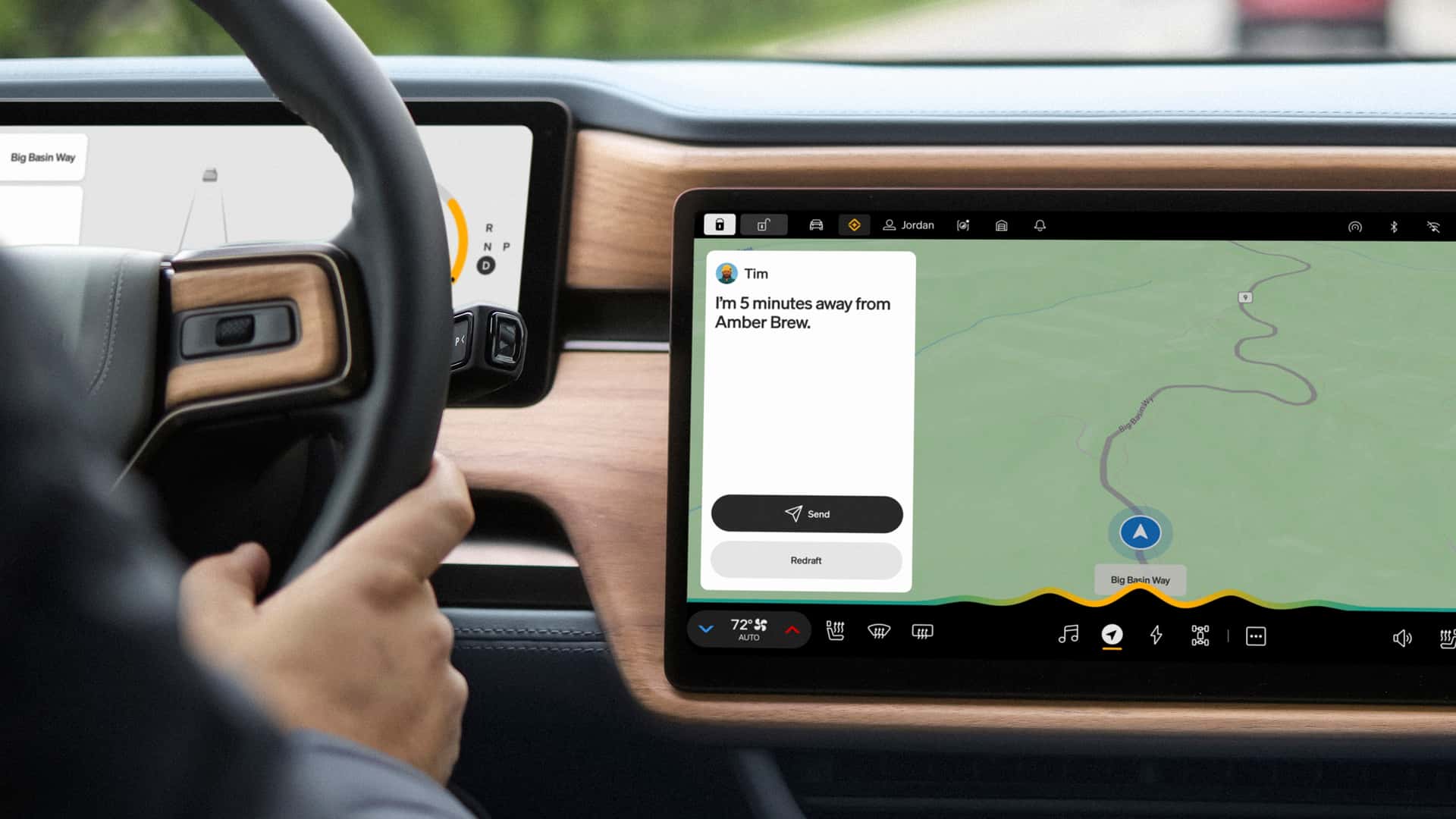
One of the standout features of the Rivian Assistant is its ability to process complex, multi-step commands. For example, a driver could instruct the assistant to simultaneously send a friend a list of restaurant recommendations and an estimated time of arrival (ETA) derived from the navigation system. This multi-faceted command execution streamlines communication and trip planning.
Furthermore, the Rivian Assistant exhibits contextual memory, meaning it can recall and build upon previous interactions within a conversation. This intelligent recall capability makes the dialogue with the AI voice assistant feel more natural and intuitive. It can also answer general knowledge questions, akin to popular AI chatbots like ChatGPT, providing instant information without diverting attention from the road.
Your Vehicle’s Digital Encyclopedia
Beyond active driving assistance, the Rivian Assistant serves as an invaluable informational resource. Rivian positions the assistant as “an encyclopedia for your vehicle,” effectively eliminating the need to consult a physical owner’s manual. Drivers can simply ask their vehicle for instructions on common maintenance tasks, such as how to change a tire, receiving immediate, voice-guided assistance.
This feature significantly simplifies vehicle ownership, making vital information accessible on demand and fostering greater self-sufficiency among Rivian owners. The ease of access to such critical information contributes to a more confident and informed driving experience.
Agentic Functionality and Google Calendar Integration
A crucial differentiator for the Rivian Assistant is its agentic capability, which allows it to connect various external services over time. The initial and most prominent integration is with Google Calendar, showcasing the practical application of this functionality.
This integration enables Rivian owners, once their Google accounts are connected, to manage their schedules directly from their vehicles using voice commands. Tasks such as moving meetings, navigating to scheduled appointments, and relaying calendar information via text messages can all be executed hands-free, transforming the vehicle into a mobile productivity hub.
The promise of future integrations suggests an expanding ecosystem of services accessible through the Rivian Assistant, further solidifying its role as a central command interface within the vehicle. This forward-looking approach underscores Rivian’s commitment to enhancing the digital lifestyle of its users.
Availability and Future Outlook
The Rivian Assistant is currently rolling out to all Gen 1 and Gen 2 R1S and R1T vehicles. This ensures that a wide base of existing Rivian owners can benefit from the advanced AI voice assistant. Looking ahead, the feature is confirmed to be integrated into the upcoming Rivian R2 platform when it launches to customers in the coming weeks.
It is important for owners to note that access to the Rivian Assistant requires an active connectivity subscription. This subscription model ensures continuous software updates, access to connected services, and the optimal performance of the AI features. As the automotive landscape continues to evolve, Rivian’s investment in sophisticated in-house AI solutions positions it at the forefront of innovative in-vehicle technology, promising a more connected, intelligent, and user-centric driving future.
Frequently Asked Questions (FAQ)
What is the Rivian Assistant?
The Rivian Assistant is an advanced AI voice system developed in-house by Rivian. It is designed to provide natural language processing capabilities for interacting with Rivian vehicles, enabling deeper control over various functions and offering information through voice commands.
Which Rivian models support the new AI voice assistant?
The Rivian Assistant is being rolled out to all Gen 1 and Gen 2 R1S SUVs and R1T pickup trucks. Additionally, it is slated for integration into the new Rivian R2 platform as soon as that model becomes available to customers.
What are some key capabilities of the Rivian Assistant?
Key capabilities include adjusting vehicle drive modes, viewing camera feeds, finding points of interest, answering general knowledge questions, and providing vehicle-specific information (like how to change a tire). It also supports complex multi-step commands and retains conversational context.
Does the Rivian Assistant require a subscription?
Yes, to access and utilize the full functionalities of the Rivian Assistant, vehicle owners must have an active connectivity subscription. This subscription ensures the system receives necessary updates and maintains its integrated services.
How does Rivian Assistant compare to other in-car AI systems?
Unlike basic voice command tools often found in phone-mirroring systems, Rivian Assistant is built directly into the vehicle’s hardware and software. This deep integration allows for comprehensive control over vehicle aspects, setting it apart from systems that rely on external smartphone AI like Google Gemini or xAI’s Grok.
What are the “agentic capabilities” of Rivian Assistant?
Agentic capabilities refer to the system’s ability to connect and interact with external services to perform tasks. The first such integration for the Rivian Assistant is with Google Calendar, allowing users to manage meetings, navigate to appointments, and share calendar information using voice commands.
When was the Rivian Assistant originally announced?
The Rivian Assistant was first announced by the company during its Autonomy & AI Day event in December, with an initial projection for its rollout scheduled for early 2026. However, Rivian has delivered the feature ahead of schedule in May 2024.