
Key Takeaways
- Rivian has officially rolled out its in-house AI voice assistant, “Rivian Assistant,” ahead of its initially projected 2026 timeline.
- The new assistant is available via the latest over-the-air software update for all R1S and R1T vehicles, requiring an active connectivity subscription.
- It offers advanced natural language capabilities, allowing for more intuitive and complex multi-step commands than standard voice recognition systems.
- Unlike phone-mirroring solutions, Rivian Assistant is deeply integrated into the vehicle’s hardware and software, enabling control over various vehicle functions.
- Key features include adjusting drive modes, accessing vehicle cameras, providing contextual information, answering general knowledge questions, and acting as a digital owner’s manual.
- The assistant boasts ‘agentic capability,’ with Google Calendar being its first integrated service, allowing users to manage appointments and share information via voice commands.
- The technology is slated to be a core feature in the upcoming Rivian R2 model upon its customer launch.
Rivian Rolls Out Innovative AI Voice Assistant Across R1 Models
Rivian, the prominent electric vehicle (EV) manufacturer, has announced the immediate rollout of its proprietary AI-powered voice assistant, dubbed “Rivian Assistant.” This sophisticated system is now becoming available to owners of the R1S SUV and R1T pickup truck through the company’s latest over-the-air (OTA) software update.
Initially projected for an early 2026 debut, this accelerated launch underscores Rivian’s commitment to enhancing the in-vehicle user experience and maintaining a competitive edge in the rapidly evolving automotive technology landscape. The Rivian Assistant aims to transform how drivers interact with their vehicles, moving beyond conventional voice commands to offer a more natural and deeply integrated conversational interface.
The Broader Trend: AI Integration in Automotive Technology
The introduction of Rivian’s AI voice assistant arrives amidst a significant industry-wide push to embed advanced artificial intelligence and natural language processing into vehicles. Automakers are increasingly leveraging AI chatbot technology to enrich their voice assistants, making them more intuitive and capable.
Recent announcements from other major players highlight this trend. General Motors, Volvo, and Polestar, for instance, have declared plans to integrate Google Gemini into their vehicle systems, promising enhanced conversational abilities and access to a vast knowledge base. Similarly, newer Tesla models are incorporating xAI’s Grok, bringing another layer of advanced AI communication to the electric vehicle segment.
This growing adoption of AI voice assistants reflects a broader consumer expectation for seamless, smartphone-like interactions within their vehicles. The goal is to minimize driver distraction while maximising convenience and access to information and functionalities.
Deep Integration: A Core Differentiator
What sets the Rivian Assistant apart in this burgeoning field is its profound integration directly into the vehicle’s core systems. Unlike many voice command tools that primarily function as extensions of phone-mirroring systems, Rivian’s solution is built from the ground up to be an intrinsic part of the vehicle’s hardware and software architecture.
This native integration offers a unique advantage. As Rivian articulated in its official press release, “Unlike basic voice command tools found in phone-mirroring systems, Rivian Assistant is built directly into your vehicle’s hardware and software, providing the unique power to talk to every aspect of the vehicle and get things done for you.” This architecture allows the assistant to exert direct control over a wide array of vehicle functions and access internal data more comprehensively.
The system leverages a combination of in-house developed artificial intelligence models and select external AI technologies to power its diverse range of tasks. This hybrid approach ensures both tailored functionality specific to Rivian vehicles and broad general knowledge capabilities, enhancing the overall utility of the voice assistant.
Enhanced Command Capabilities and Contextual Understanding
The Rivian Assistant represents a substantial leap beyond the rigid, phrase-specific limitations of conventional voice recognition systems. Demonstrations at Rivian’s tech event last year showcased the assistant’s ability to process and execute complex, multi-step commands, significantly streamlining in-car operations.
Drivers can initiate interactions by simply saying “Hey Rivian” or pressing a designated button on the steering wheel. From there, the system can interpret natural language requests to perform various actions, such as adjusting drive modes, activating and displaying views from vehicle cameras, or providing detailed information about points of interest along a route. This level of granular control over vehicle dynamics and systems via voice is a significant user experience improvement.
Moreover, the assistant’s capacity to retain context from previous interactions is a key feature. This means subsequent commands can build upon prior ones, making conversations more fluid and intuitive. The system also doubles as a comprehensive knowledge base, capable of answering general inquiries much like popular AI chatbots such as ChatGPT, adding an invaluable layer of utility for both travel and leisure.
The Vehicle as an Encyclopedia and Agent
Beyond active command execution, Rivian also positions its assistant as an “encyclopedia for your vehicle.” This functionality allows drivers to quickly access specific information about their vehicle’s operation, maintenance, or features without needing to consult a physical owner’s manual or digital documents. Questions like “how to change a tire” can be answered directly by the assistant, providing immediate, context-specific guidance.
A truly innovative aspect of the Rivian Assistant is its “agentic capability.” This refers to its ability to connect with and manage various external services, acting as a personal digital agent. The inaugural integration for this capability is Google Calendar, offering a glimpse into the future of connected in-car productivity.
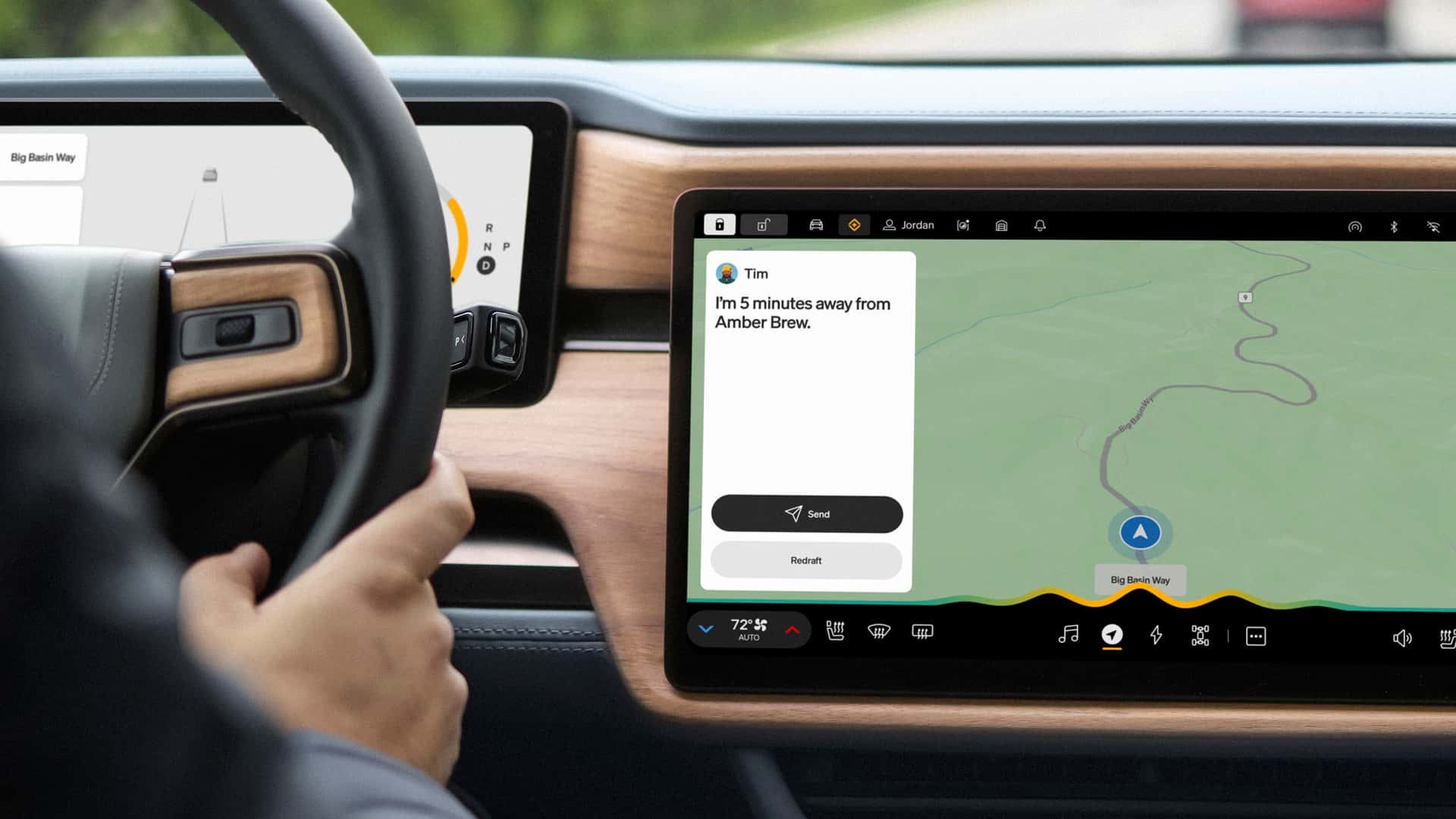
Rivian owners who link their Google accounts can now verbally manage their schedules while driving. This includes moving meetings, setting navigation to upcoming appointments, and relaying calendar event information via text message—all hands-free. This capability transforms the vehicle from a mere mode of transport into a dynamic mobile office and personal assistant, significantly enhancing convenience and productivity on the go.
Availability and Future Prospects for Rivian’s AI Voice Assistant
The Rivian Assistant is currently being rolled out to all existing Gen 1 and Gen 2 R1S and R1T vehicles. For owners to access this advanced feature, an active connectivity subscription is required, ensuring that the vehicle remains connected to Rivian’s cloud services for continuous updates and AI processing.
Looking ahead, the Rivian Assistant is slated to be a foundational technology for the forthcoming R2 platform. When the R2 launches to customers in the coming weeks, its owners will benefit from this sophisticated AI right from the start, further solidifying Rivian’s commitment to cutting-edge in-car technology across its product lineup.
This strategic rollout not only enhances the value proposition for current Rivian owners but also positions the brand as a leader in integrated automotive AI solutions. The continuous evolution of this technology, with future integrations and expanded capabilities, promises to redefine the intelligent driving experience for Rivian customers.
FAQ Section
What is the Rivian Assistant?
The Rivian Assistant is an advanced AI-powered voice assistant developed in-house by Rivian. It enables natural language interaction with your R1S or R1T vehicle, allowing for intuitive control of various vehicle functions and access to information.
Which Rivian models currently support the AI voice assistant?
The Rivian Assistant is currently rolling out to all Gen 1 and Gen 2 Rivian R1S and R1T vehicles via an over-the-air software update. It will also be available in the upcoming Rivian R2 model upon its customer launch.
Do I need a subscription to use the Rivian Assistant?
Yes, an active connectivity subscription is required for Rivian owners to access and utilise the full functionalities of the new AI voice assistant in their vehicles.
What kind of commands can the Rivian Assistant handle?
The assistant can handle complex, multi-step natural language commands. This includes adjusting drive modes, viewing vehicle cameras, asking for points of interest, answering general knowledge questions, and providing vehicle-specific information like an owner’s manual.
What is ‘agentic capability’ in the Rivian Assistant?
‘Agentic capability’ refers to the assistant’s ability to connect with and manage external services. Google Calendar is the first integration, allowing users to move meetings, navigate to appointments, and relay calendar information using voice commands.
How does Rivian Assistant compare to other in-car AI systems?
Rivian Assistant differentiates itself through deep integration directly into the vehicle’s hardware and software, offering more comprehensive control over vehicle functions compared to basic voice tools found in phone-mirroring systems or general AI chatbots.
When was the Rivian Assistant originally expected to launch?
Rivian had initially announced that its AI voice assistant would debut in early 2026. However, the company has accelerated its release, making the feature available to customers much sooner through its latest software update in 2024.