
Key Takeaways
- Rivian has commenced the rollout of its in-house AI-powered voice assistant, the Rivian Assistant, to all Gen 1 and Gen 2 R1S SUVs and R1T trucks via a recent over-the-air software update.
- The Rivian Assistant offers advanced natural-language processing capabilities, allowing for more intuitive and complex voice commands compared to conventional in-vehicle systems.
- This innovative system is deeply integrated into the vehicle’s hardware and software, providing comprehensive control over various vehicle functions, navigation, and general knowledge queries.
- A significant feature is its ‘agentic capability,’ demonstrated through its initial integration with Google Calendar, enabling voice-activated management of appointments and communications.
- Future Rivian models, including the anticipated R2, will also incorporate the Rivian Assistant, contingent upon an active connectivity subscription for optimal functionality.
BENGALURU: Electric vehicle manufacturer Rivian has officially begun deploying its sophisticated in-house AI voice assistant, dubbed the Rivian Assistant, to its fleet of R1S SUVs and R1T pickup trucks. The eagerly anticipated feature, first announced at the company’s Autonomy & AI Day in December, is now reaching owners through a seamless over-the-air software update, significantly ahead of its initially projected early 2026 availability.
This rollout marks a pivotal step in Rivian’s strategy to enhance the in-vehicle user experience, bringing advanced natural-language interaction to its electric vehicles. The introduction of the Rivian Assistant positions the company alongside other automotive industry leaders who are increasingly leveraging artificial intelligence to redefine how drivers and passengers interact with their vehicles.
The Dawn of Next-Generation In-Vehicle AI
The automotive sector is witnessing a rapid evolution in voice assistant technology, with AI chatbots at the forefront. Major players like General Motors, Volvo, and Polestar recently confirmed the integration of Google Gemini into their vehicles, while newer Tesla models feature xAI’s Grok. Rivian’s approach with its in-house AI, the Rivian Assistant, distinguishes itself through a deeper level of vehicle integration.
Unlike many basic voice command tools that often rely on phone-mirroring systems, the Rivian Assistant is intrinsically built into the vehicle’s proprietary hardware and software architecture. This foundational integration grants it unparalleled access and control over virtually every aspect of the vehicle, enabling a holistic and responsive user interface.
Proprietary and Collaborative AI Architecture
The operational backbone of the Rivian Assistant is a sophisticated blend of both proprietary in-house AI models and carefully selected external AI technologies. This hybrid approach ensures robust performance across a diverse range of tasks, from intricate vehicle controls to general knowledge queries, establishing the Rivian Assistant as a comprehensive digital co-pilot.
This strategic combination allows Rivian to maintain core control over critical vehicle functions while benefiting from the broader capabilities offered by established AI platforms. The result is a system designed for both precision in vehicle management and versatility in information retrieval.
Unlocking Advanced Capabilities with Rivian Assistant
The capabilities of the Rivian Assistant extend far beyond traditional voice recognition systems, which are typically limited to a handful of predefined functions and rigid command structures. As demonstrated during prior technology events, the Rivian Assistant facilitates a more fluid and intuitive interaction, responding to natural speech patterns.
Owners can activate the system by simply saying, “Hey Rivian,” or by pressing a dedicated button on the steering wheel. This initiates access to a broad spectrum of functions, enabling drivers to vocalize commands for actions such as adjusting drive modes, viewing live feeds from vehicle cameras, or retrieving information about points of interest along a route.
Executing Complex Multi-Step Commands
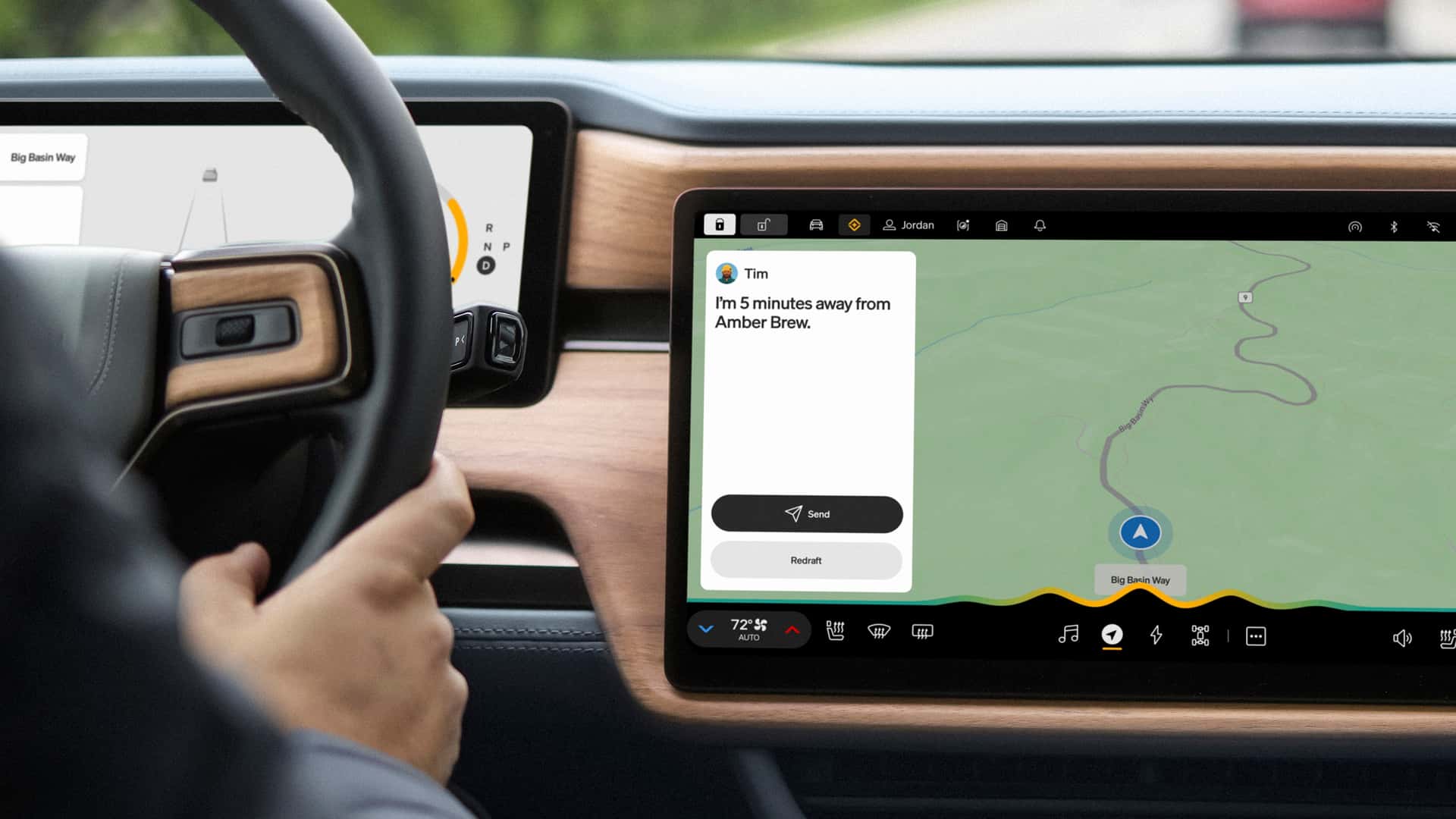
A hallmark of the Rivian Assistant’s advanced design is its ability to process and execute complex, multi-step commands. For instance, a driver can issue a single instruction to send a friend a compilation of restaurant recommendations along with their estimated time of arrival (ETA) derived directly from the navigation system. This capability streamlines in-car tasks, minimizing distractions and enhancing safety.
Furthermore, the assistant is engineered to remember conversational context. This means it can follow up on previous inquiries or commands, providing a more coherent and natural dialogue flow. Beyond vehicle-specific operations, the Rivian Assistant can also act as a general knowledge repository, answering a wide array of questions akin to leading AI chatbots like ChatGPT.
Your Vehicle’s Integrated Encyclopedia
Rivian envisions the assistant as an indispensable resource, effectively serving as an “encyclopedia for your vehicle.” This feature significantly reduces the need for drivers to consult physical or digital owner’s manuals, offering immediate, voice-activated access to essential vehicle information. For example, a driver can simply ask their vehicle how to change a tire, receiving instant, guided instructions without diverting attention from the road or requiring manual searches.
Agentic Capabilities: Integrating with Your Digital Life
What truly distinguishes the Rivian Assistant in the competitive landscape of in-vehicle AI is its pioneering “agentic capability.” This feature allows the assistant to connect with and manage various external services, moving beyond mere information retrieval to actively performing tasks on behalf of the user.
The initial and most prominent integration in this category is with Google Calendar. This groundbreaking connectivity empowers Rivian owners, upon linking their Google accounts, to manage their schedules entirely through voice commands while driving. Users can effortlessly move meetings, navigate directly to upcoming appointments, or relay crucial calendar information via text messages, all without physical interaction with screens or devices.
Rivian has indicated plans to progressively integrate additional services into the Assistant over time, promising an expanding ecosystem of interconnected functionalities. This forward-looking approach underscores the company’s commitment to creating a seamlessly integrated digital experience within its vehicles.
Availability and Future Prospects
The Rivian Assistant is currently being deployed to both Gen 1 and Gen 2 models of the R1S and R1T. This broad availability ensures that a significant portion of Rivian’s existing customer base can immediately benefit from these advanced features.
Looking ahead, the Rivian Assistant is slated to be a core feature in the upcoming R2 model, which is expected to launch to customers in the coming weeks. This continuity across product lines highlights Rivian’s long-term vision for a consistent and high-tech user experience.
It is important for Rivian owners to note that the full functionality of the Rivian Assistant requires an active connectivity subscription. This subscription ensures continuous access to the external AI models and online services that power many of the assistant’s advanced capabilities. Rivian encourages owners who gain access to the new assistant to provide feedback on their experience, fostering a continuous improvement cycle for this evolving technology.
Frequently Asked Questions (FAQ)
What is the Rivian Assistant?
The Rivian Assistant is an advanced, AI-powered voice assistant developed in-house by Rivian. It enables natural language interaction with your R1S or R1T vehicle, allowing you to control various functions, access information, and manage integrated services using voice commands.
Which Rivian models are receiving the Rivian Assistant?
The Rivian Assistant is rolling out to all existing Gen 1 and Gen 2 R1S SUVs and R1T pickup trucks through a recent over-the-air software update. It will also be integrated into the upcoming Rivian R2 model upon its launch.
How does the Rivian Assistant differ from other in-vehicle voice assistants?
Unlike basic voice tools, the Rivian Assistant is deeply integrated into the vehicle’s hardware and software. This allows for more comprehensive control over vehicle functions, multi-step commands, contextual understanding, and unique ‘agentic capabilities’ like direct Google Calendar integration, setting it apart from many phone-mirroring systems.
What are some key functionalities of the Rivian Assistant?
Users can adjust drive modes, view vehicle cameras, get information about points of interest, ask general knowledge questions, and even inquire about vehicle maintenance (like changing a tire). Its ability to process complex, multi-step commands and remember context enhances the overall user experience significantly.
Does the Rivian Assistant require a subscription?
Yes, to access and fully utilize the advanced features of the Rivian Assistant, owners will need to have an active connectivity subscription. This subscription facilitates the necessary online services and external AI model interactions that power the assistant’s capabilities.
What is the ‘agentic capability’ of the Rivian Assistant?
The agentic capability allows the Rivian Assistant to not just retrieve information but to actively perform tasks by connecting with external services. Its first implementation is with Google Calendar, enabling users to move meetings, navigate to appointments, and send calendar details via text, all through voice commands.