
Key Takeaways (TL;DR)
- Researchers at Hanyang University have established 2.5 nanometers as the optimal minimum thickness for Lithium Niobium Oxide (LNO) coatings, crucial for protecting cathode materials in next-generation sulfide solid-state batteries.
- This precise coating, applied via rotary powder atomic layer deposition (ALD), significantly suppresses side reactions between reactive sulfide solid electrolytes and NCM811 cathodes.
- The 2.5 nm LNO layer demonstrated a 43% extension in battery cycle life and reduced interfacial resistance by over 50% compared to uncoated cells, offering a practical guideline for interface optimization.
- Thinner coatings (1.0 nm) proved insufficient, leading to faster degradation, while thicker ones (5.0 nm) offered no additional benefit and reduced initial capacity.
- The findings mark a critical step towards developing high-performance, long-lasting, and safer solid-state batteries for electric vehicles and other applications.
SEO Keyword: sulfide solid-state battery
A significant barrier to the widespread adoption of sulfide-based all-solid-state batteries, particularly their cathode interface stability, has been quantitatively addressed by researchers at Hanyang University. Their groundbreaking study has identified a precise 2.5 nanometer (nm) thickness as the minimum requirement for a protective Lithium Niobium Oxide (LNO) coating to effectively shield cathode materials, providing a crucial quantitative benchmark previously missing in the field.

This breakthrough is poised to accelerate the development of next-generation energy storage solutions, offering a clearer pathway towards high-performance, durable, and safer electric vehicle (EV) batteries. Solid-state batteries promise superior energy density, enhanced safety, and faster charging capabilities compared to conventional lithium-ion counterparts, making research into their stability paramount.
Addressing the Core Challenge of Sulfide Solid-State Batteries
Sulfide solid electrolytes are highly promising components for all-solid-state batteries due to their high ionic conductivity, which is comparable to that of liquid electrolytes. However, a major hurdle has been their inherent chemical reactivity, particularly at the interface with cathode active materials such as NCM811. This reactivity leads to the generation of resistive degradation products upon contact, which dramatically shortens the battery’s cycle life and increases interfacial resistance, thereby impeding overall performance.
Preventing these detrimental side reactions is critical for unlocking the full potential of sulfide solid-state battery technology. Researchers have explored various protective coatings to act as diffusion barriers, but a clear understanding of the minimum effective thickness required for such a barrier has remained elusive until now, leaving engineers to rely on approximations or trial-and-error approaches.

Hanyang University’s Innovative Coating Strategy
The Hanyang University team, led by Professor Tae Joo Park, focused on applying Lithium Niobium Oxide (LNO) coatings to NCM811 cathode powders. NCM811 is a nickel-rich lithium nickel cobalt manganese oxide, a common high-energy cathode material in advanced lithium-ion batteries, making its integration into solid-state systems highly desirable.
The chosen deposition method was rotary powder atomic layer deposition (ALD). This advanced technique allows for the precise, conformal deposition of ultra-thin films on powder particles, layer by atomic layer. The researchers utilized a supercycle ALD method, meticulously alternating lithium and niobium deposition steps with ozone. This process ensured exceptional control over the composition and thickness of the LNO coating, which is essential for achieving optimal protective properties without compromising electrochemical performance.
Methodology: Testing Varied LNO Thicknesses
To pinpoint the optimal protective layer, the Hanyang team systematically deposited LNO coatings at three distinct thicknesses: 1.0 nm, 2.5 nm, and 5.0 nm. Each of these coated cathode powders was then integrated into all-solid-state battery cells, and their electrochemical performance, particularly initial discharge capacity, cycle life, and interfacial resistance, was rigorously evaluated against an uncoated cell benchmark.
The experimental design allowed for a direct comparison of how varying LNO coating thicknesses impacted the suppression of side reactions and the overall durability of the sulfide solid-state battery cells.
Key Findings: The 2.5 nm Sweet Spot
The results revealed a clear trade-off between initial discharge capacity and long-term cycle stability, intricately linked to the LNO coating thickness. The 1.0 nm coating initially delivered the highest discharge capacity, reaching 229 mAh g⁻¹. However, this apparent advantage was short-lived, as the cycle life of these cells was 28% shorter than those with a 2.5 nm coating. Furthermore, spectroscopic analysis confirmed that at 1.0 nm, the coating was simply too thin to effectively prevent electrolyte contact and suppress side reactions, leading to an interfacial resistance that was 59% higher than the 2.5 nm cells.
In stark contrast, cells equipped with the 2.5 nm LNO coating achieved an initial capacity of 216 mAh g⁻¹. Crucially, these cells demonstrated a significant improvement in cycle life, extending it by an impressive 43% compared to the uncoated cells. Moreover, the interfacial resistance was cut to less than half that of the uncoated baseline, indicating highly effective suppression of deleterious side reactions. This thickness proved to be the ideal balance between protection and maintaining high energy density.
Pushing the thickness further to 5.0 nm resulted in a slight reduction in initial capacity to 207 mAh g⁻¹, with no meaningful additional gain in cycle life compared to the 2.5 nm cells. This suggests that while a thicker coating provides robust protection, there is a diminishing return, and the increased inert material slightly compromises the overall energy storage capacity.
Impact and Future Implications for Battery Development
The study’s findings provide a critical quantitative guideline for optimizing the cathode–electrolyte interface in next-generation solid-state batteries. Professor Tae Joo Park, who spearheaded the research, affirmed the significance of their work, stating: “Our results show that the minimum effective thickness of the LNO protective layer to suppress side reactions in sulfide-based ASSBs is 2.5 nm. This provides a practical guideline for cathode–electrolyte interface optimization in next-generation solid-state batteries.”
This precision engineering approach can help accelerate the design and fabrication of more stable and efficient sulfide solid-state battery cells. By clearly defining the optimal coating parameters, researchers and manufacturers can avoid wasteful experimentation with sub-optimal thicknesses, streamlining the development process and focusing resources on other challenging aspects of solid-state battery commercialization.
The integration of LNO coatings using powder ALD also holds significant promise for scalable manufacturing processes. While the transition from lab-scale research to gigafactory integration remains an open challenge for many advanced battery technologies, the ALD method’s inherent precision and ability to coat large quantities of powder make it a strong candidate for future industrial applications. Addressing manufacturing scalability is vital for solid-state batteries to compete with and eventually replace traditional lithium-ion batteries in the mass market, particularly for electric vehicles.
Moving Towards Robust Electric Vehicle Power
The development of a stable cathode interface is one of the most pressing challenges in advancing sulfide solid-state battery technology. Overcoming this obstacle paves the way for batteries that are not only safer due to the absence of flammable liquid electrolytes but also offer higher energy densities, translating to longer driving ranges for electric vehicles. Furthermore, improved interface stability directly contributes to extending the battery’s lifespan, reducing the total cost of ownership for EVs and diminishing the environmental impact associated with battery replacement.
This research from Hanyang University represents a crucial step forward in establishing the fundamental engineering principles required to bring these advanced battery systems from the laboratory to commercial reality. It underscores the importance of precise material science and engineering in unlocking the full potential of next-generation energy storage solutions for a sustainable future.
The study was published in the prestigious scientific journal Energy Storage Materials.
Source: Hanyang University / Energy Storage Materials
Frequently Asked Questions (FAQs)
What is a sulfide solid-state battery?
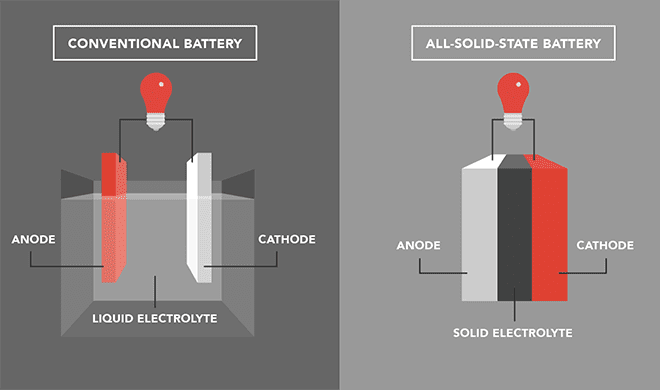
A sulfide solid-state battery is a type of electric battery that uses a solid electrolyte made of sulfide materials instead of the flammable liquid electrolytes found in conventional lithium-ion batteries. This design promises enhanced safety, higher energy density, and potentially faster charging, making it a highly sought-after technology for electric vehicles and portable electronics.
Why is the cathode interface a problem in sulfide solid-state batteries?
The cathode interface in sulfide solid-state batteries is problematic because sulfide solid electrolytes can be chemically reactive when in direct contact with cathode active materials like NCM811. This reaction generates resistive degradation products, which increase internal resistance, hinder ion flow, and significantly reduce the battery’s cycle life and overall performance.
What is Lithium Niobium Oxide (LNO) and how does it help?
Lithium Niobium Oxide (LNO) is a ceramic material used as a protective coating in solid-state batteries. It acts as a stable diffusion barrier between the reactive sulfide solid electrolyte and the cathode material. By preventing direct contact, LNO suppresses unwanted chemical side reactions, thereby reducing interfacial resistance and extending the battery’s cycle life.
What is Atomic Layer Deposition (ALD) and why was it used?
Atomic Layer Deposition (ALD) is a thin-film deposition technique that enables the precise, layer-by-layer growth of materials on a substrate. Researchers used rotary powder ALD because it allows for uniform, conformal coating of individual cathode powder particles. This method offers exceptional control over coating thickness and composition, crucial for optimizing the protective LNO layer.
What was the optimal LNO coating thickness identified by the study?
The Hanyang University study identified 2.5 nanometers (nm) as the minimum effective and optimal thickness for the LNO protective layer. Coatings thinner than 2.5 nm were insufficient to suppress side reactions, while thicker coatings (e.0 nm) offered no significant additional performance benefits and slightly reduced initial discharge capacity.
What are the main benefits of this research finding?
This research provides a quantitative, practical guideline for engineers and scientists developing sulfide solid-state batteries. By defining the optimal LNO coating thickness, it can accelerate the development of more stable, efficient, and long-lasting solid-state batteries. This directly contributes to improving battery safety, energy density, and overall performance for future electric vehicles and other advanced energy storage applications.
What are the next steps for this technology?
While the research provides a critical guideline, the next steps involve further optimizing LNO composition and deposition parameters, and exploring its integration into larger-scale battery prototypes. A key challenge remains the scalable manufacturing of these precisely coated powders for mass production, especially for gigafactory-level integration, to bring this technology to commercial viability.