
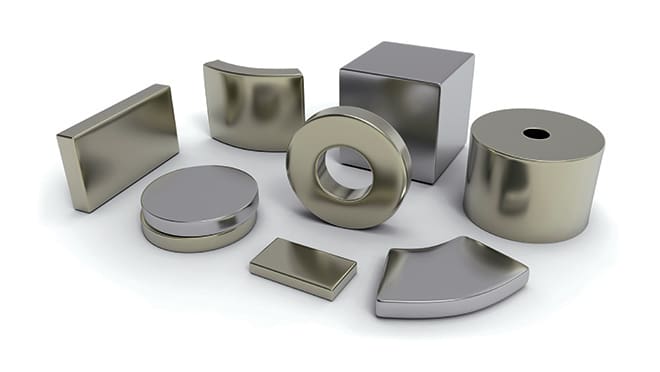
A significant hurdle in the design of high-power electric vehicle (EV) motors, linked to the limitations of Neodymium-Iron-Boron (Nd-Fe-B) magnets, has reportedly been overcome by researchers at the Korea Institute of Materials Science (KIMS). The team has introduced an innovative process that ensures uniform high-temperature coercivity throughout thick magnets, critical for advanced EV powertrains and other large-format electrical applications.
This breakthrough in Nd-Fe-B magnet technology addresses a long-standing ‘scaling problem’ where traditional methods for enhancing magnetic properties only proved effective near the surface. As EV motors demand thicker magnets for increased torque and power, the internal core of these magnets would degrade prematurely, compromising overall performance. The new ‘sandwich-structured grain boundary diffusion process’ promises to fundamentally change how these powerful magnets are manufactured and utilized.

Key Takeaways
- Korean researchers at KIMS have developed a novel ‘sandwich-structured grain boundary diffusion process’ for Nd-Fe-B magnets.
- This innovation solves the critical ‘thick-magnet coercivity problem,’ ensuring uniform magnetic strength throughout the magnet’s cross-section.
- The new method integrates a praseodymium-based light rare earth alloy at both external and internal interfaces, improving high-temperature performance.
- It simultaneously suppresses eddy currents by creating a high-resistivity internal structure, enhancing magnet efficiency and durability.
- The process simplifies manufacturing by collapsing three conventional operations (segmentation, grain boundary diffusion, insulating bonding) into a single step.
- It reduces reliance on expensive and geopolitically sensitive heavy rare earth elements by utilizing more abundant praseodymium.
Addressing the Core Challenge of High-Power Magnets
Nd-Fe-B magnets are indispensable for high-performance EV motors due to their exceptional magnetic strength. However, their efficacy in demanding environments, particularly those involving high temperatures and opposing magnetic fields, hinges on a property called coercivity. High coercivity allows a magnet to retain its magnetization despite these challenging conditions. In EV motors, where rapid acceleration and sustained high speeds generate considerable heat, maintaining this coercivity is paramount.
Conventional approaches to enhance high-temperature coercivity typically involve a grain boundary diffusion (GBD) process. This method introduces heavy rare earth elements, such as dysprosium or terbium, to the magnet’s surface, where they diffuse inward, strengthening the magnetic properties. The critical flaw, however, has been the limited penetration depth of this diffusion. In essence, the exterior of a thick magnet would benefit, while its crucial interior remained vulnerable to demagnetization.
This discrepancy meant that the core of thicker magnets, intended for higher power output, effectively worked against the desired performance, leading to an overall underperformance of the entire component. This ‘scaling problem’ has been a significant impediment to advancing the power density and efficiency of EV traction motors, industrial motors, and large-scale generators.

The Innovative Sandwich-Structured Grain Boundary Diffusion Process
The solution devised by the KIMS team, led by researchers Su-Min Kim and Jung-Goo Lee, fundamentally rethinks the GBD process. Instead of diffusing elements solely from the surface, their method strategically positions the diffusion source *within* the magnet itself.
This is achieved by stacking multiple magnet layers. During the assembly, a praseodymium-based light rare earth alloy is applied not only to the outer surfaces of the stacked magnet but crucially, also at the interlayer interfaces between each segment. Once bonded together, this innovative configuration allows diffusion to initiate from these internal boundaries as well as the external ones. The result is a uniformly distributed build-up of coercivity throughout the magnet’s entire cross-section, ensuring consistent and robust performance even in very thick magnets.
Uniform Coercivity: The Performance Differentiator
The ability to achieve uniform coercivity across the full thickness of an Nd-Fe-B magnet is a game-changer for EV engineering. It means that every part of the magnet contributes optimally to the motor’s performance, preventing localized degradation that could otherwise lead to a loss of magnetization and subsequent power reduction. This uniformity directly translates into more reliable, powerful, and efficient electric motors capable of handling greater torque and sustained high-speed operations.
Simultaneous Mitigation of Eddy Currents
Beyond addressing the coercivity challenge, the KIMS innovation simultaneously tackles another critical issue in high-speed motor operation: eddy currents. These localized electrical currents are induced within the magnet as it moves through a varying magnetic field, generating parasitic heat that further degrades performance and can lead to energy losses.
The layer boundaries formed during the sandwich-structured diffusion process are not merely interfaces for chemical diffusion. They inherently create a high-resistivity structure within the magnet. This increased electrical resistance effectively suppresses the formation and circulation of eddy currents. By impeding these unwanted currents, the new Nd-Fe-B magnet technology helps maintain cooler operating temperatures, enhance efficiency, and extend the magnet’s lifespan.
Streamlining Manufacturing and Cost Efficiency
The dual functionality of the KIMS process offers significant advantages in manufacturing. Traditionally, addressing these challenges would require a sequence of operations: segmentation of magnets to manage eddy currents, the grain boundary diffusion process for coercivity, and then insulating bonding to assemble the segments and further control current flow. The new method collapses these three distinct and often complex operations into a single, integrated step. This streamlining can lead to reduced manufacturing complexity, lower production costs, and potentially faster production cycles for high-performance permanent magnets.
Strategic Shift from Heavy to Light Rare Earths
A notable environmental and geopolitical advantage of this new Nd-Fe-B magnet technology lies in its material composition. Current industry standards for enhancing high-temperature coercivity heavily rely on expensive and strategically critical heavy rare earth elements (HREEs) like dysprosium and terbium. These elements are not only costly but also almost entirely sourced from a single geographic region, raising concerns about supply chain stability and geopolitical dependence.
The KIMS process utilizes praseodymium, a lighter and more abundant rare earth element, as the primary diffusion medium. By effectively leveraging praseodymium to achieve comparable or superior performance, the technology significantly reduces the dependence on scarce and costly HREEs. This shift has profound implications for the sustainability and economic viability of the permanent magnet industry, offering a more resilient and cost-effective supply chain for critical EV components.
Broad Applications and Future Outlook
While specific coercivity and resistivity values were not disclosed in the initial announcement, the potential applications of this advanced Nd-Fe-B magnet technology are extensive. Beyond EV traction motors, the researchers anticipate its utility in a range of high-power systems, including industrial motors, large-scale wind generators, and even massive applications like electric ship propulsion systems.
The successful implementation of this research could unlock new possibilities for power density and efficiency across various sectors reliant on advanced magnetic materials. The KIMS team confirms that follow-up work is currently underway, focusing on the practical integration of this technology into real-world motor systems, marking a crucial step towards commercialization.
The findings of this pioneering study were formally published in the scientific journal *Scripta Materialia* on March 18, 2026, marking a significant milestone in the field of advanced materials science and EV engineering.
Frequently Asked Questions (FAQ)
What is the primary problem this Nd-Fe-B magnet technology solves?
The primary problem solved is the ‘scaling problem’ of Nd-Fe-B magnets for high-power applications. Traditional grain boundary diffusion processes only improve coercivity near the surface, leaving the core of thick magnets vulnerable to demagnetization, which degrades overall performance in demanding environments like EV motors.
How does the ‘sandwich-structured grain boundary diffusion process’ work?
This process involves stacking multiple magnet layers and applying a praseodymium-based alloy at both the outer surface and the internal interlayer interfaces before bonding. This allows the diffusion process to initiate from inside the magnet, ensuring uniform coercivity buildup throughout its entire cross-section, not just the surface.
What is coercivity, and why is it important for EV motors?
Coercivity is a measure of a magnetic material’s resistance to demagnetization. For EV motors, high coercivity is crucial because it allows magnets to maintain their magnetic strength under the intense heat and opposing magnetic fields generated during high-speed and high-torque operation, ensuring consistent motor performance.
How does this new technology address eddy currents?
The layer boundaries formed during the sandwich-structured diffusion process inherently create a high-resistivity internal structure within the magnet. This increased electrical resistance effectively suppresses the formation of eddy currents, which are parasitic currents that generate heat and reduce efficiency in high-speed motor operation.
What are the manufacturing benefits of this innovation?
The technology collapses three conventional manufacturing operations—segmentation (to reduce eddy currents), grain boundary diffusion (for coercivity), and insulating bonding—into a single integrated step. This streamlining can lead to reduced manufacturing complexity, lower production costs, and potentially faster production cycles for advanced magnets.
How does this innovation impact the use of rare earth elements?
The KIMS process uses praseodymium, a lighter and more abundant rare earth element, as the diffusion medium, rather than expensive and geopolitically sensitive heavy rare earth elements like dysprosium and terbium. This reduces reliance on a concentrated supply chain and offers a more sustainable and cost-effective solution for magnet production.
What are the potential applications for this advanced magnet technology?
Beyond EV traction motors, the technology is applicable to various high-power systems. These include industrial motors, large-scale wind generators, and significant applications such as electric ship propulsion, indicating its potential to enhance efficiency and performance across multiple sectors.