
Key Takeaways
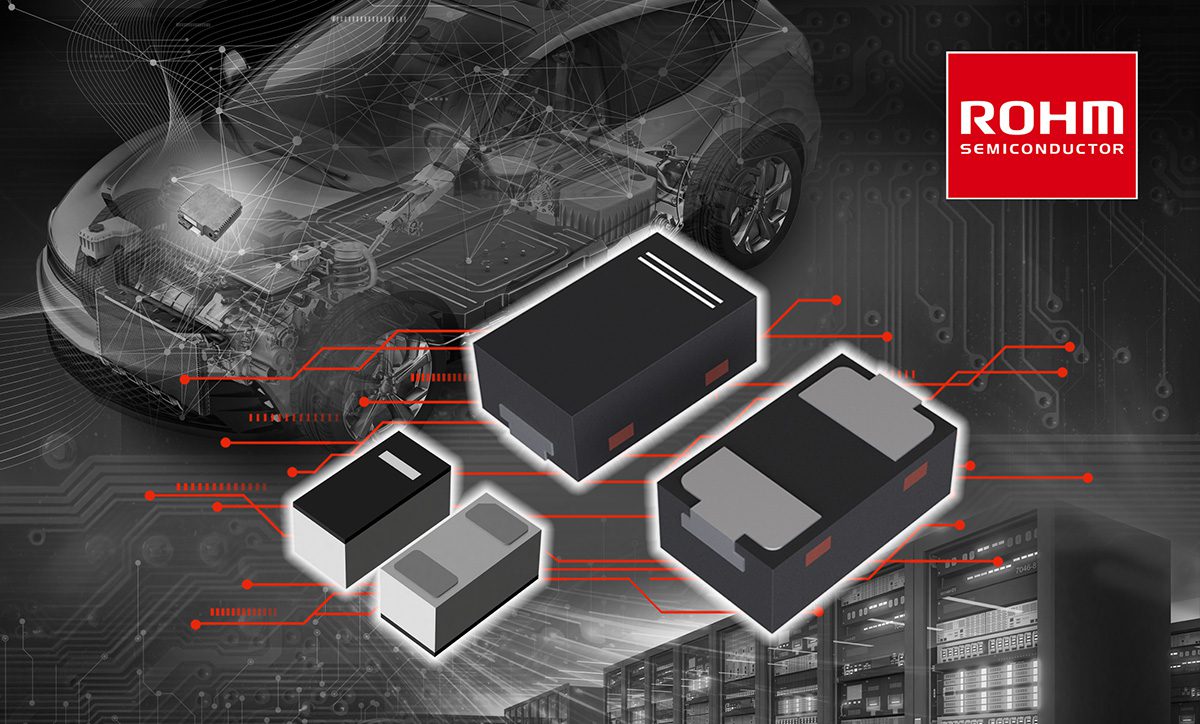
- ROHM Semiconductor has launched the RESDxVx series, a new line of ESD protection diodes engineered for high-speed interfaces operating at and above 10 Gbps.
- These innovative ESD diodes overcome a critical design challenge by combining ultra-low terminal capacitance (0.24 pF bidirectional, 0.48 pF unidirectional) with a low dynamic resistance of 0.28 Ω.
- This unique combination results in an approximately 40% lower clamping voltage compared to conventional products, providing superior protection without signal distortion.
- Automotive-qualified variants are AEC-Q101 certified, making them ideal for ADAS, autonomous driving cameras, surround view systems, and ECUs utilizing SerDes communication.
- Non-automotive versions extend their utility to AI servers, data center switches, 5G/6G base stations, and consumer interfaces such as USB4, Thunderbolt 4, PCIe, HDMI, DisplayPort, and MIPI D-PHY/C-PHY.
Revolutionizing High-Speed Interface Protection with ROHM’s New ESD Diodes
ROHM Semiconductor, a global leader in semiconductor innovation, has announced a significant breakthrough in circuit protection with the introduction of its new RESDxVx series of ESD protection diodes. These advanced components are specifically engineered to safeguard high-speed interfaces that transmit data at rates exceeding 10 gigabits per second (Gbps), a critical requirement in the rapidly evolving automotive and data communications sectors.
The development addresses a longstanding challenge in high-speed circuit design: balancing robust electrostatic discharge (ESD) protection with the imperative to maintain signal integrity. ROHM’s new series promises to deliver both, setting a new benchmark for device protection in cutting-edge applications.

The Intricacies of High-Speed Data Transmission and ESD Protection
As data rates continue to climb in modern electronic systems, the demands on component performance become increasingly stringent. Interfaces operating above 10 Gbps are particularly susceptible to signal degradation caused by even minute parasitic capacitances. These unwanted capacitances can distort high-frequency signal waveforms, leading to data errors, reduced system reliability, and diminished performance.
Traditionally, designers faced a difficult trade-off when selecting ESD protection diodes. Reducing the terminal capacitance, which is crucial for preserving signal integrity at high speeds, often came at the expense of increased dynamic resistance. A higher dynamic resistance, in turn, weakens the clamping response of the diode, leaving sensitive downstream integrated circuits (ICs) more vulnerable to damaging overstress events caused by ESD.
This conundrum forced engineers to compromise, either sacrificing some level of signal quality for better protection or accepting higher risks of ESD-induced damage for optimal signal transmission. The need for a solution that effectively mitigates both challenges has become paramount in industries relying on lightning-fast data processing.
ROHM’s Innovative Solution: The RESDxVx Series Unveiled
The RESDxVx series of ESD protection diodes represents a pivotal advancement in overcoming this traditional design dilemma. ROHM Semiconductor reports that these new devices achieve an exceptional balance between low terminal capacitance and low dynamic resistance.
Specifically, the bidirectional variants boast a terminal capacitance of merely 0.24 picofarads (pF), while the unidirectional versions offer 0.48 pF. Both types maintain an impressively low dynamic resistance of 0.28 ohms (Ω). This combination of specifications is particularly noteworthy because it defies the conventional inverse relationship between these two critical parameters.
According to ROHM, the innovative design allows the RESDxVx series to deliver a clamping voltage approximately 40% lower than that of conventional competing products at equivalent capacitance levels. A lower clamping voltage means that the diode can suppress ESD events more effectively, diverting harmful current away from protected ICs faster and more efficiently, thereby significantly enhancing device longevity and system reliability.
Ensuring Automotive Reliability: AEC-Q101 Certification
The automotive industry stands as a primary beneficiary of these new ESD diodes. With the proliferation of advanced driver-assistance systems (ADAS) and the rapid progress towards autonomous driving, vehicles are increasingly reliant on complex high-speed communication networks.
To meet the rigorous demands of automotive environments, specific variants within the RESDxVx series have earned AEC-Q101 certification. This industry standard signifies that components have undergone stringent reliability testing, ensuring their suitability for harsh automotive conditions, including temperature extremes, vibration, and electrical transients.
The automotive-qualified models, including the RESD3V3BASAFH, RESD5V0BASAFH, RESD3V3UASAFH, and RESD5V0UASAFH, are all provided in compact DFN1006-2W packages. They are precisely tailored for critical automotive applications such as high-resolution cameras in ADAS and surround view systems, as well as electronic control units (ECUs) that employ SerDes (Serializer/Deserializer) communication for high-speed data links.
The robust ESD protection offered by these diodes is essential for the uninterrupted and safe operation of these vital automotive systems, where reliability is not merely a performance metric but a fundamental safety requirement.
Broadening Horizons: Non-Automotive Applications and Versatility
Beyond the automotive sector, the RESDxVx series extends its protective capabilities to a broad spectrum of high-speed communication infrastructure and consumer electronics. Non-automotive variants, available in the even smaller DSN0603-2J package, are designed to cater to the burgeoning needs of data centers and next-generation communication networks.
Key target applications include high-performance AI servers, where massive amounts of data are processed at incredible speeds, and data center switches, which form the backbone of modern internet infrastructure. These diodes are also critical for 5G and future 6G base stations, ensuring the integrity of the high-frequency signals that power advanced wireless communication.
Furthermore, the RESDxVx series provides essential ESD protection for a wide array of consumer interfaces that demand high data throughput. This includes cutting-edge standards such as USB4, Thunderbolt 4, PCIe, HDMI, DisplayPort, and MIPI D-PHY/C-PHY. As devices become more interconnected and data-intensive, the need for robust and efficient ESD protection diodes like ROHM’s new offering becomes increasingly pronounced across all sectors.
The Significance of Robust ESD Protection in Modern Electronics
Electrostatic discharge events, though often unseen, pose a significant threat to the integrity and longevity of electronic devices. A single ESD strike can introduce high voltage and current spikes that can permanently damage sensitive semiconductor components, leading to device failure, costly repairs, or even complete system shutdowns.
In high-speed communication systems, where data integrity is paramount, inadequate ESD protection can result in corrupted data, intermittent connectivity, or a complete loss of signal. This is particularly critical in applications like ADAS, where real-time data processing is vital for safety, or in data centers, where even minor interruptions can have vast economic consequences.
ROHM’s RESDxVx series of ESD diodes underscores the company’s commitment to advancing semiconductor technology, ensuring that critical electronic systems can operate reliably and efficiently, even in the face of challenging electrical environments. By offering superior protection without compromising signal integrity, these diodes enable the continued innovation and adoption of high-speed digital communication across industries.
Conclusion
The introduction of ROHM’s RESDxVx series marks a pivotal moment in the evolution of ESD protection technology. By successfully addressing the complex trade-off between low capacitance and low dynamic resistance, ROHM has delivered a solution that not only safeguards high-speed interfaces but also ensures their optimal performance.
These new ESD diodes are poised to become indispensable components in the next generation of automotive electronics, AI servers, data centers, 5G/6G infrastructure, and advanced consumer devices. Their ability to protect sensitive ICs while preserving signal integrity at data rates exceeding 10 Gbps will be instrumental in enabling the continued advancement of these critical technologies, promising a future of more reliable and robust electronic systems.
Frequently Asked Questions (FAQs)
Q1: What is the primary advantage of ROHM’s new RESDxVx series ESD protection diodes?
A1: The primary advantage is their ability to combine ultra-low terminal capacitance with low dynamic resistance. This balance results in an approximately 40% lower clamping voltage compared to conventional products, ensuring superior ESD protection without distorting high-speed signals above 10 Gbps.
Q2: What specific capacitance and dynamic resistance values do these ESD diodes offer?
A2: The RESDxVx series offers a terminal capacitance of 0.24 pF for bidirectional variants and 0.48 pF for unidirectional variants. Both types achieve a low dynamic resistance of 0.28 Ω, which is crucial for high-speed data integrity.
Q3: Which automotive applications are targeted by the AEC-Q101 certified variants?
A3: The AEC-Q101 certified automotive variants are designed for critical applications such as ADAS (Advanced Driver-Assistance Systems), autonomous driving cameras, surround view systems, and Electronic Control Units (ECUs) that rely on high-speed SerDes communication.
Q4: Can these new ESD diodes be used in non-automotive applications?
A4: Yes, non-automotive variants of the RESDxVx series are available. They are ideal for demanding applications including AI servers, data center switches, 5G/6G base stations, and a range of consumer interfaces like USB4, Thunderbolt 4, PCIe, HDMI, DisplayPort, and MIPI D-PHY/C-PHY.
Q5: Why is balancing capacitance and dynamic resistance crucial for high-speed interfaces?
A5: At data rates above 10 Gbps, even small parasitic capacitance can distort signal waveforms, causing data errors. However, reducing capacitance traditionally increased dynamic resistance, weakening ESD protection. The RESDxVx series effectively breaks this trade-off, ensuring both signal integrity and robust protection.
Q6: What is the significance of AEC-Q101 certification for these diodes?
A6: AEC-Q101 certification is an industry standard for automotive-grade components. It signifies that the diodes have passed rigorous reliability tests under harsh conditions, ensuring their robustness and dependable performance in safety-critical automotive environments.