
Key Takeaways (TL;DR)
- The Hyundai Staria Load Electric is a new entrant in the commercial EV segment, boasting an 84 kWh battery and a claimed WLTP range of 450 km.
- It features an advanced 800-volt architecture, enabling ultra-fast DC charging from 10% to 80% in just 20 minutes with a suitable 350 kW charger.
- With 4,935 litres of cargo capacity, a 1,005 kg payload, and 2-tonne towing, its practical utility matches its diesel and hybrid counterparts.
- A significant premium of $21,000 over the diesel model presents a considerable challenge for businesses, despite potential long-term savings in running costs and EV tax incentives.
- While offering a refined driving experience and useful V2L functionality, it notably lacks several premium features found in cheaper Staria variants, like a 360-degree camera.
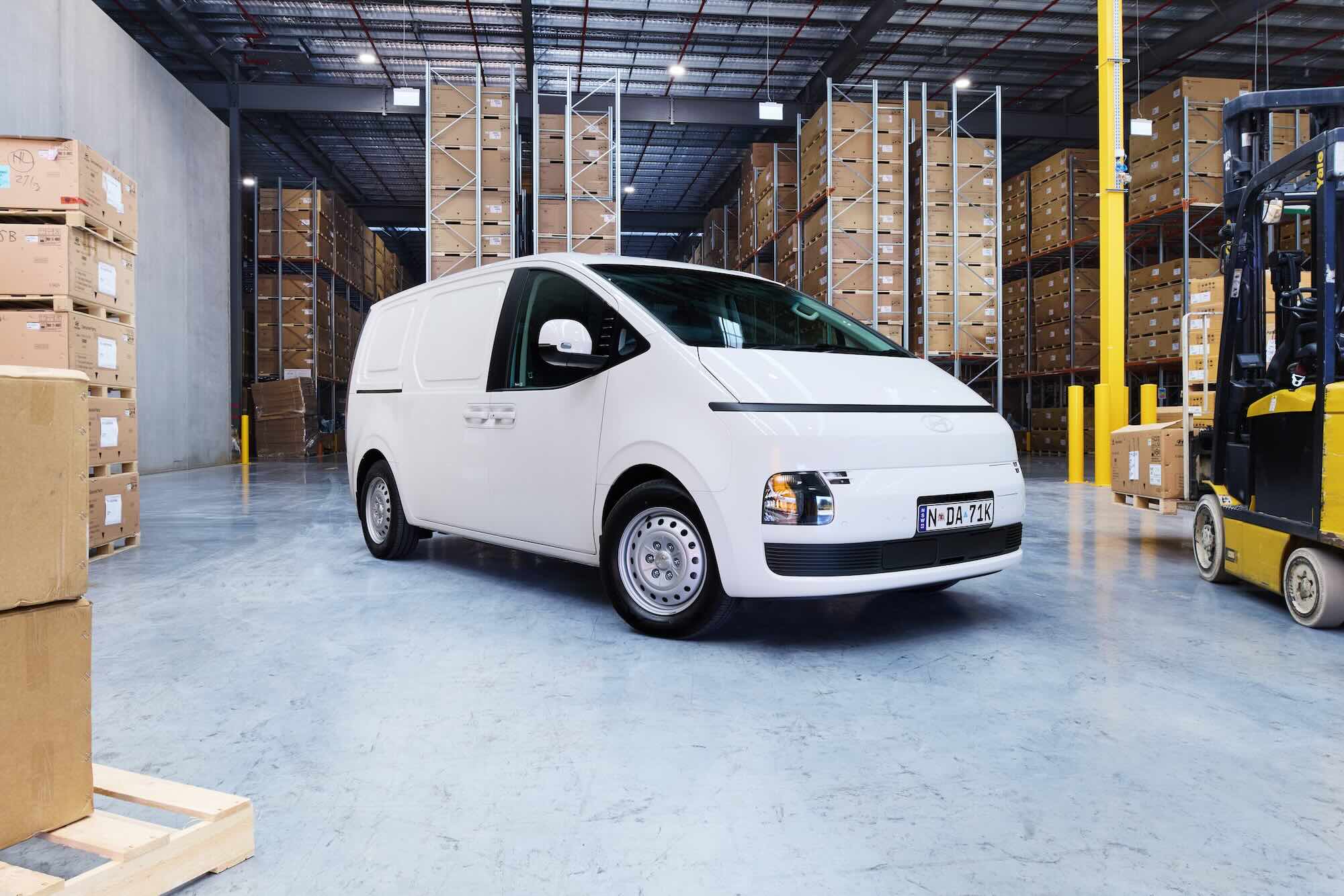
Hyundai has officially introduced the Staria Load Electric, a new all-electric variant of its distinctive commercial van, known for its futuristic aesthetic. This latest addition joins the existing diesel and hybrid versions, marking a significant step in the brand’s commitment to commercial vehicle electrification.

The electric Staria Load brings with it a substantial battery, impressive fast-charging capabilities, and the promise of reduced operating costs inherent to electric vehicles, positioning it as a strong contender in the evolving segment of sustainable transport solutions for businesses.
Evaluating the Electric Premium: Price vs. Value
Despite its advanced features and environmental benefits, the Hyundai Staria Load Electric comes with a notable price tag. Starting at $70,990 before on-road costs, it commands a premium of $21,000 over its diesel counterpart and $17,500 more than the standard hybrid model.
This substantial difference in upfront cost raises questions for commercial operators, who typically prioritize financial viability and total cost of ownership (TCO) in their purchasing decisions. The initial investment is a critical factor for businesses, impacting fleet management strategies and budget allocations.
Long-Term Cost Implications for Businesses
While the purchase price is higher, electric vehicles generally offer significantly lower running costs. This is particularly true for businesses covering extensive daily distances and utilizing affordable overnight depot charging.
Beyond fuel savings, electric powertrains typically require less maintenance compared to traditional internal combustion engines, potentially leading to substantial long-term savings. For fleet operators, these combined savings, alongside existing EV tax incentives in certain regions, could eventually offset the initial premium, making the Hyundai Staria Load Electric a viable option over its lifecycle.
Performance, Range, and Rapid Charging Capabilities
Underpinning the Hyundai Staria Load Electric is an 84 kWh battery, which powers a front-mounted electric motor. This configuration delivers a robust 160 kW of power and 350 Nm of torque, providing ample performance for commercial applications.
Hyundai claims an impressive driving range of up to 450 kilometres on the WLTP cycle. This figure is respectable for a vehicle of its stature, measuring over 5.2 metres in length and weighing upwards of 2.2 tonnes.
Real-World Range Considerations
It is important to note that real-world range can fluctuate based on factors such as load weight and driving conditions, particularly at motorway speeds. However, for urban deliveries, tradespeople, and businesses operating on predictable routes, the claimed range offers substantial flexibility and reliability.
Advanced 800-Volt Charging Architecture
One of the most compelling aspects of the electric Staria is its advanced 800-volt electrical architecture. This cutting-edge system facilitates remarkably quick DC charging, a crucial advantage for commercial operators where minimizing downtime is paramount for productivity.
Hyundai states that the battery can be charged from 10% to 80% in a mere 20 minutes when connected to a suitable 350 kW fast charger. While the actual peak DC charging speed is closer to 250 kW, this rapid charging capability significantly enhances operational efficiency. Additionally, AC charging is supported at up to 10.5 kW for convenient overnight charging.
Practicality and Utility: Designed for Work
Commercial vans are primarily judged by their capacity to carry goods efficiently. The Hyundai Staria Load Electric excels in this regard, offering substantial cargo volume and payload capacity.
The vehicle provides 4,935 litres of cargo space, a generous payload of 1,005 kg, and a braked towing capacity of two tonnes. Crucially, the cargo volume for this electric variant is identical to that of its diesel and hybrid counterparts, ensuring no compromise on utility for businesses transitioning to electric mobility.
Cargo Configuration and Vehicle-to-Load (V2L) Functionality
The electric Staria Load is available in a single specification, with buyers having the choice between a conventional liftback tailgate or practical twin swing rear doors, both at the same cost. This flexibility allows businesses to select the most suitable configuration for their specific operational needs.
A highly beneficial feature for tradespeople and mobile professionals is the interior Vehicle-to-Load (V2L) functionality. A standard power outlet in the cargo area delivers up to 4 kW, enabling users to power tools, laptops, and other equipment directly from the vehicle’s battery. This eliminates the need for external generators, enhancing efficiency and convenience on job sites.
Interior Design and Driver Comfort
The cabin of the Hyundai Staria Load Electric is remarkably spacious, a significant advantage for drivers spending extended periods behind the wheel. The generous headroom and expansive windows create an open and airy environment, contributing to excellent all-round visibility.
This design consideration addresses a common challenge in commercial vehicles, ensuring a comfortable driving position for individuals of varying heights.
Advanced Infotainment and Practical Storage
The driver-centric cabin features two 12.3-inch digital displays: one for the instrument cluster and another for the infotainment system. The latter utilizes Hyundai Motor Group’s newer software platform, shared with recent Kia models, which offers improved responsiveness and minimal lag between menus.
Key technological inclusions are wireless Apple CarPlay and Android Auto, a wireless phone charger, two USB-C ports, and a 12V outlet. The retention of physical buttons for climate controls is a welcome ergonomic decision, promoting safer and more intuitive adjustments while driving. Storage is another strong point, with a large open centre console, additional compartments, generous door storage, and an overhead mesh net, optimizing the vast cabin space for practical use.
Notable Feature Omissions
Despite its technological advancements, the Hyundai Staria Load Electric surprisingly omits several features that are standard in the less expensive Hybrid Premium version of the same vehicle, which retails for $61,240 before on-road costs. These missing functionalities could impact operational convenience and driver experience.
Features absent from the electric variant include a 360-degree surround-view camera, heated front seats, a heated steering wheel, a powered tailgate, an auto-dimming rear-view mirror, Highway Driving Assist, LED headlights, and LED rear lights. Furthermore, the electric Staria is equipped with steel wheels, while the Hybrid Premium boasts 17-inch alloy wheels.
Impact of Missing Safety and Convenience Features
The absence of a 360-degree camera is particularly noteworthy for a commercial van of this size. Such technology is invaluable for navigating narrow urban streets, congested loading docks, and tight parking spaces, where precision maneuvering is essential. While a reversing camera and parking sensors are included, a comprehensive surround-view system would significantly enhance safety and reduce driver stress in challenging environments.
Additionally, a digital rear-view mirror would be a beneficial inclusion, particularly for operators whose rear visibility is often obstructed by cargo. Hyundai’s existing access to these features within the broader Staria range makes their omission from the top-tier electric model a point of contention for potential buyers.
Driving Dynamics and Efficiency
The driving experience of the Hyundai Staria Load Electric offers significant advantages for commercial use. The absence of a noisy diesel engine results in an impressively quiet cabin, enhancing driver comfort during long hours of urban driving.
The 160 kW electric motor provides smooth and responsive acceleration, delivering ample power for city traffic and merging onto faster roads. A Sport mode is available, sharpening accelerator response for increased urgency when needed.
Regenerative Braking and Ride Comfort
The regenerative braking system is well-integrated, offering several selectable levels, including Hyundai’s i-Pedal mode for effective one-pedal driving. This feature is particularly advantageous for delivery drivers frequently stopping and starting in urban environments, contributing to both driving comfort and energy efficiency.
The suspension system also delivers a refined ride. Hyundai has incorporated a multi-link rear suspension system and additional sound insulation, which noticeably improves bump absorption and minimizes the rattling often associated with older commercial vans. The result is a surprisingly enjoyable and comfortable driving experience, even for a vehicle of its size.
Real-World Efficiency Data
In a week of predominantly city driving with light loads, the Hyundai Staria Load Electric demonstrated excellent efficiency, averaging 16.5 kWh/100 km. This figure is notably better than Hyundai’s official combined consumption rate of 20.7 kWh/100 km.
Such efficiency, especially under urban conditions that generally favor electric vehicles, is commendable for a vehicle of this size and weight. At this consumption rate, the 84 kWh battery could theoretically offer over 500 kilometres of range, although this remains an optimistic figure for all driving scenarios.
Conclusion: A Capable Workhorse with a Price Dilemma
The Hyundai Staria Load Electric presents a compelling package of attributes: a spacious and comfortable cabin, robust cargo capacity, impressive range, and ultra-fast charging capabilities. Its V2L functionality is a genuinely useful addition for various commercial applications, and its real-world efficiency is particularly encouraging.
However, the substantial price premium of $70,990 before on-road costs, which is significantly higher than its diesel and hybrid counterparts, remains a considerable hurdle. This pricing strategy may challenge businesses that base purchasing decisions primarily on immediate operating costs rather than solely on adopting the latest technology.
The omission of key features like the 360-degree camera, which are available in cheaper variants, further complicates the value proposition. While the electric powertrain is well-suited for commercial use, there is a sense that the overall package, particularly in terms of features-for-price, has not been fully optimized.
For fleet operators covering significant daily distances and with access to affordable depot charging, the long-term operational savings and available EV tax incentives could eventually justify the higher upfront investment. However, for others, particularly those unable to capitalize on cheaper electricity, the substantial additional cost might be harder to rationalize.
Despite these challenges, the introduction of the Hyundai Staria Load Electric is a welcome development in the broader transition to cleaner transport solutions. The electrification of commercial fleets plays a crucial role in reducing emissions and fostering sustainable mobility beyond personal vehicles.
Frequently Asked Questions (FAQ)
What is the battery capacity and claimed range of the Hyundai Staria Load Electric?
The Hyundai Staria Load Electric is equipped with an 84 kWh battery. It boasts a claimed driving range of up to 450 kilometres on the WLTP cycle, making it suitable for extensive daily commercial operations, particularly in urban and suburban environments.
How fast can the Staria Load Electric be charged?
Thanks to its advanced 800-volt electrical architecture, the electric Staria can charge from 10% to 80% in just 20 minutes when connected to a suitable 350 kW DC fast charger. It also supports AC charging at up to 10.5 kW for slower, overnight charging.
What is the cargo capacity and payload of the electric Staria?
The Hyundai Staria Load Electric offers a generous 4,935 litres of cargo capacity, identical to its diesel and hybrid variants. It also provides a substantial payload capacity of 1,005 kg and a braked towing capacity of two tonnes, catering to diverse commercial needs.
How does the price of the electric Staria compare to its diesel and hybrid versions?
Starting at $70,990 before on-road costs, the Hyundai Staria Load Electric is significantly more expensive. It is $21,000 dearer than the diesel model and $17,500 more than the standard hybrid, presenting a notable premium for businesses.
Does the electric Staria Load have Vehicle-to-Load (V2L) functionality?
Yes, the Hyundai Staria Load Electric includes interior Vehicle-to-Load (V2L) functionality. A standard power outlet in the cargo area can deliver up to 4 kW, allowing tradespeople and businesses to power tools, computers, and other equipment directly from the vehicle’s battery.
What features are missing from the electric variant compared to other Staria models?
Notably, the electric Staria Load omits several features found in the cheaper Hybrid Premium model, such as a 360-degree surround-view camera, heated front seats, a heated steering wheel, powered tailgate, and LED headlights. These omissions can impact convenience and safety features for drivers.