
Key Takeaways (TL;DR)
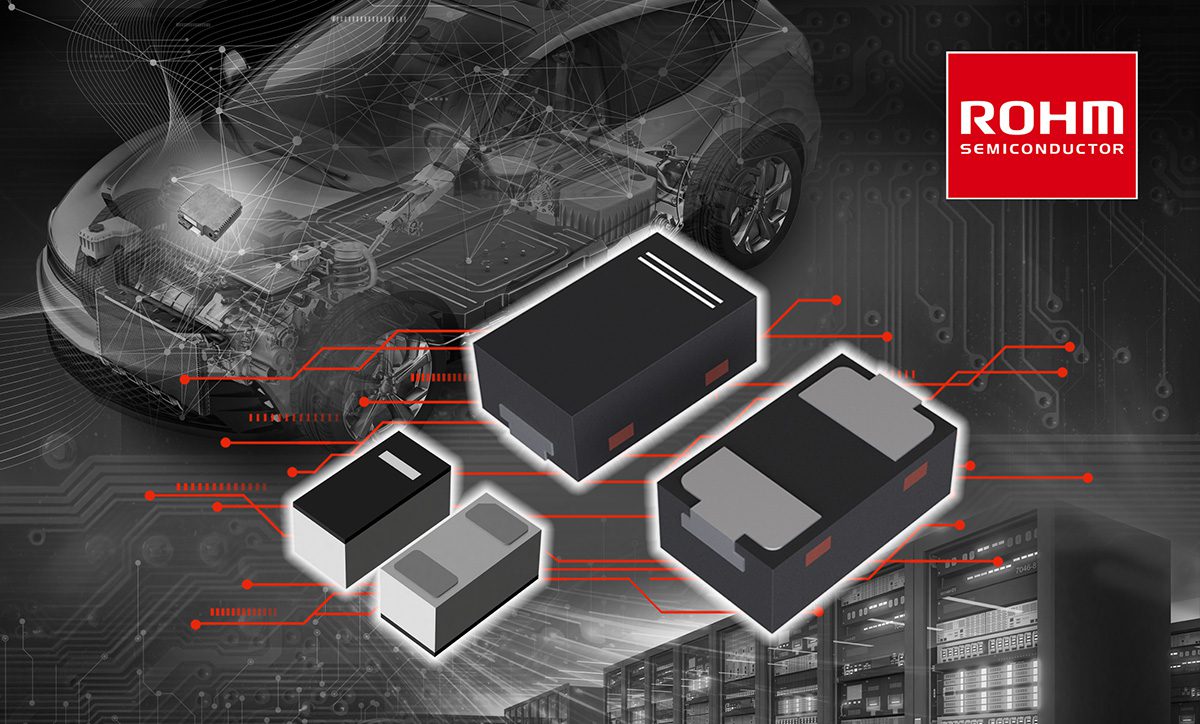
- ROHM Semiconductor has launched the RESDxVx series, a new line of ESD protection diodes designed for critical high-speed interfaces operating above 10 Gbps.
- These innovative diodes address a long-standing challenge in signal integrity by combining ultra-low parasitic capacitance with exceptionally low dynamic resistance.
- ROHM reports a significant breakthrough, with clamping voltages approximately 40% lower than conventional alternatives at equivalent capacitance levels, enhancing protection for sensitive downstream ICs.
- Automotive-qualified variants, holding AEC-Q101 certification, are crucial for advanced applications like ADAS, autonomous driving cameras, and ECU SerDes communication.
- The technology also extends its critical high-speed ESD protection for automotive interfaces and a wide range of non-automotive sectors, including AI servers, data centers, 5G/6G base stations, and consumer electronics.
The Accelerating Demand for High-Speed Data in Modern Electronics
The relentless march of technological progress continues to drive an exponential increase in data transfer rates across various electronic systems. From the burgeoning world of advanced driver-assistance systems (ADAS) and autonomous vehicles to the complex infrastructure of AI servers and 5G/6G base stations, the demand for interfaces capable of handling data at 10 gigabits per second (Gbps) and beyond is now a fundamental requirement. This rapid acceleration, however, introduces significant engineering challenges, particularly in safeguarding sensitive integrated circuits (ICs) from electrostatic discharge (ESD) events without compromising signal integrity.

In the automotive sector, specifically, the proliferation of cameras, radar, lidar, and sophisticated electronic control units (ECUs) necessitates robust, high-bandwidth communication pathways. These systems generate vast amounts of data that must be processed and transmitted with absolute reliability and minimal latency. Similarly, the backbone of modern digital infrastructure, including data centers, AI computing, and next-generation wireless networks, relies heavily on interconnects that can sustain extreme data rates. Ensuring the longevity and operational stability of these critical components against ESD transients has become paramount.
Addressing the Critical Trade-Off in ESD Protection
ESD events, while momentary, can inflict severe damage on semiconductor devices, leading to system failure, reduced lifespan, or intermittent errors. Traditional ESD protection diodes, while effective at lower speeds, face a significant hurdle when deployed in environments pushing 10 Gbps and higher. The core dilemma lies in a long-standing design trade-off: achieving ultra-low parasitic capacitance, essential for preserving signal waveforms at high frequencies, typically comes at the expense of increased dynamic resistance.
Parasitic capacitance, even in minute amounts, can cause signal distortion, compromising the integrity of high-speed data streams. This distortion manifests as ‘eye closure’ in eye diagrams, making it difficult for receivers to correctly interpret data. To mitigate this, engineers strive for the lowest possible capacitance. However, a higher dynamic resistance in the ESD protection device means a weaker clamping response during an ESD event, allowing a higher voltage to reach the protected IC, thus leaving it vulnerable to overstress and potential damage.
ROHM’s Breakthrough: The RESDxVx Series Redefines High-Speed Protection
Recognizing this critical engineering challenge, ROHM Semiconductor has engineered a pioneering solution with the introduction of its RESDxVx series of ESD protection diodes. This new series is specifically designed to overcome the traditional capacitance-resistance trade-off, offering unprecedented performance for interfaces operating above 10 Gbps. The diodes achieve an impressive terminal capacitance of just 0.24 pF for bidirectional configurations and 0.48 pF for unidirectional configurations.
Crucially, this ultra-low capacitance is paired with an exceptionally low dynamic resistance of 0.28 Ω. This combination represents a significant leap forward, allowing for robust protection without sacrificing the delicate signal integrity required for high-speed data transmission. ROHM reports that this innovative design enables a clamping voltage approximately 40% lower than that of conventional competing products at equivalent capacitance levels. This enhanced clamping capability ensures that sensitive downstream ICs are far better protected from harmful overstress during an ESD event, significantly bolstering system reliability.
Key Technical Specifications of the RESDxVx Series:
- Terminal Capacitance: 0.24 pF (bidirectional), 0.48 pF (unidirectional)
- Dynamic Resistance: 0.28 Ω
- Clamping Voltage: Approximately 40% lower than conventional products at equivalent capacitance
Critical Role in Automotive Innovation: Driving Safety and Autonomy
The automotive industry stands as a primary beneficiary of ROHM’s new RESDxVx series. As vehicles become increasingly reliant on sophisticated electronic systems for safety, connectivity, and autonomous functions, the need for robust and reliable components is paramount. The automotive-qualified variants of the RESDxVx series, including the RESD3V3BASAFH, RESD5V0BASAFH, RESD3V3UASAFH, and RESD5V0UASAFH, proudly carry AEC-Q101 certification.
AEC-Q101 certification is a rigorous standard for discrete semiconductors used in automotive applications, ensuring high levels of reliability, quality, and performance under harsh operating conditions. This certification underscores the diodes’ suitability for critical automotive environments, where temperature extremes, vibrations, and other stressors are common. These robust ESD protection diodes are specifically targeted at vital automotive applications such as ADAS and autonomous driving cameras, surround view systems, and ECUs utilizing SerDes (serializer/deserializer) communication.
SerDes technology is fundamental for high-speed data transfer over long distances within vehicles, consolidating multiple data streams into a single serial link. Protecting these SerDes interfaces with superior high-speed ESD protection for automotive interfaces is non-negotiable for ensuring the uninterrupted operation of safety-critical systems. The RESDxVx series provides the necessary shield against ESD threats, enabling the seamless and reliable operation of the advanced sensor arrays and processing units that power the next generation of intelligent vehicles.
Broader Impact Across High-Speed Electronics
Beyond the automotive sector, the capabilities of the RESDxVx series extend to a broad spectrum of high-speed electronic applications that grapple with similar challenges in signal integrity and ESD protection. Non-automotive variants of these diodes, packaged in the compact DSN0603-2J, are poised to make a significant impact across various industries. These include advanced AI servers, where data throughput is critical for computational efficiency, and data center switches, which form the backbone of global digital communication.
Furthermore, the rapid deployment of 5G and future 6G base stations, demanding unprecedented data rates and reliability, will benefit immensely from this advanced ESD protection. In the realm of consumer electronics, where devices are becoming ever more sophisticated and interconnected, the RESDxVx series offers crucial protection for high-speed interfaces such as USB4, Thunderbolt 4, PCIe (Peripheral Component Interconnect Express), HDMI (High-Definition Multimedia Interface), DisplayPort, and MIPI D-PHY/C-PHY used in mobile devices and displays.
Each of these interfaces operates at speeds where even minor signal degradation can lead to performance issues or data loss. ROHM’s solution provides the robust high-speed ESD protection for automotive interfaces and consumer electronics alike, ensuring that these complex systems can function optimally and reliably, even in electrically noisy environments where ESD events are a constant threat. The universal applicability of this technology highlights its foundational importance in the current era of ubiquitous high-speed digital communication.
Ensuring Reliability and Longevity in Demanding Environments
The significance of effective ESD protection extends beyond merely preventing immediate failure; it fundamentally contributes to the long-term reliability and operational lifespan of electronic systems. In high-stress applications like automotive electronics or industrial computing, components are subjected to continuous environmental challenges. A robust ESD solution like the RESDxVx series ensures that the delicate internal circuitry of advanced ICs remains shielded from transient voltage spikes that can incrementally degrade performance over time, even if they don’t cause instantaneous damage.
For automotive systems, adherence to standards like AEC-Q101 is not just a regulatory requirement but a testament to the component’s ability to perform consistently in safety-critical roles. The assurance of such high-speed ESD protection for automotive interfaces fosters greater trust in the reliability of self-driving capabilities and sophisticated ADAS features. Similarly, in data centers and telecommunications infrastructure, where downtime is prohibitively expensive, the enhanced protection offered by ROHM’s diodes translates directly into greater system uptime and reduced maintenance costs.
The Future of High-Speed Interconnects Demands Advanced Protection
As data rates continue to climb and electronic devices become more integrated and interconnected, the challenges associated with signal integrity and robust protection will only intensify. The development of advanced ESD protection diodes like ROHM’s RESDxVx series is not merely an incremental improvement; it represents a foundational enabler for the next wave of innovation in high-speed electronics. By effectively mitigating the traditional trade-offs between capacitance and dynamic resistance, ROHM has provided engineers with a powerful tool to design more reliable, higher-performing systems.
This commitment to developing cutting-edge solutions for high-speed ESD protection for automotive interfaces and a multitude of other applications ensures that the crucial data pathways of our digital future remain secure and uncompromised. The RESDxVx series is a testament to the continuous drive for innovation necessary to support the ever-increasing demands of modern technology, from autonomous vehicles on our roads to the intricate networks powering global connectivity.
Frequently Asked Questions (FAQ)
What is the primary innovation of ROHM’s RESDxVx series?
The RESDxVx series introduces a breakthrough in ESD protection by simultaneously achieving ultra-low parasitic capacitance (0.24 pF bidirectional) and very low dynamic resistance (0.28 Ω). This innovation breaks the traditional design trade-off, allowing for robust protection and superior signal integrity for data rates exceeding 10 Gbps.
How do these new ESD diodes improve protection compared to conventional products?
ROHM reports that the RESDxVx series achieves a clamping voltage approximately 40% lower than conventional competing products at equivalent capacitance levels. This significantly stronger clamping response better shields sensitive downstream ICs from the damaging effects of electrostatic discharge, enhancing overall system reliability.
Which automotive applications benefit most from the RESDxVx series?
These automotive-qualified ESD protection diodes are critical for advanced driver-assistance systems (ADAS), autonomous driving cameras, surround view systems, and Electronic Control Units (ECUs) employing SerDes communication. Their AEC-Q101 certification ensures reliability in demanding automotive environments.
Are there non-automotive applications for this new ESD protection technology?
Yes, the RESDxVx series also targets a wide range of non-automotive high-speed interfaces. These include applications in AI servers, data center switches, 5G/6G base stations, and consumer electronics interfaces such as USB4, Thunderbolt 4, PCIe, HDMI, DisplayPort, and MIPI D-PHY/C-PHY.
Why is low parasitic capacitance important for high-speed interfaces?
At data rates above 10 Gbps, even small amounts of parasitic capacitance can distort signal waveforms, leading to signal integrity issues and data errors. The ultra-low capacitance of the RESDxVx series helps preserve the integrity of these high-speed signals, ensuring reliable data transmission.
What does AEC-Q101 certification signify for these diodes?
AEC-Q101 is a global standard for discrete semiconductor components used in automotive applications. This certification indicates that the RESDxVx diodes meet stringent requirements for quality, reliability, and performance under the harsh environmental conditions typically encountered in vehicles, such as temperature extremes and vibrations.