
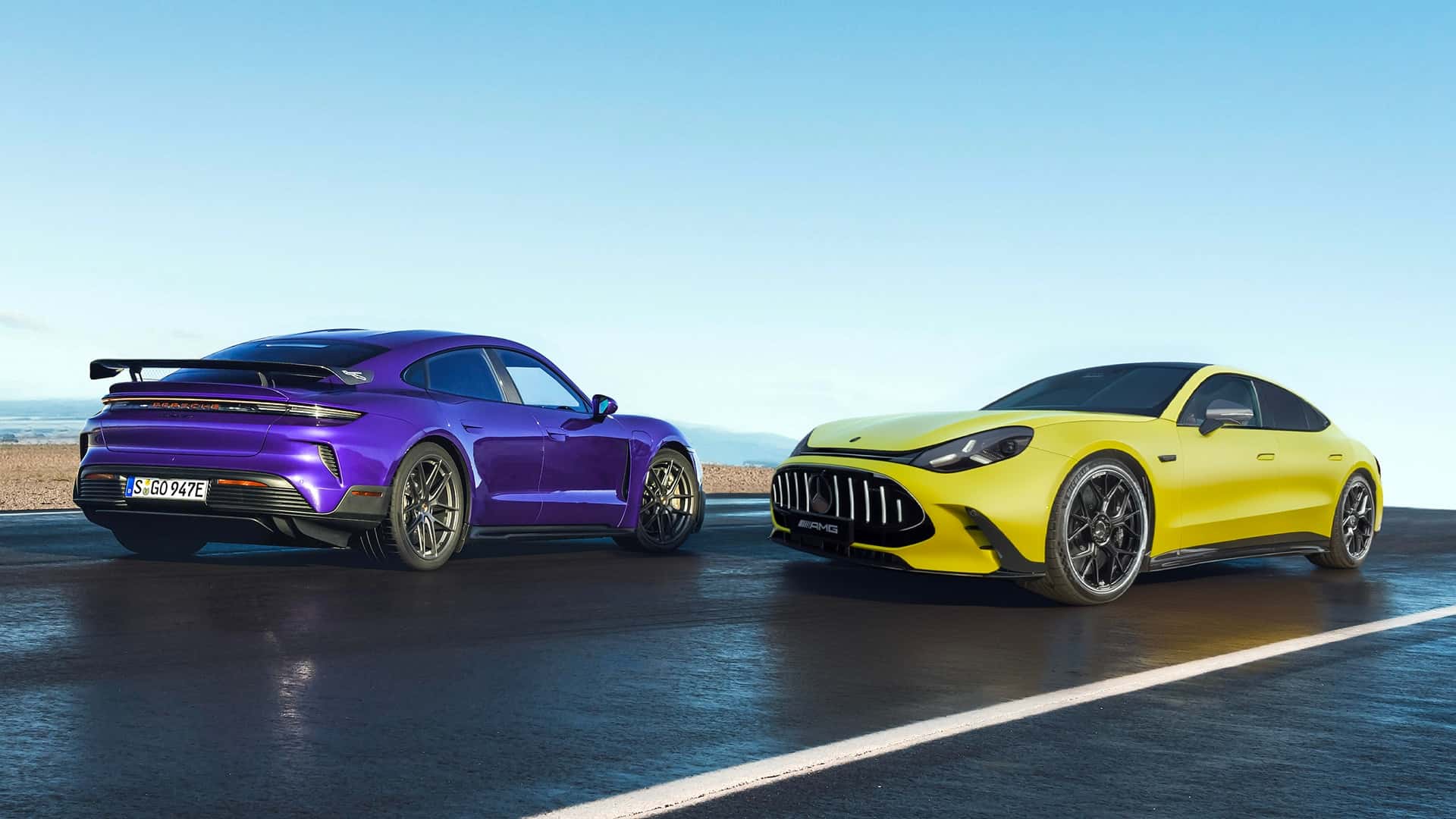
Key Takeaways
- The new Mercedes-AMG GT 4-Door EV emerges as a formidable competitor to the Porsche Taycan, particularly the potent Turbo GT variant.
- Equipped with an advanced tri-motor setup featuring axial-flux motors, the AMG model boasts superior torque vectoring for enhanced driving dynamics and control.
- The AMG GT 4-Door EV surpasses the Taycan Turbo GT in raw power and torque, delivering 1,153 hp and 1,327 lb-ft of twist, enabling a 0-60 mph sprint in 2.0 seconds.
- Utilizing an 800-volt platform, the AMG claims the title of the fastest-charging electric car from a Western automaker, supporting up to 600 kW charging.
- While the Taycan maintains a two-speed rear transmission, the AMG’s dual rear motors offer sophisticated torque distribution without this component.
- The AMG.EA platform underpinning the new GT 4-Door EV is designed to handle over 1,600 horsepower, hinting at future, even more powerful variants.
The landscape of high-performance electric vehicles is witnessing a fierce new contender in the form of the Mercedes-AMG GT 4-Door EV. For years, the Porsche Taycan has stood as a benchmark, earning accolades from driving enthusiasts for its blend of electric prowess and genuine driver engagement. However, Mercedes-AMG’s latest electric fastback now enters the arena, boasting impressive specifications and innovative features that position it as a serious rival, potentially even surpassing the most potent Taycan variants.
This escalating rivalry signals a new chapter in the electric performance segment, where German engineering titans push the boundaries of speed, agility, and technological sophistication. The arrival of the Mercedes-AMG GT 4-Door EV is not merely an addition to the market; it represents a significant challenge to the established order, promising an elevated driving experience with its unique technological advancements.

Advanced Drivetrain: The Tri-Motor Advantage
At the core of the Mercedes-AMG GT 4-Door EV’s formidable capabilities lies its innovative tri-motor layout, a significant departure from the conventional dual-motor setups found in many high-performance EVs, including the Porsche Taycan. This configuration features one motor driving the front axle, complemented by two additional axial-flux motors positioned at the rear. Each of these rear motors independently controls a single wheel, allowing for an exceptionally fine degree of torque control.
This granular control is crucial for managing the car’s immense power output, exceeding 1,100 horsepower, without compromising tire integrity. The precision offered by this system allows the Mercedes-AMG GT 4-Door EV to deploy its power with unparalleled efficiency and control, setting a new standard for managing extreme electric performance. The implementation of axial-flux motors, known for their compact design and high power density, further enhances the overall efficiency and packaging of the drivetrain.
Precision Torque Vectoring for Dynamic Driving
The sophisticated tri-motor system in the Mercedes-AMG GT 4-Door EV facilitates advanced torque vectoring, a technology poised to redefine the electric driving experience. By independently varying torque across the rear axle, AMG engineers can leverage software to enable the car to exhibit remarkable agility and responsiveness. This means the vehicle can precisely rotate, maintain a controlled slide, and then dynamically exit corners, with each rear wheel receiving the exact amount of power dictated by the electronic brain.

This level of dynamic control is expected to make the Mercedes-AMG GT 4-Door EV one of the most engaging and playful electric vehicles to drive. It promises a connection between driver and machine that transcends raw speed, offering a nuanced and exhilarating experience previously associated with highly tuned internal combustion performance cars. The advanced torque vectoring capabilities ensure that every ounce of power translates into precise, controllable motion.
The 800-Volt Architecture and Charging Prowess
Both the Mercedes-AMG GT 4-Door EV and the Porsche Taycan are built upon bespoke 800-volt EV platforms, a cutting-edge technology that significantly enhances their performance capabilities. This high-voltage architecture allows for much faster charging speeds and improved thermal management, which is critical for sustained high-performance driving. In the case of the Mercedes-AMG GT 4-Door EV, this platform enables it to be the fastest-charging electric car ever made by a Western automaker.
The vehicle can charge at an astonishing rate of up to 600 kilowatts, allowing for a 10-80% charge in a mere 11 minutes, assuming access to such high-capacity charging infrastructure. This rapid charging capability addresses a key concern for many EV owners and enthusiasts, significantly reducing downtime during long journeys. Furthermore, the Mercedes’ battery pack is integrated as a structural member of the chassis. This innovative design not only contributes to a lower center of gravity, enhancing handling and stability, but also significantly boosts the car’s torsional rigidity, translating to a more precise and responsive driving feel.
Performance Benchmarks: Power, Torque, and Acceleration
On paper, the Mercedes-AMG GT 4-Door EV makes a compelling case against its primary competitor, the Porsche Taycan Turbo GT. The AMG’s 63 model delivers an impressive 1,153 horsepower, a marginal but notable increase over the Taycan Turbo GT’s temporary overboost peak of 1,092 hp. However, the most significant difference lies in torque.
The Mercedes-AMG GT63 4-Door EV unleashes a staggering 1,327 lb-ft (1,800 Nm) of twist. This dwarfs the Taycan Turbo GT Weissach’s already substantial 988 lb-ft (1,340 Nm). This substantial torque advantage is expected to provide an even more visceral and head-snapping acceleration experience. In terms of outright sprint performance, the AMG proves quicker. The 63 model completes the 0-60 mph (96 km/h) dash in a blistering 2.0 seconds flat, or 2.1 seconds to reach 62 mph (100 km/h). This edges out the Taycan Turbo GT with the Weissach package, which requires 2.2 seconds for the 0-62 mph sprint.
Despite the differences in acceleration and torque, both vehicles are remarkably similar in top speed. The Mercedes-AMG GT 4-Door EV, when equipped with the optional driver’s package, reaches a maximum top speed of 186 mph (300 km/h). The Porsche Taycan Turbo GT, with the Weissach pack, slightly surpasses this at 190 mph (305 km/h), up from 180 mph (290 km/h) without the specialized package.
Transmission Strategies: Single vs. Two-Speed
An interesting point of divergence between these two German powerhouses lies in their transmission strategies. While Mercedes often employs a two-speed gearbox on the rear motor in several of its newer electric vehicles, the new four-door Mercedes-AMG GT 4-Door EV does not incorporate this feature. This decision is likely influenced by its unique dual-motor setup at the rear, which allows for sophisticated individual wheel control without the need for a multi-speed transmission to manage a single rear motor’s power delivery.
Conversely, Porsche has consistently equipped the Taycan with a two-speed rear transmission since its inception, a formula that remains unchanged with the 2024 update and the introduction of the Taycan Turbo GT. This design choice in the Taycan aids in both rapid acceleration from a standstill and efficient cruising at higher speeds, providing a broader performance envelope for its dual-motor setup.
The Taycan Turbo GT: Porsche’s Ultimate Expression
The Porsche Taycan Turbo GT represents the pinnacle of what the current Taycan platform can achieve. In regular driving, it is a brutally quick four-door performance car generating 777 hp. Activating Launch Control boosts its output to an astounding 1,034 hp. For brief bursts of extreme power, a temporary overboost function can be engaged, briefly raising the output to 1,092 hp.
For enthusiasts seeking an even more extreme track-focused experience, the optional Weissach package for the Taycan Turbo GT dramatically enhances its performance, albeit with a trade-off in practicality. This package involves the deletion of the rear seats, the addition of more aggressive aerodynamic elements, and further weight reduction, all geared towards maximizing its capabilities on the racetrack. This clearly illustrates Porsche’s commitment to pushing the Taycan to its absolute performance limits.
Nürburgring Ambitions and Future Potential
The Nürburgring Nordschleife, often referred to as ‘The Green Hell,’ remains the ultimate proving ground for performance vehicles, with lap records serving as crucial bragging rights in the automotive world. Porsche recently reclaimed the Nürburgring EV lap record from BYD, achieving this feat with a lightly modified Taycan Turbo GT featuring a Manthey kit. This demonstrates the Taycan’s inherent track capability and Porsche’s dedication to track performance.
While Mercedes-AMG has not yet announced any plans for a Nürburgring lap record attempt with the new Mercedes-AMG GT 4-Door EV, its underlying AMG.EA platform holds immense potential. AMG engineers have indicated that this platform is capable of handling over 1,600 horsepower. This statement strongly hints at the possibility of even more powerful variants of the Mercedes-AMG GT 4-Door EV in the pipeline, potentially setting the stage for a future assault on the Nürburgring record and intensifying the rivalry at the very top of the electric performance car segment.
The Broader Landscape of Electric Super Sedans
The Mercedes-AMG GT 4-Door EV and Porsche Taycan are not the only players in the burgeoning segment of ultra-high-performance electric sedans. Emerging rivals from different regions are also making their mark. For instance, the Xiaomi SU7 Ultra presents a compelling challenge, at least on paper. With a claimed output of 1,548 hp and a sprint time of 1.98 seconds to 62 mph, it theoretically surpasses the German contenders in raw acceleration.
However, as demonstrated by its Nürburgring performance—where it held the EV lap record before the YangWang U9 Extreme but was not quite as fast as the Taycan around a track despite its higher power—raw horsepower does not always directly translate to superior track performance. This underscores the complex interplay of chassis tuning, aerodynamics, and thermal management that defines a true performance EV. The competitive landscape continues to evolve rapidly, pushing manufacturers to innovate across all dimensions of electric vehicle performance.
Frequently Asked Questions (FAQ)
What is the key advantage of the Mercedes-AMG GT 4-Door EV’s tri-motor setup?
The tri-motor layout, with two independent rear axial-flux motors, allows for exceptionally fine torque vectoring. This precision control enhances driving dynamics, enabling more playful handling, controlled rotation, and efficient power deployment without losing traction, even with over 1,100 horsepower.
How does the Mercedes-AMG GT 4-Door EV’s charging speed compare to rivals?
The Mercedes-AMG GT 4-Door EV supports up to 600 kW charging thanks to its 800-volt platform. This makes it the fastest-charging electric car from a Western automaker, capable of achieving a 10-80% charge in just 11 minutes under optimal conditions.
Is the Mercedes-AMG GT 4-Door EV faster than the Porsche Taycan Turbo GT in acceleration?
Yes, the most potent Mercedes-AMG GT 4-Door EV (63 model) accelerates from 0-60 mph in 2.0 seconds. The Porsche Taycan Turbo GT with the Weissach package takes 2.2 seconds to reach 62 mph, making the AMG slightly quicker off the line.
What is the significance of the AMG.EA platform for future models?
The AMG.EA platform, which underpins the Mercedes-AMG GT 4-Door EV, is engineered to handle over 1,600 horsepower. This indicates significant future potential for even more powerful variants and advanced electric performance vehicles from Mercedes-AMG.
Why does the Mercedes-AMG GT 4-Door EV not have a two-speed gearbox on its rear motor like the Taycan?
The Mercedes-AMG GT 4-Door EV’s dual independent rear motors provide sophisticated individual wheel torque control, reducing the need for a multi-speed transmission typically used to optimize a single rear motor’s performance across different speed ranges. The Taycan’s two-speed gearbox serves a similar purpose for its dual-motor setup.
How does the structural battery pack benefit the Mercedes-AMG GT 4-Door EV?
Integrating the battery pack as a structural component of the chassis lowers the car’s center of gravity, improving handling and stability. It also significantly enhances the vehicle’s torsional rigidity, contributing to a more precise and responsive driving experience.
Has Mercedes-AMG attempted a Nürburgring lap record with the new GT 4-Door EV?
As of now, Mercedes-AMG has not announced any official plans for a Nürburgring lap record attempt with the new GT 4-Door EV. However, given the platform’s extreme power capabilities, such an attempt remains a distinct possibility in the future, intensifying competition for EV track supremacy.