
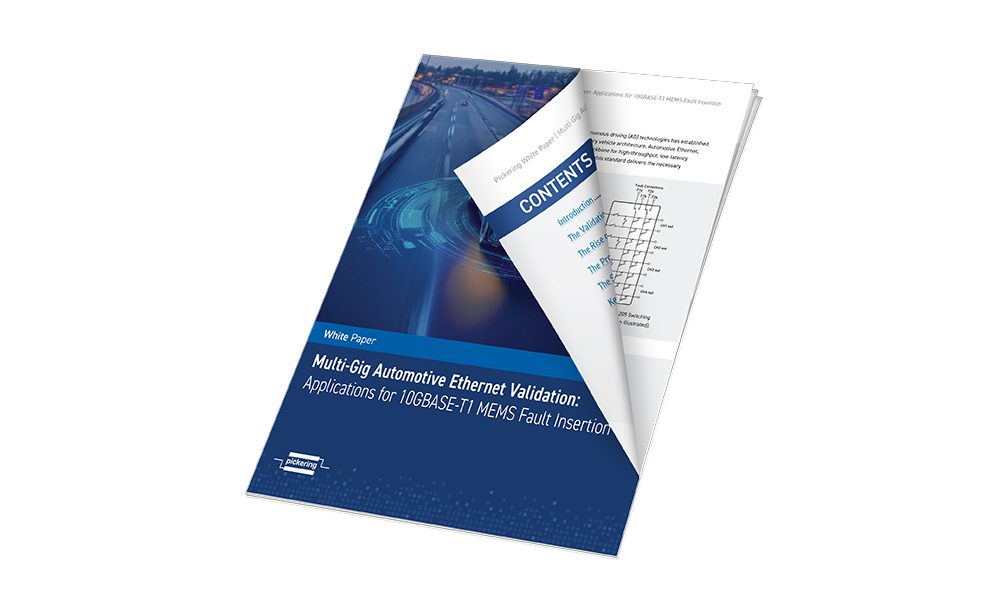
Key Takeaways:
- The rapid evolution of Electric Vehicle (EV) architectures, driven by advanced driver-assistance systems (ADAS) and autonomous functionalities, necessitates robust `multi-gig automotive ethernet validation`.
- Traditional road testing methods are proving insufficient for the intricate demands of 10GBASE-T1 Automotive Ethernet links due to time constraints and lack of repeatability.
- Automated MEMS-based fault insertion emerges as a critical technology, enabling engineers to simulate real-world connectivity faults efficiently within a laboratory environment.
- This innovative approach significantly enhances test repeatability, safeguards signal integrity, and accelerates Hardware-in-the-Loop (HIL) validation.
- Ultimately, advanced fault insertion techniques build greater confidence in the performance and reliability of high-speed automotive networks, crucial for the safety and functionality of next-generation vehicles.
As Electric Vehicle (EV) architectures continue their rapid evolution, integrating increasingly sophisticated Advanced Driver-Assistance Systems (ADAS) and paving the way for full autonomy, the underlying in-vehicle communication networks face unprecedented demands. High-bandwidth data transfer is no longer a luxury but a fundamental requirement, making the validation of high-speed links, particularly 10GBASE-T1 Automotive Ethernet, an increasingly complex and critical challenge for the automotive industry.

The sheer volume of data generated by multiple sensors, cameras, radar, and lidar systems, combined with the processing power required for real-time decision-making, necessitates robust and reliable network infrastructure. Ensuring the integrity and performance of these networks, therefore, becomes paramount for vehicle safety, operational efficiency, and the overall user experience.
The Imperative for High-Bandwidth Automotive Networks
The transition towards ADAS and autonomous driving has fundamentally reshaped vehicle electronic architectures. Traditional low-speed networks are no longer adequate to handle the torrent of data streams from advanced perception systems, high-resolution displays, and sophisticated infotainment units. This surge in data traffic mandates the adoption of `multi-gig automotive ethernet validation` technologies, specifically the 10GBASE-T1 standard, which offers the necessary bandwidth and reliability for next-generation vehicles.
10GBASE-T1 Automotive Ethernet provides a robust, high-speed, and cost-effective solution for in-vehicle networking. However, its implementation introduces new layers of complexity in terms of design, integration, and, most critically, validation. Ensuring these links perform flawlessly under diverse real-world conditions is a monumental task that traditional testing methodologies struggle to meet.

Challenges of Traditional Validation Approaches
Historically, much of the validation for automotive communication systems relied heavily on extensive road testing. While crucial for real-world scenario assessment, this approach presents significant drawbacks when dealing with the intricacies of `multi-gig automotive ethernet validation`.
Road testing is inherently time-consuming, expensive, and, most notably, lacks repeatability. Environmental variables, traffic conditions, and the impossibility of precisely replicating specific fault scenarios make it exceedingly difficult to isolate, diagnose, and consistently reproduce network anomalies. This often leads to prolonged development cycles and can introduce uncertainties regarding system reliability.
The Need for Controlled Fault Simulation
To overcome the limitations of purely physical testing, there is a growing demand for laboratory-based simulation environments that can accurately replicate real-world connectivity faults. These faults can range from intermittent connections, shorts, and opens to signal degradation caused by electromagnetic interference (EMI) or power fluctuations.
Effective simulation allows test engineers to rigorously stress-test network components and systems, identifying vulnerabilities before they manifest as critical failures in deployed vehicles. This proactive approach is vital for maintaining the high standards of safety and performance expected in modern automobiles.
Automated MEMS-Based Fault Insertion: A Breakthrough Solution
In response to these escalating challenges, automated Micro-Electro-Mechanical Systems (MEMS)-based fault insertion technology has emerged as a transformative solution for `multi-gig automotive ethernet validation`. This innovative approach allows test engineers to move beyond the limitations of manual or traditional fault injection methods, offering unparalleled precision and control.
MEMS-based systems utilize tiny, electro-mechanically operated switches to introduce various types of faults into network links under controlled laboratory conditions. These devices can simulate a wide array of electrical imperfections, such as open circuits, short circuits, and resistance changes, precisely where and when required, enabling detailed analysis of system behaviour under stress.
Key Advantages for Enhanced Validation
The deployment of MEMS-based fault insertion systems offers several distinct advantages that significantly improve the efficiency and efficacy of high-speed automotive network validation:
Improved Repeatability: One of the most significant benefits is the ability to perfectly replicate fault scenarios. Unlike unpredictable road tests, automated fault insertion ensures that the exact same fault can be introduced multiple times, allowing for precise debugging, regression testing, and consistent performance evaluation across different development stages or hardware iterations.
Protection of Signal Integrity: High-speed Ethernet signals are highly susceptible to even minor disturbances. MEMS-based switches are designed to introduce faults with minimal impact on the inherent signal characteristics of the 10GBASE-T1 link when not actively injecting a fault. This ensures that the testing environment itself does not inadvertently introduce noise or degradation, allowing for accurate assessment of the device under test’s resilience.
Accelerated Hardware-in-the-Loop (HIL) Validation: HIL testing is a crucial phase where physical electronic control units (ECUs) are integrated with simulated vehicle environments. Automated fault insertion seamlessly integrates into HIL setups, enabling dynamic and real-time injection of network faults. This accelerates the validation process, allowing engineers to quickly assess how ECUs and entire systems react to communication failures within a controlled, repeatable virtual driving scenario.
Building Greater Confidence in Network Performance: By systematically testing for vulnerabilities and observing system responses under controlled fault conditions, engineers can gain a deeper understanding of network robustness. This rigorous testing regimen ultimately leads to higher confidence in the reliability and safety of the high-speed automotive network, a non-negotiable aspect for ADAS and autonomous driving functionalities.
The Future of Automotive Testing
The shift towards sophisticated `multi-gig automotive ethernet validation` techniques, particularly those leveraging automated MEMS-based fault insertion, represents a critical advancement in automotive engineering. It signifies a move towards more efficient, precise, and reliable testing methodologies that are essential for bringing next-generation vehicles to market.
This approach not only reduces the reliance on costly and time-consuming physical road testing but also empowers test engineers with the tools to proactively identify and mitigate potential issues. The ability to simulate real-world connectivity faults in a controlled lab environment is invaluable for ensuring the robust performance and functional safety of increasingly complex in-vehicle communication systems.
As EV architectures continue to evolve and autonomous capabilities become more prevalent, the demand for such advanced validation strategies will only intensify. Embracing these technologies is not merely an option but a necessity for manufacturers aiming to deliver safe, high-performing, and reliable vehicles to consumers worldwide.
Frequently Asked Questions (FAQ)
What is 10GBASE-T1 Automotive Ethernet?
10GBASE-T1 is a standard for high-speed Ethernet communication specifically designed for in-vehicle networks. It supports data rates up to 10 Gigabits per second over a single unshielded twisted pair cable, making it ideal for the demanding bandwidth requirements of modern ADAS, infotainment, and autonomous driving systems in electric vehicles.
Why is validating multi-gig automotive Ethernet links challenging?
The high data rates and complex vehicle architectures introduce challenges such as maintaining signal integrity, managing electromagnetic compatibility, and ensuring reliable performance under diverse operating conditions. Traditional testing methods struggle with the repeatability and comprehensive fault simulation required for these advanced networks, particularly when dealing with intermittent faults.
What is MEMS-based fault insertion?
MEMS (Micro-Electro-Mechanical Systems) based fault insertion is a technology that uses miniature, electrically controlled switches to precisely introduce specific electrical faults (like opens or shorts) into an automotive network link. This allows engineers to simulate real-world connectivity issues in a controlled lab environment for thorough testing and debugging.
How does MEMS-based fault insertion improve repeatability?
Unlike manual methods or unpredictable road testing, MEMS-based systems can accurately reproduce the exact same fault scenario multiple times. This allows test engineers to consistently evaluate system responses, verify bug fixes, and conduct comprehensive regression testing, ensuring reliable and comparable test results across different iterations.
What is HIL validation, and how does fault insertion accelerate it?
Hardware-in-the-Loop (HIL) validation involves connecting physical ECUs (Electronic Control Units) to a real-time simulation of the vehicle and its environment. Automated fault insertion accelerates HIL by enabling the dynamic and precise injection of communication faults into the network during simulation, quickly testing how ECUs react to network failures without needing a full physical vehicle prototype.
What are the practical benefits of lab-based fault simulation over road testing?
Lab-based fault simulation offers several benefits: it’s less time-consuming and costly than extensive road tests, allows for precise control over fault conditions, improves test repeatability, and facilitates easier isolation and diagnosis of issues. This accelerates the development cycle and enhances the overall confidence in the robustness of automotive network performance.
How does this technology protect signal integrity in high-speed networks?
MEMS-based fault insertion modules are engineered to introduce faults cleanly, without adding significant noise or degrading the signal path when not actively injecting a fault. This is crucial for high-speed signals like 10GBASE-T1, ensuring that the testing apparatus itself does not corrupt the signal, thus allowing accurate assessment of the network’s inherent resilience and performance.