
Key Takeaways (TL;DR)
- Soteria Battery Innovation Group has licensed QinetiQ’s Q-TRED, a thermal event detection technology.
- Q-TRED employs cell-level coatings that emit volatile compounds when overheating, providing an early warning.
- This technology integrates into Soteria’s Battery Safety IP Exchange (IPX), a unified licensing platform for battery safety innovations.
- The IPX aims to streamline the adoption of critical safety advancements across diverse applications like EVs and energy storage.
- Experts emphasize the crucial role of early detection in preventing catastrophic battery failures.
New Delhi: In a significant development for the burgeoning electric vehicle (EV) and energy storage sectors, Soteria Battery Innovation Group has announced the licensing of Q-TRED, an innovative thermal event detection technology developed by the defense and security powerhouse QinetiQ. This strategic integration marks a pivotal enhancement to Soteria’s Battery Safety IP Exchange (IPX), a pioneering licensing platform designed to consolidate and simplify access to complementary battery safety technologies.

The move is poised to address one of the most pressing challenges facing modern battery systems: the early and reliable detection of thermal anomalies that can lead to hazardous thermal runaway events and fires. By embedding Q-TRED into its comprehensive battery safety platform, Soteria aims to accelerate the deployment of safer, more robust battery solutions across a multitude of applications.
The Critical Need for Advanced Battery Safety
The global transition towards electrification, driven by the rapid adoption of electric vehicles, grid-scale energy storage systems, and an array of micromobility devices, has underscored the critical importance of robust battery safety. Lithium-ion batteries, while offering high energy density, pose inherent risks, primarily thermal runaway. This phenomenon, often triggered by internal shorts, overcharging, or external damage, can lead to uncontrolled temperature increases, gas venting, and, in severe cases, fire or explosion.
Traditional battery monitoring systems largely rely on temperature probes strategically placed at a limited number of points within a battery pack. While essential, this method presents a significant limitation: it can frequently miss highly localized heating events occurring within individual cells situated between these measurement points. Such undetected hot spots can escalate rapidly, bypassing early warning thresholds and leading to a catastrophic failure before any intervention is possible.

The challenge for engineers and manufacturers lies in developing systems that can detect these subtle, nascent thermal events at their origin – the individual battery cell – rather than waiting for heat to propagate to a macro-level sensor. This distributed and granular approach to thermal monitoring is seen as the next frontier in achieving truly resilient and safe battery designs.
Introducing Q-TRED: A New Paradigm in Thermal Detection
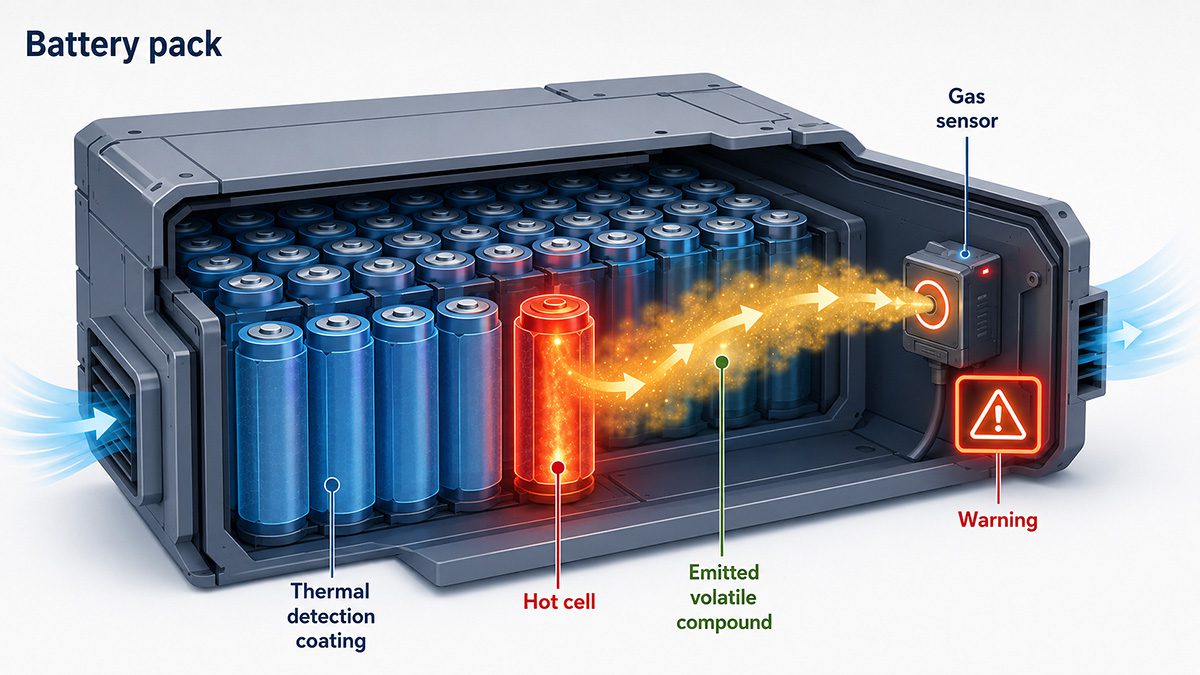
Q-TRED, or QinetiQ Thermal Runaway Event Detection, offers a revolutionary solution to this inherent sensing gap. Developed by QinetiQ, a company renowned for its defense and security innovations, this technology redefines how thermal events are identified within battery cells. Instead of relying solely on direct temperature readings, Q-TRED utilizes specialized coatings applied directly to individual battery cells.
These proprietary coatings are engineered to react at elevated temperatures, even before a full thermal runaway commences. When a cell begins to overheat, reaching critical pre-runaway temperatures, the coatings emit detectable volatile compounds. These compounds, essentially chemical signatures of impending thermal distress, can then be picked up by commercially available gas sensors integrated within the battery pack.
The core innovation of Q-TRED lies in its ability to provide a true early warning signal. By detecting chemical changes at the cell level, rather than macroscopic temperature increases, the system offers a significantly faster and more precise indication of a developing problem. This distributed sensing approach ensures that virtually every cell within a pack is under constant, vigilant chemical surveillance, moving beyond the ‘spot monitoring’ limitations of conventional thermal probes.
Soteria’s IPX: A Unified Approach to Innovation
The integration of Q-TRED into Soteria’s Battery Safety IP Exchange (IPX) underscores a strategic vision to overcome a prevalent hurdle in the adoption of battery safety innovations. Historically, manufacturers seeking to enhance battery safety often face the cumbersome task of negotiating separate licensing agreements for each individual technology – a process fraught with complexity, cost, and delays.
Soteria’s IPX acts as a comprehensive battery safety platform, bundling a suite of complementary safety technologies under a single, streamlined licensing framework. This unified structure is designed to significantly reduce the friction and barriers to entry for manufacturers, allowing them to more readily adopt and implement cutting-edge safety features without the burden of fragmented intellectual property negotiations.
Q-TRED joins an array of other advanced safety technologies already part of Soteria’s IPX. These encompass innovations ranging from internal cell materials designed to prevent short circuits, to propagation resistance mechanisms that limit the spread of thermal events, as well as detection, mitigation strategies, and safer overall design principles. The platform’s holistic approach aims to provide a multi-layered defense against battery hazards, creating a more secure ecosystem for battery-powered products.
Industry Impact and Future Prospects
The collaboration between Soteria and QinetiQ, facilitated by the IPX, promises far-reaching implications across multiple sectors. Soteria has explicitly stated its commitment to working closely with supply chain partners to develop Q-TRED into tangible products for a diverse range of applications. This includes, but is not limited to, the rapidly expanding electric vehicle market, large-scale energy storage systems critical for grid stability, compact micromobility solutions like e-scooters and e-bikes, and demanding aerospace applications where safety is paramount, alongside other battery-powered devices.
The ability to identify potential problems earlier and respond faster is not just an incremental improvement; it represents a paradigm shift in battery safety management. For consumers, this translates into greater peace of mind regarding the safety of their EVs and other devices. For manufacturers, it offers a pathway to differentiate their products with superior safety features, potentially reducing warranty claims and reputational risks associated with thermal events.
Moreover, as regulatory bodies worldwide continue to tighten safety standards for battery technologies, solutions like Q-TRED, offered through an accessible battery safety platform like the IPX, become indispensable. They empower the industry to meet and exceed these evolving standards, fostering greater trust and accelerating the adoption of sustainable energy solutions.
Expert Insight on Early Warning Systems
Commenting on the significance of this licensing agreement, Brian Morin, CEO of Soteria Battery Innovation Group, highlighted the crucial role of proactive detection. “Early warning is one of the most important layers in battery safety, and it is underserved by limited, discreet measurement points,” Morin stated. He further articulated the collective benefit of this integration: “By combining Q-TRED with broader industry collaboration through the IPX, the industry can build battery systems that identify problems earlier, respond faster, and reduce the risk of damaging failures.”
This statement underscores the philosophy behind Soteria’s IPX: that combining innovative technologies with a collaborative spirit is the most effective way to address complex safety challenges. The aim is to move from reactive measures to predictive prevention, safeguarding lives and assets.
Conclusion
The licensing of QinetiQ’s Q-TRED technology by Soteria Battery Innovation Group marks a significant leap forward in battery safety. By integrating a novel cell-level thermal event detection system into its Battery Safety IP Exchange, Soteria is creating a more accessible and robust battery safety platform for manufacturers worldwide. This development promises to enhance the reliability and security of battery-powered applications across vital sectors, driving the industry towards a safer and more sustainable electrified future.
Source: Soteria Battery Innovation Group
Frequently Asked Questions (FAQ)
What is Q-TRED technology?
Q-TRED (QinetiQ Thermal Runaway Event Detection) is a thermal event detection technology that uses specialized coatings applied to individual battery cells. These coatings emit detectable volatile compounds when a cell reaches elevated temperatures, providing an early warning signal of potential thermal issues before they escalate.
How does Q-TRED improve upon existing battery safety measures?
Traditional battery sensing relies on temperature probes at limited points, which can miss localized overheating. Q-TRED’s cell-level coatings and gas sensor detection offer a distributed sensing approach across every cell, providing a much earlier and more precise warning of thermal events than conventional methods.
What is Soteria’s Battery Safety IP Exchange (IPX)?
The IPX is a licensing platform created by Soteria Battery Innovation Group. It bundles complementary battery safety technologies, including internal cell materials, propagation resistance, detection, mitigation, and safer design strategies, under a single framework to simplify adoption for manufacturers and reduce friction in integrating safety innovations.
Which industries will benefit from this enhanced battery safety platform?
The enhanced battery safety platform, featuring Q-TRED, is intended for a wide range of battery-powered applications. Key beneficiaries include electric vehicles (EVs), large-scale energy storage systems (ESS), micromobility devices, and aerospace applications, among others, where robust battery safety is paramount.
Why is early warning detection so important for battery safety?
Early warning detection is crucial because it allows for intervention before a thermal event progresses to a critical stage like thermal runaway or fire. Detecting problems earlier enables faster responses, helping to mitigate risks, prevent severe damage, protect users, and enhance the overall reliability and lifespan of battery systems.