
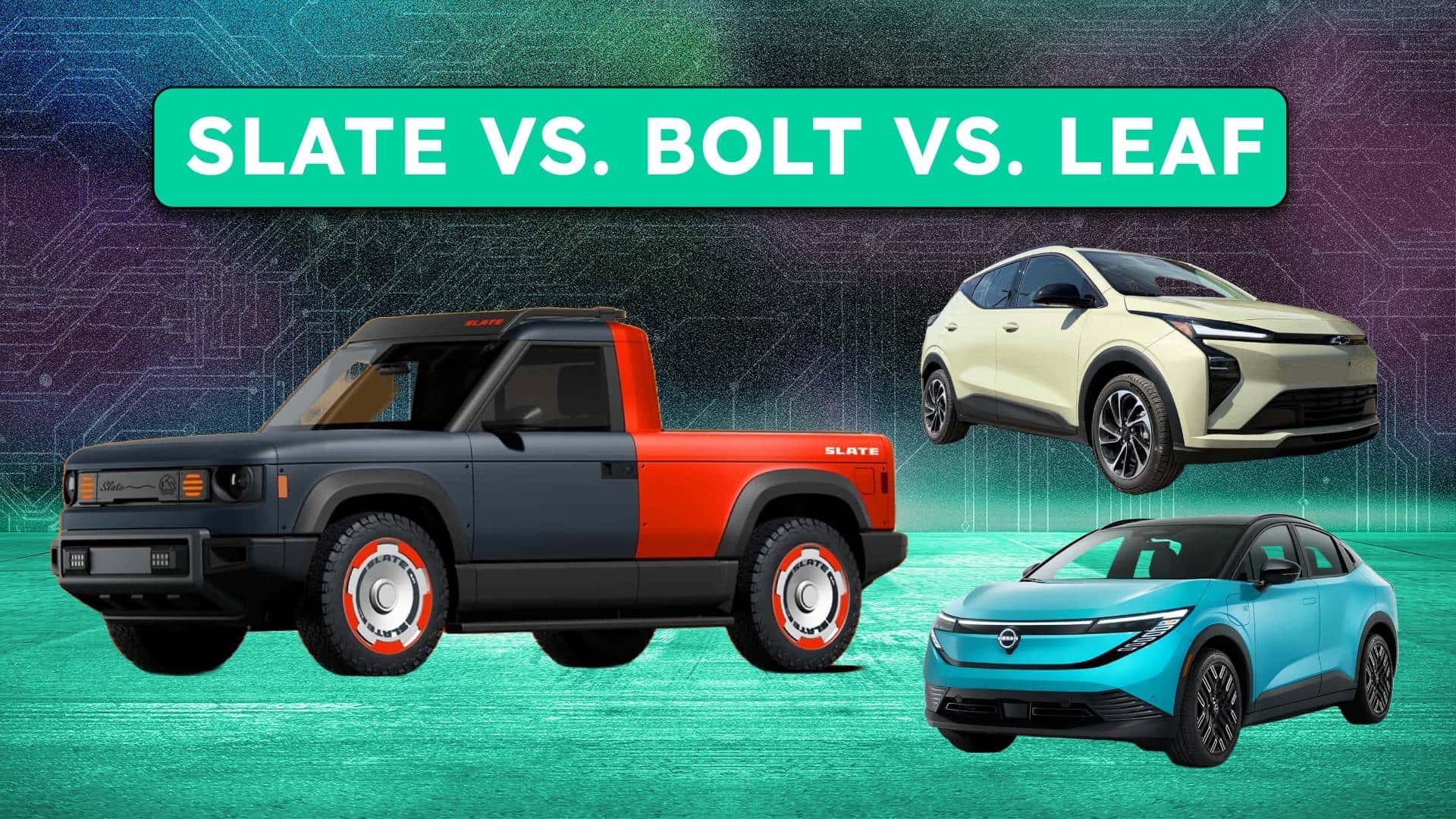
As the electric vehicle (EV) market continues its rapid expansion, accessibility and affordability remain critical factors for widespread adoption. A new entrant, the Slate truck, is poised to redefine the entry-level segment, launching as America’s most affordable electric vehicle and its cheapest pickup. Priced aggressively at $24,950 before destination and fees, it carves out a unique niche with no direct competitors in its specific category.
However, many consumers considering an affordable electric vehicle comparison will weigh its value against more established, budget-friendly options. This includes the refreshed Chevrolet Bolt and the latest-generation Nissan Leaf, both of which start in the $30,000 bracket and offer compelling propositions. This comprehensive analysis delves into how these three electric vehicles stack up across crucial metrics such as range, charging capabilities, performance, price, and overall equipment, providing prospective buyers with a detailed overview to inform their purchasing decisions.

Key Takeaways for Affordable Electric Vehicles
- The Slate truck emerges as the market’s most affordable EV, starting at $24,950, but features a bare-bones design and reliance on customisation.
- Nissan Leaf S+ offers the superior range at 303 miles EPA, while the Chevy Bolt LT balances range and performance effectively.
- All three EVs adopt the NACS charging port, providing broad access to Tesla Superchargers and other networks via adapter.
- The Slate prioritises modularity and over 200 accessories for a highly personalised ownership experience, contrasting with the Bolt and Leaf’s more integrated, tech-rich standard offerings.
- While the Slate presents an unmatched entry price, opting for body style upgrades or extensive accessories can narrow its cost advantage over its rivals.
The Emerging Contender: The Slate Electric Truck
Set for deliveries in the fourth quarter of this year, the Slate truck is set to disrupt the American EV landscape. Its starting price point of $24,950 positions it in a league of its own, particularly within the electric pickup segment. This aggressive pricing strategy aims to attract a new demographic of electric vehicle buyers.
Designed with intentional simplicity, the base Slate truck offers a fundamental driving experience. Its appeal lies not in luxurious amenities or advanced integrated technology, but in its promise of affordability and a unique modular design. This approach targets consumers who value cost-effectiveness and the ability to tailor their vehicle to specific needs.
Established Players: Chevrolet Bolt and Nissan Leaf
Standing as formidable alternatives in the affordable electric vehicle comparison are the Chevrolet Bolt and Nissan Leaf. Both models have earned their stripes in the EV market, consistently offering a blend of practicality, efficiency, and reasonable pricing.

The refreshed Chevy Bolt and the latest-generation Nissan Leaf, particularly the Leaf S+, represent genuine value. They provide a more conventional automotive experience with integrated infotainment systems and a broader suite of standard features, appealing to those seeking a well-rounded and proven electric car.
Head-to-Head: Range and Battery Technology
Electric vehicle range is often a primary concern for potential buyers, influencing daily usability and suitability for longer journeys. In this crucial aspect, the Nissan Leaf S+ distinguishes itself with a superior performance.
The Slate truck, equipped with a 65 kilowatt-hour (kWh) lithium-iron-phosphate (LFP) battery, offers a manufacturer-estimated range of 205 miles. This figure reflects its practical design and target utility. The Chevy Bolt LT, utilising a similar-sized 65 kWh LFP pack, achieves a noticeably better EPA-estimated 262 miles, largely attributed to its more aerodynamic design compared to the Slate’s truck-like form factor.
Outperforming both, the Nissan Leaf S+ secures the range victory with an impressive 303 miles, thanks to its larger 75 kWh nickel manganese cobalt (NMC) battery unit. This extended range provides a significant advantage for drivers frequently undertaking longer trips or those with limited charging access.
It is important to note that the Slate’s range estimates are preliminary. Future SUV and fastback body styles, expected to offer improved aerodynamics, might yield slightly better figures. Additionally, the Slate’s 2,000-pound towing capacity and 1,500-pound payload mean real-world range will predictably decrease when hauling heavy loads, a factor crucial for buyers considering its utility as a work truck.
Charging Infrastructure and Speed Analysis
Efficient charging is vital for electric vehicle ownership, and compatibility with a broad charging network is a significant advantage. In a welcome development for consumers, all three vehicles—the Slate truck, Chevy Bolt LT, and Nissan Leaf S+—are adopting the Tesla-style North American Charging Standard (NACS) port. This integration grants owners access to over 27,500 Tesla Superchargers nationwide, significantly enhancing convenience and reducing range anxiety.
Furthermore, CCS (Combined Charging System) stalls remain accessible for all three models via an adapter, ensuring flexibility across various charging networks. When it comes to charging speed, the Slate truck is projected to charge its LFP battery from 20% to 80% in approximately 30 minutes, peaking at a rate of 120 kilowatts (kW).
The Bolt and Leaf models offer slightly faster peak charging rates, both reaching around 150 kW. Chevrolet claims a 10% to 80% charge for the Bolt in 25 minutes, while Nissan rates the Leaf for the same in 35 minutes. These figures highlight competitive fast-charging capabilities across the board, crucial for minimising downtime during longer journeys.
However, the Slate truck notably lags in integrated route planning. Both the Bolt and Leaf come equipped with built-in Google infotainment systems that intelligently suggest charging stops along a planned route. While the base Leaf S+ lacks this native Google integration, it supports wireless Apple CarPlay and Android Auto, both of which are receiving updates for enhanced route planning functionalities. The Slate, intentionally designed as a low-tech vehicle, foregoes a central infotainment system entirely, relying instead on a smartphone app for navigation and related functions. This approach may present a learning curve for some users, but aligns with its minimalist philosophy.
Performance Metrics: Power, Torque, and Acceleration
While none of these affordable electric vehicles are engineered for extreme high-performance thrills, their acceleration and driving dynamics contribute significantly to the overall user experience. The Nissan Leaf and Chevy Bolt, in particular, offer a surprisingly engaging drive, demonstrating that budget-friendly EVs can still be enjoyable.
During testing, the Leaf exhibited a spirited performance, with its front wheels occasionally spinning under hard acceleration, evoking a ‘hot-hatch’ energy unexpected from an affordable electric vehicle. The Bolt, while more comfort-oriented, remains nimble and enjoyable to drive, benefiting from its compact dimensions.
Both the Leaf and Bolt surpass the Slate in terms of raw power and torque. The Leaf is rated at 214 horsepower and 261 pound-feet of torque, while the Bolt delivers 210 horsepower and 169 pound-feet. Both achieve 0 to 60 miles per hour in under seven seconds, providing brisk acceleration for city driving and highway merging.
The Slate truck, powered by a rear-mounted motor, offers a more measured pace, completing the 0 to 60 mph sprint in 8.0 seconds. It produces 181 horsepower and 195 pound-feet of torque. Despite the slower official figures, early impressions from short rides, including one noted by InsideEVs’ Tim Levin, suggest that the Slate provides ample low-end torque and the characteristic immediate acceleration inherent to EVs. The Autopian even described its driving experience as “insanely fun” for its price point, hinting at an enjoyable, albeit not blistering, performance.
Interior, Features, and Customisation: A Detailed Look
The interior design and available features are crucial differentiators within this affordable electric vehicle comparison. The Slate truck adopts a deliberate ‘bare bones’ approach, setting it apart from its rivals.
At its base price of $24,950, the Slate comes equipped with cloth seats, essential air conditioning and heating, manual crank windows, and steering wheel controls for navigating the gauge cluster. Notably, it lacks a central infotainment display, reflecting its low-tech design philosophy. To compensate, a smartphone mount is provided, allowing owners to use their personal devices for navigation and entertainment.
The Slate’s core value proposition revolves around customisation. It offers an extensive catalogue of over 200 accessories, with more than 80% priced under $500. This modularity allows buyers to personalise their vehicle with options such as tablet and speaker mounts, a center console, door pockets, upgraded seat covers, and various cosmetic enhancements like gunmetal cabin accents. Furthermore, customers can select from over 30 ‘starter packs,’ which bundle different combinations of body styles and accessories, offering a more curated look without requiring individual configuration of every element.
Standard safety features on the Slate include traction control, airbags, a rear camera, and forward collision warning, ensuring essential protection. Practical utility is also addressed with a frunk (front trunk) offering 7.0 cubic feet of cargo volume and a five-foot bed providing 35.1 cubic feet of space.
In stark contrast, the base Bolt and Leaf arrive from the factory considerably better equipped. Both feature large infotainment screens, automatic climate control, multiple USB ports, and integrated speaker systems. The base Leaf includes wireless Apple CarPlay and Android Auto, while higher trims like the SV+ and Platinum+ incorporate a native Google-based infotainment system. The Chevy Bolt opts for a solely built-in Google system for navigation and media, omitting phone-mirroring capabilities. Neither the Bolt nor the Leaf offer the extensive, build-it-yourself customisation that is central to the Slate’s identity, appealing instead to buyers who prefer a ready-to-drive, feature-rich package.
Pricing Dynamics and Value Proposition
The pricing strategy is a defining element in this affordable electric vehicle comparison. The base Slate truck significantly undercuts both the Chevy Bolt and Nissan Leaf, with a starting price that is $4,000 to $5,000 less, respectively.
However, this lower entry point comes with specific trade-offs: reduced range, slower charging speeds, a two-seat configuration in its base truck form, and a cabin that could be described as spartan even by budget car standards. For buyers requiring more space or features, opting for the SUV or fastback body kit adds a second row of seating but also increases the price by an additional $5,000 to $7,000. Further customisation through accessories can push the total cost considerably higher, potentially diminishing the initial price advantage over its competitors.
The Chevrolet Bolt and Nissan Leaf, while having higher starting prices ($28,995 and $31,535, including destination, respectively), offer more extensive range, faster charging capabilities, and a greater array of standard technology right out of the factory. These vehicles are also products of established automakers, providing a certain level of assurance regarding reliability, service networks, and resale value.
Ultimately, the Slate truck presents a unique value proposition: a genuinely modular vehicle that buyers can extensively customise to their specific preferences and needs. This contrasts with the Bolt and Leaf, which provide a more conventional, integrated, and technologically advanced experience. The success of the Slate will hinge on whether its promise of affordability and extreme personalisation resonates sufficiently with budget-conscious consumers to outweigh its inherent compromises in standard features and performance metrics.
Conclusion: The Evolving Landscape of Affordable EVs
The burgeoning market for affordable electric vehicles is witnessing an exciting evolution, driven by innovations like the Slate truck and the continued refinement of models such as the Chevy Bolt and Nissan Leaf. Each of these vehicles presents a distinct value proposition, catering to diverse segments of environmentally conscious and budget-aware consumers.
The Slate truck is pioneering a new frontier with its ultra-low entry price and unparalleled customisation potential, challenging traditional notions of vehicle ownership. Conversely, the Chevrolet Bolt and Nissan Leaf continue to offer robust, well-rounded packages with proven performance, comfort, and integrated technology, representing a more conventional and established path to EV adoption. The decision between these contenders will ultimately depend on individual priorities, weighing initial cost against standard features, range, and the desire for a personalised driving experience. As the electric revolution accelerates, competition in the affordable EV segment promises to deliver increasingly compelling options for all.
Frequently Asked Questions (FAQ) about Affordable EVs
What is the starting price of the Slate electric truck?
The Slate electric truck will launch with a starting price of $24,950, excluding destination and fees. This positions it as America’s most affordable electric vehicle and the cheapest electric pickup truck available upon its release in the fourth quarter of this year.
How does the Slate truck’s range compare to the Chevy Bolt and Nissan Leaf?
The Slate truck offers an estimated 205 miles of range. In comparison, the Chevy Bolt LT provides an EPA-estimated 262 miles, while the Nissan Leaf S+ leads with an impressive EPA-estimated 303 miles, making it the top performer in terms of range among the three.
Which charging standard do these affordable EVs use?
All three vehicles, the Slate truck, Chevy Bolt LT, and Nissan Leaf S+, will ship with the North American Charging Standard (NACS) port. This grants owners access to the extensive Tesla Supercharger network, and CCS stalls remain accessible via an adapter.
What are the key differences in interior features and technology?
The Slate truck features a minimalist interior with manual windows and no central infotainment, focusing on customisation via accessories and smartphone integration. The Bolt and Leaf, however, come standard with larger infotainment screens, automatic climate control, and integrated navigation (Google-based or via Apple CarPlay/Android Auto).
Can the Slate truck be customised significantly?
Yes, customisation is a core selling point for the Slate truck. It offers over 200 accessories, more than 80% of which are under $500, allowing buyers to add features like tablet mounts, improved seat covers, and various cosmetic touches. Over 30 starter packs are also available.
Are there any compromises with the Slate truck’s low price point?
The Slate’s ultra-low price involves compromises such as less range, slower charging speeds, a two-seat configuration in its base form, and a spartan cabin. Upgrading to SUV or fastback body styles (adding a second row) costs an additional $5,000-$7,000, which narrows its price gap with competitors.
What is the performance difference between these EVs?
The Nissan Leaf S+ (214 hp, 261 lb-ft) and Chevy Bolt LT (210 hp, 169 lb-ft) both accelerate from 0-60 mph in under 7.0 seconds. The Slate truck, with 181 hp and 195 lb-ft, takes a more leisurely 8.0 seconds for the same acceleration, though it offers strong low-end EV torque.