
Key Takeaways:
- ROHM Semiconductor has introduced the TSC3PAK, a pioneering surface-mount package for Silicon Carbide (SiC) MOSFETs.
- The new package delivers heat dissipation performance on par with conventional TO-247-4L through-hole packages, a significant advancement for automated manufacturing.
- Its unique top-side heat dissipation structure and proprietary groove design allow for a 6.66 mm creepage distance, supporting AC peak voltages up to 1,200 V.
- This innovation is crucial for emerging 800 V battery systems in electric vehicles (EVs), enabling robust performance in onboard chargers and electric compressors.
- Mass production of the TSC3PAK, which integrates ROHM’s 4th Generation SiC MOSFETs, commenced in June 2026.
Revolutionising SiC MOSFET Packaging for Advanced Power Electronics
ROHM Semiconductor, a global leader in power semiconductor technology, has officially announced the launch of its new TSC3PAK package designed specifically for Silicon Carbide (SiC) MOSFETs. This innovative solution represents a significant leap forward in power module technology, offering heat dissipation capabilities comparable to traditional TO-247-4L through-hole packages, while simultaneously being fully compatible with automated surface-mount assembly processes. The company confirmed that mass production of the TSC3PAK commenced in June 2026, marking its immediate availability for diverse high-power applications.

The introduction of the TSC3PAK package addresses a long-standing challenge in power electronics: balancing superior thermal management with the efficiency and cost-effectiveness of automated manufacturing. SiC MOSFETs are critical components in modern power conversion systems due to their high efficiency and power density. However, their full potential can only be realised with effective thermal dissipation.
Overcoming Conventional Packaging Limitations
Historically, designers of power conversion systems have faced a dilemma when selecting SiC MOSFET packages. Through-hole SiC packages, such as the industry-standard TO-247, are well-regarded for their robust heat dissipation properties. This is primarily due to their direct connection to a heatsink, allowing for efficient thermal transfer away from the device. However, these packages come with significant drawbacks in modern manufacturing environments.
The necessity for manual mounting means that through-hole components cannot be integrated into automated pick-and-place assembly lines, increasing production time and labour costs. Furthermore, their taller profile often restricts board density, posing challenges for compact designs increasingly demanded in various applications, particularly in the electric vehicle sector where space is at a premium.

While surface-mount alternatives for SiC devices have been available, they typically involved a compromise on thermal performance. To achieve a surface-mount footprint, these earlier solutions often traded away critical heat dissipation capabilities, limiting their suitability for high-power, high-temperature applications where sustained performance and reliability are paramount. The new ROHM SiC MOSFET package directly confronts this trade-off.
Innovative Thermal Management with Top-Side Dissipation
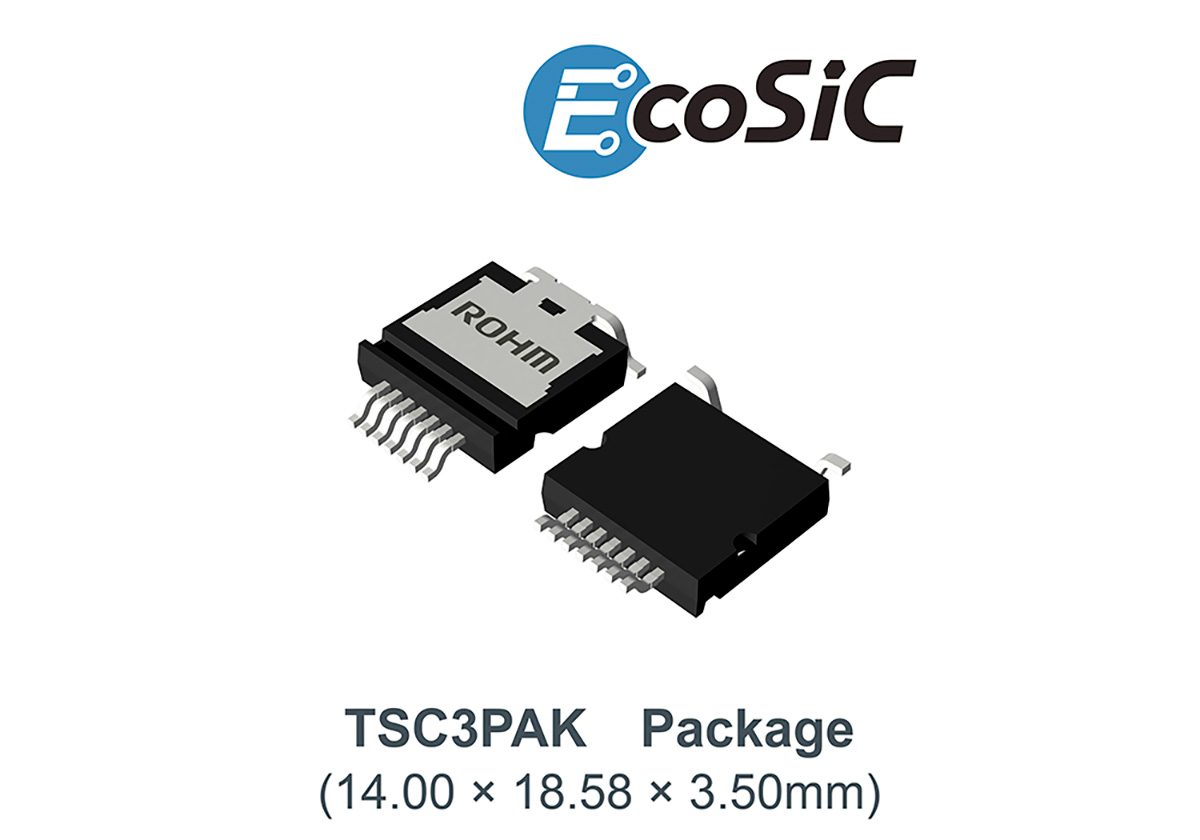
The ROHM TSC3PAK package, measuring a compact 14.00 × 18.58 × 3.50 mm, differentiates itself through an ingenious design feature: a top-side heat dissipation structure. Unlike conventional packages where heat typically dissipates downwards towards the PCB, the TSC3PAK’s heat spreader faces upwards. This configuration allows for highly efficient thermal transfer away from the SiC MOSFET, enabling it to achieve thermal performance comparable to the much larger TO-247 package, all within a surface-mount footprint. This advanced thermal management solution is a cornerstone of the new ROHM SiC MOSFET package, ensuring optimal operational temperatures even under strenuous conditions.
This innovative approach not only facilitates seamless integration into automated assembly processes but also enhances overall system reliability by maintaining lower operating temperatures for the power semiconductor. For applications demanding high power density and efficiency, such as advanced electric vehicle powertrains and industrial power supplies, the ability to combine automated assembly with high-level thermal performance is a critical enabler for next-generation designs.
Enhanced Voltage Endurance and Creepage Distance
Beyond its thermal performance, the TSC3PAK package incorporates ROHM’s proprietary groove structure, a key design element contributing to its exceptional electrical isolation capabilities. This unique feature enables the package to achieve an impressive 6.66 mm creepage distance, a crucial metric for ensuring electrical safety and preventing breakdown in high-voltage environments. Creepage distance refers to the shortest distance between two conductive parts along the surface of an insulating material, directly impacting a component’s ability to withstand high voltages without arcing or insulation failure.
This robust isolation allows the TSC3PAK to support AC peak voltages of up to 1,200 V in a Pollution Degree 2 environment. This high voltage rating is particularly significant for contemporary automotive applications, especially those featuring 800 V battery systems. The increasing prevalence of 800 V architectures in electric vehicles, driven by the need for faster charging and greater efficiency, pushes voltage requirements well beyond what conventional 650 V or 900 V packages can safely or reliably handle. The TSC3PAK’s 1,200 V capability ensures a substantial safety margin and operational longevity in these demanding scenarios.
Key automotive components like onboard chargers (OBC) and electric compressors, which are integral to the functionality and efficiency of modern EVs, require power components capable of enduring these elevated voltage levels. The new ROHM SiC MOSFET package is thus specifically engineered to meet these evolving power demands, supporting the ongoing shift towards higher voltage platforms in electric mobility.
Powering Next-Generation Applications with 4th Generation SiC MOSFETs
At the core of the TSC3PAK are ROHM’s advanced 4th Generation SiC MOSFETs. These cutting-edge semiconductor devices are renowned for their superior characteristics, which include low on-resistance and high-speed switching capabilities. Low on-resistance minimises conductive power losses, ensuring that more energy is delivered to the load rather than being dissipated as heat within the device itself. High-speed switching, on the other hand, allows for more rapid transitions between on and off states, significantly reducing dynamic switching losses during power conversion processes.
By integrating these high-performance SiC MOSFETs within the innovative TSC3PAK, ROHM is enabling substantial reductions in overall power losses across various power conversion stages. This directly translates into higher system efficiency, cooler operation, and ultimately, more compact and reliable end products. The synergy between the advanced SiC chip technology and the novel packaging design makes the ROHM SiC MOSFET package a powerful solution for energy-efficient systems.
The applications for the TSC3PAK are wide-ranging and critical to current and future technological advancements. In the automotive sector, the package is ideally suited for integration into onboard chargers, which convert AC grid power to DC to charge the EV battery, and electric compressors, vital for thermal management systems in EVs. For industrial applications, the TSC3PAK provides robust performance for PV inverters, which convert DC power from solar panels into AC electricity for the grid, and server power supplies, where efficiency and reliability are paramount for data centres.
FAQ Section
What is the primary advantage of ROHM’s new TSC3PAK package?
The TSC3PAK combines high heat dissipation, previously found in larger through-hole packages like TO-247-4L, with full compatibility for automated surface-mount assembly. This allows for more efficient manufacturing and higher board density without compromising thermal performance, especially crucial for the ROHM SiC MOSFET package.
How does the TSC3PAK achieve superior heat dissipation?
It utilises a unique top-side heat dissipation structure, where the heat spreader faces upwards away from the PCB. This design allows for effective thermal management, enabling the compact surface-mount package to match the thermal performance of larger, manually mounted alternatives.
Why is the 1,200 V voltage rating important for this package?
The 1,200 V rating, facilitated by a 6.66 mm creepage distance, is essential for applications featuring advanced 800 V battery systems, particularly in electric vehicles. It provides the necessary safety margin and reliability for components like onboard chargers and electric compressors, which face increasingly high voltage demands.
What are the key applications for the TSC3PAK?
The TSC3PAK is designed for both automotive and industrial applications. In the automotive sector, it’s ideal for onboard chargers and electric compressors. Industrially, it’s well-suited for PV inverters and server power supplies, where high efficiency and robust thermal management are critical for the ROHM SiC MOSFET package.
When did the TSC3PAK begin mass production?
Mass production of the ROHM TSC3PAK package, integrating the company’s 4th Generation SiC MOSFETs, commenced in June 2026. This indicates its immediate availability for manufacturers looking to enhance their power conversion solutions.