
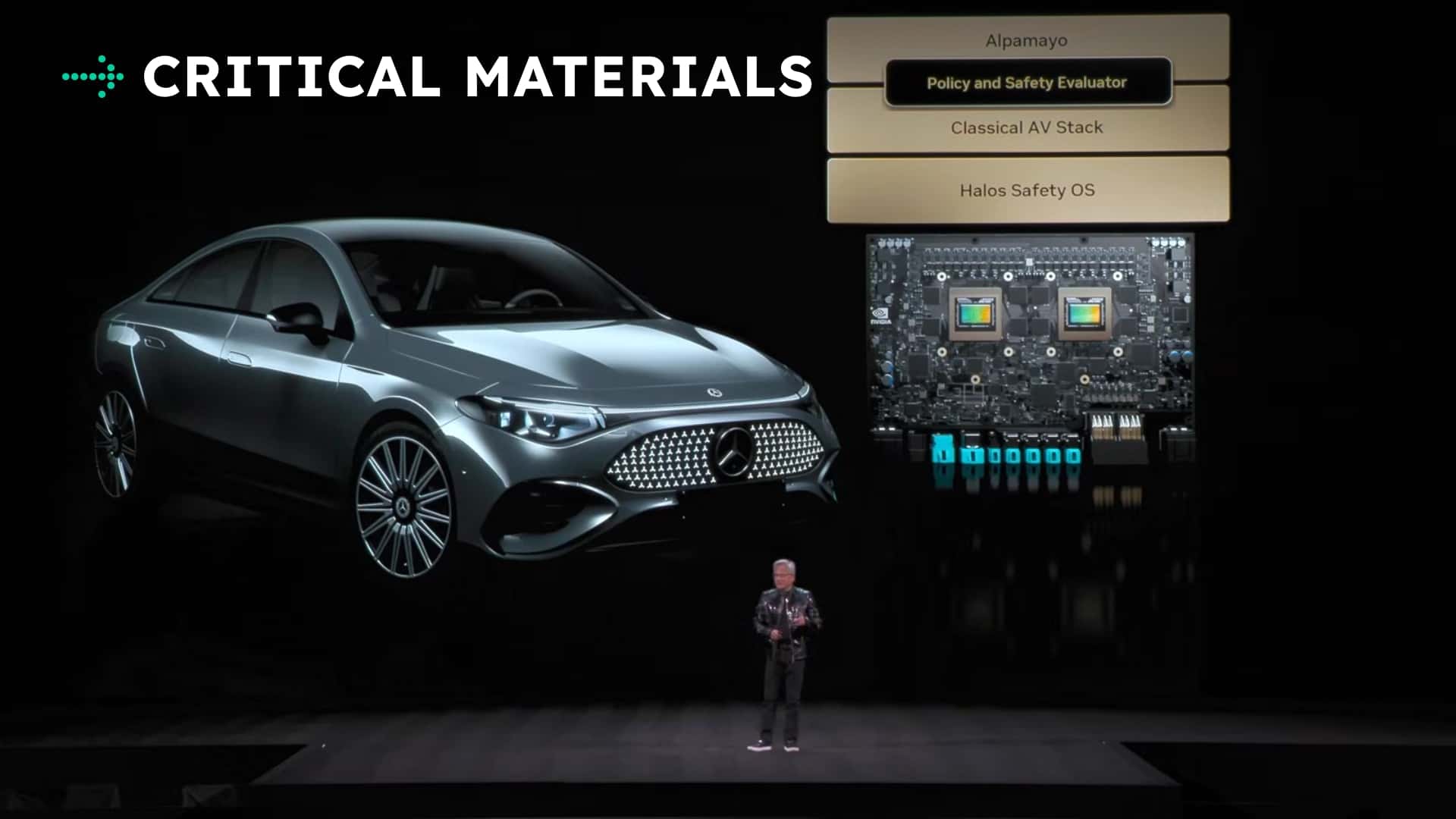
While the much-anticipated CES 2026 might have felt subdued on the electric vehicle front to some, the underlying narrative of the autonomous driving race was clearer than ever. Amidst the flurry of technological advancements and executive discussions, one company consistently emerged as a pivotal player, not as a car manufacturer, but as the technological backbone: Nvidia.
Welcome back to Critical Materials, your essential guide to the innovations shaping the future of transportation. This week, we delve into Nvidia’s surprising ascendancy in the self-driving arena, explore Polestar’s recent European successes, and examine Stellantis’ strategic pivot away from plug-in hybrids.
Nvidia’s AI Engine: Fueling the Self-Driving Car Wars
At CES 2026, the automotive industry showcased a spectrum of technologies—from advanced software and cutting-edge chips to sophisticated radar, cameras, and lidar systems—all aimed at achieving the ultimate goal of driverless vehicles. What became strikingly apparent was Nvidia’s pervasive influence across many of these ambitious autonomy projects.
Beyond merely supplying chips, Nvidia unveiled Alpamayo, a groundbreaking suite of open-source AI models, simulation tools, and datasets designed to accelerate the training of autonomous vehicles. In essence, Nvidia is offering a comprehensive AI solution, positioning itself as the indispensable partner for every automaker and robotaxi company striving for advanced driver-assistance systems (ADAS) and full self-driving capabilities.
The laborious process of manually training autonomous systems, once a decade-long endeavor, can now be dramatically expedited through AI. Nvidia CEO Jensen Huang articulated this shift, stating, “The ChatGPT moment for physical AI is here—when machines begin to understand, reason, and act in the real world. Alpamayo brings reasoning to autonomous vehicles, allowing them to think through rare scenarios, drive safely in complex environments, and explain their driving decisions.”

This offering provides a significant advantage. Companies lacking the extensive resources, capital, or specialized software expertise to develop robust AI for self-driving cars can leverage Nvidia’s integrated platform, contingent on the use of their GPUs and hardware. The extensive list of partners highlighted during Huang’s keynote underscores Nvidia’s long-term strategic importance in this sector.
Even Tesla, a company heavily invested in its AI-driven autonomy, relies on Nvidia. As reported, Elon Musk acknowledged Nvidia’s capabilities, stating on X, “Well that’s just exactly what Tesla is doing ????.” He further elaborated that while achieving consistent performance is achievable, mastering the unpredictable edge cases remains the true challenge.
Musk has long asserted Tesla’s system will possess the ability to reason, mirroring human decision-making in complex traffic scenarios, through future software updates. Nvidia’s CEO, upon learning of Musk’s comments, remarked, “I wouldn’t be surprised… I think the Tesla stack is the most advanced AV stack in the world.”
While Tesla and Nvidia operate on fundamentally different business models—one an integrated electric automaker, the other a technology supplier—Nvidia’s vast capabilities and rapid expansion suggest that the future leader in self-driving technology might not be a traditional car company.
Polestar’s European Resurgence
After a decade of striving to be a Sino-European rival to Tesla, Geely Group-owned Polestar has faced considerable headwinds. Despite initial traction with the Polestar 2, the brand has grappled with slowing sales, a limited model range, production delays, financial instability, import tariffs, and executive turnover. The current EV market slowdown in the U.S. and Polestar’s diminished presence in China have further complicated its trajectory.
However, a recent strategic focus on Europe has yielded encouraging results. According to Reuters, Polestar’s fourth-quarter sales surged by 27% to 15,608 vehicles, contributing to a total of 60,119 cars sold throughout the year. Europe now represents approximately 78% of its sales, a deliberate shift driven by challenging conditions in the U.S. and China.
“Europe is absolutely the core, and we see it works exceptionally well,” stated CEO Michael Lohscheller. “We go into France, we hire Volvo retailers. We bring a French team in there and our cars are very well received.”
With upcoming models like the premium convertible Polestar 6 and the European-built crossover Polestar 7, designed to compete with models like the Tesla Model Y, Polestar appears poised to navigate the global EV market by strengthening its European foothold.
Stellantis Shifts Gears: The End of Plug-In Hybrids in the US
Stellantis has officially discontinued its U.S. market plug-in hybrid models, including the Jeep Wrangler 4xe, Jeep Grand Cherokee 4xe, and Chrysler Pacifica PHEV. This decision follows the company’s embrace of a “back to gas” powertrain strategy, a move facilitated by the easing of stringent fuel economy regulations.
This pivot is notable, especially considering the Jeep Wrangler 4xe was America’s best-selling PHEV. The discontinuation also comes after reports of fire-related recalls and the waning appeal of PHEVs without the federal tax credit.
Rather than abandoning electrification, Stellantis is channeling its efforts into extended-range EVs (EREVs). These vehicles utilize an EV platform but incorporate a gasoline engine as a generator. Automotive News reports that this technology is slated for debut this year in the Jeep Grand Wagoneer and Ram 1500.
A Stellantis spokesperson clarified that recalls did not influence the decision, attributing it instead to evolving customer demand. “This approach reinforces the company’s commitment to offering advanced propulsion systems that maximize efficiency and provide options from internal combustion to hybrid range-extended, and fully electric solutions,” the spokesperson added.
Sean Hogan, chairman of the Stellantis National Dealer Council, expressed a preference for vehicles driven by inherent merit rather than subsidies. “I think the market is heading towards a regular hybrid,” Hogan commented. “If you look at just the general market, it’s the hybrid cars that are killing it, not the plug-in hybrid. We hate to lose a powertrain, but I feel that Stellantis is probably making investments into powertrain systems that, in the end, are going to pay off much better than a plug-in hybrid.”
The success of Stellantis’ EREV strategy will hinge on consumer education and market acceptance, presenting a new challenge as the company navigates the evolving landscape of electrified powertrains.
The Future of Autonomous Driving: What Do You Envision?
As the autonomous vehicle revolution accelerates, what are your expectations? Are you looking forward to enhanced highway driving assistance, broader availability of urban point-to-point autonomy, widespread adoption of robotaxis, or perhaps a different vision altogether? Share your thoughts in the comments below.
Contact the author: patrick.george@insideevs.com