
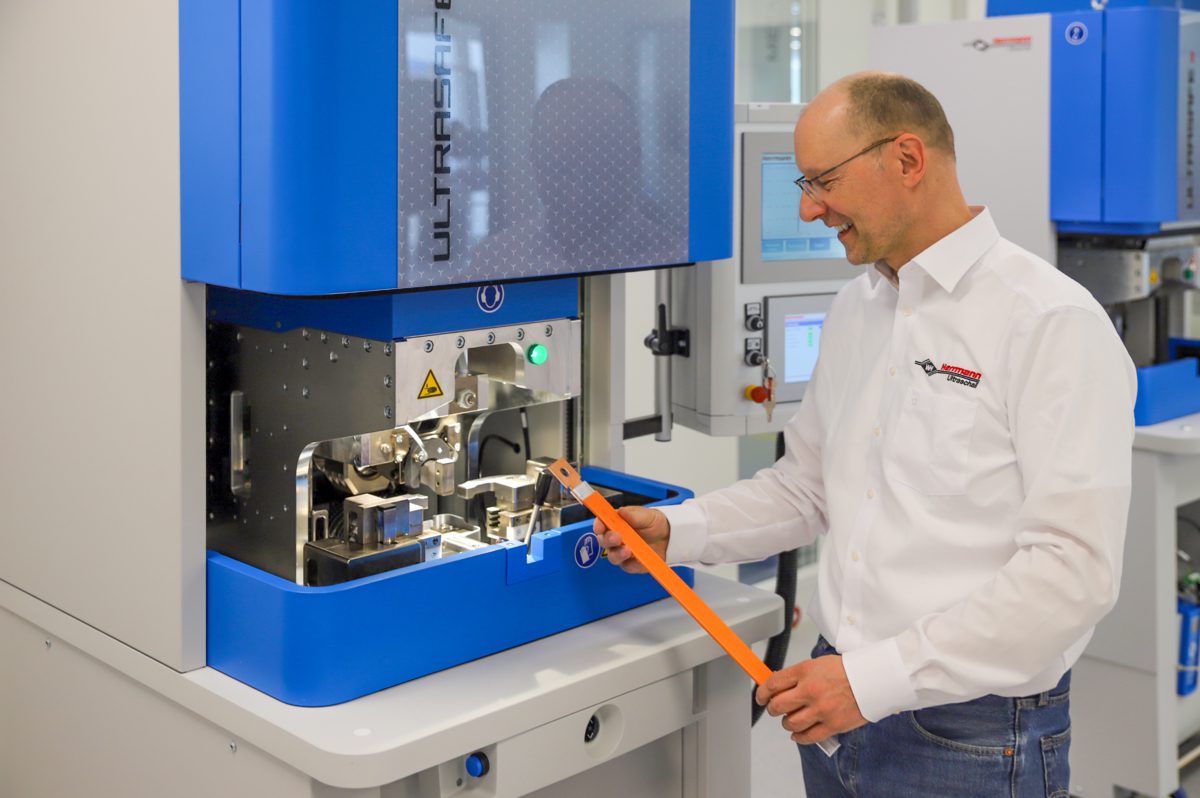
Key Takeaways:
- The growing demands of e-mobility, data centers, and power electronics necessitate advanced busbar manufacturing techniques.
- Ultrasonic welding offers a transformative solution, joining non-ferrous metals like copper and aluminum without heat or additives, preventing material degradation.
- This innovative method delivers high-strength, low-resistance connections crucial for optimal electrical performance and longevity.
- Key benefits include accelerated cycle times due to no cooling requirements, precise process control, and real-time data monitoring.
- The technology ensures scalable production with minimal rejects, leading to a more efficient and cost-effective manufacturing process.
- Compared to conventional methods like laser welding, crimping, and soldering, ultrasonic welding provides superior technical advantages in material integrity and conductivity.
- Adopting ultrasonic welding for busbar production enhances output, maintains consistent quality, and supports the rigorous requirements of modern electrical systems.
Addressing the Evolving Demands in Busbar Production
The global landscape of electrical systems is undergoing a profound transformation, driven by an escalating need for higher performance and greater efficiency. Industries at the forefront of this evolution, including e-mobility, sophisticated data centers, and advanced power electronics, are continuously pushing the boundaries of conventional manufacturing capabilities. Central to these demanding applications are busbars, critical components that facilitate efficient power distribution within complex electrical assemblies.

Traditional methods of busbar manufacturing are increasingly encountering limitations as performance requirements intensify. Issues such as thermal stress, material degradation, and the need for post-processing steps often impede production efficiency and compromise the integrity of electrical connections. This growing disparity between demand and conventional capacity has necessitated a re-evaluation of current production methodologies, paving the way for innovative joining technologies.
Ultrasonic Welding: A Paradigm Shift in Non-Ferrous Metal Joining
Amidst these challenges, ultrasonic welding has emerged as a groundbreaking solution, redefining how non-ferrous metals, particularly copper and aluminum, are reliably joined. This advanced joining process distinguishes itself by eliminating the need for external heat sources, fluxes, or filler materials, which are often problematic in conventional welding techniques. Instead, it leverages high-frequency mechanical vibrations to create a solid-state metallurgical bond.
The principle behind ultrasonic welding for busbars involves pressing two metal parts together under moderate force while applying ultrasonic vibrations. This action generates localized friction and plastic deformation at the interface, disrupting oxide layers and forming a true atomic bond without melting the base materials. The absence of a melt phase is crucial, as it preserves the intrinsic material properties and microstructure of the busbar components, ensuring superior electrical and mechanical performance.

Key Advantages of Heat-Free Bonding
Unlike processes that introduce significant thermal energy, ultrasonic welding avoids the heat-affected zones that can weaken materials or alter their electrical conductivity. This characteristic is particularly beneficial for sensitive components in power electronics and battery systems, where thermal management and material integrity are paramount. The clean, robust bonds formed through this method contribute directly to the longevity and reliability of electrical connections.
Unlocking Efficiency: Seven Core Benefits of Optimized Busbar Manufacturing with Ultrasonic Welding
The adoption of ultrasonic welding in busbar production offers a compelling array of benefits that directly address the performance and efficiency demands of modern electrical systems. These advantages collectively contribute to a more streamlined, cost-effective, and high-quality manufacturing process.
1. High-Strength, Low-Resistance Connections
One of the most critical benefits of ultrasonic welding for busbars is its ability to create exceptionally strong and electrically efficient connections. The solid-state bond formed ensures minimal electrical resistance, which is vital for reducing energy losses and heat generation within power transmission pathways. This enhanced conductivity translates directly into improved system efficiency and reduced operational costs, particularly in high-current applications.
Furthermore, the inherent strength of these bonds provides superior mechanical integrity, making them highly resistant to vibration, fatigue, and environmental stressors. This durability is indispensable for applications in e-mobility, where components are subjected to dynamic forces and harsh operating conditions, ensuring long-term reliability of busbar assemblies.
2. Accelerated Cycle Times Without Cooling
Conventional welding or soldering often requires significant cooling periods to prevent material deformation or allow components to solidify. Ultrasonic welding eliminates this bottleneck entirely. The process is inherently fast, with cycle times typically measured in seconds, and requires no subsequent cooling phase, allowing immediate handling of welded parts.
This rapid processing capability dramatically improves overall production throughput. Manufacturers can achieve higher output rates without expanding their footprint or increasing labor, leading to substantial gains in operational efficiency and responsiveness to market demands for advanced electrical components.
3. Precision and Control in Manufacturing
Modern manufacturing demands exacting precision, and ultrasonic welding technology delivers on this front. Advanced ultrasonic welding systems are equipped with sophisticated controls that allow for precise regulation of welding parameters, including amplitude, pressure, and time. This level of control ensures consistent weld quality across large production batches.
Coupled with real-time data monitoring, manufacturers gain unprecedented insight into every weld cycle. This capability allows for immediate identification and correction of any deviations, preventing defects before they escalate and ensuring adherence to stringent quality standards for every busbar connection. Such precise process management is invaluable for high-reliability applications.
4. Scalability and Minimal Rejects
The consistency and repeatability offered by ultrasonic welding make it highly scalable for mass production environments. Whether manufacturing components for a single data center or millions of electric vehicles, the process maintains its integrity and efficiency. This scalability is a key competitive advantage in rapidly expanding markets.
Furthermore, the inherent precision and control of the process significantly reduce the incidence of manufacturing defects and rejects. By minimizing waste and rework, companies can achieve considerable cost savings and improve their overall resource efficiency, contributing to a more sustainable and profitable production model.
5. Enhanced Output and Consistent Quality
The combination of short cycle times, minimal rejects, and robust process control directly translates into a higher production output without compromising quality. Ultrasonic welding enables manufacturers to meet the escalating volume demands of industries like e-mobility while maintaining a uniform, high standard for every busbar.
This consistent quality is paramount for critical applications where reliability is non-negotiable. It ensures that every electrical connection performs as expected, contributing to the overall safety and performance of the end product, from intricate power modules to large-scale energy storage systems.
6. Reliable Welding of Thicker Busbars for Optimal Conductivity
One of the long-standing challenges in busbar manufacturing involves reliably joining thicker non-ferrous materials while preserving optimal electrical conductivity. Ultrasonic welding excels in this regard, offering robust solutions for even substantial cross-sections of copper and aluminum.
The unique solid-state bonding mechanism ensures that the bulk material properties, particularly electrical conductivity, are maintained across the joint interface. This is critical for high-current busbar applications where any increase in resistance across a connection can lead to significant power losses and localized heating, potentially compromising system performance and safety.
7. Optimising Cycle Rates and Overall Throughput
Beyond individual weld speeds, ultrasonic welding contributes to the overall optimisation of manufacturing cycle rates and throughput. By integrating seamlessly into automated production lines, it reduces the need for manual intervention and subsequent quality checks that are often associated with less precise joining methods.
This holistic improvement in manufacturing flow leads to a more agile and responsive production system capable of adapting quickly to changes in demand and product specifications. The result is a highly competitive and efficient operation that maximizes resource utilization and minimizes lead times.
Comparing Advanced Joining Technologies: Ultrasonic Welding vs. Conventional Methods
Understanding the full scope of advantages offered by ultrasonic welding necessitates a comparison with alternative busbar joining technologies that are commonly employed in the industry. Each method presents its own set of characteristics, but ultrasonic welding consistently demonstrates superior technical advantages in several key areas.
Versus Laser Welding
Laser welding, while capable of precise joining, introduces significant thermal energy into the materials. This intense heat can lead to the formation of brittle intermetallic compounds, particularly when joining dissimilar metals like copper and aluminum, which can compromise the mechanical strength and electrical conductivity of the busbar. Furthermore, the heat-affected zones can alter the microstructure of the base materials, potentially reducing their long-term reliability.
In contrast, ultrasonic welding operates below the melting point, preventing such thermal degradation and the formation of undesirable intermetallic layers. This solid-state process ensures that the inherent properties of the non-ferrous metals are preserved, yielding superior, stable connections without thermal distortion or material embrittlement.
Versus Crimping
Crimping is a mechanical joining process that creates a connection by deforming the materials under pressure. While often a cost-effective initial solution, crimped connections can be susceptible to issues over time, such as relaxation, corrosion, and fretting, which can lead to increased electrical resistance and potential failure. The reliability of a crimp heavily depends on consistent pressure application and material properties.
Ultrasonic welding forms a true metallurgical bond, which is inherently more stable and reliable than a purely mechanical connection. This ensures a consistent, low-resistance electrical pathway that is highly resistant to environmental factors and mechanical stress, maintaining its performance characteristics over the entire lifespan of the busbar assembly.
Versus Soldering
Soldering involves using a filler metal with a lower melting point to join components. This method introduces various challenges, including the need for fluxes (which can be corrosive), the creation of brittle solder joints, and thermal stress on adjacent components. The thermal cycling involved in soldering can also lead to fatigue failures in the long term, especially in dynamic applications.
Ultrasonic welding eliminates the need for filler metals and fluxes, resulting in clean, environmentally friendly joints. The absence of a high-temperature melt process avoids thermal shock and minimizes stress on the busbar materials, contributing to a more robust and durable connection ideal for high-performance and high-reliability electrical systems. This makes it a preferred method for critical applications in modern power electronics.
The Future of Electrical Systems Relies on Advanced Busbar Solutions
As industries continue to demand higher power density, greater efficiency, and uncompromising reliability, the role of advanced manufacturing techniques for busbars becomes increasingly critical. The shift towards electrification in automotive, the expansion of high-performance computing, and the evolution of renewable energy systems all depend on robust and efficient electrical interconnections.
Ultrasonic welding stands as a proven technology capable of meeting these stringent requirements, offering a scalable, precise, and highly efficient method for joining non-ferrous metals. Its ability to produce high-quality connections without thermal degradation positions it as an indispensable tool in the ongoing innovation of modern electrical systems, driving progress across multiple high-tech sectors.
Further Insights and Expert Whitepaper
For a deeper dive into these technical advantages and a comprehensive guide to optimizing busbar manufacturing with ultrasonic welding, readers can access detailed resources from industry experts. The full whitepaper titled ‘Re-thinking busbar production: 7 benefits of optimized manufacturing with ultrasonic welding’ offers an in-depth exploration of the technology, its applications, and practical implementation strategies.
This valuable resource provides specific insights into how ultrasonics reliably welds even thicker busbars while ensuring optimal conductivity, strategies to optimize cycle rates and output, and detailed technical advantages compared to laser welding, crimping, and soldering. Interested parties seeking to leverage this transformative technology for their production lines can access the comprehensive details through the ‘Whitepaper Download’ portal, typically requiring registration to obtain the complete data.
Frequently Asked Questions (FAQ)
What challenges do conventional busbar manufacturing methods face today?
Conventional methods struggle with rising performance demands from e-mobility, data centers, and power electronics. They often encounter limitations such as thermal stress on materials, potential degradation from heat and additives, and slower cycle times due to cooling requirements, hindering efficiency and consistent quality in high-volume production.
How does ultrasonic welding differ from traditional joining techniques?
Ultrasonic welding uses high-frequency mechanical vibrations to create a solid-state bond in non-ferrous metals like copper and aluminum. Unlike traditional methods, it operates without external heat, fluxes, or filler materials, preventing material degradation, preserving intrinsic properties, and eliminating heat-affected zones often found in laser welding or soldering.
What are the primary benefits of using ultrasonic welding for busbars?
Key benefits include the creation of high-strength, low-resistance electrical connections crucial for efficiency and durability. It offers accelerated cycle times without cooling, precise process control with real-time data monitoring, and ensures scalable production with minimal rejects, leading to cost-effective and high-quality manufacturing outcomes for busbars.
Can ultrasonic welding effectively join thicker busbars?
Yes, ultrasonic welding is highly effective for reliably joining even thicker busbars. Its solid-state bonding mechanism ensures that optimal electrical conductivity is maintained across the joint interface, which is critical for high-current applications where power loss and localized heating must be rigorously minimized to ensure system performance and safety.
How does ultrasonic welding improve overall production efficiency?
By eliminating cooling times and enabling immediate handling of welded parts, ultrasonic welding significantly accelerates cycle rates. Its precision and control capabilities reduce rejects and rework, contributing to higher throughput and streamlined operations. This results in enhanced output and greater cost-effectiveness for busbar manufacturing facilities.
Is ultrasonic welding environmentally friendly compared to other methods?
Ultrasonic welding is generally considered more environmentally friendly. It does not require fluxes or filler materials, which can be chemically intensive or produce harmful fumes. The absence of high-temperature processes also reduces energy consumption compared to methods requiring significant heating, aligning with modern sustainability goals in manufacturing.
What types of materials are best suited for ultrasonic welding in busbar applications?
Ultrasonic welding is exceptionally well-suited for joining non-ferrous metals, particularly copper and aluminum. It can also effectively join dissimilar combinations of these metals. This capability is crucial for busbar applications where combinations of highly conductive materials are frequently used to optimize electrical performance and reduce weight, especially in e-mobility.