
Key Takeaways:
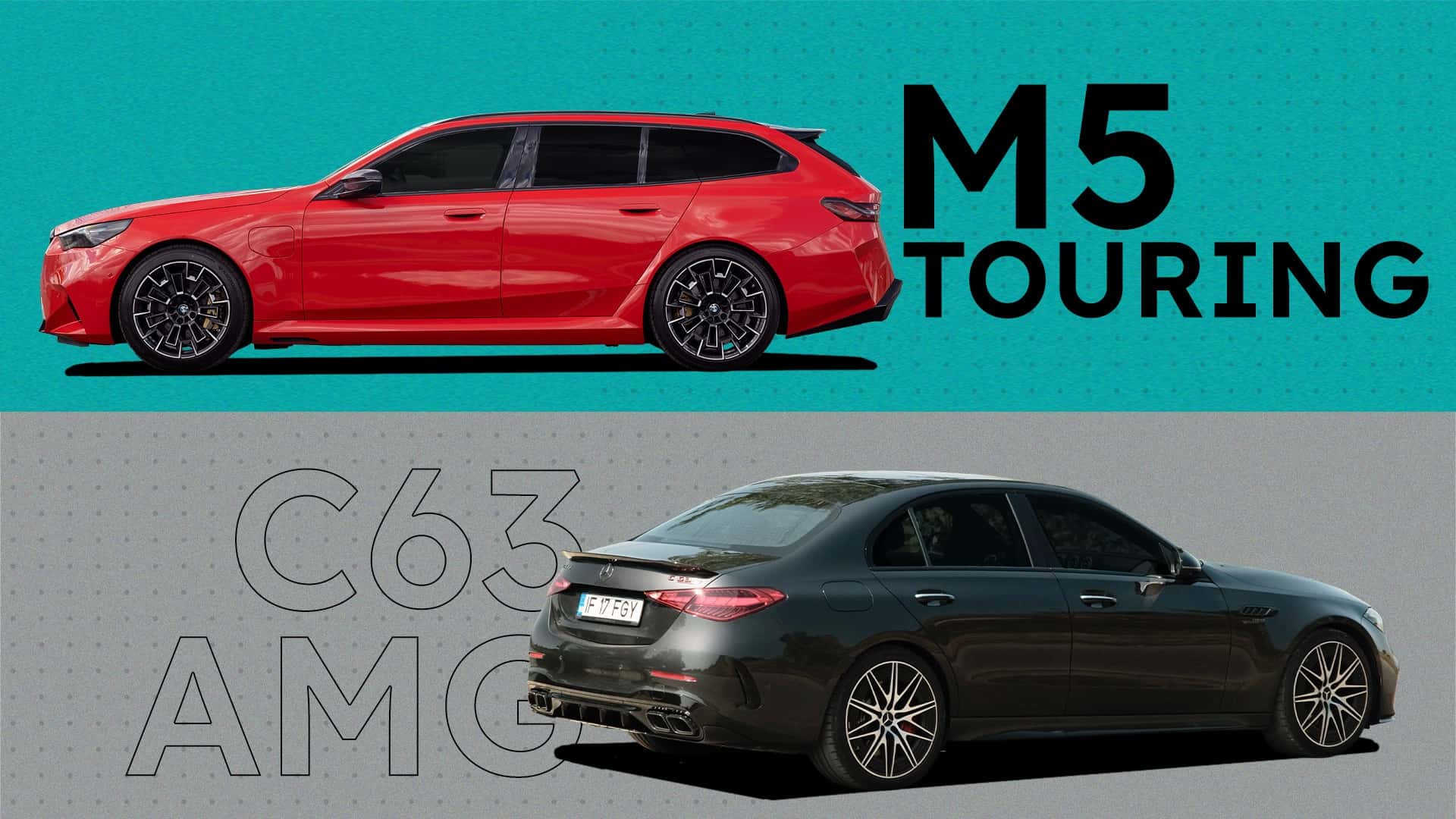
The latest generation of high-performance plug-in hybrid electric vehicles (PHEVs) from BMW and Mercedes-AMG presents contrasting approaches to electrification. While the 2025 BMW M5 Touring leverages a large V-8 and a substantial 22.1 kWh battery for immense power and considerable electric range, its 5,456-pound curb weight significantly compromises agility and ride quality. In contrast, the Mercedes-AMG C63s E-Performance, though a class smaller, prioritizes performance with a bespoke, lighter 6.1 kWh battery and a potent four-cylinder engine, delivering superior handling dynamics despite less electric range. This comparison underscores a critical insight: for true driver engagement in performance PHEVs, a smaller, strategically integrated battery can yield a more compelling experience than one designed primarily for extended electric-only driving.

The automotive landscape is rapidly evolving, with even the most revered performance flagships embracing electrification. This shift often involves integrating substantial batteries into vehicles previously celebrated for their raw internal combustion power, creating a new breed of high-performance hybrid. However, this convergence of power and electric capability has led to some peculiar outcomes, particularly concerning vehicle dynamics. A recent evaluation comparing the all-new G99 BMW M5 Touring and the Mercedes-AMG C63s E-Performance highlights these divergent engineering philosophies and their impact on the ultimate driving experience.
Both models represent the pinnacle of their respective brands’ performance offerings but adopt fundamentally different strategies for integrating hybrid technology. The core dilemma, as revealed by a direct comparison, is whether adding more power and battery capacity invariably translates to a superior, more enjoyable driving experience. While both vehicles are undeniably quick in a straight line, their on-road character, particularly when navigating challenging corners, paints a clearer picture of how effectively each manufacturer has managed the inherent compromises of hybridisation in the pursuit of high-performance excellence.
BMW M5 Touring: A Heavyweight Contender
Unleashing Raw Power with Electric Boost
The 2025 BMW M5 Touring makes a compelling statement with its formidable powertrain. Beneath its hood lies a 4.4-liter twin-turbocharged V-8 engine, complemented by a robust electric motor. This combination is officially rated at a staggering 717 horsepower, though recent dyno tests suggest its real-world output could be closer to 800 horsepower, delivering nearly 700 hp to the wheels. Such figures translate into an alarming pace, pinning occupants to their seats with brutal acceleration from both standing starts and rolling inputs. The sheer shove of 737 pound-feet (1,000 Nm) of torque is a visceral reminder of its immense capabilities.

The integration of the electric motor, positioned within the eight-speed automatic gearbox, further enhances the M5’s versatility. Producing 197 hp and 206 lb-ft (280 Nm) of torque, this motor is surprisingly capable of propelling the M5 Touring on its own. Even for a vehicle weighing a substantial 5,456 pounds (2,475 kg), the M5 felt brisk and responsive in purely electric vehicle (EV) mode, offering around 35 miles of zero-emission driving. This electric capability provides a quiet and smooth around-town experience, complete with a subtle, fun acceleration sound piped through the speakers and perceptible gear shifts, even without the V-8 engaged. Power is routed to all four wheels, ensuring reliable traction even in challenging low-grip conditions.
The Weight of Electrification: Handling Compromises
Despite its undeniable straight-line prowess and impressive electric mode, the BMW M5 Touring introduces a significant trade-off in dynamic driving scenarios. The substantial 22.1-kilowatt-hour battery contributes heavily to its considerable curb weight, making it even heavier than BMW’s pure electric i5 Touring M60. This mass necessitates a specially tuned suspension system, which, unfortunately, results in a notably inconsistent ride quality. The M5 struggles to find a balance, often feeling like it oscillates between the luxurious plushness of a ‘Maybach’ and the jarring stiffness of a ‘pogo stick’, leaving the driver uncertain of its character on varying road surfaces.
The consequences of this weight become particularly evident when cornering. Mid-corner bumps can unsettlingly disturb the car’s composure, causing noticeable transfers of force and demanding constant micro-corrections. When driven spiritedly, the immense inertia consistently attempts to pull the car into understeer, creating a sensation akin to an ‘athlete trying to run with ankle weights’. This ultimately detracts from the precise, agile driving experience expected from a vehicle bearing the M badge, raising questions about the optimal balance between power, electric range, and dynamic integrity in a modern performance PHEV.
Mercedes-AMG C63s E-Performance: Agility Through Focused Electrification
A Nimble Competitor with Bespoke Engineering
Stepping into the Mercedes-AMG C63s E-Performance immediately highlights the stark contrast in engineering philosophies. While still a heavy vehicle by traditional sports car standards, it feels considerably more agile than the M5, despite belonging to a smaller vehicle class. This is partly due to its lighter overall mass, being approximately 880 pounds (400 kg) lighter than the BMW. The C63’s powertrain, though featuring only four cylinders compared to the M5’s V-8, delivers a driving experience that many find more engaging and ‘special’ to drive. And while its engine may only be a 2.0-liter, it’s an actual AMG engine hand-assembled by someone who puts their name and signature on it.
The signed plaque is proudly displayed when you pop the hood, and you also get to see the big turbo and electric supercharger setup sitting to the side of the engine. This was a more impressive sight than what was described for the M5, whose clever hot-V twin-turbo setup is hidden by an underwhelming plastic engine cover. The M139 engine, derived from Mercedes-AMG’s potent compact offerings like the CLA 45, produces well over 400 horsepower independently. When combined with its electric motor, the C63 unleashes a total of 670 hp and an astonishing 752 lb-ft (1,020 Nm) of torque. This torque figure surpasses that of the BMW, and the lighter overall package ensures that every pound-foot is felt, delivering an acceleration experience that is nothing short of breathtaking.
Performance-First Hybrid Integration
The C63’s ‘Race Start’ function generates a G-force sensation described as unlike anything experienced in a combustion car, giving the impression of being even faster than the BMW, despite comparable on-paper figures. An electric supercharger works in concert with the turbocharger to build boost rapidly, virtually eliminating lag and ensuring a highly responsive powertrain. The combined surge from the electric motor and the combustion engine creates a truly exhilarating experience. Furthermore, its exhaust note, even with piped-in enhancement disabled, is described as ‘characterful,’ allowing the driver to appreciate the mechanical symphony of the turbo building and releasing pressure.
Crucially, the C63 excels where the M5 falters: through corners. Its chassis feels significantly more composed and responsive, providing a ‘track car’ focus on optimal corner exit with minimal drama. Unlike older C63s known for their propensity to shred rear tires, the new model offers a more precise and controlled dynamic. Mercedes-AMG’s ingenuity lies in its bespoke, smaller hybrid system. Instead of simply adapting components from lesser PHEV models, the C63 features a compact 6.1 kWh battery and an electric motor integrated directly into the rear axle. This design choice explicitly prioritizes performance enhancement over extensive electric-only range, though it can still manage approximately 5 miles on pure electricity.
Efficiency vs. Engagement: The Core Philosophical Divide
The fundamental difference in battery philosophy is central to the varied driving experiences. The BMW M5’s 22.1 kWh battery, while providing a generous 35 miles of electric range, is a primary contributor to its considerable weight and subsequent handling compromises. Its WLTP efficiency rating of 1.6 to 1.7 liters/100 km (nearly 150 mpg) is achievable only under ideal conditions with a fully charged battery. The more realistic EPA combined rating for a depleted battery stands at 13 mpg (18 l/100 km).
Conversely, the C63’s smaller 6.1 kWh battery is a strategic choice. Its primary role is to satisfy regulatory emissions standards in Europe and, more importantly, to boost performance without overburdening the chassis. While it offers a minimal 5 miles of electric range, its claimed average efficiency of 6.9 l/100 km (34 mpg) is attainable with careful driving. Even when driven spiritedly, similar to the BMW, it returns around 15 mpg, and the EPA rates it at 20 mpg with a depleted battery, demonstrating remarkable efficiency given its explosive acceleration. This approach emphasizes that for a high-performance PHEV, a judiciously sized battery can deliver greater driver engagement and potentially better real-world efficiency by avoiding excessive weight penalties.
The Evolution of Performance PHEVs: Redefining Expectations
The ongoing debate surrounding performance PHEVs suggests that more battery capacity is not always the optimal solution for achieving an exhilarating driving experience. While electrification can undoubtedly enhance efficiency in various automotive applications, its primary purpose in a true performance vehicle should be to amplify dynamics and power delivery without compromising handling. The sheer mass introduced by oversized batteries can paradoxically make a plug-in hybrid less efficient in spirited driving than a pure internal combustion engine counterpart, besides hindering agility.
The Mercedes-AMG C63s E-Performance exemplifies a successful strategy, aligning its philosophy more closely with high-end exotic performance PHEVs such as the second-generation Acura NSX, the Corvette E-Ray, the Ferrari 296 GTB, or the new Lamborghini Temerario. These vehicles demonstrate that keeping battery size under 8 kWh, as seen in Ferrari’s SF90 and 296 GTB, allows for pure handling characteristics to be retained while still benefiting from electric power. In these applications, the few miles of electric driving are a welcome bonus, but the main objective of electrification remains performance enhancement, not extended electric range.
A common concern with smaller batteries in performance applications is the potential for the internal combustion engine to act as a generator, recharging a depleted pack at the expense of power, akin to a ‘hamster wheel’ effect. However, extensive real-world testing, including over half an hour of aggressive driving in the C63 on a twisty road, indicated ample battery charge remaining (around 33%), with no discernible loss of performance. This suggests that for most spirited road use, the smaller, performance-oriented battery architecture is more than sufficient to sustain its hybrid boost, proving that intelligent design can overcome perceived limitations.
Conclusion
The comparison between the 2025 BMW M5 Touring and the Mercedes-AMG C63s E-Performance offers a crucial lesson for the future of high-performance vehicles. While both showcase incredible engineering and potent powertrains, Mercedes-AMG’s approach with the C63, prioritizing agility and a bespoke, lighter battery system for performance enhancement rather than extensive electric range, emerges as the more effective formula for driver engagement. The M5, despite its immense power, struggles under the burden of its significant mass, resulting in a less consistent and ultimately less thrilling dynamic experience.
For discerning enthusiasts seeking an electrifying yet dynamically satisfying performance PHEV, the C63 demonstrates that judicious integration of hybrid technology, where electrification serves primarily to boost performance and maintain chassis integrity, is paramount. This philosophical distinction highlights that in the quest for ultimate driving enjoyment, sometimes less, particularly in terms of battery size and weight, truly is more.
Frequently Asked Questions About Performance PHEVs
Q1: What is a performance PHEV?
A1: A performance Plug-in Hybrid Electric Vehicle (PHEV) combines a powerful internal combustion engine with an electric motor and battery, where the primary goal of electrification is to enhance acceleration and overall dynamic capability, rather than just maximize electric range or fuel efficiency.
Q2: How do the BMW M5 Touring and Mercedes-AMG C63s E-Performance differ in their hybrid approach?
A2: The BMW M5 Touring uses a larger 22.1 kWh battery for substantial electric range (35 miles) but incurs a significant weight penalty. The Mercedes-AMG C63s E-Performance employs a smaller, bespoke 6.1 kWh battery focused on boosting performance with minimal weight, offering only about 5 miles of electric range.
Q3: Which vehicle offers a better driving experience, and why?
A3: The Mercedes-AMG C63s E-Performance is noted for a more engaging driving experience. Its lighter weight, combined with a performance-focused hybrid system, results in superior agility, better cornering dynamics, and a more responsive feel compared to the heavier BMW M5 Touring.
Q4: Does a larger battery always mean better performance in a PHEV?
A4: Not necessarily for driving dynamics. While a larger battery provides more electric range and potentially higher peak power, the added weight can negatively impact handling, ride quality, and overall agility, as observed in the BMW M5 Touring, making it less fun to drive spiritedly.
Q5: What are the real-world efficiency figures for these performance PHEVs?
A5: The BMW M5 Touring has an EPA combined rating of 13 mpg with a depleted battery. The Mercedes-AMG C63s E-Performance, despite its performance focus, achieves a more favorable EPA rating of 20 mpg with a depleted battery, and around 15 mpg in spirited driving.
Q6: Can smaller batteries in performance PHEVs sustain their power output?
A6: Yes, in many cases. The Mercedes-AMG C63s E-Performance, with its 6.1 kWh battery, demonstrated sustained performance even after aggressive driving for over 30 minutes, indicating that its system effectively manages battery charge to maintain hybrid boost without significant power loss.
Q7: What other vehicles exemplify the ‘performance-first’ PHEV philosophy?
A7: Other notable performance PHEVs that prioritize dynamic engagement over extensive electric range include the second-generation Acura NSX, the Chevrolet Corvette E-Ray, the Ferrari 296 GTB, and the new Lamborghini Temerario, all utilizing strategically sized batteries to preserve handling purity.