
In an era increasingly defined by the shift towards sustainable mobility, global automotive giant Toyota is actively working to ensure its vast workforce is aligned with its evolving vision for the future. A recent immersion in Toyota Motor North America’s ‘Electrification 101’ program revealed a significant, yet unsurprising, truth: not all employees, even within a leading car manufacturer, possess an inherent understanding of electric vehicle (EV) technology or its broader implications. This revelation underscores the critical need for comprehensive internal education as the automotive industry navigates its most profound transformation in a century.
Key Takeaways
- Many Toyota employees initially lacked basic knowledge regarding vehicle electrification, including hybrids, EVs, and fuel cell technologies.
- Toyota launched its ‘Electrification 101’ program to educate staff, recognizing that not every employee is an automotive enthusiast.
- The program emphasizes Toyota’s ‘multi-pathway’ strategy, focusing on hybrids for today and eyeing battery electric vehicles (BEVs) and hydrogen fuel cell electric vehicles (FCEVs) for the future.
- Content covered powertrain basics, dispelled EV myths, highlighted efficiency and cleanliness benefits, and included hands-on demonstrations.
- A core lesson highlighted the inherent simplicity and efficiency of electric motors compared to traditional internal combustion engines.
- The training aims to foster internal advocacy, with employees like Brigette Armato becoming informed proponents of electrified vehicles among customers and colleagues.
- This educational initiative is crucial for long-horizon decision-making within the company and for accelerating the adoption of cleaner vehicle technologies.
Bridging the Knowledge Gap: Toyota’s Proactive Approach
It is often assumed that employees of a prominent car manufacturer possess an encyclopedic knowledge of automotive advancements. However, the reality, as observed during Toyota’s ‘Electrification 101’ program, paints a different picture. Many individuals working within the corporate structure of Toyota Motor North America are drawn by the company’s robust benefits, career stability, respectful culture, and the prestige associated with working for the world’s largest automaker. Their roles, whether in corporate finance, software development, or human resources, do not inherently require an in-depth understanding of powertrain technologies.

Even automotive enthusiasts within the company might primarily appreciate conventional internal combustion engine (ICE) vehicles, lacking familiarity with the intricate technicalities of electric and hybrid systems, such as the distinctions between Nickel-Cobalt-Manganese (NCM) and Lithium Iron Phosphate (LFP) battery chemistries. Recognizing this diverse knowledge base, Toyota has proactively developed the ‘Electrification 101’ program, marking it as the second such foundational course, following an earlier general ‘Automotive 101’ introduction.
Understanding Toyota’s Multi-Pathway Strategy
The program’s deliberate title, ‘Electrification 101,’ rather than ‘EV 101,’ reflects Toyota’s deeply rooted ‘multi-pathway’ approach to sustainable mobility. This strategy underscores a contemporary focus on hybrid electric vehicles (HEVs), coupled with a forward-looking perspective on battery electric vehicles (BEVs) and, notably, hydrogen fuel cell electric vehicles (FCEVs). This comprehensive vision is supported by recent sales data: in the last quarter, a substantial 56.8% of Toyota’s total vehicle sales were electrified, encompassing HEVs, BEVs, plug-in hybrid electric vehicles (PHEVs), and FCEVs. Pure BEVs, however, accounted for a smaller proportion, at 1.7% of these electrified sales.
The curriculum meticulously details the fundamentals of these diverse powertrain types, clearly differentiating between HEVs and PHEVs. While Toyota’s current market emphasis leans heavily on hybrids, a significant portion of the training is dedicated to clarifying misconceptions surrounding BEVs. The program effectively contextualizes the transition by drawing parallels to the early 20th-century automotive landscape, where gasoline cars faced challenges such as nascent infrastructure, limited public education, and unclear regulations, making horse ownership a seemingly simpler alternative. The eventual triumph of the automobile serves as a powerful analogy for the current EV transition.

Dispelling Myths and Highlighting Advantages
Central to the training is an elucidation of the inherent benefits of electrification, primarily efficiency and environmental cleanliness. Toyota champions its multi-pathway strategy not only for offering diverse customer choices but also, as the company argues, for optimizing the use of finite battery resources. It is important to note, however, that while Toyota advocates for this resource optimization, most independent research suggests that BEVs typically represent the cleanest option over their lifecycle, even when considering the energy sources used for charging. Other studies, such as this comprehensive analysis, reinforce the environmental superiority of EVs.
The program’s segment on the comparative advantages of each powertrain, while informative, did reveal a particular bias. The focus often leaned towards the limitations of BEVs, with less emphasis placed on the maintenance demands and noise, vibration, and harshness (NVH) characteristics of traditional gasoline vehicles. Hydrogen technology, particularly embodied by the Toyota Mirai, received a characteristically bullish presentation. A program slide, for instance, suggested hydrogen could ‘reduce ‘range anxiety’ as number of stations grow,’ citing the Mirai’s impressive 402-mile range per tank. While such figures were groundbreaking in the early days of EVs, the contemporary landscape sees more than eight BEV models in the U.S. market already surpassing this range, with numerous others expected soon. The Mirai, primarily available in select regions of California in the U.S., also faces the challenge of hydrogen fuel costing twice as much as gasoline.
Interactive Learning: Demystifying Electric Power
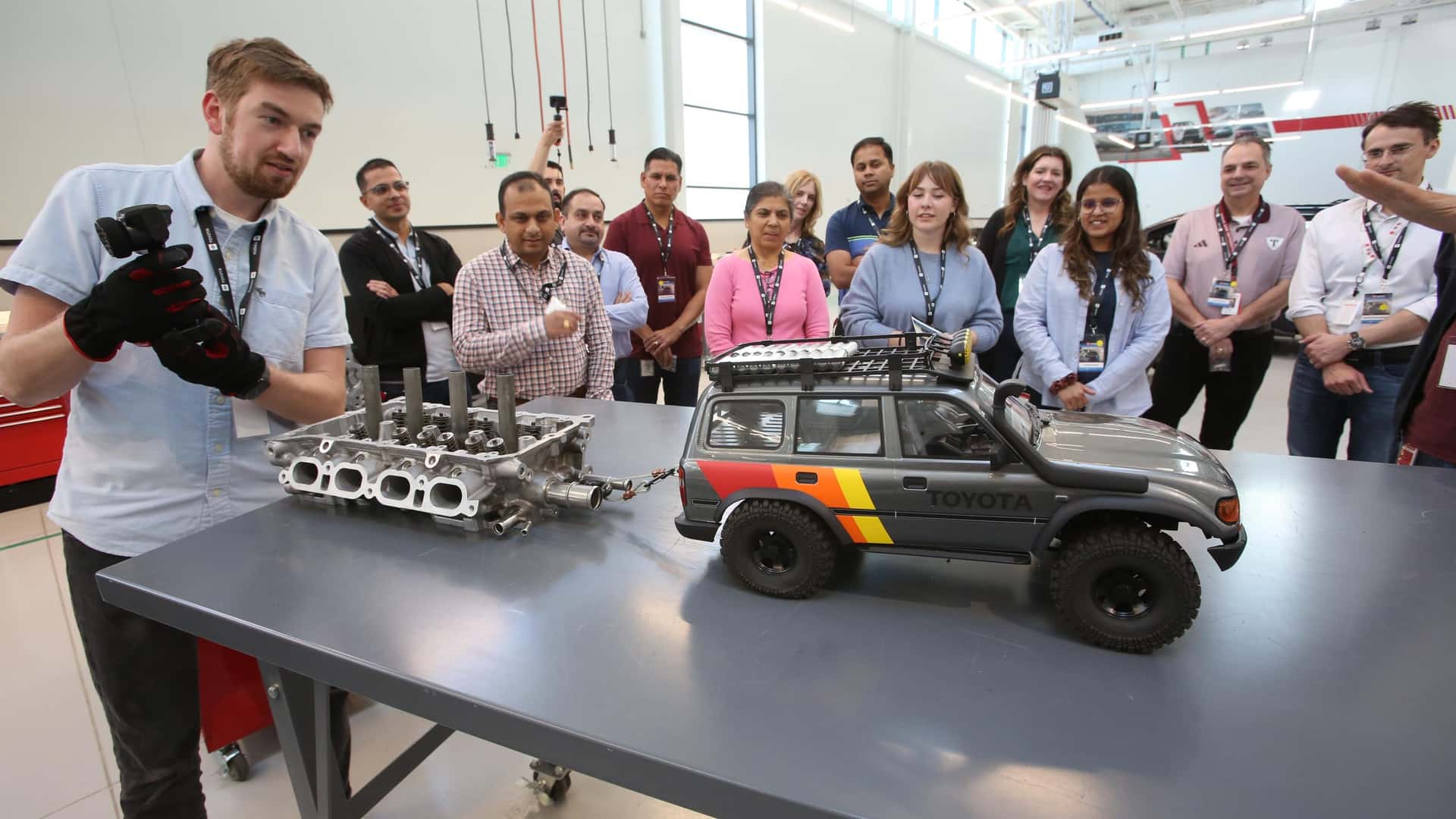
Beyond theoretical discussions, the ‘Electrification 101’ program excelled in its interactive elements, providing a tangible understanding of electric principles. Participants engaged in building a rudimentary electric motor using simple components like a screw, a magnet, a AA battery, and a piece of wire. Another hands-on activity involved constructing a basic potato-based battery and observing varying charging outputs. A highlight was a demonstration of the instantaneous torque of an EV motor, where a miniature remote-controlled Land Cruiser effortlessly towed a cylinder head weighing over 30 pounds, showcasing the potent, immediate power delivery characteristic of electric propulsion.
The classroom content, otherwise, provided a solid foundation in battery chemistries, different charging types, and core electrical concepts such as kilowatts and kilowatt-hours. An overview of ongoing battery recycling initiatives also formed a key part of the curriculum, addressing a crucial aspect of sustainable EV adoption.
The Fundamental Shift: Simplicity of Electric Propulsion
A profound revelation from the training underscored the technological superiority of electric motors. Presenters effectively illustrated this by contrasting a stripped-down Toyota V-6 engine, with its myriad complex accessories and intricate components, against an equivalent electric motor. The electric motor, far smaller in footprint and significantly simpler in design, demonstrated superior power output. This simplification extends even to hybrid powertrains, where integrating an electric motor can reduce complexity by eliminating components like the traditional, often ‘finicky’ transmission.
The core message was clear: introducing electric propulsion, at any level, enhances efficiency with minimal compromises. This principle strengthens as the degree of electrification increases. Ultimately, a pure battery electric vehicle represents the pinnacle of simplicity, with ‘a lot less to go wrong’ due to fewer moving parts. Toyota representatives, however, maintained that significant improvements in battery chemistry and charging infrastructure are prerequisites before BEVs become a universally applicable solution. Despite this cautious stance, the overall tenor of the program undeniably aimed to generate enthusiasm among employees for a future dominated by electric drive technologies.
Fostering Internal Advocacy for Toyota’s Electrification Strategy
The strategic importance of such internal education cannot be overstated. When employees are unaware of the long-term advantages of electrification, particularly those in roles like corporate procurement, they might perceive new component designs or the onboarding of new suppliers solely as added costs and operational complexities. This natural resistance to change can impede progress.
However, by fostering enthusiasm and understanding, companies can motivate their workforce to embrace short-term challenges for the sake of long-term strategic objectives. Brigette Armato, a Toyota employee from the lease experience team who attended the program, exemplifies this transformation. Admitting she knew ‘nothing’ about EVs and hybrids beforehand, Armato emerged as an advocate.
“I work with our lease experience team, so I’m actually working with the customers and the vehicles. This was extremely helpful because now I can have an educated conversation with them and maybe convince them to go for an electric vehicle, whereas before I don’t think I had that skill,” she stated as the session concluded. Her newfound knowledge extends to personal consideration; despite her attachment to her current Toyota 4Runner, she expressed a desire for an electric alternative, signifying a potential personal shift towards BEV ownership.
“I wish we would gravitate more towards electric vehicles across the lineup,” Armato remarked. This sentiment reflects a growing internal consensus. With hundreds participating in these classes and a substantial waitlist for subsequent sessions, Toyota’s North American headquarters is cultivating a burgeoning community of EV proponents. This initiative acknowledges that, much like the broader consumer market, many within the organization simply ‘didn’t know any better’ about the benefits of electrification until properly informed.
Frequently Asked Questions (FAQ)
What is the purpose of Toyota’s ‘Electrification 101’ program?
The program aims to educate Toyota employees on fundamental aspects of vehicle electrification, including hybrids, plug-in hybrids, battery electric vehicles, and fuel cell electric vehicles. It seeks to bridge knowledge gaps, dispel myths, and foster an informed workforce that can support Toyota’s evolving electrification strategy.
What is Toyota’s ‘multi-pathway’ approach to electrification?
Toyota’s multi-pathway strategy focuses on offering a diverse range of electrified vehicles, primarily emphasizing hybrids in the present. It also allocates resources to the development and deployment of battery electric vehicles and hydrogen fuel cell electric vehicles for future market needs, aiming to provide varied solutions for different customer requirements and energy infrastructures.
How much of Toyota’s recent sales are electrified vehicles?
In the last quarter, 56.8% of Toyota’s total vehicle sales were electrified. This figure includes hybrids, plug-in hybrids, battery electric vehicles, and hydrogen fuel cell vehicles. Pure battery electric vehicles constituted a smaller portion, representing 1.7% of these electrified sales.
What topics are covered in the ‘Electrification 101’ classroom sessions?
Classroom sessions delve into the basics of various powertrain types, distinctions between hybrids and PHEVs, common EV myths, and the advantages of electrification in terms of efficiency and cleanliness. It also covers battery chemistries, different charging methods, core concepts like kilowatts and kilowatt-hours, and current battery recycling efforts.
What were some of the interactive elements of the training?
The interactive portion included hands-on activities such as building a simple electric motor using basic components and constructing a rudimentary potato-based battery. Participants also witnessed a demonstration of an EV motor’s instant torque, showcasing the powerful and immediate responsiveness of electric propulsion.
Why is employee education important for Toyota’s electrification goals?
Educating employees is crucial for fostering internal understanding and advocacy for Toyota’s electrification strategy. Informed staff are better equipped to make long-term decisions, overcome resistance to adopting new technologies, and effectively communicate the benefits of electrified vehicles to customers, thereby accelerating the transition towards sustainable mobility.
Does Toyota’s program address the environmental impact of EVs?
Yes, the program highlights the advantages of electrification, including improved efficiency and environmental cleanliness. It emphasizes how the multi-pathway approach can optimize battery resource utilization, aligning with broader sustainability goals and aiming to reduce the overall carbon footprint of the automotive sector.
What is the main ‘lesson’ Toyota wants its employees to learn from this training?
The primary lesson is that electric motors are incredibly efficient and technologically simpler than complex internal combustion engines. The program demonstrates that integrating electric propulsion, even in hybrids, reduces complexity and that a full battery electric vehicle offers maximum simplicity with fewer potential points of failure.