
Key Takeaways
- Walmart is rapidly expanding its EV fast-charging network, adding 368 public ports in Q2 2023, surpassing all networks except Tesla.
- The company recently celebrated its 100th owned-and-operated fast-charging station, extending its presence to 20 states.
- A recent firsthand charging attempt at a New Jersey Walmart Supercenter encountered significant issues, including repeated failures of the proprietary app-based payment system.
- Despite having advanced Alpitronic HYC400 hardware supporting 400 kW, the station failed to initiate a charge for 40 minutes, leading to an unproductive session.
- The experience highlights the critical need for seamless user interface and diverse payment options to enhance the overall Walmart EV charging experience and bolster EV adoption.
- Walmart acknowledges technical challenges and is actively exploring additional payment methods, including swipe-and-dip card terminals, to improve service reliability.
Walmart, one of America’s largest retailers, is strategically positioned to significantly broaden the accessibility of electric vehicle (EV) charging infrastructure across the nation. With thousands of stores boasting expansive parking facilities and a customer base numbering in the millions, the retail giant has embarked on an aggressive campaign to install fast chargers, even amidst periods of fluctuating EV sales.
This initiative has rapidly gained traction. In the second quarter of 2023, Walmart substantially increased its public fast-charging port count by 368, a deployment rate exceeded only by Tesla’s Supercharger network in the U.S. This rapid expansion saw the company inaugurate its 100th owned-and-operated fast-charging station, solidifying its presence in 20 states and underscoring its commitment to bolstering the national EV charging landscape.

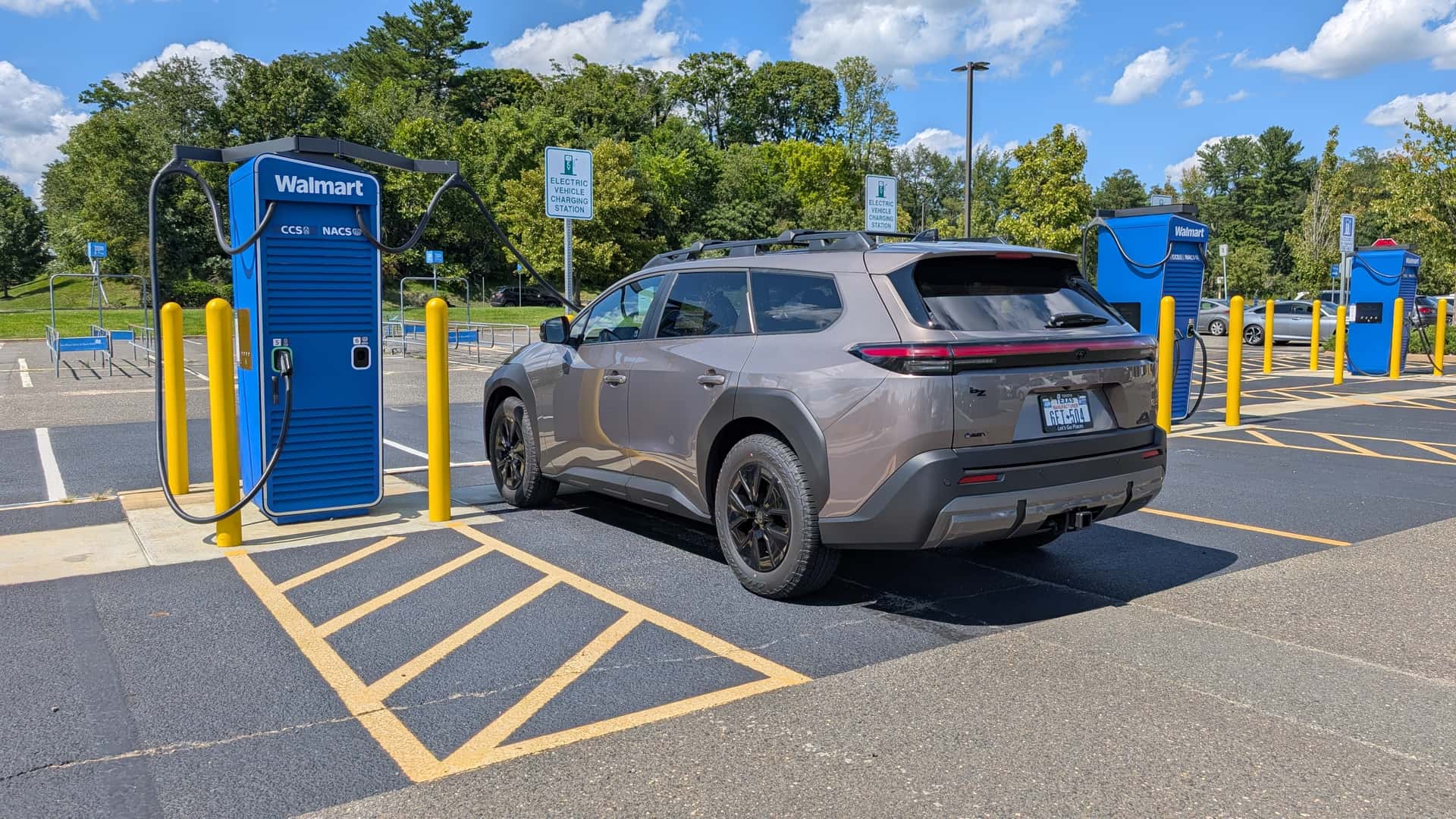
To assess the practical reality of this burgeoning network, a firsthand evaluation was conducted at a Walmart charging station in New Jersey. The objective was straightforward: to conduct a standard 10-80% charging test on a Toyota bZ Woodland press car, followed by routine errands. However, the experience diverged sharply from expectations, transforming a planned convenience into a 40-minute unproductive ordeal without a single electron transferred to the vehicle.
This incident not only prevented the intended charging session but also disrupted the associated shopping plans, highlighting potential user experience challenges within Walmart’s nascent EV charging ecosystem. The implications extend beyond individual inconvenience, touching upon broader issues of EV charging network reliability and the critical role of user-friendly interfaces in encouraging widespread EV adoption.
Walmart’s Expanding Footprint in EV Charging
Walmart’s foray into the electric vehicle charging infrastructure market is a significant development, reflecting a broader trend among major retailers to integrate EV services into their customer offerings. The company’s extensive physical presence provides an unparalleled advantage in deploying charging solutions in diverse geographic locations, including areas where dedicated charging stations might be scarce.
The scale of Walmart’s ambition is evident in its Q2 2023 statistics. By adding 368 new public fast-charging ports, the retailer demonstrated a deployment pace that positions it as a key player in the national charging landscape. The milestone of 100 owned-and-operated stations across 20 states underscores a strategic, long-term commitment to this sector.
This aggressive expansion is particularly noteworthy given the current market dynamics, where some analysts observe a softening in EV sales growth. By continuing to invest in fast charging stations, Walmart is not only catering to existing EV owners but also proactively building the infrastructure necessary to support future growth and consumer confidence in electric mobility.
The Drive to the Charger: Anticipation Meets Reality
The journey to evaluate Walmart’s charging capabilities commenced from Brooklyn, setting a course for a Supercenter in Freehold Township, New Jersey. This particular location was selected for its proximity and its status as a site for a Walmart-operated charger. While alternative, highly reliable charging options, such as a local Tesla Supercharger, were available, the objective was to specifically test and document the emerging Walmart EV charging experience for the benefit of readers.
The approximately 45-mile, hour-long drive to Central Jersey was undertaken with a Toyota bZ Woodland, its battery intentionally depleted to 12% to facilitate a thorough 10-80% charging cycle test. The anticipation was for a routine performance review of the vehicle’s charging capabilities at a new network. However, the subsequent events shifted the narrative from a vehicle assessment to an unexpected examination of public charging infrastructure challenges.
Upon arrival, the charging station presented an array of four Alpitronic HYC400 units, prominently marked in Walmart’s distinctive blue livery. These advanced hardware units are capable of delivering up to 400 kilowatts (kW) of power and are designed to serve eight charging stalls. Notably, the stalls offered both NACS (North American Charging Standard) and CCS (Combined Charging System) connectors, providing broad compatibility for modern EVs.
The Toyota bZ Woodland, equipped with a NACS port, was expected to connect seamlessly, bypassing the need for an adapter – a common hurdle in the evolving EV charging industry. This initial assessment of the physical setup suggested a promising and technologically current infrastructure. Yet, as often happens in the nascent stages of new technologies, the hardware proved to be only one component of the overall user experience equation.
The Digital Barrier: A Smartphone App Saga
A critical aspect of the Walmart EV charging experience, as with many emerging networks, revolves around digital interaction. The expectation was that most Walmart stations would not yet be equipped with integrated credit card readers. Consequently, preparations included downloading the Walmart app, establishing an account, and pre-loading credit card information, aiming for a swift activation upon arrival.
However, the activation process proved to be far from seamless, contrasting sharply with the reliability often observed at established networks like Tesla or even many other major charging providers. The on-screen instructions mandated plugging in the vehicle first, followed by scanning a QR code via the Walmart app. After confirming the port number on the smartphone, the final step was to initiate the charging session.
Initial attempts to scan the QR code were met with persistent failures. Multiple tries, including closing and reopening the app and ensuring a clean camera lens, were required before the app eventually recognized the code. This directed the user to the payment screen, where saved card details were expected to facilitate the transaction. Instead, the app displayed a generic “something went wrong” message.
Undeterred, the process was restarted. The cable was unplugged and reinserted, and the app interface revisited. Exacerbating the issue, the metal buttons on the charger, exposed to the summer sun, had become uncomfortably hot to touch. A subsequent attempt yielded a different error message: “We’re having technical issues, try again in a moment.” Even trying with the vehicle both on and off, to account for potential communication glitches between car and charger, proved fruitless. The cumulative effect was growing frustration.
Seeking Assistance and the Unresolved Problem
With repeated failures and no progress in initiating a charge, a call to Walmart’s customer service line became necessary. The representative attributed the errors to potential connectivity problems or a glitch within the Walmart app itself. While cellular connectivity at the location was not exceptionally strong, it registered three to four bars with an LTE or 5G connection, and all other smartphone applications were functioning normally, suggesting the issue was specific to the charging system.
The recommended troubleshooting step, to uninstall and reinstall the Walmart app, then log back in and reattempt the QR code scan, was followed despite its perceived absurdity given the app had just been downloaded. This measure, however, failed to resolve the problem, with the same errors persisting. Attempts to use an adjacent dispenser also yielded no different outcome, reinforcing the systemic nature of the issue.
By this juncture, five separate charging attempts had been made over approximately 40 minutes, all under the direct exposure of the hot summer sun, resulting in zero charge delivered. The customer service representative, unable to provide an immediate solution, offered to suggest alternative charging stations nearby. This prompted a decision to abandon the Walmart station in favor of a pre-planned contingency.
A Stark Contrast in Charging Experiences
The contingency plan involved relocating to an Ionna Rechargery situated at a Wawa gas station, merely four miles away. The transition highlighted a dramatically different user experience. Upon arrival at the Ionna station, the charging process was initiated by a simple tap of a smartphone on the integrated card reader, followed by plugging in the cable. Within less than a minute, the Toyota bZ Woodland commenced charging.
A notable observation during this shift was the stark difference in station activity. While the Walmart station remained entirely empty during the prolonged attempt to charge, the Ionna station was bustling with other EVs. While it is challenging to definitively attribute this disparity solely to the charging issues at Walmart, the contrast between an unused, problematic station and a busy, functional one, particularly given both utilize identical Alpitronic HYC400 hardware, was difficult to overlook.
The fundamental difference lay not in the physical hardware, but in the operational interface – the Ionna station offered direct tap-to-pay functionality, whereas Walmart’s system relied exclusively on a problematic app. This underscores a crucial point in the evolution of public EV charging: advanced hardware alone is insufficient; ease of use and reliable payment solutions are paramount.
Broader Implications for EV Charging Infrastructure
The experience at the Walmart station resonates with some of the historical challenges that have plagued the EV charging industry. While advancements have largely moved past the “adapter-hell” phase and many networks have improved their reliability, the reliance on glitch-prone smartphone applications can feel like a step backward to earlier stages of EV adoption.
Even for non-Tesla EVs charging at Superchargers, where the Tesla app is typically used, the experience is generally robust and reliable, barring rare widespread system outages. The repeated failures and the necessity of customer service intervention encountered at Walmart represent the kind of friction that the industry actively seeks to eliminate to encourage broader EV acceptance.
Throughout the Northeast, various charging providers like Revel, EvolveNY, and Applegreen Electric have demonstrated generally functional, albeit sometimes imperfect, services. Minor glitches or out-of-order stalls at older stations are not uncommon, but the necessity of completely relocating to a different charging network due to systemic app failures is an unacceptable scenario in 2026, the implied current year based on context.
Walmart’s Path Forward and Future Solutions
In response to inquiries regarding the encountered issues, Walmart acknowledged the goal of providing a “simple and reliable” charging experience. A company spokesperson stated, “We want charging at Walmart to be simple and reliable,” a Walmart spokesperson told me over email. “We continuously work with vehicle manufacturers and technology partners to improve compatibility. Customers may currently pay for charging through the Walmart app, and we continue to explore additional payment options.” While specific details about the incident were not provided, the company’s commitment to exploring additional payment methods is a critical step forward.
Plans to introduce swipe- and dip-to-pay terminals at its charging stations are particularly good news for customers. These direct payment options would offer a much-needed alternative to app-based systems, especially when digital platforms experience technical difficulties or connectivity issues. The timeline for these upgrades and whether all dispensers will be retrofitted remains to be seen, but it signals a recognition of the problem.
It is important to acknowledge that Walmart’s charging division is relatively new, and teething issues are a natural part of developing large-scale infrastructure. However, the true value of Walmart’s vast national footprint and its potential to democratize access to public fast charging hinges on the network’s usability. Building numerous chargers is only half the effort; ensuring they are consistently easy to use is the other, equally vital, component. Otherwise, these significant investments risk becoming underutilized assets, failing to serve the very customers they are intended for.
Frequently Asked Questions (FAQ)
What is Walmart’s strategy for EV charging?
Walmart aims to leverage its vast store network and parking lots to become a major player in EV charging, rapidly installing fast chargers. This strategy seeks to provide convenient charging options for its millions of customers and support the broader adoption of electric vehicles across the U.S.
How many EV charging ports has Walmart installed recently?
In the second quarter of 2023, Walmart added 368 public fast-charging ports to its stores. This made it the second-largest deployer of new charging ports in the U.S. during that period, trailing only Tesla’s Supercharger network.
What kind of charging hardware does Walmart use?
Walmart’s charging stations typically utilize Alpitronic HYC400 units. These advanced chargers can deliver up to 400 kilowatts (kW) of power and are designed to serve multiple charging stalls, often splitting compatibility between NACS and CCS connectors for broad EV support.
What payment options are currently available at Walmart EV chargers?
Currently, payment for charging at Walmart stations is primarily facilitated through the Walmart mobile app. Users are required to download the app, create an account, and input payment details to initiate a charging session. Walmart is exploring additional payment options for future implementation.
What issues were encountered during a recent Walmart EV charging experience?
A recent test at a New Jersey Walmart station revealed significant problems with the app-based payment system. Issues included persistent QR code scanner failures, error messages like “something went wrong,” and “technical issues,” leading to 40 minutes of failed attempts to initiate a charge despite troubleshooting with customer service.
How does Walmart plan to improve its charging services?
Walmart acknowledges the need for simple and reliable charging. The company is continuously working with vehicle manufacturers and technology partners to enhance compatibility and is exploring additional payment options. This includes plans to add swipe- and dip-to-pay terminals to its charging stations to offer more reliable alternatives to the app.