
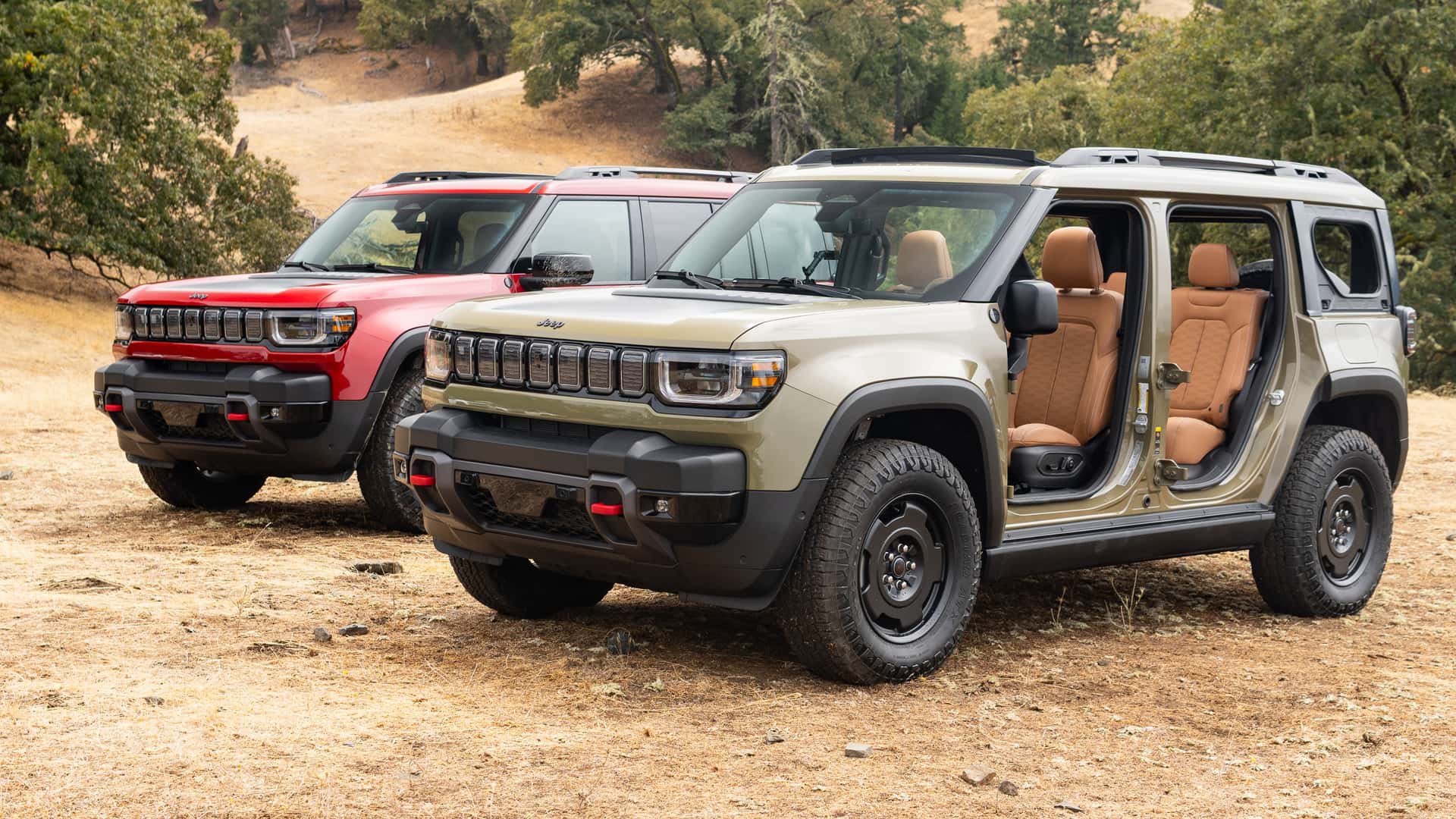
The all-electric Jeep Recon Moab has ignited considerable debate within the automotive community, primarily concerning its reported 222-mile range and a starting price point of $66,995. Initial reactions from journalists at the L.A. Auto Show last year, and subsequent public commentary, have largely conveyed disappointment, suggesting a perceived shortfall in range and affordability for the electric off-roader. However, this perspective, while understandable, often overlooks the intricate engineering trade-offs inherent in developing a truly capable off-road electric vehicle.
To argue that Jeep could have delivered greater range for less money without sacrificing the vehicle’s core off-road prowess fundamentally misunderstands the complexities of modern automotive design, especially in the burgeoning electric vehicle segment. Vehicle development, particularly for specialized applications like extreme off-roading, is a delicate art of compromise, balancing conflicting goals such as performance, efficiency, capability, and cost.

Key Takeaways: Understanding the Jeep Recon’s Range
- The Jeep Recon Moab’s 222-mile range is a direct consequence of its specialized off-road design, not a manufacturing oversight.
- Achieving high off-road capabilities (ground clearance, aggressive tires, robust gearing) inherently reduces electric vehicle efficiency.
- Comparisons with on-road EVs like the Wagoneer S (294 miles with same battery) highlight the efficiency penalty of off-road features.
- Other electric off-roaders, such as the Rivian R1S and Mercedes G580 w/EQ Technology, also demonstrate similar range-versus-capability trade-offs at higher price points.
- The current state of battery technology and charging infrastructure necessitates these compromises for hardcore electric off-road vehicles.
The Fundamental Trade-Off: Capability Versus Efficiency
The core of the discussion around the Jeep Recon’s range revolves around an immutable principle in vehicle engineering: enhancing off-road capability almost invariably reduces on-road efficiency. This holds true regardless of whether the powertrain is gasoline-powered or electric.
Consider a traditional internal combustion engine (ICE) 4×4 truck with a body-on-frame construction, lifted suspension, and aggressive gearing. These vehicles typically deliver significantly less than 20 miles per gallon, often closer to 10 or 15 mpg. Enthusiasts and seasoned off-roaders understand this as an inherent characteristic of the segment.
Aerodynamics and Rolling Resistance: The Efficiency Killers
Several design elements crucial for off-road performance directly impede efficiency. Tall suspension, essential for increasing ground clearance during rock crawling, significantly boosts aerodynamic drag. A higher profile means the vehicle pushes more air, requiring more energy to maintain speed, especially on highways.

Furthermore, large, knobby, all-terrain (AT) tires, while indispensable for traction in mud, sand, or over rocks, are inherently inefficient on paved roads. Their aggressive tread patterns increase rolling resistance and generate considerable noise at highway speeds, consuming more energy compared to smooth, road-optimized tires.
The Impact of Drivetrain and Gearing
A robust 4×4 system, while invaluable in challenging terrain, introduces additional friction and weight. When engaged, it demands more power and thus reduces fuel or energy efficiency. Similarly, aggressive gearing — designed to amplify torque at the wheels for superior climbing and obstacle negotiation — causes the engine or electric motors to spin faster at higher road speeds, leading to increased fuel consumption or energy drain.
This reality is starkly evident when comparing a fuel-efficient vehicle like a Toyota Prius with an off-road icon such as a Jeep Wrangler. One is meticulously engineered for maximum efficiency, the other for uncompromised off-road prowess. Modifying a Prius for off-road use, by lifting it and adding larger tires, would inevitably diminish its exemplary 50 mpg fuel economy. The principle remains constant: off-road enhancements come at an efficiency cost.
Jeep Recon’s Engineering Decisions Explained
For the all-electric Jeep Recon, these fundamental engineering truths are amplified. High ground clearance, a dual-motor configuration, substantial all-terrain tires, and a boxy, upright silhouette — all crucial for off-road capability — collectively contribute to a lower range figure. These aren’t merely ‘nice-to-have’ features; they are foundational requirements for a vehicle genuinely designed for challenging trails.
Jeep, in fact, offers an alternative: the Wagoneer S. This electric SUV, sharing the same 100.5 kWh battery pack as the Recon, achieves an estimated 294 miles of range. The key difference lies in its design philosophy: the Wagoneer S prioritizes on-road efficiency with approximately 6 inches of ground clearance and street-oriented tires. The Recon, by contrast, is engineered for the trail.
Specific Off-Road Enhancements and Their Range Implications
The Jeep Recon boasts 9.1 inches of ground clearance, significantly more than its road-biased sibling. It incorporates heavy skid plates for underbody protection and rides on substantial 33-inch all-terrain tires. Its more upright design optimizes approach and departure angles, vital for navigating steep inclines and descents without scraping the vehicle’s extremities. Each of these attributes, while enhancing off-road performance, inherently reduces aerodynamic efficiency and adds weight, thereby impacting the overall electric range.
A critical, yet often overlooked, factor in EV efficiency is gearing. While electric vehicles do not have traditional multi-speed transmissions like ICE cars, they utilize gear ratios that dictate how motor torque is delivered to the wheels. Taller ratios (e.g., a lower numerical value like 9:1 for an EV) are generally favored for cruising efficiency. Conversely, shorter gearing increases torque multiplication at the wheels from a standstill, significantly improving climbing ability and low-speed control, which is paramount for off-roading.
The Recon, prioritizing low-end torque for its off-road mission, employs a 15:1 gearing ratio on its rear motor. This decision directly contributes to its formidable capability to climb over and push through challenging obstacles. An additional benefit of this aggressive gearing is quicker acceleration, enabling the Recon to achieve 0-60 mph in a swift 3.6 seconds. However, this engineering choice comes with an inherent compromise: lower gearing negatively impacts efficiency, partially explaining why the vehicle was observed achieving approximately 2.5 miles per kWh.
Comparative Landscape: Other Electric Off-Roaders
To further contextualize the Jeep Recon’s range, it is instructive to look at other electric off-road vehicles in the market, each presenting its own set of compromises.
Rivian R1S: Balancing Range and Capability
The heavier Rivian R1S often exhibits better efficiency than the Recon, even when equipped with all-terrain tires. However, Rivian itself highlights the trade-offs: all-terrain tires are not offered with the base 108 kWh battery pack. Customers desiring ATs must upgrade to the larger 140 kWh version, which sees its range drop from 410 miles to 370 miles. This upgrade also pushes the vehicle’s price point to approximately $96,000. Furthermore, the R1S, despite its impressive capabilities, typically features taller gearing and lacks a locking rear differential, features that the Recon offers for enhanced extreme off-roading.
Mercedes G580 w/EQ Technology: Peak Capability at a Premium
For even greater off-road capability, the Mercedes G580 w/EQ Technology stands out. It incorporates separate low-range gears for each of its four motors, allowing for superior climbing ability and the flexibility to switch to higher gears for more efficient on-road cruising. However, this advanced engineering comes at a steep price: approximately $163,000. Despite its 116 kWh usable battery capacity and sophisticated hardware, its EPA estimated range is 239 miles, only marginally higher than the Recon. It is also important to note that for all these vehicles, highway range is generally expected to be significantly lower than combined range estimates, as the factors affecting efficiency compound at higher speeds.
Broader Implications for the EV Industry
The discussions surrounding the Jeep Recon’s range serve as a crucial lesson for the evolving electric vehicle industry. As the transition to electric powertrains progresses, it becomes increasingly clear that electrifying inherently inefficient vehicle types, such as heavy-duty trucks and dedicated off-roaders, presents the most significant engineering challenges.
The fact that vehicles like the Volkswagen ID. Buzz or the Jeep Recon offer what some might perceive as lower ranges should not come as a surprise. Fitting an exceptionally large battery pack incurs substantial cost, and even a 91 kWh or 100 kWh pack is by no means small. The issue is not necessarily the battery size, but rather how far that energy can propel a vehicle that is large, aerodynamically challenging, and heavy.
The impact is further exacerbated by the integration of performance-enhancing off-road features such as aggressive all-terrain tires, increased ground clearance, and specific gearing optimized for torque. As battery technology advances, charging times decrease, and the charging network expands, these present challenges will gradually mitigate. However, for the foreseeable future, consumers seeking serious electric off-roading capabilities should anticipate a necessary compromise on both overall range and the purchase price.
FAQ: Decoding the Jeep Recon’s Range and Design
Q1: Why does the Jeep Recon have a relatively low range compared to other EVs?
A1: The Jeep Recon’s 222-mile range is a result of its design prioritizing extreme off-road capability. Features like high ground clearance, heavy skid plates, large all-terrain tires, a boxy shape, and aggressive gearing for low-end torque significantly increase energy consumption compared to road-focused electric vehicles.
Q2: How does off-road design impact an EV’s efficiency?
A2: Off-road elements such as lifted suspensions increase aerodynamic drag, knobby tires create higher rolling resistance, and specialized 4×4 systems add weight and friction. Additionally, gear ratios optimized for torque rather than highway efficiency mean the motors spin faster, all contributing to reduced range per charge.
Q3: Is the Jeep Recon’s price justified given its range?
A3: The $66,995 starting price reflects the specialized engineering required for its off-road prowess, including robust components, advanced drivetrain technologies, and a substantial battery. The cost reflects the balance of delivering extreme capability within an electric vehicle platform, rather than just raw range.
Q4: How does the Jeep Recon compare to other electric off-roaders like the Rivian R1S or Mercedes G580 w/EQ Technology?
A4: The Recon offers a unique blend of capability at its price point. While the Rivian R1S offers more range with larger battery packs, its off-road gearing and differential setup differ. The Mercedes G580, with even greater off-road tech, still provides comparable range but at a significantly higher price, illustrating common trade-offs across the segment.
Q5: Will future electric off-roaders offer better range and price?
A5: As battery technology improves, becoming more energy-dense and affordable, and as charging infrastructure expands, the compromises between range, capability, and price for electric off-roaders are expected to diminish. However, for now, specialized electric off-road vehicles will continue to balance these factors.