
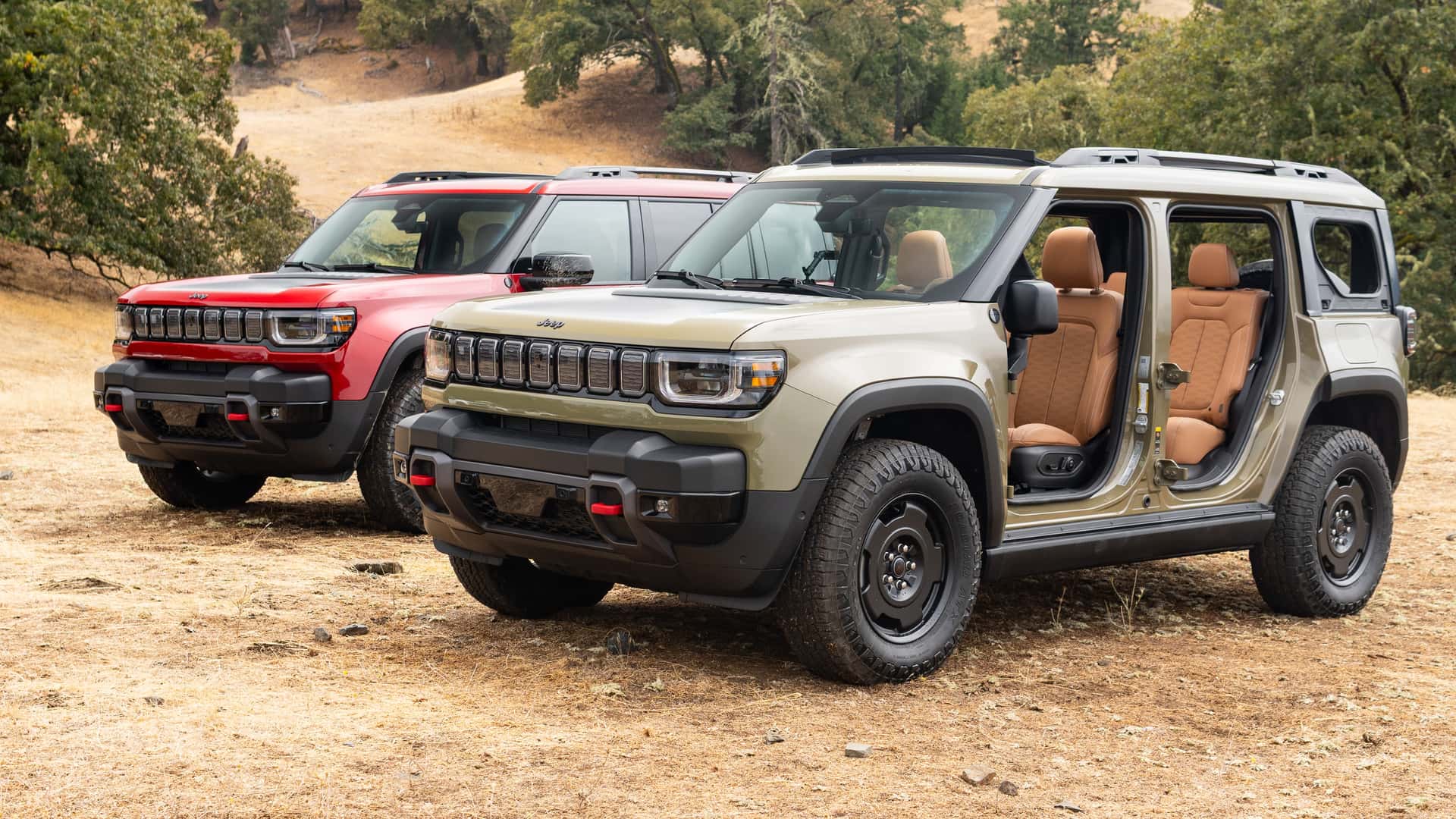
Key Takeaways: The 2026 Jeep Recon Moab’s 222-mile range and $66,995 starting price have drawn criticism, but this figure is a direct consequence of its advanced off-road capabilities. Unlike mass-market EVs, the Recon prioritizes features like high ground clearance, aggressive gearing, and rugged tires, which inherently reduce energy efficiency. This trade-off between range, cost, and extreme capability is a fundamental challenge in electrifying serious off-road vehicles, a reality often overlooked by critics. Comparable high-capability electric SUVs from Rivian and Mercedes also demonstrate similar compromises in balancing range with performance and price.
The announcement of the all-electric Jeep Recon Moab’s estimated range of under 230 miles has ignited considerable debate within automotive circles and among prospective buyers. Journalists at the Los Angeles Auto Show voiced concerns last year, and recent commentary continues to challenge the vehicle’s range and price point.

Specifically, the Jeep Recon Moab, with its 222-mile range and a starting price of $66,995, is perceived by many as failing to deliver a compelling mass-market proposition. However, this perspective often overlooks the intricate engineering compromises inherent in developing a truly capable electric off-road vehicle.
To assert that Jeep could have simultaneously offered greater range and a lower price without sacrificing the Recon’s core capabilities represents a fundamental misunderstanding of automotive manufacturing and, more specifically, the demands of serious off-roading.
Both vehicle design and off-road engineering are disciplines built on the art of compromise. Achieving optimal off-road prowess, an attractive price point, and extensive electric range are often conflicting objectives. While the Recon Moab’s range and price may appear to fall short of some expectations, these figures are a direct result of deliberate design choices aimed at delivering unparalleled off-road performance.

The Inherent Trade-Offs in Off-Road Vehicle Design
For decades, conventional wisdom in the automotive industry has dictated that vehicles designed for extreme off-road use inherently exhibit lower fuel efficiency. This principle applies universally, whether the powertrain is gasoline-powered or electric.
Consider a typical gas-powered, body-on-frame 4×4 truck equipped with a lifted suspension and aggressive gearing; its fuel economy rarely surpasses 20 miles per gallon, often dipping into the 10-15 mpg range. This is a widely accepted reality for enthusiasts.
Aerodynamics and Rolling Resistance: The Silent Range Killers
Several design elements critical for off-road capability directly impede efficiency. Tall suspension systems, while providing essential ground clearance for navigating challenging terrain and rock crawling, dramatically increase the vehicle’s frontal area and air resistance. This aerodynamic penalty becomes particularly pronounced at highway speeds, requiring significantly more energy to maintain momentum.
Similarly, knobby, large all-terrain (AT) tires are indispensable for traction in mud, sand, and rocky environments. However, their aggressive tread patterns and larger contact patches generate considerably more rolling resistance than conventional street tires. This increased friction translates directly into greater energy consumption, making them inefficient and often noisy on paved roads.
Furthermore, a robust 4×4 system, while crucial for slippery conditions, introduces additional drivetrain losses. Even when not fully engaged, the components add weight and friction. When active, it consumes more energy than a two-wheel-drive system. Aggressive gearing, designed to multiply torque at the wheels for superior climbing ability, invariably causes the powertrain to operate at higher RPMs, leading to increased fuel or energy consumption during sustained highway cruising.
My personal experience with a Chevrolet Tahoe, albeit not a dedicated off-roader, highlighted these compromises. Equipped with 33-inch AT tires, a 4WD system with low range, and a potent V-8 engine for low-end grunt, it consistently delivered approximately 13 miles per gallon in city driving conditions.
These fundamental engineering truths explain why a fuel-efficient Toyota Prius bears no resemblance to an off-road-focused Jeep Wrangler. Each vehicle is optimized for a distinct purpose, with efficiency at the forefront for one and rugged capability for the other. Attempting to enhance a Prius’s off-road prowess, for instance, by lifting it and adding larger tires, would inevitably necessitate sacrificing its impressive 50 mpg fuel economy.
The principle remains consistent for electric vehicles. High ground clearance, the weight and complexity of dual-motor designs, massive all-terrain tires, and inherently boxy vehicle shapes all negatively impact an EV’s efficiency and, consequently, its electric range. Yet, for a vehicle aspiring to be a true off-roader, these features are not merely desirable; they are non-negotiable prerequisites. A vehicle cannot genuinely claim off-road capability with just 6 inches of clearance and thin, road-oriented tires.
Jeep’s Deliberate Engineering Compromise for the Recon
Jeep has demonstrated its understanding of these trade-offs with the introduction of its electric Wagoneer S. This vehicle, sharing the same 100.5 kWh battery pack as the Recon, achieves an impressive estimated range of up to 294 miles. The key differentiator? The Wagoneer S is designed with 6 inches of ground clearance and street-focused tires, optimizing it for on-road efficiency and comfort rather than extreme off-road performance.
The Jeep Recon, by contrast, is engineered from the ground up to deliver authentic off-road capability. It boasts a substantial 9.1 inches of ground clearance, a suite of heavy-duty skid plates for underbody protection, robust 33-inch all-terrain tires, and an upright, purposeful design that maximizes approach and departure angles. Each of these critical off-road enhancements, by their very nature, contributes to a reduction in the vehicle’s overall electric range.
The Role of Gearing in EV Performance and Efficiency
Beyond the visible physical attributes, a crucial factor often overlooked by critics is the vehicle’s gearing. While electric vehicles do not feature conventional multi-speed transmissions in the same way internal combustion engines do, they still employ gear ratios. These ratios dictate how the electric motor’s torque is delivered to the wheels, profoundly influencing both performance and efficiency.
Taller gear ratios, characterized by a lower first number (e.g., 9:1 for an EV), are optimized for sustained cruising and greater efficiency at higher speeds. Conversely, shorter gearing amplifies torque delivery at the wheels, providing superior thrust from a standstill and significantly improving climbing capability. However, this comes at the cost of reduced efficiency at higher road speeds, as the motors spin faster for a given wheel speed.
For the Jeep Recon, off-roading performance hinges on prodigious low-end torque. Consequently, the Recon incorporates a 15:1 gearing ratio on its rear motor. This strategic engineering decision ensures that the vehicle can overcome and navigate formidable obstacles with ease, directly addressing the core requirement of serious off-road use. An ancillary benefit of this aggressive gearing is quicker acceleration, contributing to the Recon’s ability to reach 60 mph in a swift 3.6 seconds.
However, this focus on low-end torque and acceleration introduces an inherent compromise: diminished efficiency. My observations during testing indicated an efficiency of merely 2.5 miles per kWh for the Recon, directly attributable to these design choices.
Comparative Analysis with Competitors
Examining other electric off-road contenders further illuminates these trade-offs. The heavier Rivian R1S, for instance, generally demonstrates better efficiency, even when equipped with all-terrain tires. Yet, Rivian itself acknowledges the range impact: all-terrain tires are not even offered on models with the base 108-kWh battery pack. To obtain AT tires, customers must upgrade to the larger 140-kWh version, where the range still drops from an impressive 410 miles to 370 miles. At this specification, the R1S carries a price tag nearing $96,000.
While the Rivian offers substantial range, it often features taller gearing and lacks a locking rear differential, placing it at a disadvantage in certain extreme off-road scenarios compared to the Jeep Recon’s dedicated setup.
At the pinnacle of electric off-road capability, the Mercedes-Benz G580 with EQ Technology sets an even higher benchmark. This vehicle surpasses both the Recon and R1S in off-road prowess, featuring separate low-range gears for each of its four motors. This sophisticated engineering allows it to climb more effectively than its rivals and then transition to higher gears for more efficient on-road cruising.
Despite its ingenious hardware, a premium price tag exceeding $163,000, and a substantial 116 kWh of usable battery capacity, the Mercedes G580 still achieves an EPA-estimated range of only 239 miles. For all these highly capable vehicles, it is also important to remember that highway range typically falls significantly below combined range estimates, as the aforementioned factors compound at higher speeds.
Implications for the Evolving EV Industry
The experience with the Jeep Recon serves as a crucial lesson for both consumers and the broader electric vehicle industry: expectations must be recalibrated. The transition to an all-electric future is a complex journey, and it is becoming increasingly evident that the most energy-intensive vehicle segments will present the greatest electrification challenges.
It should, therefore, come as no surprise when vehicles like the Volkswagen ID. Buzz or the Jeep Recon offer ranges that might seem modest compared to sleek, aerodynamically optimized sedans. Equipping such vehicles with an absurdly large battery pack to compensate for efficiency losses would incur exorbitant costs, and the 91- or 100-kWh packs already deployed are far from small.
The core issue remains that the energy stored in these batteries does not translate into proportional range when the vehicle is large, geometrically inefficient, and heavy. This effect is compounded significantly by the inclusion of all-terrain tires, elevated ground clearance, and aggressive gearing—all indispensable for true off-road performance.
As advancements in battery technology, charging speeds, and the proliferation of robust charging infrastructure continue, these inherent challenges will gradually diminish. However, for the foreseeable future, consumers seeking a highly capable electric off-roader must be prepared to accept a compromise on both achievable range and overall vehicle price.
Frequently Asked Questions About EV Off-Roaders and Range
Q1: Why do electric off-road vehicles like the Jeep Recon have lower ranges?
A1: Electric off-roaders prioritize features essential for rugged terrain, such as high ground clearance, heavy-duty tires, boxy designs, and aggressive gearing for torque. These elements significantly increase aerodynamic drag, rolling resistance, and energy consumption, leading to a reduced electric range compared to more road-focused EVs.
Q2: Is the Jeep Recon’s 222-mile range considered low for an EV?
A2: While 222 miles might be lower than some mainstream electric sedans or SUVs, it’s competitive for a dedicated off-roader given its design compromises. This range is a trade-off for its extreme capability, which requires more energy per mile than a standard electric vehicle.
Q3: How does gearing affect an EV’s range and off-road performance?
A3: Shorter (or aggressive) gearing in an EV multiplies the motor’s torque at the wheels, providing immense power for climbing and navigating obstacles. However, this efficiency comes at the cost of higher energy consumption at sustained highway speeds, thus reducing overall range.
Q4: Are all-terrain tires a major factor in reduced EV range?
A4: Yes, all-terrain tires contribute significantly to reduced EV range. Their aggressive tread patterns create more rolling resistance compared to smooth street tires, demanding more energy from the battery to propel the vehicle, especially at higher speeds.
Q5: How does the Jeep Recon compare to other electric off-roaders like the Rivian R1S or Mercedes G580?
A5: The Recon’s 222-mile range is lower than the Rivian R1S (370-410 miles) but comparable to the Mercedes G580 (239 miles). However, each vehicle represents different compromises: the Recon prioritizes dedicated off-road hardware and aggressive gearing, while the Rivian balances range with capability, and the G580 offers extreme capability at a much higher price point.
Q6: Will EV off-road ranges improve in the future?
A6: Yes, as battery technology advances, becoming more energy-dense and lighter, and as charging infrastructure improves, the range of electric off-road vehicles is expected to increase. Better aerodynamic designs and more efficient motor technologies will also contribute to future enhancements.