
Key Takeaways
The integration of simulated engine sounds and artificial gear shifts in electric vehicles (EVs) is a growing trend, aiming to enhance driver engagement. However, the true value of these features, particularly in high-performance EVs like the Porsche Taycan, remains a subject of debate among automotive enthusiasts and experts.
While some manufacturers like Mercedes-AMG and Hyundai are investing heavily in creating realistic or game-like simulations, the inherent excellence of an EV’s driving dynamics can often overshadow the need for such artificial enhancements. Authentic feedback, primarily from tire grip and chassis response, is crucial for a complete and exhilarating driving experience.

The primary benefit of any sound in an EV, whether simulated or unique to electric propulsion, is to provide an audible reference for speed and acceleration, enhancing driver confidence and control. Ultimately, the future of the EV driving experience may lie in fostering unique electric vehicle characteristics rather than mimicking traditional internal combustion engine sensations.
The Evolving Landscape of Electric Vehicle Dynamics
The automotive industry is in a perpetual state of evolution, with electric vehicles (EVs) at the forefront of this transformation. As manufacturers push the boundaries of EV performance, a notable trend has emerged: the incorporation of simulated engine sounds and artificial gear shifts. This development seeks to address a perceived lack of driver engagement, often cited by enthusiasts accustomed to the visceral feedback of internal combustion engines (ICE) cars.
Initially, Porsche, a brand synonymous with precision engineering and pure driving dynamics, appeared to resist this trend. Its ethos has always prioritised authentic mechanical excellence over synthetic augmentations. Therefore, the brand’s eventual adoption of simulated gears in some of its electric models surprised many, suggesting a shift in strategy to cater to broader market preferences and enhance the EV driving experience.

Porsche’s Approach to Synthetic Engagement
Upon experiencing Porsche’s simulated engine and gear system, it becomes evident that considerable engineering effort has been invested to meet the brand’s exacting standards. However, its impact on the overall driving experience differs significantly from that observed in other high-performance electric vehicles such as the Hyundai Ioniq 5 N or the Mercedes-AMG GT 4-Door EV.
Mercedes-AMG, for instance, has meticulously crafted a highly believable simulated V-8 sound, arguably the most realistic system available across all EV segments. Porsche’s implementation, in contrast, shares similarities with Hyundai’s approach, leaning towards a more explicit, video game-esque simulation rather than an attempt to precisely replicate an internal combustion engine’s acoustic profile. This distinction highlights varied philosophies in enhancing the EV driving experience through artificial means.
Driving the Taycan: Purity Over Simulation
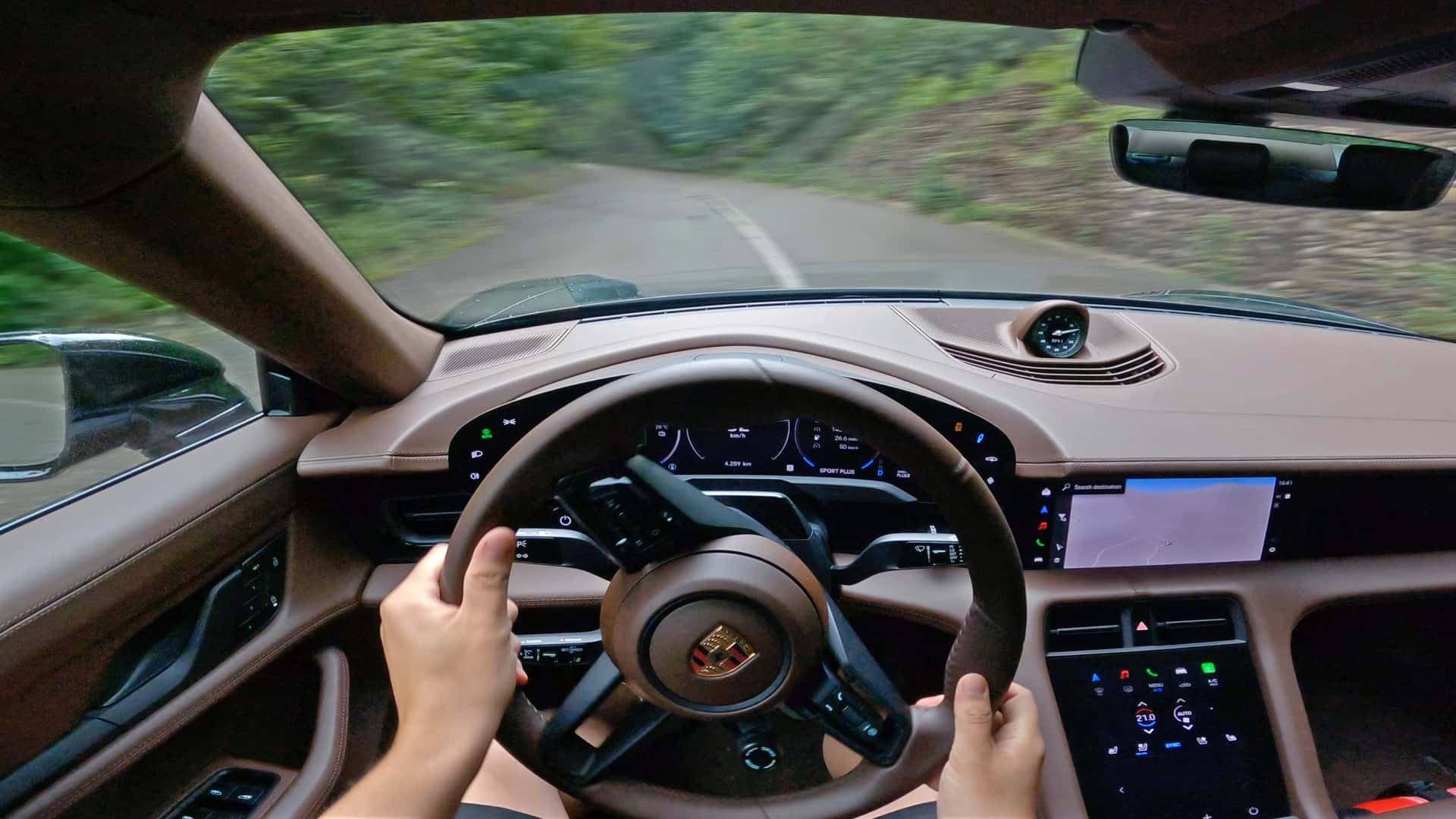
A recent test drive of the refreshed 2026 Porsche Taycan provided an insightful perspective on this debate. The particular test vehicle was not equipped with the optional simulated engine and gear-swapping feature. While an opportunity to evaluate the system in a sedan configuration would have been welcomed, its absence was not ultimately missed.
The Taycan delivers an exceptionally accomplished EV driving experience, rewarding the driver even in complete silence. Its prowess as a corner-carving machine stands out among performance cars, regardless of powertrain. The vehicle’s chassis exhibits remarkable neutrality, poise, and predictability, allowing drivers to quickly establish a confident rhythm on challenging, winding roads. The seamless flow from one corner to the next made any thought of missing an engine or gear shifts irrelevant to the thrilling EV driving experience.
The Indispensable Role of Sound in EV Driving
The Taycan 4 tester featured a basic, spaceship-like acceleration sound. This type of audible feedback is crucial for gauging speed in an EV, where the absence of traditional engine noise can lead to over-reliance on the speedometer. A consistent sound profile provides a vital auditory reference, allowing drivers to modulate braking and acceleration more instinctively, based on what the vehicle is audibly conveying.
This principle was articulated by a BMW engineer, who explained the rationale behind creating the acceleration sound for the forthcoming electric M3. The engineer emphasised that the sound serves as an audible reference for speed, not merely an emulation of a petrol-powered experience. This reasoning deeply resonates, drawing parallels to spirited drives in vehicles like the Tesla Model 3 Performance, which, despite its excellent driving dynamics, can feel less engaging without any auditory feedback, thus diminishing the overall EV driving experience.
Challenges of a Completely Silent EV
The absence of any sound in an EV can present specific challenges. Drivers may occasionally carry more speed into corners than intended, necessitating abrupt and potentially alarming braking manoeuvres. This situation is less common in combustion-engined vehicles, where engine noise provides constant, intuitive feedback on speed and effort.
Furthermore, modulating accelerator input, especially when balancing the car through a bend or accelerating out of it, becomes less intuitive without auditory cues. A sound that dynamically responds to accelerator input adds an essential layer of feedback, making these precise adjustments feel more natural and enhancing the EV driving experience. Research supports the role of sound in the perception of power delivery, even if it doesn’t definitively prove that silent EVs are inherently harder to control.
The Amplified Sounds of Silence: Tire Grip and Chassis Feedback
A significant advantage of a completely silent EV is the amplification of all other vehicle sounds. Foremost among these are the sounds emanating from the tires. In an EV, the driver can more clearly discern the subtle changes in tire noise, which indicate proximity to the limits of grip. This crucial feedback is often masked by engine noise in combustion cars, but in an EV, it becomes a distinct and valuable asset.
The Taycan exemplifies this benefit, allowing drivers to easily hear what the tires are communicating. This auditory input significantly aids in correcting the vehicle’s line through accelerator and brake inputs. Conversely, if an artificial engine sound is simulated, it can obscure these critical tire noises, making it harder to perceive the vehicle’s true grip limits. This suggests that while artificial sounds can enhance engagement, they might inadvertently compromise other vital aspects of the EV driving experience.
Broader Industry Trends and the Porsche Cayenne Electric
The debate surrounding synthetic sounds and gears extends beyond the Taycan. Other models, such as the new Porsche Cayenne Electric, also offer optional fake shifting. However, a recent test drive of a Cayenne Electric during the Eurocharge by Schaeffler EV road trip, which lacked this feature, further solidified the notion that artificial aids are not always necessary.
The Cayenne Electric instead featured a unique, gearless acceleration sound—a futuristic V-8-like roar, suggesting propulsion by an unknown element. This sound proved perfectly adequate for conveying speed while descending Austria’s challenging Grossglockner high Alpine pass. It added to the experience without compelling the driver to engage in pretend gear shifts that paradoxically slow the vehicle, undermining the purist’s appreciation for unadulterated performance.
Ultimately, while the technical achievement of believably faking combustion in an EV is impressive, it is a feature many performance EV drivers could comfortably forgo. The core EV driving experience, when delivered with Porsche’s renowned engineering, requires no such artificial sweeteners.
Looking Ahead: The Future of EV Nostalgia
The automotive world is constantly forging new forms of driver connection and emotion. What will future generations, those learning to drive electric vehicles today, become nostalgic about? It is plausible that an early performance EV, celebrated for its unique electric characteristics, might one day be remembered as fondly as many enthusiasts currently cherish a naturally aspirated straight-six engine.
These future drivers might lament the perceived loss of certain qualities in newer models. This underscores a crucial challenge for manufacturers: to innovate and create original, compelling aspects in EVs that foster genuine attachment and a distinct EV driving experience, rather than relying on software-based reenactments of past automotive technologies. The emphasis should be on pioneering unique electric motoring sensations that truly captivate the next generation of drivers.
FAQ Section
Q1: What are simulated gears and sounds in EVs?
Simulated gears and sounds in EVs are artificial auditory and haptic feedback systems designed to mimic the experience of driving an internal combustion engine vehicle. They aim to provide a more traditional and engaging EV driving experience by recreating engine noise and the sensation of gear shifts.
Q2: Why do some EV manufacturers implement fake gears and sounds?
Manufacturers implement these features to appeal to drivers accustomed to ICE vehicles, who might find the quiet, linear acceleration of EVs less engaging. The goal is to enhance the perceived performance and driver involvement by adding sensory feedback that traditional cars offer, thus enriching the overall EV driving experience.
Q3: How does the Porsche Taycan’s approach to simulated features differ from others?
The Porsche Taycan offers simulated features as an option, but even without them, its inherent driving dynamics are exceptional. While other brands like Mercedes-AMG aim for highly realistic ICE replication, Porsche’s simulation, similar to Hyundai’s, leans towards a more clearly artificial, video game-like sound profile.
Q4: Is auditory feedback important for EV driving?
Yes, auditory feedback is crucial for an optimal EV driving experience. It provides drivers with an audible reference for speed and acceleration, which is vital for intuitive braking and power modulation. Without sound, drivers may struggle to accurately gauge speed, potentially impacting confidence and control, even if not strictly necessary for basic operation.
Q5: Do simulated engine sounds interfere with hearing important car sounds?
Potentially, yes. While a silent EV amplifies crucial sounds like tire grip, allowing drivers to better understand the vehicle’s limits, an overlaid simulated engine sound could mask these natural cues. This interference might hinder a driver’s ability to precisely judge road conditions and vehicle behaviour, affecting the nuanced EV driving experience.
Q6: What is the author’s overall conclusion on fake gears in performance EVs?
The author concludes that while simulated features are an impressive technical achievement, they are not essential for a compelling EV driving experience, especially in high-performance vehicles like the Taycan. The inherent excellence of EV engineering, chassis dynamics, and real feedback like tire noise are sufficient for driver engagement.
Q7: What does the article suggest about the future of EV identity?
The article suggests that EV manufacturers should focus on creating unique and authentic characteristics for electric vehicles that foster new forms of nostalgia. Instead of mimicking combustion cars, the industry should develop original EV attributes that future generations will value and miss, shaping a distinct electric automotive identity.