
Key Takeaways:
- Geely Auto Group has unveiled an innovative electric vehicle battery capable of handling over 1,000 kilowatts of charging power.
- The automaker introduced a 2.2-megawatt charger, allowing high-end EVs to peak at 1,100 kW, dramatically reducing charging times.
- To counteract accelerated battery degradation from such extreme speeds, Geely’s new battery incorporates novel solutions.
- Key innovations include a shorter cell design, structural modifications to cathode and anode, “lithium pulse restoration” technology, and an AI-powered five-point liquid cooling system.
- Geely has extended its battery warranty, signaling strong confidence in the long-term health and durability of its advanced EV battery.
In a significant leap forward for electric vehicle (EV) technology, Chinese automotive giant Geely Auto Group has introduced a revolutionary electric vehicle battery designed to withstand charging speeds exceeding 1,000 kilowatts. This development positions Geely at the forefront of the global race for ultra-fast EV charging capabilities, far surpassing current Western standards.
The company recently unveiled a colossal 2.2-megawatt charger at a launch event in Ningbo, China. This charging infrastructure is not only capable of dispensing immense power from a single gun, but it also uniquely allows two EVs to simultaneously draw megawatt speeds from the same station, a world first.
While such rapid charging promises to alleviate range anxiety and transform the EV ownership experience, it typically comes with a critical challenge: accelerated battery degradation. Addressing this, Geely spent considerable time explaining its comprehensive approach to managing aging in its new battery technology.
The Era of Megawatt Charging: A New Frontier
The global electric vehicle industry is locked in an intense competition to reduce charging times, making EVs as convenient as their internal combustion counterparts. Chinese automakers, in particular, have been pushing the boundaries, consistently exceeding charging speeds seen elsewhere.
While Western companies have reached peak charging rates of around 600 kilowatts, with plans for 750 kW chargers, Chinese manufacturers like BYD and Geely Auto Group have already crossed the 1,000 kW threshold for passenger vehicles. This aggressive innovation aims to significantly cut down the time EVs spend plugged in, bringing a Lynk & Co 10, for example, from 10 percent to 97 percent charge in a mere 8 minutes and 40 seconds during a live demonstration.
This performance comfortably outpaces the fastest-charging EVs in the U.S., such as the Lucid Gravity and the Porsche Cayenne Electric, which typically peak at around 400 kilowatts. Even the highly anticipated Mercedes-AMG GT is projected to peak at 600 kW, while most mass-market models in the U.S. currently average approximately 30 minutes for a 10-80 percent charge.
Addressing Battery Degradation Concerns
The pursuit of ultra-fast charging, however, is not without its complexities. Frequently subjecting electric vehicle batteries to such high power inputs can significantly impact their long-term health and lifespan. Battery manufacturers traditionally strive for a delicate balance between rapid charging capabilities and maintaining battery longevity, as an imbalance can lead to severe performance issues over time.
Geely Auto Group’s CEO, Jerry Gan, openly acknowledged these potential adverse effects. “We do not advocate fast-charging technologies at the expense of lifespan,” Gan stated. He further cautioned, “If a battery frequently fast-charged is not maintained or repaired, its lifespan suffers irreversible decline.” This candid admission underscores the critical need for advanced engineering solutions when pushing charging speeds into megawatt territory.
To demonstrate confidence in its engineering prowess and the durability of Geely’s new battery, the automaker announced an extension of its battery warranty. The coverage has been increased from the previous eight years or 150,000 kilometers (approximately 93,205 miles) to a more robust eight years or 200,000 kilometers (approximately 124,000 miles).
Understanding the Mechanisms of Battery Degradation
Before delving into Geely’s specific innovations, it is crucial to understand the primary culprits behind accelerated battery aging during rapid charging. According to the automaker, the two fundamental causes are lithium plating and extreme temperatures within the battery cells.
Lithium Plating: A Silent Threat
Lithium plating is a major contributor to battery degradation, particularly during fast charging. It occurs when lithium ions, which are typically absorbed by the anode during charging, are forced to migrate too quickly. This rapid influx can lead to an accumulation of ions on the anode’s surface, preventing their proper absorption.
Persistent or excessive plating can result in the formation of lithium dendrites. These are tiny, needle-like metallic structures that grow internally within the battery cell. Dendrites can puncture the separator between the anode and cathode, leading to internal short circuits, reduced battery capacity, and in extreme cases, thermal runaway and permanent damage.
Thermal Stress: The Heat Challenge
High temperatures are another significant factor in battery aging. Geely’s analysis revealed that megawatt charging speeds account for a staggering 60 percent of the heat generated within the battery. This substantial heat primarily arises from the current being pushed through the internal paths of the cells.
An additional 35 percent of the heat originates from electrochemical reactions occurring during the charging process. The remaining percentage comes from what the company termed “entropic” heat, which is generated from electrode reactions. Efficiently managing and dissipating this heat is paramount for maintaining battery health and safety during ultra-fast charging cycles.
Geely’s Innovative Solutions for Battery Longevity
Ren Xiangfei, Geely Auto Group’s chief engineering scientist, detailed the multifaceted approach taken to mitigate these degradation issues. The solutions involve fundamental changes to the battery cell design, the raw materials used, the manufacturing process, and the introduction of a sophisticated AI-powered charger management system.
Optimised Cell Architecture: The Ultra Short Blade Battery
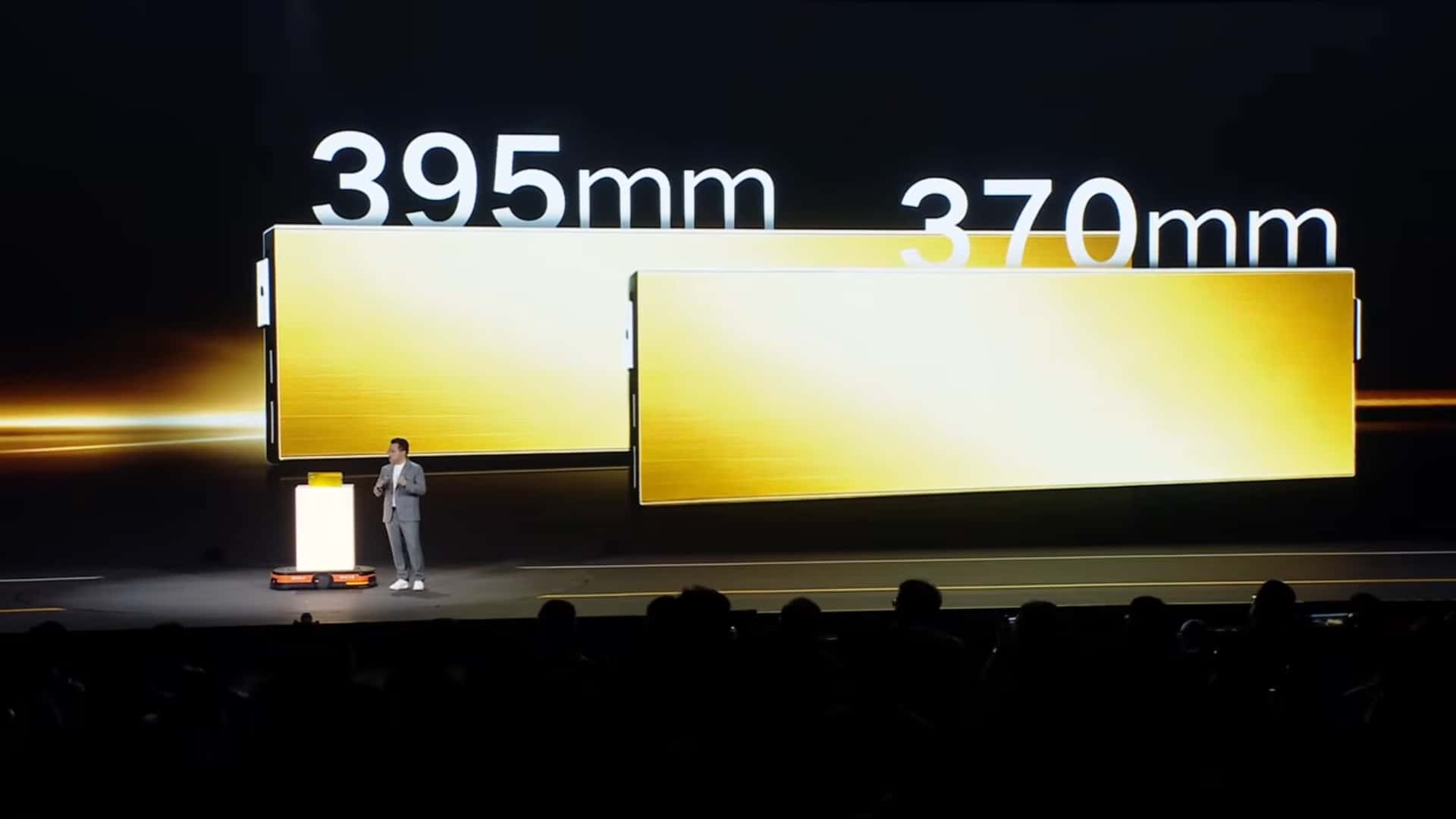
Geely’s new Ultra Short Blade Battery cell is a cornerstone of its strategy. These cells come in two primary sizes: 395 mm and 370 mm in length. This is notably smaller than typical industry standards, which are often around 960 mm, and even smaller than Geely’s previous 580 mm cells.
The rationale behind the smaller cell size is straightforward yet impactful: it significantly reduces the migration path for ions during both charging and discharging. A shorter journey for the ions directly translates to lower internal resistance within the cell, which in turn leads to a substantial reduction in heat generation during high-power charging, making Geely’s new battery more efficient.
Enhanced Material and Structural Engineering
Beyond the physical dimensions of the cell, Geely has implemented critical structural modifications to both the cathode and the anode to actively prevent lithium plating. Xiangfei elaborated on these advancements:
- Cathode Enhancements: The introduction of “high entropy elements” into the cathode’s composition has effectively widened the pathways through which lithium ions move from the cathode to the anode. Xiangfei likened this improvement to “turning a single lane into a multi-lane highway,” facilitating smoother and faster ion flow without congestion.
- Anode Modifications: Structural changes to the graphite anode are designed to improve its ability to absorb ions evenly. Xiangfei described these modifications as equivalent to “building a flyover,” indicating a sophisticated architectural rearrangement that optimizes ion intercalation and reduces surface accumulation.
Lithium Pulse Restoration Technology
To actively combat ion accumulation and prevent the formation of dendrites, Geely has pioneered a “lithium pulse restoration” technology. This innovative process involves injecting a “micro amplitude pulse current” into the anode at a very specific frequency.
The purpose of this precisely controlled pulse is to agitate and redistribute the accumulated ions on the anode surface, encouraging their proper absorption. Xiangfei offered an accessible analogy, comparing the process to “using a massage gun on muscles after a workout to relieve the tension,” thereby preventing the buildup of stress (or lithium ions) within the battery.
Advanced Thermal Management System
Heat management is paramount for high-performance batteries, especially with megawatt charging. Geely has developed an advanced “end-to-end five-point liquid cooling system.” This comprehensive system operates harmoniously across multiple critical components, including the on-site energy storage battery, the power module, the charger itself, the charging port, and Geely’s new battery within the EV.
This integrated cooling network is orchestrated by an AI-powered system named Xingrui PowerMind. This intelligent system is capable of predicting battery temperatures 30 seconds in advance, allowing it to adjust charging speeds in real-time. This predictive and adaptive thermal management is designed to maintain the battery’s average temperature at an optimal 55 degrees Celsius, with a stringent ceiling of 65 degrees Celsius.
The 65°C threshold is particularly significant as it aligns with a new national standard in China, implemented in July 2023, specifically aimed at preventing EV batteries from overheating and ensuring their long-term safety and performance.
The Broader Landscape and Future Implications
Geely’s ambitious claims and sophisticated technological advancements represent a significant push in the EV charging domain. However, the commercialization of such high-power charging technologies is relatively recent, primarily gaining scale in China over the last year. Consequently, the long-term impacts of megawatt charging on battery health are still an area of ongoing observation and study.
It is worth noting that the industry has seen instances where independent verification of charging performance and battery thermal behavior has been met with skepticism. A past incident involving Chinese automaker BYD, where a blogger’s independent charging tests allegedly showed higher temperatures than displayed by the vehicle, leading to police involvement, highlights the need for transparency and robust validation in this rapidly evolving sector.
Despite these complexities, Geely’s decision to extend its battery warranty underscores its confidence in the durability of Geely’s new battery technology. This move aims to reassure consumers about the long-term reliability of vehicles equipped with its Ultra Short Blade Battery and megawatt charging capabilities.
It is also important for consumers to remember that battery degradation is a multifaceted phenomenon. It is influenced not only by charging speeds but also by driving behavior, charging habits, ambient climate, and the inherent design of the battery technology itself. While some early studies indicated that frequent fast-charging could accelerate battery aging, modern EV battery technology has advanced considerably, often demonstrating minimal degradation even with regular fast-charging.
For optimal battery health, EV owners are generally advised to adhere to manufacturer-recommended charging practices. Utilizing a home charger for daily driving needs whenever possible and reserving public fast-chargers for longer journeys remains a practical strategy. As advancements like Geely’s new battery continue to emerge, the concerns surrounding EV battery longevity are steadily diminishing, paving the way for a more convenient and sustainable electric future.
FAQ Section
What is unique about Geely’s new battery charging capabilities?
Geely’s new Ultra Short Blade Battery can handle charging speeds exceeding 1,000 kilowatts, with high-end EVs peaking at 1,100 kW. It supports a 2.2-megawatt charger, which is reportedly the first in the world to allow two electric vehicles to draw megawatt speeds simultaneously from a single station.
How does Geely’s new battery address accelerated degradation from fast charging?
Geely has implemented several solutions, including a shorter cell design to reduce ion migration paths and heat, structural modifications to the cathode and anode, a “lithium pulse restoration” technology to prevent ion accumulation, and an AI-powered five-point liquid cooling system to manage thermal stress.
What are the primary causes of battery degradation during fast charging?
According to Geely, the two main root causes of accelerated battery degradation during fast charging are lithium plating and extreme temperatures. Lithium plating involves ions accumulating on the anode, potentially forming dendrites, while high temperatures, particularly from current flow, can stress battery components.
What is “lithium pulse restoration” technology?
Lithium pulse restoration is a proprietary technology developed by Geely. It involves injecting a “micro amplitude pulse current” into the anode at a specific frequency. This process helps to reduce the accumulation of lithium ions on the anode surface, thereby mitigating lithium plating and preventing the formation of damaging dendrites.
How does Geely manage battery temperatures during megawatt charging?
Geely utilizes an “end-to-end five-point liquid cooling system” that actively cools the energy storage battery, power module, charger, charging port, and the EV battery itself. This system is paired with an AI-powered system called Xingrui PowerMind, which predicts battery temperatures 30 seconds in advance to adjust charging speeds in real time, maintaining optimal thermal conditions.