
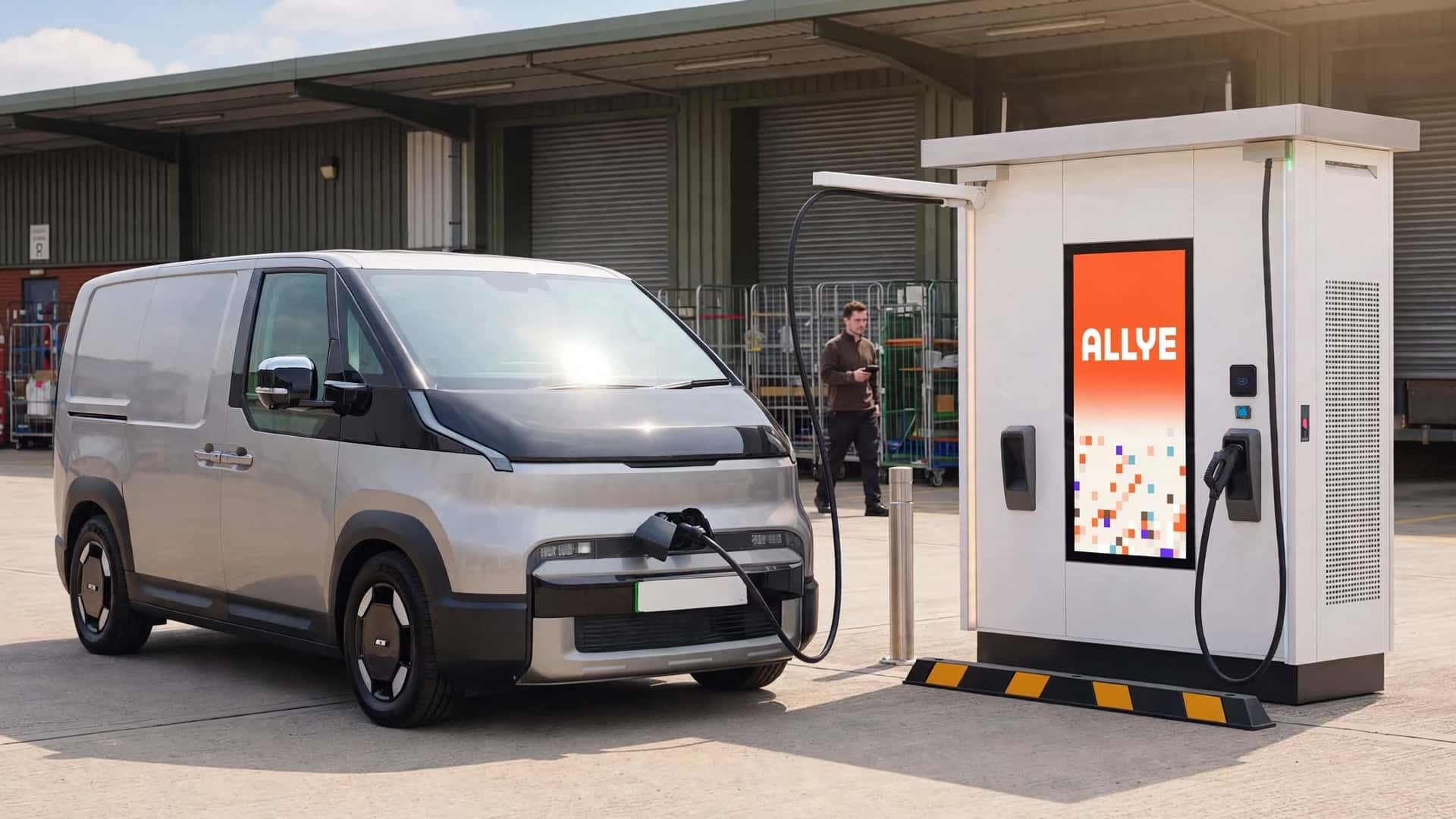
The rapid expansion of electric vehicle (EV) fleets worldwide faces a significant bottleneck: the conventional electricity grid infrastructure. Traditional installations of high-power DC fast chargers often demand extensive and costly grid upgrades, frequently entailing permits and construction timelines stretching over many months. This challenge has prompted a search for innovative, agile, and cost-effective charging solutions, especially for commercial operations and temporary sites.
Addressing this pressing need, Great Britain-based Allye Energy has introduced a groundbreaking mobile DC fast charger, the MEV, which leverages second-life EV batteries to overcome these infrastructure hurdles. This novel approach allows for rapid deployment and robust charging capabilities without requiring substantial modifications to existing grid connections, offering a compelling alternative to conventional high-power EV charging infrastructure.

Key Takeaways (TL;DR)
Allye Energy’s new MEV is a mobile, battery-buffered EV charger that delivers up to 400 kW using repurposed electric vehicle batteries for integrated storage. It significantly reduces the need for expensive and time-consuming grid upgrades, connecting to a standard 16A three-phase grid connection and becoming operational in hours. This innovative solution is ideal for commercial depots and temporary sites, offering flexible, cost-effective, and sustainable EV charging infrastructure with advanced safety features and a strong commitment to local sourcing.
The Growing Challenge of EV Charging Infrastructure
As the global transition to electric mobility accelerates, the demand for reliable and high-speed charging infrastructure is soaring. However, the current electrical grid, designed primarily for static consumption patterns, is not always equipped to handle the instantaneous, high-power draw required by modern DC fast chargers. Integrating these powerful units into the existing network often necessitates complex engineering, reinforcement of local substations, and the laying of new, heavy-duty cables.
High Costs and Time Delays
These grid reinforcement projects are not only prohibitively expensive, potentially running into hundreds of thousands of pounds or dollars, but also incredibly time-consuming. The administrative processes for approvals and the physical construction work can delay the commissioning of new charging stations by several months, or even over a year. This lengthy waiting period is particularly problematic for businesses looking to electrify their fleets quickly or for temporary event organisers needing on-demand charging solutions.

For many companies, the prospect of such significant upfront investment and prolonged delays makes the transition to EVs a daunting challenge. This creates a critical need for solutions that can deliver substantial charging power while minimising reliance on extensive grid upgrades, thereby accelerating EV adoption across various sectors.
Allye Energy’s Groundbreaking MEV Charger
In response to these pervasive challenges, Allye Energy has developed the MEV, positioning it as the world’s first dedicated EV charger featuring built-in battery storage derived from repurposed electric vehicle packs. This innovative design marks a significant step forward in making high-power EV charging more accessible and adaptable.
Powering with Purpose: Second-Life EV Batteries
The core of Allye’s innovation lies in its utilisation of second-life EV batteries. These batteries, sourced from various manufacturers and differing in age, are integrated into the MEV to create a powerful energy buffer. This approach not only provides a sustainable second life for batteries that might otherwise be discarded but also enhances the economic viability of the charging solution by reducing reliance on new, expensive battery manufacturing.
By acting as an energy reservoir, the onboard batteries allow the charger to draw power from the grid at a lower, consistent rate, storing it until an EV needs a charge. When an electric vehicle is connected, the battery-buffered EV charger then delivers a high-power output directly from its internal storage, effectively decoupling the charging event from the immediate grid capacity.
Technical Specifications and Operational Mechanics
The MEV battery-buffered EV charger is designed for high performance and flexibility. It can deliver an impressive 400 kilowatts of power, capable of charging two electric vehicles simultaneously through its integrated cables. Additionally, the system is versatile enough to send power to multiple charging satellites if a wider distribution is required.
The internal battery storage is available in two capacities: 155 kilowatt-hours or 232 kilowatt-hours, providing ample energy for numerous charging sessions. Crucially, the minimum grid connection required is a modest three-phase 16-ampere hookup, a standard industrial connection often readily available. The system can support up to 125A connections, offering scalability for various site conditions without triggering major grid upgrade requirements.
The operational principle is straightforward and efficient: when the charging ports are not in use, the system intelligently recharges its internal batteries from the modest grid connection. When an EV is plugged in, the stored energy is rapidly discharged, providing instant high-power charging. This intelligent energy management system optimises grid usage and maximises charging efficiency.
Economic and Environmental Advantages
The deployment of Allye’s battery-buffered EV charger offers a multitude of benefits, primarily revolving around significant cost savings, accelerated deployment, and enhanced sustainability.
Swift Deployment for Commercial Operations
For commercial entities, particularly those operating vehicle depots, the ability to deploy high-power charging in hours instead of months is a game-changer. The all-in-one MEV unit can simply be positioned on the ground and connected to the main power supply via an industrial outlet or through hardwiring. This ‘plug-and-play’ functionality eliminates the complex and time-consuming civil engineering and electrical infrastructure projects typically associated with new fast charger installations.
The mobile nature of the MEV also provides unparalleled flexibility. Should a depot’s lease expire, or if operations need to be relocated, the entire charger unit can be lifted, transported on a truck, and redeployed at a new site with minimal fuss. This adaptability makes the battery-buffered EV charger an ideal solution for dynamic business environments and temporary applications where permanent infrastructure is not feasible or desirable.
A Commitment to Local Sourcing and Sustainability
Allye Energy’s commitment extends beyond technological innovation to include sustainability and local economic development. The company states that 95% of the MEV’s components are British-sourced, a move that supports local industries and reduces the carbon footprint associated with long-distance supply chains. Notably, the repurposed EV batteries themselves are sourced from UK-registered cars, further reinforcing the circular economy model within the region.
The utilisation of second-life batteries is a cornerstone of the MEV’s environmental credentials. By giving these batteries a new purpose in charging infrastructure, Allye contributes significantly to reducing waste and conserving resources, preventing them from entering the recycling stream prematurely and maximising their useful life.
Real-World Impact: The Glasgow Case Study
The practical benefits of Allye’s battery-buffered EV charger were clearly demonstrated through a deployment at J&M Murdoch’s refuse depot in Glasgow. This real-world application underscored the significant advantages of the MEV in overcoming typical infrastructure challenges.
At the Glasgow depot, a conventional grid upgrade to support new EV charging facilities was quoted at a substantial £300,000 (approximately $400,000 USD, as of October 2023). Facing this considerable expenditure and the associated delays, J&M Murdoch opted for Allye’s battery-backed EV charger as an alternative. The outcome was a testament to the solution’s efficacy: the unit was fully operational within a single day, eliminating the need for the costly and protracted grid upgrade project.
Currently, this deployed MEV unit is supplying approximately 200 kilowatt-hours of energy daily, reliably meeting the depot’s charging needs. This case study effectively illustrates how Allye’s technology provides a viable, cost-efficient, and rapid solution for businesses looking to electrify their fleets without incurring the prohibitive expenses and lengthy timelines of traditional grid enhancements.
Enhancing Safety and Security Standards
Given the high-power electrical components and integrated battery packs, safety and security are paramount in the design of the MEV battery-buffered EV charger. Allye Energy has incorporated several advanced features to ensure both operational reliability and protection against external threats.
To deter and mitigate cable theft, a common issue at charging stations, the units are equipped with cut detection systems and forensic marking. Additionally, quick-release terminals facilitate swift and easy replacement of cables if damage or theft occurs, minimising downtime and operational disruption. Internally, the MEV incorporates sophisticated safety measures for its battery packs. Each battery pack features a dedicated pyro fuse, designed to rapidly disconnect in the event of an electrical fault, preventing runaway thermal events. Off-gas detection systems are also standard, providing early warning of potential battery issues, while fire barriers placed between individual packs add an extra layer of containment and protection.
Furthermore, the MEV is designed for broad compatibility, working seamlessly with both 800-volt and 400-volt electric vehicles, accommodating the diverse architectures of modern EVs. This comprehensive approach to safety, security, and compatibility underscores Allye Energy’s commitment to delivering a robust and dependable charging solution.
The Future Landscape of EV Charging Solutions
Allye Energy’s MEV battery-buffered EV charger represents a significant evolution in the electric vehicle charging landscape. By strategically addressing the limitations of existing grid infrastructure through innovative battery buffering and the sustainable use of second-life batteries, the company offers a blueprint for more flexible, cost-effective, and environmentally conscious charging solutions.
As the electrification of transportation continues to expand, particularly within commercial fleets and logistical operations, solutions like the MEV will become increasingly vital. They provide the agility required to support rapid EV adoption, ensuring that businesses and communities can transition to sustainable mobility without being hampered by prohibitive infrastructure costs or prolonged deployment timelines. This approach not only facilitates faster EV integration but also promotes a circular economy, maximising the utility of critical battery components.
Frequently Asked Questions (FAQ)
What is a battery-buffered EV charger?
A battery-buffered EV charger, like Allye’s MEV, integrates internal battery storage to deliver high power for EV charging. It draws electricity from the grid at a lower, consistent rate to charge its internal batteries, then discharges that stored energy rapidly to an EV. This method bypasses the need for costly and time-consuming grid upgrades often required by direct high-power connections.
How does Allye’s MEV charger use second-life EV batteries?
Allye’s MEV charger repurposes batteries from used electric vehicles. These ‘second-life’ batteries are integrated into the charging unit to provide the necessary energy storage. This sustainable approach gives new purpose to batteries that might otherwise be recycled, reducing waste and contributing to a circular economy while lowering the overall cost of the charging infrastructure.
What grid connection is required for the MEV charger?
The Allye MEV charger requires only a modest grid connection, with a minimum of a three-phase 16-ampere hookup. This significantly reduces installation complexities and costs compared to traditional DC fast chargers, which typically demand substantial grid upgrades. The system can support up to 125A connections, offering flexibility for various industrial or commercial settings.
What is the maximum power output of the MEV charger?
The MEV battery-buffered EV charger can deliver up to 400 kilowatts of power. This high output allows it to charge two electric vehicles simultaneously through its integrated cables. It can also be configured to supply power to multiple charging satellites, making it suitable for larger depots or areas requiring distributed charging points.
How quickly can Allye’s charger be deployed?
One of the key advantages of Allye’s MEV is its rapid deployment capability. Unlike traditional fast charger installations that can take months due to grid upgrade requirements, the MEV can be placed on site and made operational within hours. This swift setup is ideal for temporary locations, commercial depots, and situations where immediate charging solutions are needed.
What safety features are integrated into the MEV unit?
The MEV charger includes comprehensive safety and security features. For theft prevention, it has cut detection, forensic marking, and quick-release cable terminals. Internally, each battery pack is protected by a pyro fuse, with off-gas detection and fire barriers between packs as standard. These measures ensure reliable and secure operation for both the equipment and users.
Where is the MEV charger most effectively used?
Allye Energy highlights depots as a prime use case for the MEV, where industrial electrical connections are typically available. Its mobile and self-contained nature also makes it highly effective for temporary sites, construction projects, or event venues where permanent infrastructure is not practical. The flexibility to easily relocate the unit further enhances its utility for dynamic operational needs.