
Key Takeaways
- Electric vehicle (EV) motors, often overshadowed by batteries, are diverse in their design and operation, impacting efficiency, performance, and cost.
- The primary distinction among EV motor types lies in how their rotor generates magnetism: through permanent magnets or electrically powered coils.
- Permanent-Magnet Synchronous Motors (PMSMs) offer high efficiency and power density but rely on rare-earth elements, posing sourcing challenges.
- Induction Motors (Asynchronous Motors) are robust and do not require rare-earth elements, though they exhibit lower efficiency due to slip-induced current.
- Electrically Excited Synchronous Motors (EESMs) allow for adjustable magnetic fields, offering optimised control and reduced reliance on rare earths, but add complexity and consume power for excitation.
- Many modern all-wheel-drive EVs employ a combination of these motor types to balance efficiency, performance, and cost-effectiveness across different driving conditions.
While the spotlight often shines on battery technology, the electric motor remains a foundational component of any electric vehicle. These sophisticated powerplants are far more intricate than simply converting electricity into rotational force. Automakers meticulously select and integrate various EV motor types, balancing critical factors such as energy efficiency, overall performance, packaging constraints, and manufacturing costs.
At its core, the most significant differentiation among these motor designs lies in the method by which the rotor—the rotating inner component—generates its magnetic field. Some motors utilise fixed, permanent magnets, while others achieve magnetism by channelling electricity through coils. All fundamentally leverage magnetic principles, but their execution varies significantly in how this magnetism is produced and utilised to deliver propulsion.
The Fundamental Mechanics of Electric Vehicle Motors
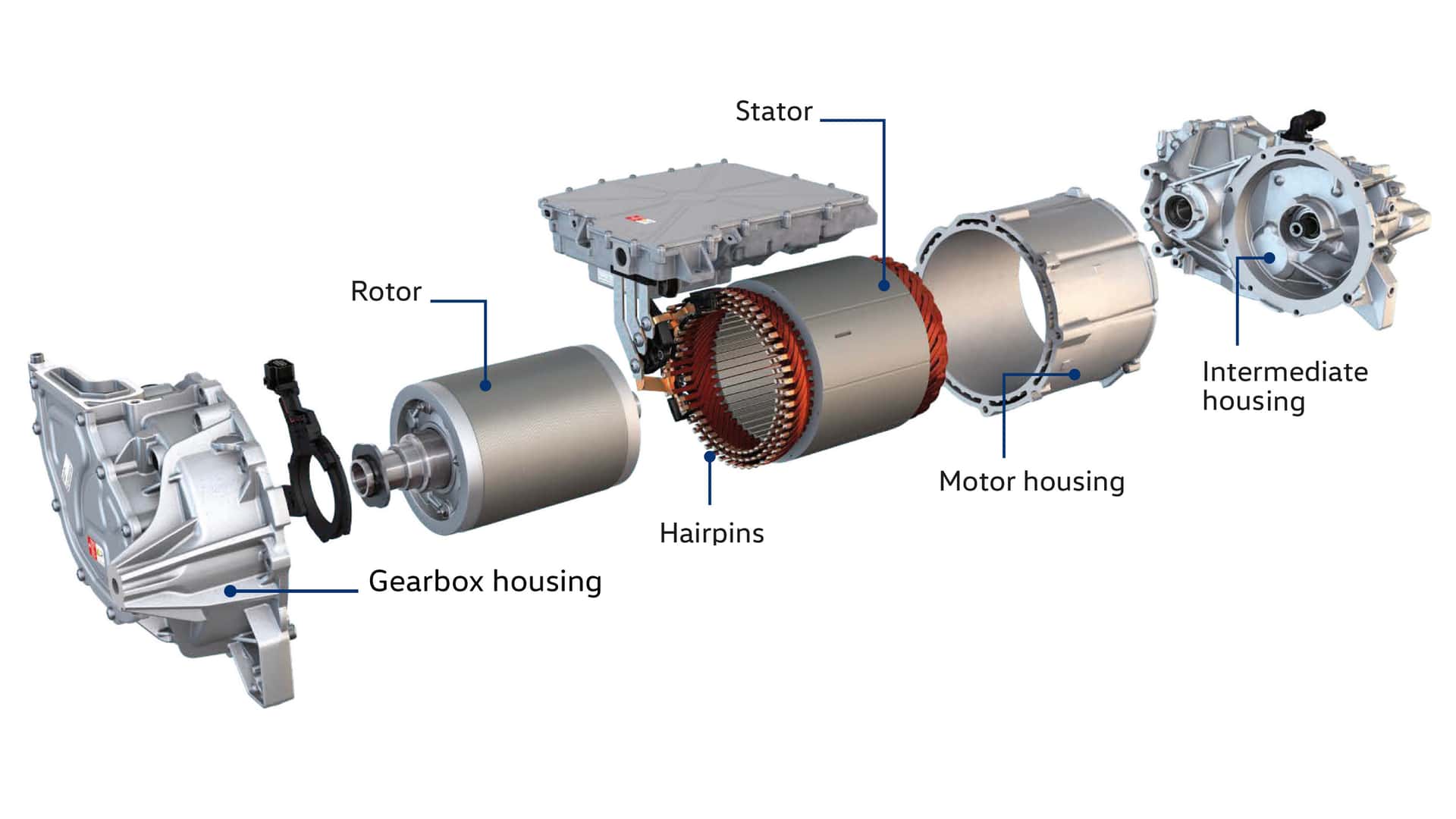
Every electric vehicle motor comprises two primary sections: the stator, which is the stationary outer casing, and the rotor, which rotates within it. The rotor’s rotation is transmitted to the vehicle’s wheels via a shaft, typically through reduction gearing to manage speed and torque effectively. This entire system requires a direct current (DC) supply from the vehicle’s high-voltage battery pack.
An essential component, the inverter, transforms this DC power into controlled alternating current (AC). This AC is then fed into the stator’s precisely wound coils in a meticulously sequenced manner. This sequence generates a continuously rotating magnetic field around the stator, which the rotor is compelled to follow, thereby inducing rotational motion.
The term ‘synchronous’ describes a class of EV motor types where the rotor rotates at the exact same speed as the stator’s magnetic field. Both permanent-magnet and electrically excited motors fall into this category. In contrast, induction motors operate with a deliberate speed differential between the stator’s magnetic field and the rotor’s rotation.

Permanent-Magnet Synchronous Motors (PMSMs): Harnessing Inherent Magnetism
Permanent-Magnet Synchronous Motors (PMSMs) are a prevalent choice among contemporary EV motor types. In these designs, the rotor is equipped with powerful permanent magnets, either attached to its surface or embedded within its structure, which inherently generate a constant magnetic field. The stator’s rotating magnetic field then interacts with these fixed magnets, effectively pulling the rotor around.
This principle can be visualised by imagining a compass needle aligning itself with a moving external magnet. In a PMSM, this controlled magnetic pull is continuous, driving the rotor’s rotation. A key advantage of this design is that the rotor’s magnets do not require an external electrical supply to maintain their magnetic properties, which significantly contributes to the motor’s high efficiency by minimising energy losses associated with powering rotor windings.
PMSMs are widely favoured for their impressive efficiency and their ability to generate substantial power output within a relatively compact and lightweight package. This combination of attributes makes them the preferred choice for the primary drive motors in a majority of electric vehicles globally.
However, the use of powerful magnets in PMSMs presents certain challenges. These magnets typically incorporate rare-earth elements, such as neodymium and dysprosium. The reliance on these materials can expose automotive manufacturers to potential sourcing complexities, geopolitical risks, and significant price volatility in global commodity markets. While not all permanent magnets are rare-earth-based, the high-performance demands of automotive applications often necessitate their use.
Induction Motors (Asynchronous Motors): The Principle of Magnetic Lag
Also known as asynchronous motors, induction motors represent another significant category of EV motor types. Instead of permanent magnets, the rotor in an induction motor contains conductive bars, which are often connected at both ends by rings, forming a structure commonly referred to as a ‘squirrel cage’ due to its resemblance to a rodent’s exercise wheel.
When the stator’s moving magnetic field sweeps past these conductive bars, it induces an electric current within them. This induced current, in turn, generates its own magnetic field within the rotor. This elegant design allows the rotor to produce torque without the need for permanent magnets or a direct electrical connection to power the rotor itself.
A distinctive characteristic of an induction motor is that its rotor always turns slightly slower than the stator’s rotating magnetic field. This speed difference, known as ‘slip,’ is crucial for the motor’s operation, as it is necessary to induce current in the rotor and generate torque. If the rotor were to catch up completely with the magnetic field, the induction effect, and thus the torque, would cease.
This design is celebrated for its robustness and its independence from rare-earth magnets, offering a more sustainable manufacturing pathway. However, the process of inducing current in the rotor inevitably generates heat, which can lead to energy losses and reduce overall efficiency compared to PMSMs. A notable benefit, though, is that when an induction motor is not actively receiving power, its rotor can spin with minimal drag, offering an advantage in certain driving scenarios.
This characteristic is highlighted by manufacturers like Audi, which utilises an induction motor for the front axle of its Q6 E-tron Quattro, complementing a permanent-magnet motor at the rear. This allows the front motor to provide additional propulsion and traction when needed, while offering minimal resistance when disengaged. This hybrid motor strategy is common in all-wheel-drive EVs, where a potent permanent-magnet motor often drives the primary, continuously engaged axle, while a less powerful induction motor assists on the secondary axle. Tesla and General Motors are among the many automakers employing this configuration for various EV motor types.
Electrically Excited Synchronous Motors (EESMs): Adjustable Magnetism for Optimisation
The Electrically Excited Synchronous Motor (EESM) presents a third distinct approach among EV motor types. In this design, the rotor is fitted with coils that are supplied with electricity, effectively transforming the rotor into an electromagnet. Unlike an induction motor, an EESM does not rely on slip to generate its rotor’s magnetic field.
Conceptually, an EESM can be viewed as an evolution of the permanent-magnet design, but with the critical enhancement of adjustable electromagnets instead of fixed permanent ones. The term ‘excited’ simply denotes that the rotor’s magnetism is generated and maintained by an electrical current. This capability to precisely control and adjust the strength of the rotor’s magnetic field provides engineers with an additional degree of freedom to optimise the motor’s operation across a wide range of speeds and loads.
BMW, for instance, has incorporated EESMs into its latest sixth-generation EV powertrains. The manufacturer cites their energy efficiency in everyday driving and their ability to sustain strong power delivery even at very high rotational speeds as key advantages. Renault also champions this approach in vehicles such as the Renault 5 E-Tech, explicitly highlighting the reduced dependence on rare earths and a more diversified supplier base for magnet components as compelling reasons for adopting wound rotor designs.
The primary trade-off with EESMs is that generating and maintaining the rotor’s magnetic field consumes electricity, adding to the overall energy expenditure. Furthermore, the presence of windings and their associated power supply system on the rotor introduces additional complexity to the motor’s design and manufacturing process. Thus, the benefit of avoiding permanent magnets comes with its own set of engineering and cost considerations.
Strategic Integration: Why EV Manufacturers Combine Motor Types
The example of the Audi Q6 E-tron Quattro, which employs two distinct EV motor types—a permanent-magnet rear motor and an induction front motor—aptly illustrates the strategic rationale behind combining different designs. This configuration allows the vehicle to leverage the high efficiency of the permanent-magnet motor for primary propulsion, while the induction motor on the front axle provides supplementary performance and enhanced traction when required, all with minimal drag when it is inactive.
BMW’s latest all-wheel-drive architecture offers another compelling illustration, pairing an electrically excited synchronous motor on the rear axle with an induction motor at the front. Similarly, some new Mercedes-Benz EVs feature a permanent-magnet motor at the front that can be mechanically disconnected from the wheels when not in use. This clever engineering reduces drag and mitigates energy losses, thereby boosting overall efficiency by preventing the motor from unnecessarily spinning.
The careful selection and strategic integration of various EV motor types are paramount for optimising a vehicle’s energy consumption. This involves not only maximising power output when acceleration is needed but also minimising energy wastage when power is not required. As electric vehicle technology continues to evolve, this nuanced approach to motor design and application will undoubtedly remain a cornerstone of engineering innovation, ensuring a diverse range of motor solutions in future EVs.
Frequently Asked Questions About EV Motor Types
What are the primary differences between permanent-magnet and induction EV motors?
Permanent-magnet motors use fixed magnets on the rotor, offering high efficiency and power. Induction motors use conductive bars on the rotor where magnetism is induced by the stator’s field. They are robust and avoid rare earths but are generally less efficient due to energy losses from induced currents and the need for ‘slip’.
Why do some electric vehicles use multiple types of motors?
Automakers often combine different EV motor types, especially in all-wheel-drive configurations, to balance efficiency, performance, and cost. For example, a high-efficiency permanent-magnet motor might be paired with a lower-drag induction motor that engages only when additional power or traction is needed, optimising energy use.
Are rare-earth elements essential for all EV motors?
No, rare-earth elements are typically used in Permanent-Magnet Synchronous Motors (PMSMs) to achieve high power density and efficiency. Induction motors and Electrically Excited Synchronous Motors (EESMs) are designed to operate without rare-earth magnets, offering alternatives that mitigate sourcing challenges and price volatility associated with these materials.
How do Electrically Excited Synchronous Motors (EESMs) differ from other EV motor types?
EESMs feature rotor coils that are supplied with electricity, turning the rotor into an adjustable electromagnet. This allows for precise control over the magnetic field strength, optimising efficiency and performance across varying conditions. This flexibility comes at the cost of additional complexity and power consumption for rotor excitation, unlike permanent-magnet motors.
What does ‘synchronous’ mean in the context of EV motors?
‘Synchronous’ refers to EV motor types where the rotor spins at exactly the same speed as the rotating magnetic field generated by the stator. Permanent-Magnet Synchronous Motors (PMSMs) and Electrically Excited Synchronous Motors (EESMs) fall into this category. Induction motors, conversely, are ‘asynchronous’ because their rotor always lags behind the stator’s magnetic field.
What role does the inverter play in an EV motor system?
The inverter is a critical component that converts the direct current (DC) supplied by the EV’s battery into alternating current (AC). This AC is then precisely fed to the stator’s coils in a sequence that creates the rotating magnetic field, which is essential for driving all EV motor types, regardless of their specific design.