
Key Takeaways
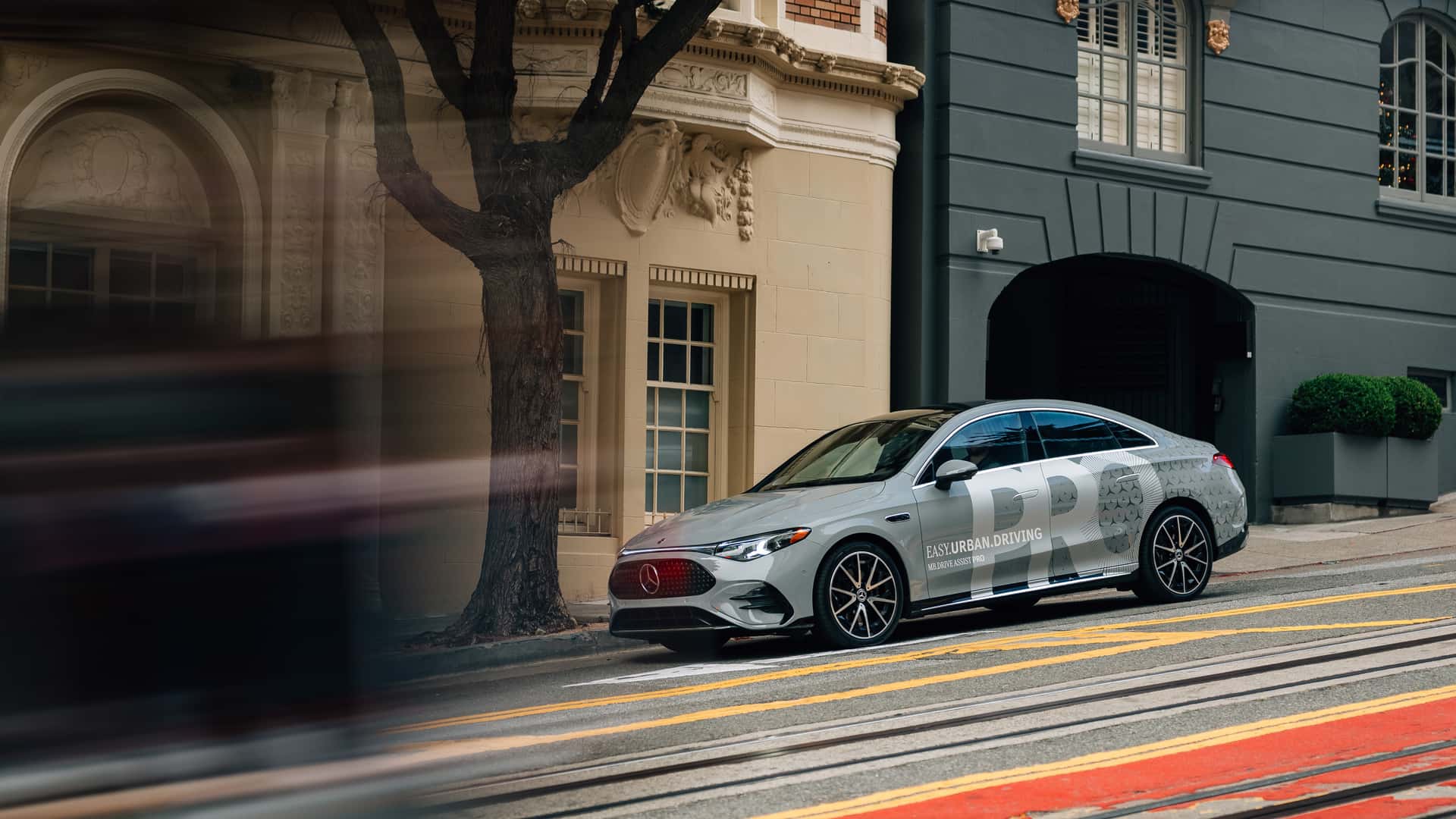
- Mercedes-Benz is launching its MB.Drive Assist Pro system, a direct competitor to Tesla’s Full Self-Driving (FSD) feature, available early next year via over-the-air updates for eligible vehicles.
- Unlike Tesla FSD, which allows hands-off driving on surface streets, Mercedes’ system requires drivers to keep a hand on the wheel when not on controlled-access highways.
- This distinction stems from Mercedes’ strict adherence to the Society of Automotive Engineers (SAE) Level 2 definition, emphasizing driver responsibility, contrasted with FSD users’ real-world hands-off experience.
- Technologically, MB.Drive Assist Pro utilizes a comprehensive sensor suite including cameras, five radar sensors, and twelve ultrasonic sensors, while Tesla’s FSD primarily relies on cameras.
- Customer perception varies, with some drivers prioritizing the convenience of hands-off driving, while others appreciate Mercedes’ safety-first, regulated approach.
For many commuters, the daily grind can be a relentless challenge. Imagine navigating a scenic yet congested route like Laurel Canyon from the San Fernando Valley to Los Angeles’ west end. This daily ordeal, described as a “tedious, never-ending nightmare” by resident Lucian Capellaro, underscores a growing desire for advanced driving assistance.
Capellaro, like many, has heard colleagues laud the capabilities of Tesla’s Full Self-Driving (Supervised) feature, which promises point-to-point autonomous navigation. While the concept of a car handling the entire journey sounds like a relief, his personal preferences lean away from Tesla, citing factors such as design aesthetics, interior quality, and body style, alongside broader political considerations.
Mercedes-Benz is poised to offer a compelling alternative. Its advanced MB.Drive Assist Pro system is slated for introduction in a significant number of its electric and internal combustion vehicles early next year. Crucially, existing eligible vehicles will gain access to this sophisticated system through seamless over-the-air (OTA) software updates, expanding the reach of advanced driver assistance technology.
Understanding MB.Drive Assist Pro: Functionality and Philosophy
MB.Drive Assist Pro shares fundamental similarities with Tesla’s Full Self-Driving (Supervised). Both systems enable drivers to input a destination, allowing the vehicle to autonomously navigate to the chosen location and even perform parking maneuvers. This point-to-point automated driving capability represents a significant leap in convenience for many users, aiming to alleviate the cognitive load associated with driving.
However, a critical distinction lies in the level of driver engagement required, particularly on different road types. While the Mercedes system, much like FSD (Supervised), permits hands-free operation on controlled-access highways, it mandates that the driver maintain a hand on the steering wheel when traversing surface streets. This operational nuance is not merely a technical limitation but, as Mercedes executives contend, a deeply philosophical choice rooted in safety and regulatory adherence.
Adhering to SAE Autonomy Levels
Mercedes-Benz articulates a strict interpretation of the autonomous driving “levels” as defined by the Society of Automotive Engineers (SAE). The MB.Drive Assist Pro system is categorized as a Level 2 system, or what Mercedes refers to as “Level 2 Plus Plus.” This designation signifies that while the system provides substantial assistance, the driver remains fully responsible and must constantly supervise the vehicle’s operation.
The distinction between Level 2 and Level 3 autonomy is paramount to Mercedes’ approach. Level 3 systems are characterized by allowing drivers to disengage from driving tasks under specific conditions, potentially enabling activities like watching a movie or reading a book. Crucially, at Level 3, the machine, or the vehicle’s software stack, assumes responsibility for driving, shifting liability away from the human driver.
Mercedes Chief Technology Officer Jörg Burzer emphasized this critical boundary, stating, “There is a very important borderline between the levels. That borderline is that with Level 2 Plus Plus, you are responsible. At Level 3, the machine, the car, the software stack, is responsible.” This highlights Mercedes’ commitment to clearly delineating driver and system responsibilities.
The Complexity of Urban Driving
The decision to require hands-on engagement for surface streets is directly linked to the inherent complexities of urban environments. Controlled-access highways, by their nature, present a more predictable and less variable driving scenario for advanced driver assistance systems. In contrast, surface streets are characterized by dynamic and chaotic conditions, including pedestrians, cyclists, varied speed limits, complex intersections, and unpredictable traffic patterns.
For Mercedes, these chaotic variables necessitate active driver supervision. The company’s philosophy prioritizes ensuring the driver is ready to assume full control immediately. This rationale resonates with individuals like Lucian Capellaro, who, despite being a motorcycle rider and not risk-averse, expressed a pragmatic view: “Think about the reaction time it must be for someone to take their hands from off the wheel to on the wheel. I’d view my hand on the wheel as lessening the seconds of reaction time to something crazy happening.”
Customer research conducted by Mercedes reportedly supports this cautious stance, particularly among European drivers. Jörg Burzer noted, “In the city, they like to have something, some regulation or some requirement that you have to have a hand on the wheel.” However, he acknowledged that U.S. customer preferences might differ, posing a market challenge.
The Divergence: Mercedes’ Regulation vs. Tesla Users’ Experience
The core difference between MB.Drive Assist Pro and Tesla’s FSD (Supervised) often comes down to this hands-on versus hands-off debate on non-highway roads. Many Tesla FSD users actively engage with their vehicles in a manner that, from Mercedes’ perspective, blurs the lines of SAE Level 2 autonomy. These users frequently report hands-off driving on city streets, interpreting their car’s capabilities as already reaching or exceeding Level 2 definitions.
Antonio Hidalgo, an L.A. resident and frequent FSD user, exemplifies this real-world experience. He openly admits to taking naps while his Tesla drives, particularly when wearing a hat and sunglasses to avoid immediate system warnings. Hidalgo points out that the only flaws he currently observes with FSD relate to parking functionalities. This sentiment reflects a significant trust built through practical usage, even if it goes beyond a strict interpretation of supervised driving.
When directly confronted with the question of why a customer would choose the Mercedes system over Tesla’s, given the hands-off capability on surface streets, Burzer reiterated Mercedes’ commitment to regulations and SAE autonomy levels. He repeatedly emphasized, “The big question is when is level 3 coming? Because then you can have the hands off (anywhere).” This underscores the philosophical chasm between a manufacturer adhering strictly to definitions and users experiencing advanced capabilities in practice.
Mharlon Barrientos, who relies on FSD for his commute in Indianapolis, also highlights the evolving trust in Tesla’s system. Initially, he would “hover” a hand near the wheel, but successive system updates and prolonged experience have led him to drive fully hands-off on city streets. He directly articulated the impact of Mercedes’ requirement: “Having a hand on the wheel as a requirement would be a bit of a step back to the feel of full autonomous driving that I’ve gotten used,” noting that his Model Y originally required a hand on the wheel. This perspective is crucial, as it comes from someone who experienced both hands-on and hands-off requirements with FSD’s evolution.
Technological Approaches to Safety and Performance
Beyond the philosophical differences, Mercedes-Benz strongly advocates for its multi-sensor approach as a cornerstone of enhanced safety and performance for advanced driver assistance systems. MB.Drive Assist Pro integrates a diverse array of sensors, including multiple cameras, five radar sensors, and twelve ultrasonic sensors. This comprehensive sensor suite is designed to feed raw, rich data to the car’s Nvidia-powered computer, providing a robust perception of the surrounding environment.
This contrasts with Tesla’s FSD (Supervised) system, which primarily relies on cameras to sense obstacles and navigate. Christoph von Hugo, Mercedes’ Head of Active Safety, clearly articulated the company’s position: “Different sensor inputs increases performance and safety.” He implicitly critiqued camera-only systems, adding, “Relying on one just is not enough.” Mercedes further asserts its commitment to safety by stating that it will only ascend to SAE Level 3 capability upon the integration of LiDAR technology, in addition to its existing cameras, radar, and ultrasonic sensors. It is notable that Mercedes had previously offered a Level 3 system in the U.S. for a brief period, which has since been phased out.
However, the impact of these technical specifications on consumer decisions remains a point of debate. Mharlon Barrientos, the Indianapolis FSD user, expressed skepticism about sensor types being a primary selling point. He remarked, “I honestly haven’t even thought about the tech behind it, so I’m not so sure knowing that there’s radar and ultra-sonic sensors (on the window sticker) would be a huge selling point.” For users like Barrientos, tangible performance advantages demonstrated through real-world reviews or personal experience are far more convincing than a list of technical components. “Just like the Tesla system, I think it would take me some mileage on both highway and streets to gain a trust for the system to know it’ll handle either situation well,” he added.
Beyond Automated Driving: The Holistic Vehicle Experience
While autonomous driving capabilities are increasingly influential, they remain one aspect of a consumer’s overall vehicle preference. Many drivers, including current FSD users, consider a broader spectrum of factors when choosing a car. Mharlon Barrientos, for example, is not exclusively loyal to Tesla or its FSD system. He stated, “The hands-on requirement in the city would not be enough to sway me off of the car provided I like the rest of the car.” For him, functionality, comfort, and overall value often rank higher than the specific nuances of an autonomous system, as he still values “the feel of actually driving a car.”
Similarly, Lucian Capellaro, while intrigued by MB.Drive Assist Pro, considers how it compares to the adaptive cruise control and hands-free highway driving assist available in his wife’s BMW i4, which operates effectively at low, traffic-jam speeds. His primary interest lies in the system’s ability to handle highly complex, point-to-point routes like Laurel Canyon. If MB.Drive Assist Pro can competently navigate such challenging environments with merely a hand resting on the wheel, he finds that “super appealing,” regardless of the specific sensor technology.
Conclusion: A New Chapter in Driver Assistance
The introduction of Mercedes-Benz’s MB.Drive Assist Pro marks a significant development in the rapidly evolving landscape of advanced driver assistance systems. It presents a distinct philosophical and technological counterpoint to Tesla’s Full Self-Driving (Supervised) system, particularly regarding the level of driver engagement required on surface streets. Mercedes prioritizes a strict interpretation of SAE autonomy levels and a multi-sensor approach for enhanced safety, while some Tesla users have grown accustomed to a more permissive, hands-off experience.
The ultimate efficacy and market acceptance of MB.Drive Assist Pro will hinge on its real-world performance. Early passenger-seat observations in San Francisco in January suggested promise, but comprehensive reviews are anticipated to evaluate its capabilities fully. The central questions remain: Does the hands-on requirement on city streets truly enhance safety, and will it prove to be a significant deterrent for consumers accustomed to, or desiring, full hands-off functionality? The answers to these questions will shape the future trajectory of premium automotive autonomy.
Frequently Asked Questions (FAQ)
What is Mercedes-Benz MB.Drive Assist Pro?
MB.Drive Assist Pro is Mercedes-Benz’s advanced point-to-point automated driving system. It allows vehicles to navigate to a destination and park autonomously. It will be rolled out to a broad range of Mercedes electric and internal combustion vehicles through over-the-air updates starting early next year.
How does MB.Drive Assist Pro differ from Tesla’s Full Self-Driving (FSD)?
The primary difference lies in driver engagement on surface streets. While both systems allow hands-free driving on highways, Mercedes’ MB.Drive Assist Pro requires drivers to keep a hand on the steering wheel when operating on city streets, a contrast to Tesla FSD (Supervised).
Why does Mercedes require hands on the wheel for city driving?
Mercedes adheres strictly to SAE Level 2 autonomous driving definitions, where the driver remains responsible. Urban environments present complex, chaotic variables, necessitating active driver supervision to ensure immediate takeover capability. This is a philosophical decision prioritizing safety and regulatory compliance.
What sensor technology does MB.Drive Assist Pro use?
MB.Drive Assist Pro employs a comprehensive sensor suite including multiple cameras, five radar sensors, and twelve ultrasonic sensors. Mercedes emphasizes that this multi-sensor approach enhances performance and safety compared to systems relying primarily on a single sensor type, such as cameras.
Will MB.Drive Assist Pro be available for existing Mercedes owners?
Yes, eligible Mercedes-Benz vehicles already purchased will be able to add the MB.Drive Assist Pro feature. This will be facilitated through convenient over-the-air (OTA) software updates, making the advanced system accessible to a wider existing customer base.
How do consumers perceive the hands-on requirement?
Perceptions vary. European drivers, according to Mercedes’ research, often prefer some hand-on-wheel requirement in cities. However, some Tesla FSD users, accustomed to hands-off driving on surface streets, view such a requirement as a step back, prioritizing the convenience and “feel” of full autonomy.