
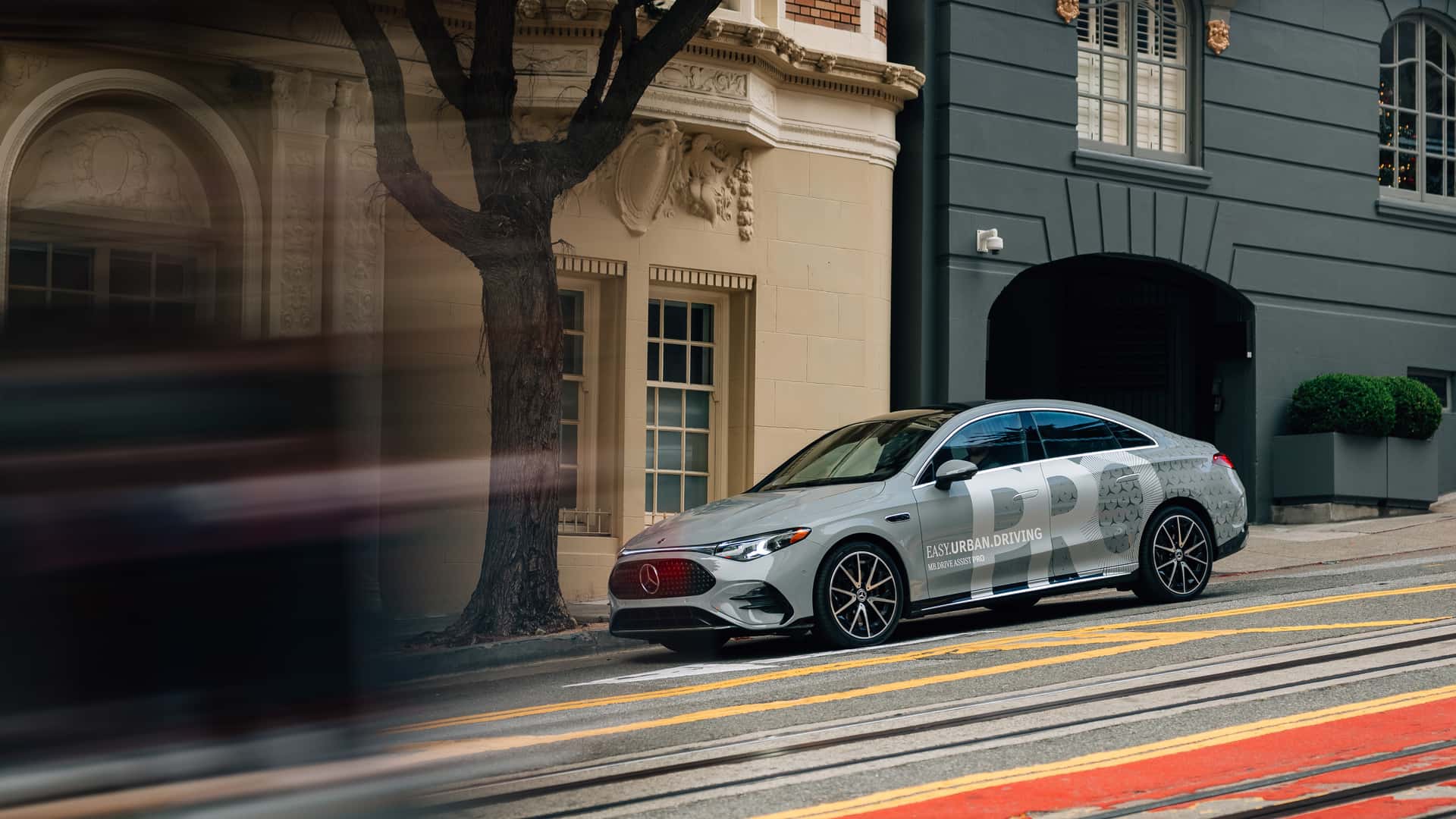
Key Takeaways: Mercedes MB.Drive Assist Pro vs. Tesla FSD
- Mercedes-Benz is set to introduce MB.Drive Assist Pro, a new point-to-point automated driving system.
- The system is positioned as an alternative to Tesla’s Full Self-Driving (Supervised) feature, offering navigation, driving, and parking capabilities.
- A primary distinction is Mercedes’ requirement for drivers to maintain a hand on the wheel on surface streets, contrasting with Tesla FSD’s hands-off capability in similar environments.
- Mercedes justifies this by adhering strictly to the Society of Automotive Engineers (SAE) Level 2 autonomy definitions, emphasizing driver responsibility.
- The German automaker highlights its multi-sensor approach (cameras, radar, ultrasonic sensors) for enhanced safety, differing from Tesla’s camera-centric system.
- Tesla FSD users express skepticism about the hands-on requirement, accustomed to greater autonomy and convenience.
- The effectiveness and public acceptance of Mercedes MB.Drive Assist Pro, particularly its hands-on mandate, remain key areas for evaluation as it rolls out.
Mercedes-Benz Enters Advanced Driver-Assistance Arena
For many daily commuters, navigating congested routes can be a significant source of frustration. Lucian Capellaro, for instance, faces a monotonous drive through Laurel Canyon in Los Angeles, a journey that has made him keenly aware of advanced driver-assistance systems. His co-workers’ accounts of Tesla’s Full Self-Driving (FSD) feature—where a vehicle autonomously navigates to a destination and parks—sounded appealing, yet he harbored a preference for a non-Tesla vehicle, citing design, interior quality, and body style.
Mercedes-Benz is poised to offer a compelling alternative with its upcoming MB.Drive Assist Pro point-to-point automated driving system. Slated for integration into a wide range of the brand’s electric and internal combustion vehicles early next year, this technology will also be available to existing eligible vehicles via an over-the-air update. This move marks Mercedes’ definitive entry into the advanced driver-assistance segment, promising a sophisticated solution for demanding commutes.
A New Option for Commuters
The introduction of Mercedes MB.Drive Assist Pro aims to address the growing demand for automated driving capabilities beyond basic cruise control. The system is designed to handle complex driving scenarios, offering a significant leap in convenience for drivers who spend considerable time on the road. For individuals like Capellaro, who seek an autonomous driving experience without compromising on their preferred vehicle aesthetics and luxury, MB.Drive Assist Pro presents a fresh perspective.
This expansion of automated driving features is expected to reshape consumer expectations, particularly in the premium automotive segment. As the technology becomes more accessible across Mercedes’ diverse portfolio, it sets the stage for a critical evaluation against established rivals, primarily Tesla’s widely discussed Full Self-Driving system.
Understanding the Core Difference: Hands-On vs. Hands-Off Autonomy
Both Mercedes MB.Drive Assist Pro and Tesla’s Full Self-Driving (Supervised) allow drivers to input a destination and have the vehicle navigate and park autonomously. However, a fundamental philosophical and operational difference distinguishes the two systems: while both offer hands-free driving on controlled-access highways, the Mercedes system mandates that drivers keep a hand on the wheel when operating on surface streets. This contrasts sharply with Tesla FSD, which permits hands-off driving even in urban environments.
Adhering to SAE Autonomy Levels
This disparity in functionality stems from Mercedes-Benz’s strict interpretation of the Society of Automotive Engineers (SAE) autonomous driving levels. MB.Drive Assist Pro, like FSD (Supervised), is classified as a Level 2 system—or what Mercedes refers to as “Level 2 Plus Plus.” This designation signifies a system where the driver must continuously supervise its operation. True Level 3 systems are characterized by the vehicle taking full responsibility for driving under specific conditions, allowing the driver to engage in non-driving activities like watching a movie or reading.
Jörg Burzer, Mercedes Chief Technology Officer, articulated the company’s position to InsideEVs: “There is a very important borderline between the levels. That borderline is that with Level 2 Plus Plus, you are responsible. At Level 3, the machine, the car, the software stack, is responsible.” This highlights Mercedes’ commitment to a clear division of responsibility between human and machine, especially given the varying complexities of driving environments.
Mercedes’ Philosophical Stance on Driver Responsibility
The decision to require hands-on driving on surface streets is rooted in Mercedes’ assessment of the inherent chaos and unpredictability of urban environments compared to controlled-access highways. Highways present fewer variables, making hands-free operation more manageable for a Level 2 system. Surface streets, however, involve pedestrians, cyclists, varied traffic laws, and unexpected obstacles, demanding a higher degree of immediate human supervision.
Lucian Capellaro, the aforementioned commuter, resonates with this rationale despite his risk-averse nature as a motorcycle rider. He notes, “Think about the reaction time it must be for someone to take their hands from off the wheel to on the wheel. I’d view my hand on the wheel as lessening the seconds of reaction time to something crazy happening.” This perspective underscores a preference for a more immediate intervention capability.
Burzer indicated that customer research, particularly among European drivers, supports this cautious approach. He stated, “In the city, they like to have something, some regulation or some requirement that you have to have a hand on the wheel,” though he acknowledged uncertainty regarding U.S. customer preferences. When pressed on why a customer would choose the Mercedes system over Tesla’s hands-off option in city driving, Burzer reiterated the importance of regulations and SAE autonomy levels, emphasizing that full hands-off capability “anywhere” is contingent on achieving Level 3 autonomy.
The Technology Behind Mercedes MB.Drive Assist Pro
Mercedes-Benz asserts that its MB.Drive Assist Pro system offers distinct advantages over Tesla FSD (Supervised) through its comprehensive sensor suite. Unlike Tesla, which predominantly relies on cameras for obstacle detection, Mercedes employs a multi-sensor approach. The system integrates five radar sensors and 12 ultrasonic sensors alongside cameras to provide raw data to the car’s advanced Nvidia-powered computer.
Beyond Cameras: A Multi-Sensor Approach
Christoph von Hugo, Mercedes’ Head of Active Safety, underscored the importance of sensor diversity, stating, “Different sensor inputs increases performance and safety.” He implicitly critiqued approaches relying solely on cameras, adding that “Relying on one just is not enough.” This multi-sensor fusion is designed to enhance the system’s perception of its environment, improving accuracy and reliability in varied driving conditions, particularly where camera vision might be compromised by adverse weather or lighting.
The synergy of cameras, radar, and ultrasonic sensors aims to create a robust and redundant perception system. Radar excels at detecting objects and their velocities at longer ranges, even in poor visibility, while ultrasonic sensors are effective for close-range detection and parking maneuvers. Cameras provide detailed visual information for lane keeping and traffic sign recognition, amongst other functions. This layered approach is intended to provide a more comprehensive and fail-safe understanding of the road ahead.
Future of Autonomy: The Role of LiDAR
Mercedes-Benz further clarifies its roadmap for higher levels of autonomy, indicating that it will not progress to Level 3 capability without the inclusion of LiDAR technology. LiDAR (Light Detection and Ranging) uses pulsed laser light to measure distances, generating highly accurate 3D maps of the environment. This technology is widely considered crucial for achieving robust Level 3 and Level 4 autonomous driving, offering superior depth perception and object detection capabilities compared to radar or cameras alone.
The company briefly offered a Level 3 system in the U.S., which has since been phased out, signaling their deliberate and cautious progression in autonomous technology deployment. This commitment to integrating advanced sensors like LiDAR for future advancements reinforces Mercedes’ safety-first philosophy and adherence to rigorous engineering standards in the development of autonomous driving solutions.
User Perspectives: Divergent Expectations on Autonomy
The philosophical differences between Mercedes and Tesla’s approaches to driver assistance are reflected in the reactions of current autonomous driving system users. Many Tesla FSD users have become accustomed to a hands-off experience, even on city streets, and are skeptical of systems requiring more active driver engagement.
Tesla FSD Users Share Experiences
Antonio Hidalgo, a Los Angeles resident and frequent FSD user, highlights the extent of his trust in the system. He admits to occasionally taking naps while driving, demonstrating a high level of comfort with its hands-off capabilities, noting that the only current flaws he perceives relate to parking. When considering a switch to a system like Mercedes MB.Drive Assist Pro, Hidalgo was contemplative, stating, “If the (Mercedes system) worked the same but I had to keep my hand on the wheel … You know, I probably wouldn’t (make the switch). I mean, I think I would be interested in having a nicer car with a better interior. But no.” This indicates that for some users, the convenience of hands-off driving outweighs other vehicle attributes.
Similarly, Mharlon Barrientos, who uses FSD for his commute in Indianapolis, described an initial period of needing to “hover” a hand over the wheel. However, system updates and prolonged experience have led him to a completely hands-off approach. He views a hands-on requirement as a regression: “Having a hand on the wheel as a requirement would be a bit of a step back to the feel of full autonomous driving that I’ve gotten used,” Barrientos said, recalling that his Model Y originally did require a hand on the wheel.
These experiences suggest a clear user expectation for minimal intervention once trust in an autonomous system is established. The added layer of radar and ultrasonic sensors in Mercedes MB.Drive Assist Pro, while touted for safety by Mercedes, might not be a primary selling point for users already comfortable with Tesla’s camera-only approach. Barrientos noted, “I honestly haven’t even thought about the tech behind it, so I’m not so sure knowing that there’s radar and ultra-sonic sensors (on the window sticker) would be a huge selling point.” He believes that hands-on experience and proven performance would be more influential in building trust.
The Value Proposition: Beyond Hands-Free Driving
Despite the strong preference for hands-off driving, not all Tesla owners are entirely committed to FSD or the brand itself. Barrientos indicated flexibility, stating, “The hands-on requirement in the city would not be enough to sway me off of the car provided I like the rest of the car. While I like the functionality of FSD, it’s still a bit further down the list of what I look for in a car. Functionality, comfort, value … I still like to feel the mechanics and have the feel of actually driving a car.” This perspective suggests that vehicle attributes like comfort and overall driving experience remain crucial decision factors, with autonomous features being secondary for some.
Lucian Capellaro, considering the Mercedes MB.Drive Assist Pro, also weighs its value beyond just the hands-free aspect. He ponders how much of an improvement it would offer over his wife’s BMW i4, which features adaptive cruise control and low-speed, hands-free highway assist for traffic jams. Ultimately, the comprehensive point-to-point navigation of MB.Drive Assist Pro holds significant appeal for him. “I guess I’d just have to experience (MB.Drive Assist Pro) for myself, but if it can navigate all the craziness that is Laurel Canyon through Hollywood, and it is literally just my hand resting on the wheel, and that’s it, then sure,” he remarked. “The fact that it’s truly point-to-point, then yes, that sounds super appealing.”
Navigating the Future of Automated Mobility
The contrasting approaches of Mercedes-Benz and Tesla highlight the ongoing evolution and debate within the autonomous driving landscape. Mercedes’ adherence to strict SAE definitions and its emphasis on a multi-sensor array underscore a cautious, safety-driven development philosophy. This is pitted against Tesla’s more aggressive rollout of hands-off capabilities, driven by software updates and real-world data collection, reflecting a different interpretation of current technological readiness and regulatory boundaries.
As Mercedes MB.Drive Assist Pro prepares for its broader launch, its real-world performance will be subject to intense scrutiny. While early passenger-seat experiences reported by InsideEVs in January indicated promise, a full review will be critical to determine how effectively it navigates complex urban environments with its hands-on requirement. The core question remains: will the enhanced safety through Mercedes’ engineering philosophy be a compelling enough differentiator, or will the desire for maximum hands-off convenience continue to shape user preferences in the burgeoning field of automated driving? The answers will significantly influence the trajectory of advanced driver-assistance systems in the years to come.
Frequently Asked Questions (FAQ)
What is Mercedes MB.Drive Assist Pro?
Mercedes MB.Drive Assist Pro is Mercedes-Benz’s upcoming point-to-point automated driving system. It is designed to navigate, drive, and park the vehicle autonomously, serving as a direct competitor to systems like Tesla’s Full Self-Driving. It will be rolled out to new and eligible existing Mercedes vehicles via over-the-air updates.
How does Mercedes MB.Drive Assist Pro differ from Tesla FSD?
The primary difference lies in the hands-on requirement on surface streets. While both systems offer hands-free driving on controlled-access highways, Mercedes MB.Drive Assist Pro mandates drivers keep a hand on the wheel in urban environments, strictly adhering to SAE Level 2 autonomous driving definitions. Tesla FSD (Supervised) often allows hands-off operation in cities.
Why does Mercedes require hands on the wheel on city streets?
Mercedes-Benz justifies this requirement by adhering to the Society of Automotive Engineers (SAE) Level 2 definition, where the driver remains responsible for supervision. They argue that surface streets present more chaotic and complex variables than highways, necessitating immediate driver intervention for safety. This is a philosophical choice prioritizing driver responsibility.
What sensor technology does Mercedes MB.Drive Assist Pro use?
Mercedes MB.Drive Assist Pro employs a robust multi-sensor suite. It utilizes cameras, five radar sensors, and 12 ultrasonic sensors to perceive its environment. This contrasts with Tesla’s camera-centric approach, with Mercedes emphasizing that different sensor inputs significantly increase performance and safety.
Will Mercedes MB.Drive Assist Pro achieve Level 3 autonomy?
Mercedes-Benz states it will not ascend to Level 3 autonomous driving capability without integrating LiDAR technology in addition to its current camera, radar, and ultrasonic sensors. Level 3 systems transfer driving responsibility to the vehicle under certain conditions, allowing drivers to engage in non-driving tasks.
How do current autonomous driving users view Mercedes’ approach?
Many Tesla FSD users, accustomed to hands-off driving in various scenarios, express skepticism about Mercedes’ hands-on requirement on city streets. They generally prefer the convenience of less driver intervention. However, some acknowledge that overall vehicle features, comfort, and value can still influence their choice, even if a system requires more engagement.