
Key Takeaways:
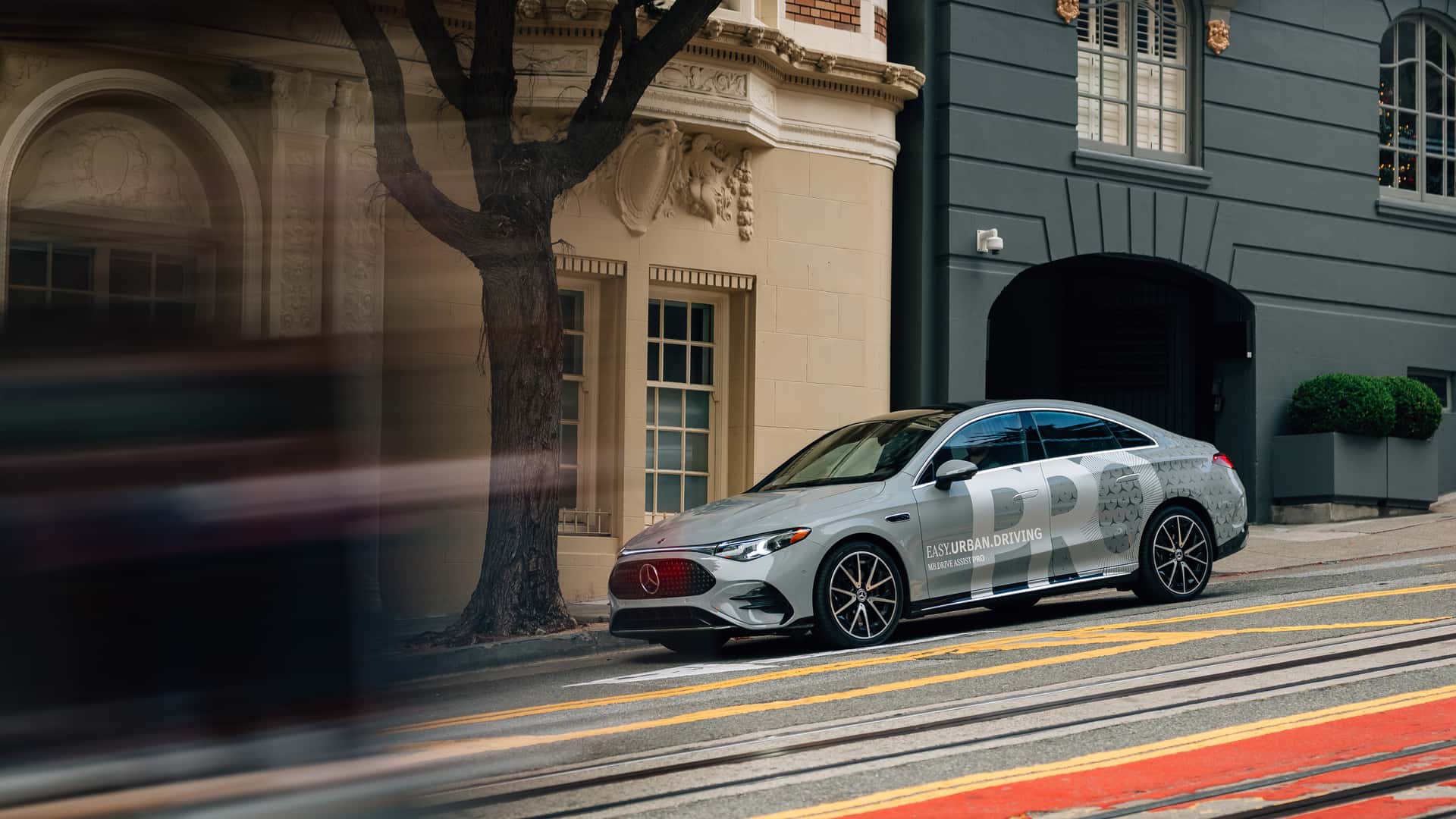
Mercedes-Benz is set to launch its MB.Drive Assist Pro, a Level 2+ advanced driver-assistance system, in early 2024 for a wide range of its vehicles.
Unlike Tesla’s Full Self-Driving (Supervised) which allows hands-off operation on surface streets, Mercedes’ system mandates drivers keep a hand on the wheel in urban environments, adhering strictly to SAE Level 2 definitions.
Mercedes executives cite a “philosophical” commitment to driver responsibility at Level 2, arguing that surface streets present significantly more chaotic and complex variables than controlled-access highways.
The MB.Drive Assist Pro employs a comprehensive sensor suite, including cameras, five radar sensors, and 12 ultrasonic sensors, contrasting with Tesla’s camera-only approach, which Mercedes’ Head of Active Safety deems insufficient.
While some Tesla FSD users appreciate its hands-off capabilities for long commutes, others and prospective Mercedes buyers acknowledge the logical safety benefit of maintaining a hand on the wheel, particularly in unpredictable city traffic.
Consumer trust and real-world performance are paramount, with many users prioritizing overall vehicle functionality, comfort, and value over just autonomous features, indicating a nuanced market for advanced driver-assistance systems.
For many commuters traversing challenging routes, the promise of advanced driver-assistance systems offers a compelling vision of relief. Lucian Capellaro, whose daily drive through Laurel Canyon from the San Fernando Valley to Los Angeles’ west end is a relentless ordeal, found himself listening intently as colleagues lauded the point-to-point capabilities of Tesla’s Full Self-Driving (FSD) feature.
The concept of simply inputting a destination and letting the vehicle navigate offered a powerful appeal. Yet, Capellaro harboured reservations, driven by a preference for non-Tesla vehicles, citing factors such as design aesthetics, interior quality, and body style, beyond any political considerations.
Mercedes-Benz is now poised to offer a significant alternative. The German luxury automotive giant is preparing to introduce its MB.Drive Assist Pro, a sophisticated point-to-point automated driving system, to a substantial portion of its electric and internal combustion vehicle lineup early next year. Existing eligible vehicles will gain access to this advanced capability through convenient over-the-air updates.
Understanding Mercedes MB.Drive Assist Pro
The MB.Drive Assist Pro system is engineered to provide comprehensive navigation, guiding drivers from their starting point to their destination and even assisting with parking. Its functionality on controlled-access highways mirrors that of Tesla’s Full Self-Driving (Supervised) by enabling hands-free operation.
However, a crucial distinction emerges when operating on surface streets: Mercedes-Benz’s system mandates that drivers maintain a hand on the steering wheel. This requirement is not indicative of technological limitation but stems from a foundational philosophical approach to autonomous driving development.
The Core Philosophical Divide: Hands On vs. Hands Off
Mercedes-Benz explicitly aligns its MB.Drive Assist Pro with the stringent interpretations of autonomous driving levels as defined by the Society of Automotive Engineers (SAE). Both MB.Drive Assist Pro and Tesla FSD (Supervised) are categorised as Level 2 systems, or what Mercedes refers to as “Level 2 Plus Plus.” This classification necessitates continuous driver supervision.
The critical demarcation between a Level 2 and a Level 3 system lies in responsibility. While Level 2 requires the human driver to remain responsible and ready to intervene, a Level 3 system shifts primary responsibility to the vehicle’s software stack under specific operational design domains. Features such as watching a movie or reading a book while the vehicle autonomously navigates are characteristics of a Level 3 system.
Jörg Burzer, Mercedes Chief Technology Officer, articulated this distinction with clarity: “There is a very important borderline between the levels. That borderline is that with Level 2 Plus Plus, you are responsible. At Level 3, the machine, the car, the software stack, is responsible.” This foundational principle informs Mercedes’ hands-on requirement in urban settings.
Navigating Urban Challenges: The Safety Perspective
The decision to require hands-on engagement on surface streets is rooted in an assessment of environmental complexity. Controlled-access highways, with their predictable traffic flow and limited variables, are comparatively simpler for Level 2 advanced driver-assistance systems to manage.
Surface streets, conversely, present a far more chaotic and unpredictable environment, teeming with pedestrians, cyclists, varied intersections, and dynamic traffic scenarios. Mercedes-Benz believes that in such complex settings, driver engagement is paramount for safety.
This rationale resonates with some users. Lucian Capellaro, despite being a motorcycle rider and possessing a higher risk tolerance, views the hands-on requirement as a crucial safety measure. He stated, “Think about the reaction time it must be for someone to take their hands from off the wheel to on the wheel. I’d view my hand on the wheel as lessening the seconds of reaction time to something crazy happening.”
Customer research conducted by Mercedes-Benz, particularly among European drivers, appears to corroborate this perspective. Burzer noted, “In the city, they like to have something, some regulation or some requirement that you have to have a hand on the wheel.” However, he acknowledged that “I don’t know about U.S. customers yet,” hinting at potential regional differences in driver preferences for advanced driver-assistance systems.
Tesla FSD: A User’s Reality and Shifting Expectations
The contrasting approach adopted by Tesla’s Full Self-Driving (Supervised) has fostered different user expectations. Many Tesla FSD users operate their vehicles hands-off even on surface streets, often perceiving the system to be capable of Level 3-like performance, irrespective of SAE definitions.
Antonio Hidalgo, another Los Angeles resident, exemplifies this user experience. He uses FSD extensively for all driving, not just commuting, and candidly admits to having taken naps while driving, with the system handling navigation. Hidalgo asserts that the only noticeable flaws in FSD now relate to parking manoeuvres.
When presented with Mercedes’ hands-on requirement, Hidalgo expressed a preference for the established hands-off experience. “If the (Mercedes system) worked the same but I had to keep my hand on the wheel … You know, I probably wouldn’t (make the switch). I mean, I think I would be interested in having a nicer car with a better interior. But no,” he conceded, highlighting that the hands-off freedom is a significant differentiator for some users of advanced driver-assistance systems.
Similarly, Mharlon Barrientos, who relies on FSD for his Indianapolis commute, described an evolution of trust. Initially, he would “hover” a hand over the wheel. However, through system updates and accumulated experience, he now drives fully hands-off. For him, a mandatory hands-on requirement would feel like “a bit of a step back to the feel of full autonomous driving that I’ve gotten used,” he explained, recalling that his Model Y originally did require hands on the wheel.
Technological Approaches to Advanced Driver-Assistance Systems
Mercedes-Benz highlights its multi-sensor approach as a distinct advantage for its MB.Drive Assist Pro system over Tesla’s camera-centric methodology. The Mercedes system integrates a diverse array of sensors, including multiple cameras, five radar sensors, and 12 ultrasonic sensors, which collectively feed raw data to an Nvidia-powered onboard computer.
Christoph von Hugo, Mercedes’ Head of Active Safety, underscored the importance of this sensor fusion for enhanced safety and performance. “Different sensor inputs increases performance and safety,” he stated, making thinly veiled references to what he implied was Tesla’s less comprehensive approach. He emphatically added that “Relying on one just is not enough.”
Von Hugo further clarified Mercedes’ future plans, noting that the company would not even advance to Level 3 capability without the integration of LiDAR technology, in addition to its existing suite of cameras, radar, and ultrasonic sensors. This emphasis on redundant and diverse perception systems forms a cornerstone of Mercedes’ strategy for developing robust advanced driver-assistance systems.
Consumer Perception of Sensor Technology
Despite Mercedes’ strong emphasis on its advanced sensor array, the direct impact on consumer decision-making might be less pronounced than anticipated. Mharlon Barrientos, for instance, expressed a pragmatic view, suggesting that the underlying technology might not be a primary selling point for all users.
“I honestly haven’t even thought about the tech behind it, so I’m not so sure knowing that there’s radar and ultra-sonic sensors (on the window sticker) would be a huge selling point,” Barrientos commented. He believes that real-world performance, demonstrated through videos or reviews, and personal experience, are more influential.
“Just like the Tesla system, I think it would take me some mileage on both highway and streets to gain a trust for the system to know it’ll handle either situation well,” he added. This highlights that for many, trust in advanced driver-assistance systems is earned through practical application and consistent reliability, rather than simply a list of integrated hardware.
The Broader Appeal: Beyond Autonomy
It is important to note that for many consumers, advanced driver-assistance systems are just one component of a vehicle’s overall appeal. Mharlon Barrientos, a Tesla owner, articulated that his loyalty is not solely tied to FSD. He explained, “The hands-on requirement in the city would not be enough to sway me off of the car provided I like the rest of the car.”
His priorities extend beyond autonomous features: “While I like the functionality of FSD, it’s still a bit further down the list of what I look for in a car. Functionality, comfort, value … I still like to feel the mechanics and have the feel of actually driving a car.” This perspective underscores that a balanced offering, combining advanced technology with traditional automotive virtues, often holds greater sway.
Lucian Capellero echoes this sentiment. He ponders how much of an improvement MB.Drive Assist Pro would offer over his wife’s BMW i4, which already features adaptive cruise control and low-speed hands-free highway assist for traffic jams. Ultimately, the true value of Mercedes’ system will be determined by its real-world performance.
“I guess I’d just have to experience (MB.Drive Assist Pro) for myself, but if it can navigate all the craziness that is Laurel Canyon through Hollywood, and it is literally just my hand resting on the wheel, and that’s it, then sure,” Capellero concluded. “The fact that it’s truly point-to-point, then yes, that sounds super appealing.”
The Road Ahead for Advanced Driver-Assistance Systems
The introduction of Mercedes-Benz’s MB.Drive Assist Pro ignites a fascinating debate within the automotive industry regarding the optimal approach to developing and deploying advanced driver-assistance systems. The philosophical divergence between Mercedes and Tesla, particularly concerning the driver’s role in Level 2 systems on urban roads, underscores the complexities of balancing innovation with safety and regulatory adherence.
While initial reports from InsideEVs suggested promising performance during a passenger-seat ride in San Francisco in January, a comprehensive, hands-on review will be crucial to fully assess MB.Drive Assist Pro’s capabilities. The automotive world eagerly awaits to see how this new system performs in diverse real-world conditions and whether its mandated hands-on approach will be perceived as a superior safety measure or a limitation by the broader driving public.
Frequently Asked Questions (FAQ)
What is Mercedes MB.Drive Assist Pro?
Mercedes MB.Drive Assist Pro is an advanced driver-assistance system that enables point-to-point automated driving and parking assistance. It allows hands-free driving on controlled-access highways but requires drivers to keep a hand on the wheel when operating on surface streets, aligning with strict SAE Level 2 autonomous driving definitions.
How does MB.Drive Assist Pro differ from Tesla’s Full Self-Driving (FSD)?
The primary difference lies in the hands-on requirement. While both are considered Level 2 systems and offer hands-free operation on highways, MB.Drive Assist Pro mandates a hand on the wheel for city driving. Tesla FSD (Supervised) often allows hands-off operation on surface streets, a practice Mercedes’ philosophy currently avoids for Level 2.
Why does Mercedes require hands on the wheel for city driving?
Mercedes-Benz adheres to a strict interpretation of SAE Level 2, which assigns responsibility to the driver. Mercedes CTO Jörg Burzer states urban environments are more chaotic and complex than highways, necessitating driver engagement. This philosophical stance prioritises safety and regulatory compliance over pushing perceived autonomy limits.
What sensor technology does MB.Drive Assist Pro use?
MB.Drive Assist Pro employs a robust sensor suite including multiple cameras, five radar sensors, and 12 ultrasonic sensors. Mercedes believes this multi-sensor approach, or sensor fusion, enhances performance and safety compared to systems that rely predominantly on a single sensor type, like Tesla’s camera-only strategy.
When will MB.Drive Assist Pro be available?
Mercedes-Benz plans to roll out its MB.Drive Assist Pro system to a wide array of its electric and internal combustion vehicles starting early next year. Eligible vehicles already purchased will be able to acquire the feature through convenient over-the-air (OTA) software updates, making it widely accessible to current owners.
Will MB.Drive Assist Pro offer Level 3 autonomous driving?
Mercedes-Benz executives have indicated that the company will not advance to Level 3 autonomous driving capabilities without incorporating additional technologies, specifically LiDAR sensors, on top of its current camera, radar, and ultrasonic suite. This reflects a cautious, technology-first approach to higher levels of autonomy.
Are consumers concerned about the hands-on requirement?
User feedback is mixed. Some drivers, like Lucian Capellaro, find the hands-on requirement logical for safety in complex urban scenarios. Others, particularly current Tesla FSD users who are accustomed to hands-off driving, perceive it as a step back, indicating a preference for convenience once trust in the system is established.