
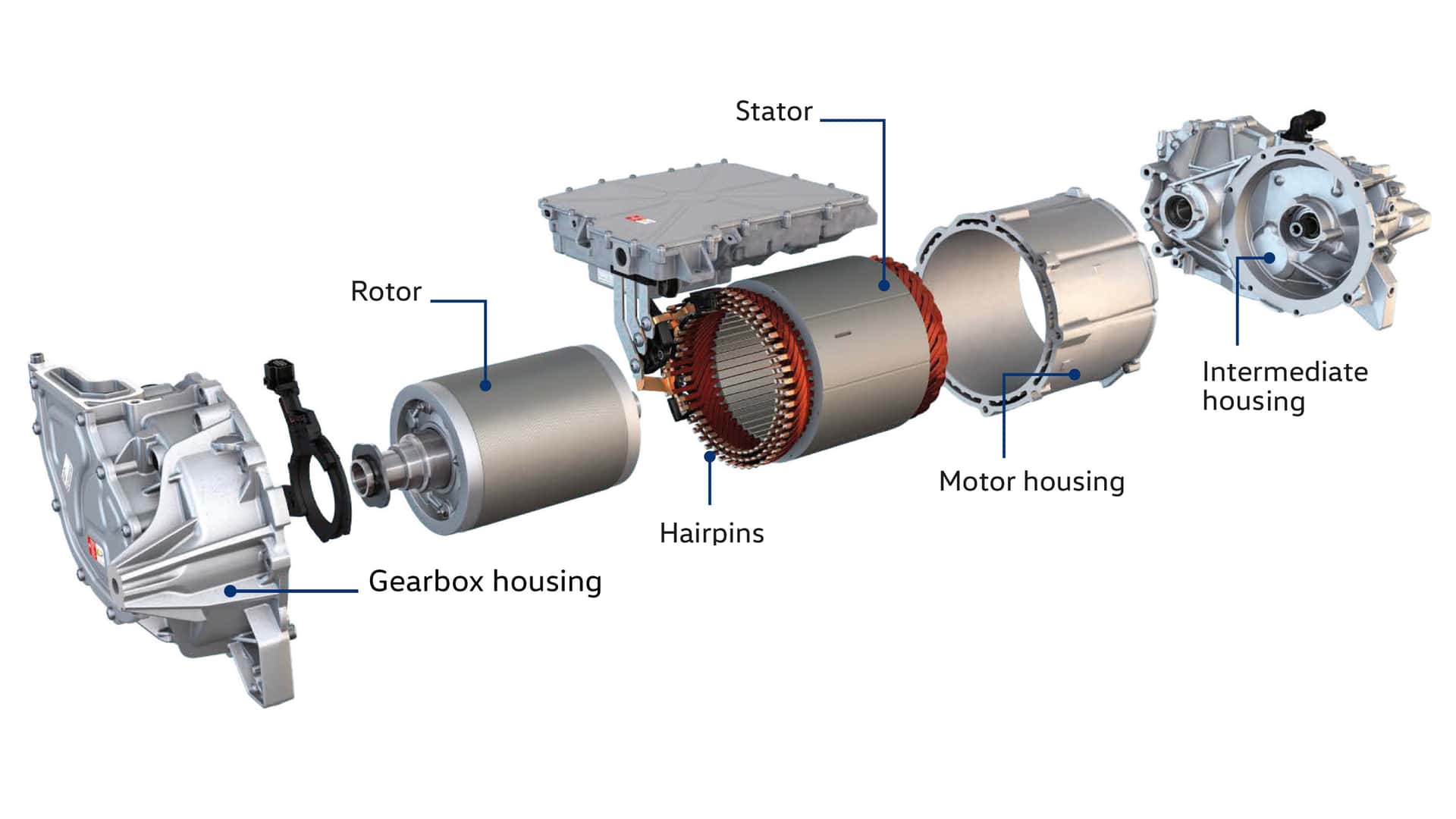
While electric vehicle (EV) batteries often dominate headlines, the sophisticated motors that convert electrical energy into propulsion are equally pivotal to performance, efficiency, and the overall driving experience. Far from being uniform, the world of EV motor technology is diverse, with automakers strategically employing various designs to balance critical factors such as power output, energy efficiency, compact packaging, and manufacturing costs.
At its fundamental level, the distinction among these motors lies in how their rotating component, the rotor, generates its magnetic field. Some designs rely on inherently magnetic materials, known as permanent magnets, while others ingeniously create this magnetic force through the controlled application of electricity. This foundational difference underpins a spectrum of engineering choices, each with unique advantages and trade-offs within the evolving landscape of electric mobility.

Key Takeaways: Understanding EV Motor Dynamics
- Diverse Motor Types: Not all EV motors are the same; they predominantly fall into Permanent-Magnet Synchronous Motors (PMSM), Induction Motors, and Electrically Excited Synchronous Motors (EESM).
- Magnetism is Key: The core difference lies in how the rotor creates its magnetic field—either through permanent magnets or via electrically powered coils.
- Efficiency vs. Cost: PMSMs offer high efficiency and power density but depend on rare earth elements, which have supply chain and cost implications.
- Robust Alternatives: Induction and EESM designs avoid rare earths, offering robust performance and adjustable characteristics, though often with slight efficiency trade-offs or increased complexity.
- Hybrid Setups: Many modern all-wheel-drive EVs combine different motor types (e.g., PMSM for primary drive, Induction for auxiliary) to optimize performance, efficiency, and cost.
The Fundamental Mechanics of Electric Motors
Every electric motor comprises two primary components: the stationary outer casing, termed the stator, and the rotating inner section, known as the rotor. The rotor is directly linked to a shaft, which transmits mechanical power to the vehicle’s wheels, typically through a set of reduction gears. Powering this intricate system requires direct current (DC) from the EV’s high-voltage battery.
However, the stator operates on alternating current (AC). An essential component called an inverter transforms the battery’s DC into precisely controlled AC. This AC is then fed into the stator’s coils in a meticulously timed sequence, generating a powerful, rotating magnetic field. The rotor, sensing this moving magnetic pull, continuously follows it, thereby generating the rotational force, or torque, needed to drive the vehicle.
The term ‘synchronous’ describes motors where the rotor’s rotational speed perfectly matches that of the magnetic field generated by the stator. Both Permanent-Magnet Synchronous Motors (PMSM) and Electrically Excited Synchronous Motors (EESM) fall into this category, maintaining a tight correlation between the electrical input and mechanical output. In contrast, induction motors operate with a slight speed differential, or ‘slip,’ between the stator’s magnetic field and the rotor’s rotation, a characteristic crucial to their functioning.

Permanent-Magnet Synchronous Motors (PMSM): Power and Precision
In a Permanent-Magnet Synchronous Motor (PMSM), the rotor is equipped with powerful permanent magnets, either affixed to its surface or embedded within its structure. These magnets inherently provide a constant magnetic field, eliminating the need for an external electrical supply to maintain their magnetism. The stator’s rotating magnetic field then interacts with these fixed magnets, creating the necessary force to pull the rotor around continuously.
This design offers several compelling advantages for EV motor technology. PMSMs are celebrated for their exceptional efficiency, as they avoid the energy losses associated with powering rotor windings, which would otherwise generate heat. They also deliver high power output from a relatively compact and lightweight package, making them ideal for the main drive motors in most contemporary electric vehicles.
Despite their benefits, PMSMs come with a significant consideration: the powerful magnets typically incorporate rare earth elements. These materials, such as neodymium and dysprosium, are crucial for achieving the high magnetic flux density required for automotive applications. However, their extraction and processing can be environmentally intensive, and their supply chains are often concentrated in a few regions globally, exposing manufacturers to potential sourcing complexities and price volatility. This reliance on rare earths is a key factor driving innovation in alternative motor designs.
Induction Motors: The Robust, Rare-Earth-Free Alternative
Also known as asynchronous motors, induction motors present a distinct approach to EV motor technology by foregoing permanent magnets entirely. Instead, their rotor houses conductive metal bars, typically arranged in a configuration often likened to a ‘squirrel cage’ due to the bars being joined by rings at both ends. When the stator generates its rotating magnetic field, this field induces an electric current directly within the rotor’s conductive bars.
This induced current, in turn, creates the rotor’s own magnetic field. The interaction between the stator’s rotating field and the rotor’s induced field generates torque, propelling the vehicle. A critical characteristic of induction motors is that the rotor must always spin slightly slower than the stator’s magnetic field—this speed difference, or ‘slip,’ is essential for inducing the current in the rotor. If the rotor were to perfectly catch up, the induction effect, and thus the torque, would cease.
The primary advantages of induction motors include their robust construction, inherent reliability, and, crucially, their independence from rare-earth magnets. This makes them less susceptible to geopolitical supply chain disruptions and volatile raw material costs. While generating current in the rotor does produce heat and can slightly reduce efficiency compared to PMSMs, induction motors possess a unique benefit: when they are not powered, they can freewheel with remarkably minimal drag. This characteristic makes them a popular choice for auxiliary drive axles in all-wheel-drive (AWD) EVs, where they can engage seamlessly when needed and disengage efficiently to conserve energy, as seen in models from Audi, Tesla, and General Motors.
Electrically Excited Synchronous Motors (EESM): Precision Control and Adaptability
The Electrically Excited Synchronous Motor (EESM) represents a third sophisticated avenue in EV motor technology. In this design, the rotor carries its own set of coils, which are supplied with electricity to transform the rotor into a controllable electromagnet. Unlike induction motors, EESMs do not rely on ‘slip’ to create the rotor’s magnetic field; instead, the field strength is directly managed by varying the electrical current flowing through the rotor coils.
Conceptually, this design shares characteristics with the permanent-magnet motor, but with a crucial enhancement: the magnetic field of the rotor is not fixed but dynamically adjustable. The term ‘excited’ simply refers to the rotor being energized by electricity. This ability to precisely regulate the rotor’s magnetic field strength provides engineers with an additional degree of freedom to optimize motor operation across a wide range of speeds and loads, potentially enhancing efficiency and performance throughout the entire operating envelope.
Automakers like BMW have adopted EESMs in their latest sixth-generation EV powertrains, citing their efficient energy utilization during everyday driving and their capacity to maintain strong power delivery even at very high rotational speeds. Renault also employs this approach, for instance in the Renault 5 E-Tech, explicitly highlighting the reduced dependence on rare earths and diversification of magnet suppliers as key motivations. The trade-off for this flexibility and rare-earth independence is the added electrical consumption required to power the rotor’s field and the increased complexity due to the necessary windings and power supply mechanisms.
Strategic Synergy: Why Many EVs Employ Multiple Motor Types
The decision to utilize a specific EV motor technology is rarely singular; indeed, many advanced electric vehicles leverage a combination of motor types within a single powertrain. The Audi Q6 E-tron Quattro serves as an excellent illustration, pairing a highly efficient permanent-magnet motor for its rear axle (the primary drive) with a robust induction motor for the front axle (providing additional propulsion and traction when required). This hybrid setup capitalizes on the PMSM’s constant efficiency while benefiting from the induction motor’s low drag when inactive, optimizing overall energy consumption and dynamic performance.
Similarly, BMW’s innovative all-wheel-drive systems might combine an electrically excited motor at the rear with an induction motor at the front, carefully balancing the strengths of each. Another strategy, observed in new Mercedes-Benz EVs, involves a permanent-magnet front motor that can be mechanically decoupled from the wheels when not needed. This mechanism effectively eliminates the parasitic drag and associated energy losses that would occur if the motor were left spinning idly, thereby further improving the vehicle’s real-world efficiency.
These diverse multi-motor configurations underscore a core principle in automotive engineering: choosing the optimal EV motor technology is not merely about maximizing power, but equally about minimizing energy waste when that power is not required. As the electric vehicle market matures, this nuanced approach to powertrain design ensures that engineers can tailor solutions that precisely meet specific vehicle requirements, ranging from ultimate performance and long-range efficiency to manufacturing sustainability and cost-effectiveness. This continuous refinement in EV motor technology ensures a vibrant and evolving future for electric propulsion.
FAQ Section: Demystifying EV Motor Technology
Q1: What are the main types of electric motors used in EVs?
The primary types of electric motors in EVs are Permanent-Magnet Synchronous Motors (PMSM), Induction Motors, and Electrically Excited Synchronous Motors (EESM). Each type offers distinct advantages in terms of efficiency, power density, and material requirements, influencing their application in various electric vehicle models and configurations.
Q2: Why do some EV motors use permanent magnets, and others don’t?
Permanent-magnet motors offer high efficiency and power in a compact size because their rotor magnets don’t need electricity. However, they rely on rare earth elements. Non-permanent magnet motors, like induction and EESM, avoid these materials but create magnetism electrically, often at a slight efficiency trade-off or increased complexity.
Q3: What are “rare earth elements” and why are they relevant to EV motors?
Rare earth elements are a group of 17 chemical elements vital for powerful, lightweight permanent magnets. They are relevant to EV motors because they are integral to PMSMs, which are highly efficient. Their limited global supply and complex extraction processes can lead to sourcing challenges and cost fluctuations for automakers.
Q4: How do induction motors differ from permanent-magnet motors in performance?
Induction motors are robust and do not require rare earths, making them cost-effective. They are often slightly less efficient than PMSMs under constant load but offer very low drag when unpowered. PMSMs provide higher power density and efficiency, making them ideal for primary drive applications where consistent power is needed.
Q5: Why do some EVs use two different types of motors?
Many all-wheel-drive EVs combine different motor types to optimize performance and efficiency. For example, a highly efficient PMSM might power the main drive axle, while a lighter, lower-drag induction motor handles the secondary axle, engaging only when extra power or traction is needed, thereby maximizing overall energy conservation.
Q6: What is the main advantage of Electrically Excited Synchronous Motors (EESM)?
The key advantage of EESMs is their adjustable magnetic field. By controlling the electricity supplied to the rotor coils, engineers can precisely regulate motor torque and efficiency across varying speeds and loads. This offers greater flexibility in optimizing performance and energy use, without relying on rare earth elements.
Q7: How does EV motor technology contribute to an EV’s range?
EV motor technology directly impacts range through its efficiency. More efficient motors convert a higher percentage of battery energy into motion, losing less as heat. Designs that reduce parasitic drag when motors are inactive, or allow for precise power delivery, also conserve energy, extending the vehicle’s overall driving range.