
Key Takeaways
- Electric vehicle (EV) motors are not monolithic; they employ diverse designs balancing efficiency, performance, and cost.
- The fundamental distinction lies in how the rotor’s magnetic field is generated: through permanent magnets, electrically powered coils, or induction.
- Permanent-Magnet Synchronous Motors (PMSMs) offer high efficiency and power density but rely on rare earth elements.
- Induction Motors (IMs) are robust and avoid rare earths but can be less efficient due to energy losses from induced currents.
- Electrically Excited Synchronous Motors (EESMs) provide adjustable magnetic fields, optimizing efficiency across various operating conditions, also without permanent magnets.
- Automakers often use a combination of different EV motor types within a single vehicle to achieve optimal performance and efficiency for all-wheel-drive configurations.
While the battery often garners the spotlight, the electric motor stands as an equally critical, intricate component within every electric vehicle. Far more than a simple mechanism that converts electricity into motion, modern EV motor technology represents a sophisticated interplay of physics and engineering, designed to balance parameters such as energy efficiency, power delivery, packaging constraints, and manufacturing costs.
Understanding the fundamental differences in these powertrains is key to appreciating the engineering marvels that drive the burgeoning electric mobility sector. Automakers are continuously innovating, often employing distinct motor designs—sometimes even within the same vehicle—to achieve a precise equilibrium of operational characteristics.
The Core Mechanics of EV Motor Technology
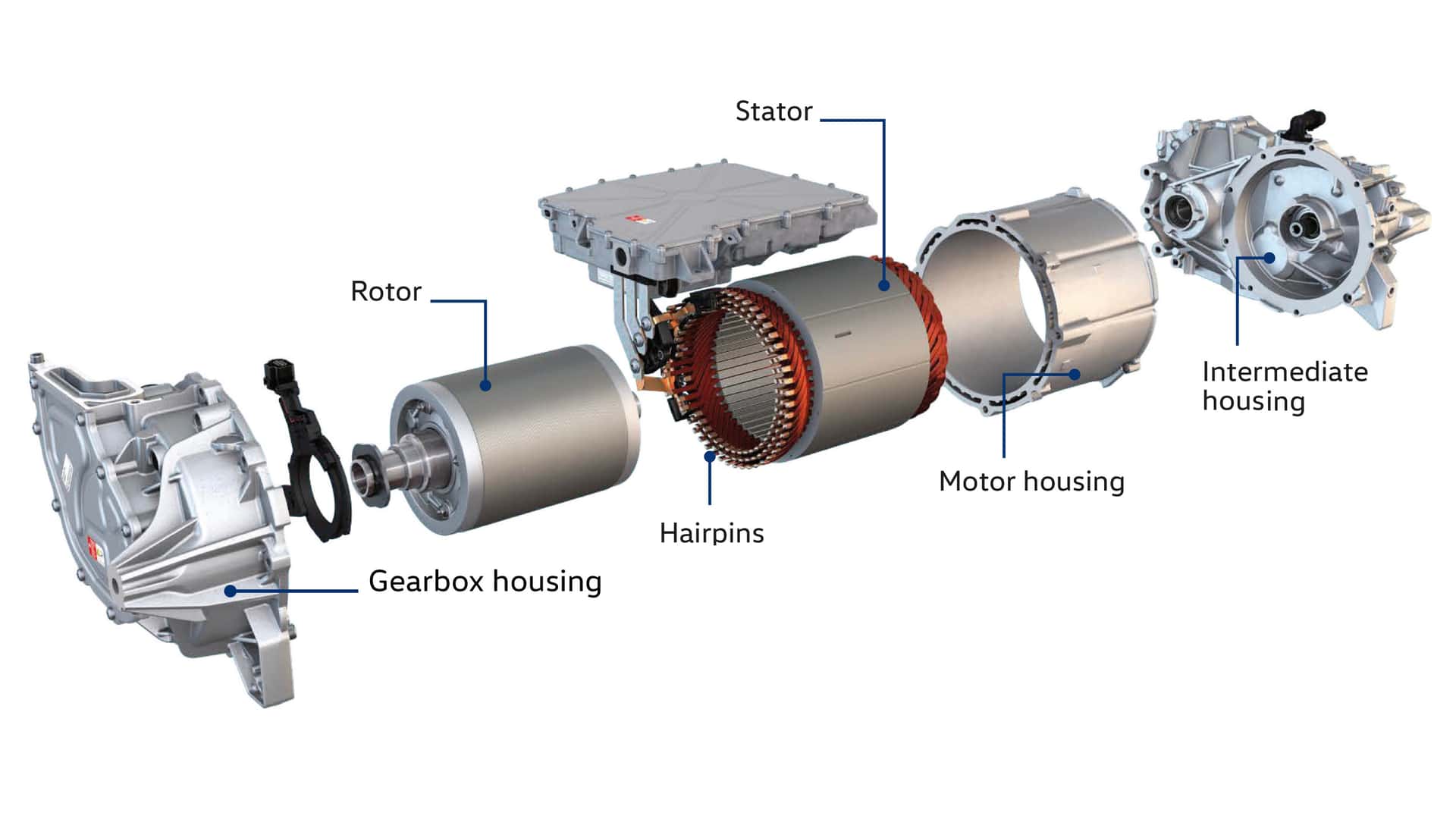
At its heart, an electric motor operates on the principles of electromagnetism. Every EV motor consists of two primary components: the stator and the rotor. The stator is the stationary outer housing, replete with coils of wire. The rotor is the inner, spinning element, directly connected to a shaft that transmits power to the vehicle’s wheels, typically through reduction gearing.
The propulsion cycle begins with the direct current (DC) from the EV battery. This DC power is then converted by an inverter into controlled alternating current (AC). This AC is fed sequentially into the stator’s coils, which in turn generates a rotating magnetic field. The rotor, whether through its inherent magnetic properties or induced magnetism, is compelled to follow this rotating field, thus generating torque and driving the vehicle.
The concept of ‘synchronous’ describes motors where the rotor spins at precisely the same speed as the magnetic field produced by the stator. Both permanent-magnet and electrically excited motors fall into this category. In contrast, induction motors operate with a slight speed differential between the stator’s magnetic field and the rotor, a phenomenon critical to their operation.

Permanent-Magnet Synchronous Motors (PMSMs): Precision and Power
The Permanent-Magnet Synchronous Motor (PMSM) represents a widely adopted form of EV motor technology. In this configuration, the rotor is equipped with powerful permanent magnets, either affixed to its surface or embedded within its structure. These magnets create a constant magnetic field within the rotor without requiring an external electrical supply.
The stator’s rotating magnetic field then interacts with the rotor’s permanent magnetic field, causing the rotor to spin in perfect synchronicity. This design is highly analogous to a compass needle aligning itself with a moving external magnet, with the stator’s controlled field continuously pulling the rotor around.
Advantages and Considerations for PMSMs
A significant advantage of PMSMs is their exceptional efficiency. Because the rotor’s magnetism doesn’t rely on an electrical supply, these motors avoid the inherent energy losses associated with powering rotor windings. This leads to higher power output from a smaller, lighter package, making them ideal for the main drive motors in many contemporary EVs.
However, this high performance comes with a notable consideration: the reliance on rare earth elements. The powerful magnets typically employed in automotive PMSMs often contain materials like neodymium, dysprosium, and terbium. While the term ‘permanent magnet’ doesn’t exclusively mean ‘rare earth,’ these specific materials are the common choice for high-performance automotive applications.
The extraction and processing of rare earth elements can present environmental challenges and often involve complex global supply chains. This can expose manufacturers to geopolitical risks, sourcing complexities, and significant price volatility, influencing the long-term cost and sustainability of PMSM-based EV motor technology.
Induction Motors (IMs): Robustness and Resource Independence
An alternative to the permanent-magnet design is the Induction Motor (IM), also known as an asynchronous motor. Instead of permanent magnets, the rotor in an induction motor incorporates conductive bars, often made of copper or aluminium. This characteristic design, where these bars are connected by rings at both ends, frequently earns it the descriptive moniker of a “squirrel cage.”
In an induction motor, the rotating magnetic field from the stator induces an electrical current within these conductive rotor bars. This induced current then generates its own magnetic field within the rotor, enabling the motor to produce torque without the need for permanent magnets or a direct electrical connection to the rotor itself.
Understanding Slip and Efficiency Trade-offs
A crucial aspect of induction motor operation is ‘slip.’ As an EV equipped with an IM operates, the rotor consistently turns slightly slower than the stator’s rotating magnetic field. This speed difference, or slip, is absolutely essential for inducing the current in the rotor bars that creates its magnetic field. If the rotor were to catch up completely with the stator’s field, the induction process would cease, and with it, the torque generation.
The primary benefits of induction motors include their robust and straightforward design, and critically, their independence from rare-earth magnets. This mitigates the supply chain and environmental concerns associated with PMSMs.
However, the process of generating current within the rotor inevitably produces heat, leading to energy losses and generally lower efficiency compared to PMSMs, particularly at partial loads. Despite this, a significant advantage is their ability to spin with very little drag when not receiving power, making them excellent for disengageable axles.
This characteristic is frequently leveraged in all-wheel-drive EVs. Manufacturers often pair a highly efficient PMSM for the primary, always-engaged drive axle with a less potent, disengageable induction motor for the secondary axle, providing on-demand performance and traction without constant energy drain. Tesla and General Motors have notably employed this strategy in various EV models.
Electrically Excited Synchronous Motors (EESMs): The Adjustable Magnet
The Electrically Excited Synchronous Motor (EESM) presents a third distinct approach to EV motor technology. Unlike PMSMs with their fixed magnets or IMs that rely on induced currents, the EESM rotor features coils that are supplied with electricity. This transforms the rotor into a controllable electromagnet, allowing its magnetic field strength to be actively adjusted.
This design can be conceptualized as a more advanced version of the permanent-magnet motor, where the fixed magnets are replaced by electromagnets whose strength can be precisely varied. The term ‘excited’ simply refers to the rotor’s coils being energized by an electrical current. This capability to dynamically adjust the magnetic field provides engineers with a powerful tool to optimize motor operation across a wide range of speeds and loads, enhancing efficiency and performance.
Balancing Benefits and Complexity
BMW has notably adopted EESMs in its latest sixth-generation EV powertrains, citing their efficient energy use in everyday driving scenarios and their consistent, strong power delivery even at very high rotational speeds. French automaker Renault also champions this technology, using it in models like the Renault 5 E-Tech, specifically highlighting its role in reducing dependence on rare earth elements and simplifying sourcing from magnet suppliers.
The primary advantage of EESMs is their superior control over the rotor’s magnetic field, enabling fine-tuning for optimal efficiency and performance under varying conditions. Furthermore, like induction motors, they avoid the reliance on rare-earth materials, addressing critical supply chain and sustainability concerns.
The trade-off for this flexibility and resource independence is increased complexity. Powering the rotor’s coils consumes additional electricity, and the presence of these windings along with their associated power supply adds to the overall system’s intricacy and weight. While avoiding permanent magnets, this design introduces its own set of engineering compromises.
Strategic Integration: Why Not Just One EV Motor Type?
The existence of diverse EV motor types is not merely an academic exercise; it reflects pragmatic engineering decisions. Automakers frequently integrate different motor technologies within a single vehicle, particularly in all-wheel-drive (AWD) configurations, to achieve an optimal blend of efficiency, performance, and cost-effectiveness.
The Audi Q6 E-tron Quattro serves as a prime example, employing a permanent-magnet synchronous motor at the rear for efficient primary propulsion and an induction motor at the front for supplementary power and enhanced traction when needed. The front induction motor’s minimal drag when inactive makes it an ideal candidate for such a role.
Similarly, BMW’s latest AWD setup pairs an electrically excited synchronous motor for the rear axle with a front induction motor. Other manufacturers, like Mercedes-Benz in some of its newer EVs, might opt for a permanent-magnet front motor but incorporate mechanical disconnection mechanisms. This allows the front motor to disengage from the wheels when not required, preventing parasitic drag and improving overall energy efficiency.
The strategic selection and combination of these advanced EV motor technology designs underscore a fundamental principle in automotive engineering: achieving maximum efficiency is as much about intelligently conserving energy when power is not needed as it is about delivering robust power when it is. This nuanced approach ensures that a variety of motor designs will continue to be a cornerstone of future electric vehicle development, catering to diverse performance targets and market demands.
FAQ Section
What is the primary difference between EV motor types?
The main difference lies in how the rotor generates its magnetic field. Permanent-magnet motors use fixed magnets, induction motors create magnetism through induced electrical currents, and electrically excited motors use powered coils to create adjustable electromagnets.
Why are rare earth elements a concern for EV motors?
Rare earth elements, like neodymium, are crucial for the powerful magnets in many permanent-magnet motors. Their sourcing involves complex supply chains, potential environmental impacts, and susceptibility to price fluctuations, influencing manufacturing costs and sustainability.
Can an EV use different motor types simultaneously?
Yes, many all-wheel-drive EVs utilize a combination of motor types. For instance, a vehicle might pair a highly efficient permanent-magnet motor for the primary drive axle with a disengageable induction motor for the secondary axle, balancing performance and efficiency.
What is ‘slip’ in an induction motor?
Slip refers to the necessary speed difference between the stator’s rotating magnetic field and the rotor in an induction motor. This differential is essential to induce the electrical currents within the rotor that generate its magnetic field and produce torque.
What are the benefits of electrically excited synchronous motors?
EESMs offer the advantage of an adjustable magnetic field in the rotor, allowing for optimal efficiency across various speeds and loads. They also avoid the use of rare earth elements, addressing critical supply chain and environmental concerns associated with permanent magnets.
Which EV motor type is most efficient?
Permanent-Magnet Synchronous Motors (PMSMs) generally offer higher efficiency due to not requiring power to maintain the rotor’s magnetic field. However, electrically excited synchronous motors can achieve high efficiency through active field control, and induction motors excel in specific applications, particularly when disengaged.
How do automakers decide which motor type to use?
Automakers consider a range of factors, including target efficiency, desired performance characteristics (e.g., peak torque, high-speed power), packaging constraints, manufacturing costs, and supply chain reliability, particularly concerning rare earth materials. Often, a combination yields the best results.