
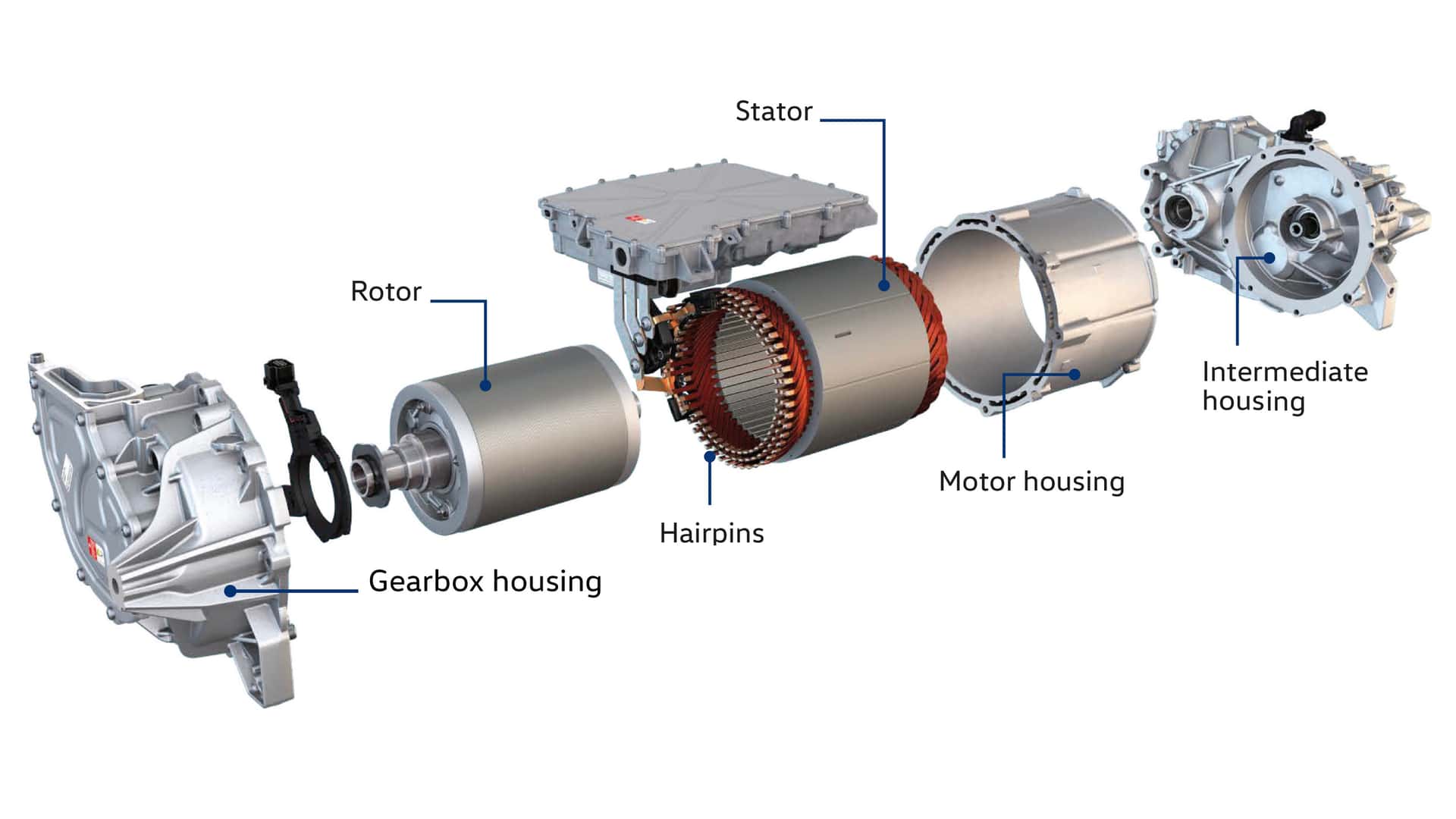
While batteries often dominate discussions about electric vehicles (EVs), the sophisticated engineering within their electric motors is equally critical. These powerhouses transform electrical energy into mechanical motion, propelling the vehicle. However, not all EV motors are designed identically. Automakers strategically employ diverse motor types, sometimes even within the same vehicle, to achieve an optimal balance of efficiency, performance, compact packaging, and cost-effectiveness. Understanding these distinctions is fundamental to appreciating the innovation driving the electric mobility revolution.
The core difference between these electric powertrains lies in how the rotor—the motor’s spinning component—generates its magnetic field. Some designs rely on inherently magnetic materials, known as permanent magnets, embedded within the rotor. In contrast, others generate this magnetic field dynamically through electrical currents. All EV motors leverage magnetism to operate, yet their methods of creating and utilising this fundamental force vary significantly, influencing their characteristics and applications.

Key Takeaways
- EV motors are not uniform; they vary in design to balance efficiency, performance, and cost.
- The main differentiator is how the rotor generates its magnetic field: using permanent magnets, electrical induction, or electrically excited coils.
- Permanent-Magnet Synchronous Motors (PMSMs) offer high efficiency and power density but depend on rare earth elements.
- Induction Motors (IMs) are robust and avoid rare earths, but are generally less efficient due to energy losses during induction.
- Electrically Excited Synchronous Motors (EESMs) allow for adjustable magnetic field strength, optimising efficiency and high-speed performance, while also reducing rare-earth reliance, but add complexity.
- Many all-wheel-drive EVs combine different motor types to leverage their individual strengths for specific axles or driving conditions.
Unpacking the Mechanics: How Electric Motors Generate Motion
Every EV motor, regardless of its specific type, comprises two primary sections: the stator and the rotor. The stator is the stationary outer casing that houses a series of wire coils. Inside, the rotor is the central, cylindrical component that spins, directly connecting to a shaft that transmits power to the vehicle’s wheels, typically through reduction gearing.
The process begins with direct current (DC) flowing from the EV’s battery. This DC power is then sent to an inverter, a crucial component that converts it into precisely controlled alternating current (AC). This AC is subsequently fed into the stator’s coils in a carefully orchestrated sequence. This sequential energisation creates a dynamic, rotating magnetic field within the stator.
This rotating magnetic field exerts a continuous pull on the rotor, causing it to spin in alignment with the field’s movement. Picture a magnetic force continuously circling, with the rotor compelled to follow its path. The term ‘synchronous’ describes motors where the rotor’s rotational speed perfectly matches the speed of this magnetic field. Permanent-magnet motors and electrically excited motors fall into this synchronous category, characterised by their harmonious operation.

Conversely, induction motors operate with a slight speed differential, known as ‘slip’, between the stator’s rotating magnetic field and the rotor’s speed. This critical distinction in how the rotor interacts with the magnetic field underpins the varying operational characteristics of different EV motor designs.
Permanent-Magnet Synchronous Motors: Maximising Intrinsic Magnetism
Permanent-Magnet Synchronous Motors (PMSMs) are among the most prevalent EV motor types, particularly for primary drive applications. In a PMSM, the rotor itself contains powerful permanent magnets. These magnets are either securely affixed to the rotor’s surface or intricately embedded within its structure, providing an inherent, constant magnetic field.
The operational principle is straightforward: the rotating magnetic field generated by the stator’s coils continuously pulls these fixed magnets on the rotor, causing it to rotate. This mechanism can be visualised as a compass needle consistently aligning with a moving external magnet. Crucially, the rotor’s magnets do not require an external electrical supply to maintain their magnetism. This inherent magnetic field generation is a significant advantage, as it eliminates the electrical losses that would otherwise occur if power were needed to energise rotor windings.
The key benefits of PMSMs include their exceptional efficiency, particularly across a broad range of speeds, and their ability to produce substantial power from a remarkably compact and relatively lightweight package. These characteristics make them a preferred choice for the main drive motors in a vast majority of contemporary EVs, where space and energy conservation are paramount.
However, this high performance often comes with a notable drawback: the reliance on rare earth elements. The powerful magnets typically employed in automotive-grade PMSMs, such as neodymium and dysprosium, are derived from these critical minerals. This dependency exposes manufacturers to potential sourcing challenges, geopolitical complexities, and significant price volatility in the global commodity markets. While the term “Permanent magnet” doesn’t necessarily mean “rare earth,” but that’s the material choice behind most such motors used for automotive applications, impacting sustainability and supply chain resilience.
Induction Motors: The Pursuit of Induced Current
Also known as asynchronous motors, induction motors (IMs) present an alternative design that bypasses the need for permanent magnets. Instead, their rotors are constructed with conductive metal bars, which are short-circuited at both ends by rings. This distinctive arrangement earns them the colloquial name “squirrel cage” due to its visual resemblance to a hamster’s exercise wheel.
The operational principle of an induction motor hinges on electromagnetic induction. When the stator’s rotating magnetic field sweeps across the conductive bars of the rotor, it induces an electrical current within them. This induced current, in turn, generates its own magnetic field within the rotor. It is the interaction between this rotor-generated magnetic field and the stator’s rotating field that produces torque, driving the rotor without the need for permanent magnets or a direct electrical connection to the rotor.
A fundamental characteristic of induction motors is the phenomenon of ‘slip’. For current to be induced in the rotor bars, there must be a relative speed difference between the stator’s rotating magnetic field and the rotor’s actual rotational speed. Consequently, the rotor of an EV equipped with an induction motor will always turn slightly slower than the magnetic field that drives it. Should the rotor ever perfectly match the speed of the magnetic field, the induction process would cease, and with it, the torque production.
Induction motors are lauded for their inherent robustness, simpler construction, and, crucially, their independence from rare-earth magnets. Another significant advantage emerges when the motor is not actively receiving power: it can spin with very minimal drag, offering a ‘freewheeling’ capability. Audi, for instance, highlights this benefit for the front induction motor in its Q6 E-tron Quattro, which serves as an auxiliary propulsion unit. This design is commonly observed in all-wheel-drive EVs, where a potent permanent-magnet motor handles the primary drive axle, while a less powerful induction motor provides additional traction and performance on the other axle when required. Many Tesla and General Motors (GM) EVs, for example, frequently employ this strategic combination.
Electrically Excited Synchronous Motors: Adjustable Power and Efficiency
The electrically excited synchronous motor (EESM) offers a third distinct approach to EV motor design. Unlike PMSMs, which use fixed magnets, or induction motors, which rely on induced currents, EESMs equip their rotors with coils that are directly supplied with electricity. This electrical input transforms the rotor into a controllable electromagnet.
This design essentially mirrors the concept of a permanent-magnet motor, but with a critical enhancement: the strength of the rotor’s magnetic field is adjustable. The term “Excited” simply means energized by electricity. This ability to dynamically vary the magnetic field strength provides engineers with a powerful tool to optimise the motor’s operation across different speeds and load conditions. By precisely controlling the excitation current, the motor’s efficiency and performance characteristics can be fine-tuned in real-time.
Leading automakers like BMW have integrated EESMs into their latest sixth-generation EV powertrains. BMW states that these motors achieve high energy efficiency during routine driving while consistently delivering robust power even at very high rotational speeds. Similarly, Renault has adopted EESMs in vehicles such as the Renault 5 E-Tech, explicitly citing the reduced dependency on rare-earth elements and a broader range of magnet suppliers as key motivators for choosing wound-rotor designs.
However, this advanced adjustability and reduced reliance on rare earths come with their own set of compromises. The coils on the rotor require a continuous supply of electricity to generate their magnetic field, which slightly increases energy consumption compared to a PMSM. Furthermore, the presence of these windings and the associated power supply system adds to the motor’s overall complexity and weight, presenting engineering challenges that must be carefully managed.
Strategic Synergy: Why Multiple Motor Types Coexist in Modern EVs
The automotive industry’s diverse adoption of EV motor technologies underscores a crucial point: there is no single ‘best’ motor for every application. The Audi Q6 E-tron Quattro, with its combination of a permanent-magnet rear motor and an induction front motor, perfectly exemplifies this strategic approach. The efficient PMSM at the rear handles the primary propulsion duties, while the induction motor at the front provides supplemental performance and enhanced traction when needed, with the added benefit of minimal drag when disengaged.
This hybrid motor configuration is a common engineering solution for all-wheel-drive (AWD) electric vehicles. It allows manufacturers to capitalise on the specific strengths of each motor type. For instance, BMW’s latest AWD setup employs an electrically excited rear motor alongside a front induction motor. This pairing aims to balance the EESM’s adjustable efficiency and high-speed capability with the induction motor’s robust, low-drag auxiliary power.
Other innovative solutions are also emerging. New Mercedes-Benz EVs, for example, feature a permanent-magnet front motor that can be mechanically decoupled from the wheels when not required. This mechanism effectively eliminates the rotational drag and associated energy losses that would occur if the motor remained engaged, thereby enhancing overall vehicle efficiency. Such advancements highlight that the selection of an EV motor extends beyond merely generating power; it encompasses a holistic strategy for energy management.
Ultimately, the continuous evolution and diversification of EV motor designs are driven by a constant pursuit of optimising vehicle performance, extending range, and reducing environmental impact. As the electric vehicle landscape matures, engineers will continue to innovate and combine these distinct motor technologies to meet increasingly sophisticated demands for power delivery, efficiency, and cost-effectiveness across a wide range of electric vehicles.
Frequently Asked Questions About EV Motor Technology
What is the primary function of an EV motor?
The primary function of an EV motor is to convert electrical energy from the vehicle’s battery into mechanical rotational energy. This rotational energy is then transferred to the wheels, propelling the electric vehicle forward or backward. It is the heart of the electric powertrain, enabling movement.
What are rare earth elements, and why are they used in some EV motors?
Rare earth elements are a group of 17 metallic elements vital for many high-tech applications, including powerful permanent magnets. They are used in some EV motors, specifically Permanent-Magnet Synchronous Motors (PMSMs), because they enable the creation of highly compact and efficient magnets, providing excellent power density for vehicle propulsion.
How does an induction motor create magnetism without permanent magnets?
An induction motor generates magnetism through electromagnetic induction. The stator’s rotating magnetic field induces an electrical current in the rotor’s conductive bars. This induced current then creates its own magnetic field within the rotor, which interacts with the stator’s field to produce torque and spin the motor.
What does ‘electrically excited’ mean in the context of an EV motor?
In an Electrically Excited Synchronous Motor (EESM), ‘electrically excited’ means that the rotor’s magnetic field is generated by coils supplied with electricity, rather than by permanent magnets. This allows for dynamic adjustment of the magnetic field strength, offering greater control over motor performance and efficiency across varying operating conditions.
Why do some all-wheel-drive EVs use different types of motors for front and rear axles?
EVs often combine different motor types (e.g., PMSM for one axle, Induction Motor for another) to leverage the specific advantages of each. This strategy helps optimise for primary propulsion efficiency, auxiliary power for performance, reduced drag when inactive, and lower reliance on rare earth materials, balancing overall vehicle characteristics like cost, weight, and range.
What is ‘slip’ in an induction motor, and why is it necessary?
‘Slip’ refers to the difference in rotational speed between the stator’s magnetic field and the rotor’s actual speed in an induction motor. This speed differential is crucial because it’s what induces current in the rotor. Without slip, no current would be induced, and the motor would not generate torque, thus preventing rotation.
Are electrically excited synchronous motors more efficient than permanent-magnet motors?
The efficiency comparison between EESMs and PMSMs is nuanced. PMSMs generally offer high efficiency, especially at lower speeds. EESMs, with their adjustable magnetic fields, can optimise efficiency across a broader operating range and particularly at high speeds, by fine-tuning excitation. However, they incur some electrical losses from powering the rotor coils, making the overall efficiency dependent on specific design and operating conditions.